Mon - Thur 7.30-15.30   Fri 7.30-14.00

Why water resistance is not the same as corrosion protection


Understanding the difference between short-term wetting performance and long-term electronics reliability

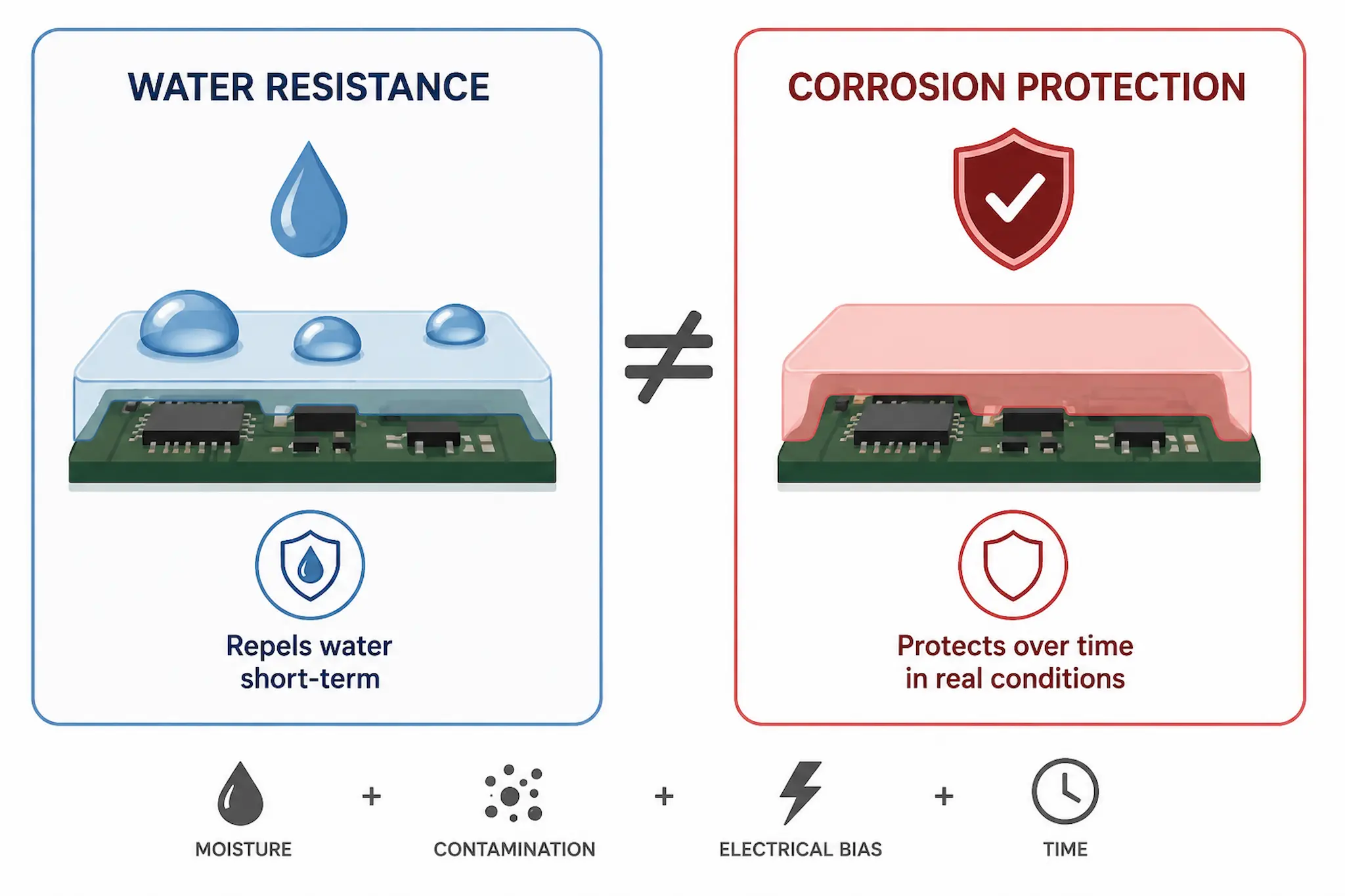
Water resistance is often misunderstood in electronics protection. A coating may cause water to bead, shed liquid quickly or allow a powered demonstration board to keep working during short-term immersion, but that does not automatically mean the assembly is protected against corrosion.

Corrosion protection depends on a different set of behaviours. It requires control of ionic contamination, moisture pathways, electrochemical activity, coating continuity, edge coverage, residues, drying conditions and the exposure environment over time.

This distinction is especially important when evaluating ultra-thin functional coatings, hydrophobic coatings, nano coatings and surface-energy treatments. These technologies can be extremely useful, but they should not be judged using the same assumptions as thicker barrier coatings or Parylene systems.

For a related explanation focused specifically on hydrophobic surface behaviour, see Why Hydrophobic Coatings Donโ€™t Protect Electronics.

Infographic comparing water resistance and corrosion protection on electronic assemblies

Water beading and hydrophobic behaviour are not the same as long-term corrosion protection for electronics.

Water resistance describes liquid behaviour at the surface

Water resistance normally describes how liquid water interacts with the visible surface of a coating or material. This may include beading, roll-off, reduced wetting, fast drainage or short-term resistance to water penetration.

These properties are usually controlled by surface energy, surface chemistry, coating morphology and the way water contacts the treated surface.

For a wider explanation of the difference between surface-function behaviour and true environmental barrier protection, see Surface Energy vs Environmental Barrier Protection.

A water droplet test can show how a surface wets, but it does not prove corrosion protection on an electronic assembly.

This is the core difference between surface-function coatings and barrier-function coatings. One changes how the surface behaves, while the other aims to isolate the electronics from the environment over time.

For some applications, surface water behaviour is exactly what matters. Examples include splash shedding, condensation reduction, optical surfaces, housings, sensors and assemblies where thickness must be kept extremely low.

However, water resistance alone does not confirm that the coating can prevent electrochemical failure, leakage current, corrosion products or long-term degradation.

Corrosion protection is a system problem

Corrosion on electronics is rarely caused by water alone. It normally requires moisture, ionic contamination, conductive pathways, exposed metal and an electrical or electrochemical driving force.

A coating may repel bulk water but still allow corrosion if residues remain under components, if edges and leads are exposed, if the coating is discontinuous, or if moisture can sit in gaps where it cannot evaporate easily.

Important corrosion factors include:

  • Ionic contamination: flux residues, salts, process residues or handling contamination can create conductive paths.
  • Moisture duration: short wetting events behave differently from long-term damp exposure or repeated condensation cycles.
  • Electrical bias: powered electronics can drive electrochemical migration and corrosion mechanisms.
  • Coating coverage: thin films may behave well on open surfaces but perform differently around edges, leads, vias and component gaps.
  • Drying behaviour: trapped water under components or within residues can be more damaging than visible water on top of the board.

This is why corrosion protection must be validated using realistic exposure conditions, not only visual water behaviour.

Why powered water demonstrations can be misleading

Demonstrations where electronics continue working under water can be useful to show short-term insulation, water shedding or surface treatment behaviour. They are not the same as a corrosion qualification test.

A board may operate during a short demonstration and still fail later because corrosion is time-dependent. The most important damage may occur after the demonstration, during drying, during repeated cycling or when contaminants remain active on the surface.

A working powered board in water proves only that the board worked under those specific conditions for that specific time. It does not prove long-term corrosion resistance.

For this reason, SCH treats water demonstrations as screening or communication tools rather than final evidence of coating reliability.

They can form part of an evaluation, but they should be supported by insulation resistance testing, humidity exposure, condensation testing, salt or contaminant exposure where relevant, and post-test inspection.

Where ultra-thin coatings can still be valuable

None of this means ultra-thin coatings, hydrophobic treatments or nano coatings are weak technologies. It means they must be used for the right protection mechanism.

Ultra-thin functional coatings can be valuable where the objective is to modify the surface without adding meaningful thickness. They may help reduce wetting, reduce liquid retention, protect optical or RF-sensitive assemblies, support drainage, or provide light-duty environmental resistance where conventional coating build would create problems.

For RF-sensitive electronics specifically, see RF Transparent Coatings for Electronics & Antennas.

They are particularly relevant where:

  • coating thickness must be extremely low;
  • connectors, contacts, tolerances or optical surfaces cannot tolerate conventional coating build;
  • water shedding or reduced surface wetting is the main requirement;
  • RF, LED, sensor or precision component performance must not be affected;
  • the exposure is controlled and validated against the real application.

For a wider explanation of this distinction, see Surface Function vs Barrier Function Coatings and What Is an Ultra-Thin Functional Coating.

The key is to define whether the application needs surface function, barrier protection, corrosion resistance, dielectric protection or a combination of these behaviours.

In many practical applications, the solution is not purely a surface treatment or a full environmental barrier. Transitional film-forming coatings can provide an intermediate route where limited film continuity and environmental support are needed without moving fully into traditional conformal coating thicknesses.

When water resistance is not enough

Water resistance should not be treated as a substitute for corrosion protection where the assembly is exposed to aggressive or uncontrolled environments.

This includes applications involving ionic contamination, outdoor exposure, condensation cycles, industrial atmospheres, powered operation under humidity, salt exposure, cleaning residues or long-term damp storage.

In these cases, a stronger barrier strategy may be needed:

  • conformal coating where broader PCB environmental protection is required;
  • Parylene where highly uniform dielectric and barrier coverage is needed;
  • selective masking and process control where only certain areas can be coated;
  • hybrid strategies where surface-function coatings support but do not replace a barrier system.

For comparison, see conformal coating solutions and advanced functional coatings.

The correct coating choice depends on the failure mechanism being controlled, not only on whether water beads on the surface.

Practical selection question

Before selecting an ultra-thin coating, ask one simple question: are we trying to change how the surface behaves, or are we trying to prevent corrosion over time?

If the answer is surface behaviour, an ultra-thin functional coating may be a good route. If the answer is corrosion protection, the coating must be validated as part of a full environmental protection system.

These types of coatings are often selected where thickness-sensitive RF, optical, sensor or precision assemblies cannot tolerate conventional barrier coating build.

This is the difference between a useful coating demonstration and a reliable production coating specification.

Why Choose SCH Services?

SCH Services supports electronics manufacturers with coating selection, process development, application trials and production coating services across conformal coatings, Parylene coatings and advanced functional coatings.

We help customers separate coating claims from real process requirements by reviewing the application, exposure conditions, masking limits, inspection route, coating thickness and validation method.

  • Technical coating experience: practical support across conformal coating, Parylene and ultra-thin functional coating applications.
  • Process-led approach: coating selection based on failure mechanism, production reality and validation evidence.
  • Application support: assistance with trials, masking, inspection, coating thickness and process control.
  • Production capability: subcontract coating services and engineering support for specialist electronics protection requirements.

To discuss whether water resistance, corrosion protection or an ultra-thin functional coating is the right route for your application, contact SCH Services for technical support.

โ†‘ Back to top

This article is provided as general technical guidance only. Coating selection, corrosion protection and environmental reliability decisions should always be validated against the relevant application requirements, operating environment, standards, qualification tests and customer specifications.

More coating does not always mean better protection


In some applications, thinner coatings can reduce risk rather than increase it

Coating thickness is often treated as a simple measure of protection. The assumption is that a thicker coating must provide better environmental protection, stronger insulation and greater reliability.

That can be true in many conventional conformal coating applications, but it is not a universal rule. On complex electronics, adding more coating can also introduce new risks.

In some situations, a thinner coating can protect better because it interferes less with the assembly, flows more effectively into critical areas, reduces masking burden and avoids some of the failure modes associated with excessive film build.

In many modern electronics assemblies, the engineering challenge is no longer maximum coating thickness, but achieving the required protection with minimum interference. This is explored further in Why Ultra-Thin Coatings Change the Protection Conversation.

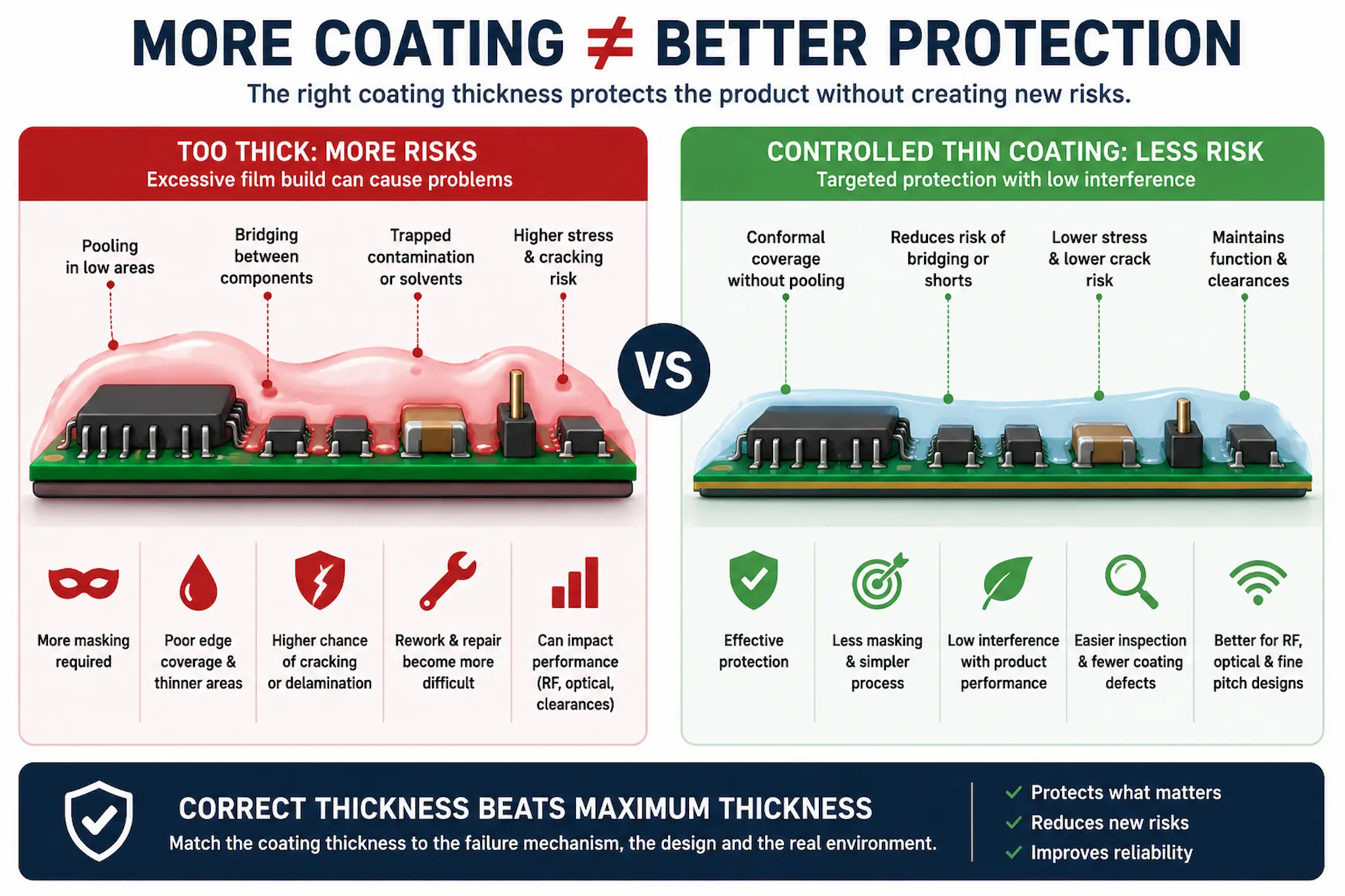
Infographic showing why excessive coating thickness can create risks in electronics protection

Excessive coating thickness can introduce pooling, cracking, masking and interference problems on sensitive electronics assemblies.

Why thickness can become a problem

Thicker coatings can be useful when a robust barrier is required, but excessive or unsuitable film build can create problems around components, connectors, fine-pitch devices and mechanical interfaces.

Common problems can include pooling, bridging, cracking, trapped contamination, poor edge behaviour, stress on delicate parts and increased rework difficulty. Excessive or poorly controlled coating build can also increase the risk of bubbles and pooling defects, coating cracking and masking-related process variation where complex keep-out areas are involved.

The correct coating thickness is the thickness that controls the real risk without creating a bigger process or performance problem.

This is why coating selection should start with the assembly, failure mechanism and exposure conditions rather than with a fixed belief that more film build is always safer.

For a wider explanation of this coating-selection logic, see Surface Function vs Barrier Function Coatings.

Where thinner coatings can help

Thin coatings can be useful when the design has sensitive areas that do not tolerate heavy coating build. This is especially relevant where the coating must protect without changing how the product works.

Fine-pitch electronics

Lower build can reduce bridging, pooling and clearance problems around dense assemblies.

LEDs and optical parts

Thin films may reduce the risk of changing light output, colour or transparency. This is explored further in Ultra-Thin Coatings for LEDs and Optical Electronics.

RF and sensor areas

Reduced film build can help limit unwanted electrical, dielectric or signal interference where coating thickness itself may affect RF or sensor behaviour. See RF transparent coatings for electronics & antennas.

Low-mask processes

Less intrusive coatings may reduce masking complexity and related production defects.

Thin does not mean weak

A thin coating should not automatically be treated as a weak coating. In many applications, the protection mechanism matters more than the physical film thickness. Some coatings protect by changing surface interaction, reducing wetting, improving chemical resistance, limiting contamination adhesion or maintaining surface function with minimal interference.

This is different from relying only on physical thickness as the main protection mechanism. The coating may be thin, but the protection mechanism may still be highly relevant to the application.

For deeper context, see Surface Function vs Barrier Function Coatings and What Is an Ultra-Thin Functional Coating?.

When thicker coatings are still the right answer

This does not mean thin coatings are always better. Many assemblies still need conventional conformal coatings, Parylene coatings or thicker barrier systems to provide insulation, coverage and environmental separation.

The mistake is not using a thick coating. The mistake is assuming thickness alone proves suitability.

The best coating is not the thickest coating. It is the coating that matches the failure mechanism, product design and validation requirement.

For this reason, thin coatings and thick coatings should be compared by function, risk and qualification evidence rather than by thickness alone. In many applications, the key distinction is between surface interaction and true environmental barrier performance. See surface energy vs environmental barrier protection.

This is also why water repellency should not be treated as proof of corrosion resistance, environmental isolation or long-term electronics reliability. See Why Water Beading Is Not Proof of Electronics Protection for more context.

What should be validated

Any coating thickness decision should be validated against real use conditions. This may include electrical performance, insulation resistance, condensation behaviour, humidity exposure, chemical resistance, optical performance, RF performance and coating coverage.

For ultra-thin, hydrophobic or functional coatings, validation should prove that the surface effect or low-interference behaviour actually reduces the failure risk. For barrier coatings, validation should prove that film build, coverage and insulation are sufficient.

Related context is available in What Is an Ultra-Thin Functional Coating?, Why Water Beading Is Not Proof of Electronics Protection and Ultra-Thin Coatings.

Why Choose SCH Services?

SCH Services supports coating selection, coating trials, process development and production coating for electronics where protection, reliability and manufacturability all need to be considered together.

  • Practical coating experience: SCH works across conformal coating, Parylene and advanced functional coating processes.
  • Process-led decision support: coating selection is based on application risk, production method and validation requirements.
  • Trial and production capability: SCH can support early evaluation, sample coating, process definition and subcontract coating routes.

โ†‘ Back to top

Disclaimer: This article is provided as general technical guidance only. Coating selection, process design and product suitability must be validated against the relevant application requirements, operating environment, customer specifications and qualification tests.

Water beading is only one part of the protection story


A surface can repel droplets and still leave electronics vulnerable

Water beading is visually persuasive. When droplets sit on a coated surface instead of spreading, it is easy to assume the electronics underneath are protected.

That assumption can be risky. Electronics protection is not proven by a surface effect alone. Real protection depends on contamination, coverage, edge behaviour, coating continuity, operating voltage, exposure time and the environment around the assembly.

Hydrophobic and ultra-thin coatings can be useful, but water repellency should not be confused with full conformal coating performance or long-term reliability validation.

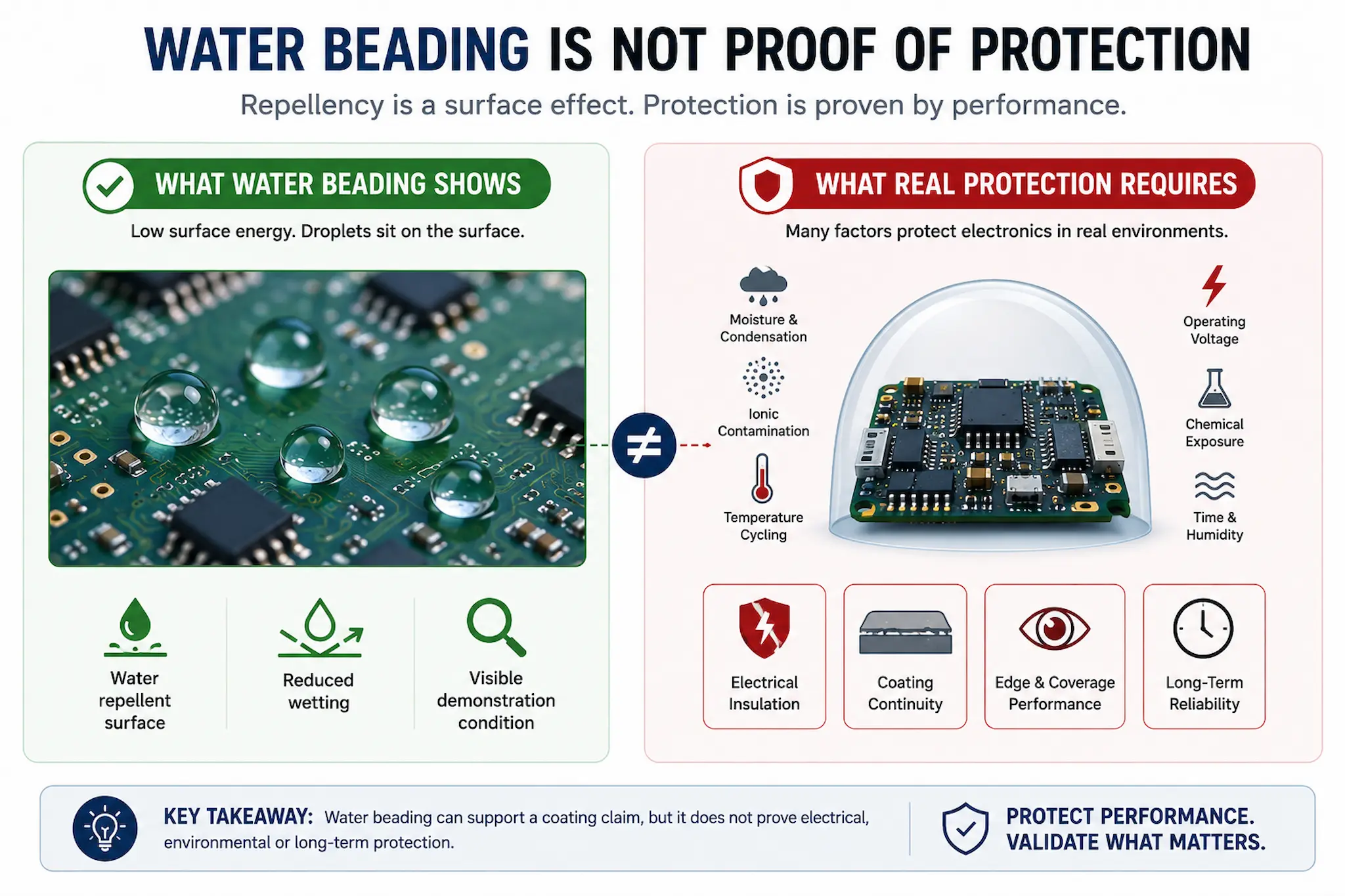
Infographic showing why water beading does not prove electronics protection or long-term coating reliability

Water repellency may look impressive, but real electronics protection depends on electrical, environmental and long-term reliability performance.

Why water beading can mislead

Water beading shows that a surface has low surface energy. It does not automatically show that the coating is thick, continuous, electrically protective or suitable for long-term exposure.

A droplet test is also usually clean, short and controlled. Electronic assemblies in service may face condensation, ionic contamination, flux residues, humidity cycling, chemical exposure, particulates, trapped moisture and voltage bias.

A coating can make water bead and still fail to prevent leakage currents, corrosion or localised failure if the real exposure conditions are different.

This is why droplet behaviour is useful as an observation, but weak as a standalone proof of protection.

The difference between repellency and protection

Repellency describes how a liquid interacts with the surface. Protection describes whether the assembly continues to operate reliably when exposed to the actual environment.

Water repellency

Shows droplet behaviour on the coating surface under visible test conditions.

Electrical protection

Requires control of leakage paths, insulation performance and contamination effects.

Environmental reliability

Depends on exposure time, humidity, temperature, chemicals, residues and field conditions.

These are connected, but they are not the same thing. A coating may show excellent water beading while still needing proper electrical, environmental and process validation.

This is why the distinction between surface function and barrier function coatings matters when selecting protection for electronics. For a deeper explanation of why low surface energy and environmental barrier performance are different engineering behaviours, see surface energy vs environmental barrier protection.

Where hydrophobic coatings are still useful

This does not mean hydrophobic coatings are ineffective. It means they must be used for the right reason and tested against the right failure mode.

Hydrophobic and ultra-thin coatings can be valuable where low film build, reduced masking, optical clarity, low surface energy or reduced wetting are important. They can be especially useful when conventional coating thickness creates a performance or production problem.

The practical question is not whether water beads. The better question is whether the coating solves the specific risk on the specific assembly. For the broader reliability distinction between short-term water behaviour and long-term electronics protection, see why water resistance is not corrosion protection.

For further technical context, see When to Use Hydrophobic Coatings, Why Hydrophobic Coatings Do Not Always Protect Electronics, What Is an Ultra-Thin Functional Coating? and Hydrophobic Coatings.

What should be validated instead

Protection should be assessed using tests and observations that match the real application. That may include electrical performance, insulation resistance, powered exposure, humidity testing, chemical resistance, visual coverage checks and process repeatability.

For electronics, contamination is particularly important. A clean water droplet on a demonstration board is not the same as moisture interacting with residues, flux, salts or process contamination on a powered assembly.

Water beading can support a coating claim, but it should not be the claim.

The strongest coating decisions are made by connecting surface behaviour to real reliability evidence.

For a related discussion on thickness assumptions, see Why Thin Coatings Can Sometimes Protect Better Than Thick Ones.

Why Choose SCH Services?

SCH Services supports coating selection, coating trials, process development and production coating for electronics where protection, reliability and manufacturability all need to be considered together.

  • Practical coating experience: SCH works across conformal coating, Parylene and advanced functional coating processes.
  • Process-led decision support: coating selection is based on application risk, production method and validation requirements.
  • Trial and production capability: SCH can support early evaluation, sample coating, process definition and subcontract coating routes.

โ†‘ Back to top

Disclaimer: This article is provided as general technical guidance only. Coating selection, process design and product suitability must be validated against the relevant application requirements, operating environment, customer specifications and qualification tests.

Ultra-thin protection changes the design conversation


Sometimes the coating decision is not about maximum thickness, but minimum interference

Traditional conformal coating thinking often starts with film build, coverage and environmental protection. That approach is still valid, but it does not fit every electronic assembly.

Some products need protection without adding meaningful thickness, changing optical output, altering RF behaviour, filling connectors or creating major masking work. In those cases, an ultra-thin coating can change the whole process decision.

The important point is not that ultra-thin coatings replace conformal coatings or Parylene. The point is that they provide an alternative engineering route when conventional coating thickness, masking or dielectric behaviour becomes too intrusive for the product being protected.

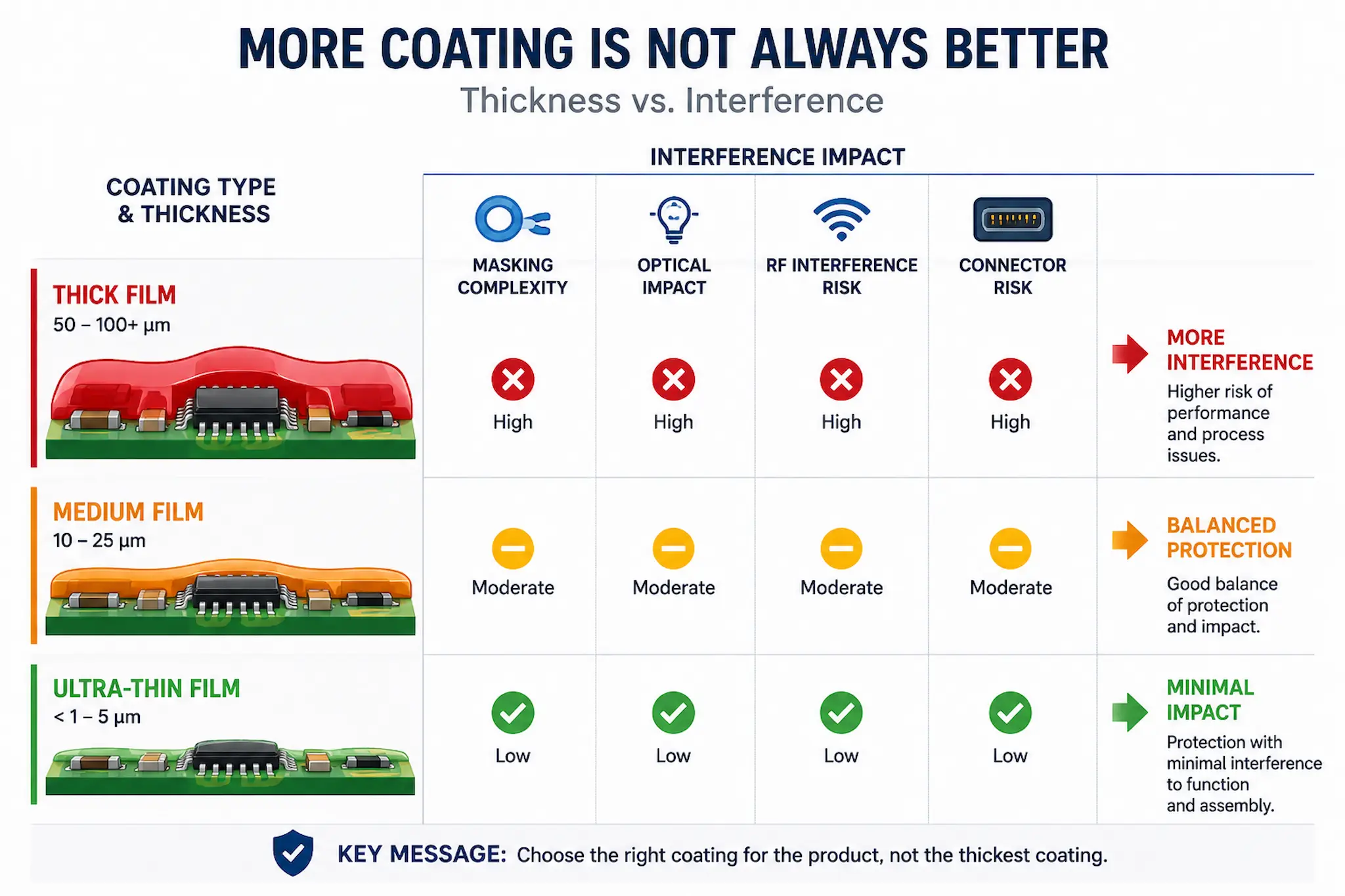
Comparison infographic showing coating thickness versus interference impact in electronics protection

Ultra-thin coatings can reduce masking complexity and performance interference compared with thicker coating systems.

Why thickness can become the problem

Film thickness is often treated as a measure of protection, but thickness also brings consequences. It can affect fine-pitch areas, connector zones, LEDs, sensors, RF circuits and assemblies where coating clearance is limited.

In these cases, the coating may technically protect the board but introduce a new production or performance problem.

The coating is only successful if the assembly still performs correctly after protection has been added.

This is where ultra-thin coating systems become interesting. Many of these systems are used as surface-function coatings, where the goal is to reduce interference while still providing useful surface behaviour or environmental protection. For the wider distinction between surface-function coatings and true barrier coatings, see surface energy vs environmental barrier protection.

Where ultra-thin coatings can be useful

Ultra-thin coatings are most relevant where the assembly has sensitive functional areas that cannot easily tolerate a conventional coating thickness.

LED assemblies

Protection may be required without visibly changing light output, colour quality or optical behaviour. This is explored further in Ultra-Thin Coatings for LEDs and Optical Electronics.

RF and sensor areas

Very thin films may reduce the risk of unwanted electrical, RF or performance changes where coating build, dielectric loading or contamination behaviour could affect the product. See RF transparent coatings for electronics & antennas.

Dense electronics

Low film build can help around BGAs, fine-pitch components and restricted geometries.

Low-mask processes

Reduced coating thickness may simplify production where masking is the main cost or risk.

The engineering question changes

The traditional question is often: how much coating do we need?

With ultra-thin coatings, the better question is: what level of protection can we achieve without disturbing the product?

That shift matters.

In some assemblies, reducing coating interference improves overall system reliability more effectively than increasing coating thickness.

It moves the decision away from simply comparing coating thickness and towards understanding product risk, exposure conditions, required reliability and acceptable process complexity. This is discussed further in Why Thin Coatings Can Sometimes Protect Better Than Thick Ones.

For deeper coating route selection, see Advanced Functional Coatings, Ultra-Thin Coatings and Advanced Functional Coating Services.

What still needs validation

Ultra-thin does not mean automatically suitable. The coating still needs to be tested against the real operating environment, including moisture exposure, chemical exposure, handling, thermal cycling, cleaning processes and electrical performance requirements.

It is also important to avoid overselling water resistance based on simple demonstrations.

Hydrophobic behaviour, water beading and thin-film demonstrations can sometimes create misleading assumptions if the actual failure mechanism has not been validated. See Why Water Beading Is Not Proof of Electronics Protection for more context.

Submersion, condensation, humidity, ionic contamination, powered bias conditions and long-term field exposure are all different reliability problems. For the difference between short-term water behaviour and corrosion reliability, see why water resistance is not corrosion protection.

Ultra-thin coatings should be treated as an engineering option, not a shortcut around qualification.

The best use case is usually where the coating solves a specific process or design conflict that thicker conformal coatings cannot solve cleanly.

Why Choose SCH Services?

SCH Services supports coating selection, coating trials, process development and production coating for electronics where protection, reliability and manufacturability all need to be considered together.

  • Practical coating experience: SCH works across conformal coating, Parylene and advanced functional coating processes.
  • Process-led decision support: coating selection is based on application risk, production method and validation requirements.
  • Trial and production capability: SCH can support early evaluation, sample coating, process definition and subcontract coating routes.

โ†‘ Back to top

Disclaimer: This article is provided as general technical guidance only. Coating selection, process design and product suitability must be validated against the relevant application requirements, operating environment, customer specifications and qualification tests.

Non-Sparking Tools Are Not Electrostatic Safe


The hidden ignition risk in explosive and defence manufacturing environments

In explosive and defence manufacturing environments, non-sparking tools are widely used to reduce ignition risk from mechanical impact. Materials such as aluminium bronze, beryllium copper, brass, bronze and Monel are commonly selected because they reduce the risk of spark generation when tools are struck, dropped or scraped.

However, non-sparking does not automatically mean electrostatically safe. A tool can be resistant to mechanical sparking and still accumulate, retain or transfer static charge during handling.

This creates an important blind spot in explosive-zone safety: tool safety should be treated as a combined spark-control and static-control problem, not simply as a material selection issue.

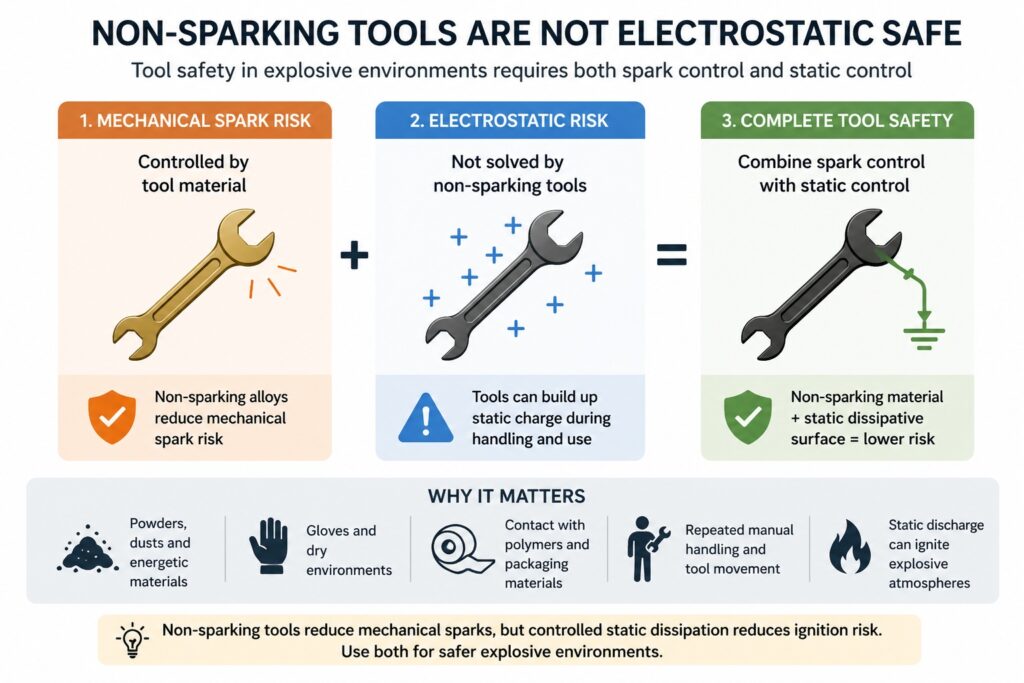
Non sparking tools static electricity risk showing spark control vs electrostatic charge dissipation

Non-sparking tools reduce mechanical spark risk but do not control static charge without dissipative surface behaviour

The Blind Spot in Explosive Zone Tooling

Non-sparking tools are designed to reduce the risk of ignition from mechanical impact. They do not inherently control electrostatic charge behaviour.

This matters in facilities handling energetic materials, propellants, pyrotechnics, ammunition components, explosive dusts, powders or sensitive assemblies.

Tools are not passive objects in these environments. They are repeatedly handled, moved across surfaces, brought into contact with packaging, used near polymers and often operated in dry processing areas.

Key insight: A tool can be non-sparking and still behave poorly from an electrostatic point of view.

That distinction is critical where static electricity is a recognised ignition source.

Explosive Zone Safety Is a Dual-Risk Problem

Tool safety in explosive environments should be viewed as two related but different risks.

Risk Type Typical Control Limitation
Mechanical spark ignition Non-sparking tool alloys Does not control static charge
Electrostatic ignition Controlled charge dissipation Often not considered at tool level

Aluminium bronze, beryllium copper, brass and other non-sparking materials address the mechanical side of the risk.

They do not automatically provide controlled electrostatic behaviour at the surface where operators hold, move and use the tool.

Where Static Charge Risk Can Develop

Static charge risk is most likely to develop where tools are part of repeated manual handling and movement.

  • Tools handled with gloves
  • Tools moved across benches or trays
  • Tools used near polymers, films or packaging
  • Tools used around powders, dusts or energetic materials
  • Tools used in dry or low-humidity environments
  • Tool holders, racks, trays, jigs and accessories used repeatedly in the same process

In these situations, the tool surface becomes part of the electrostatic control problem.

The question is not only whether the tool avoids mechanical sparks. It is also whether the tool surface can dissipate charge in a predictable and repeatable way.

Where ProShieldESD Fits

ProShieldESD can be positioned as a functional surface-safety enhancement for approved non-sparking tools and accessories.

It should not be presented as a replacement for certified tool material selection, hazardous-area classification, grounding, bonding, operating procedures or formal safety validation.

Its value is in helping introduce controlled electrostatic charge dissipation behaviour to frequently handled surfaces.

This may include tool handles, holders, trays, jigs, racks, maintenance accessories, separation pads and other contact surfaces used near energetic materials.

Positioning statement: The base tool alloy reduces mechanical spark risk. ProShieldESD supports controlled surface charge dissipation.

This creates a more complete approach: non-sparking metallurgy plus controlled dissipative surface behaviour.

Why Surface Behaviour Matters Over Lifecycle

In safety-critical environments, a single surface resistance reading is not enough. The surface behaviour must remain stable through handling, cleaning, wear and environmental change.

Filler-loaded conductive coatings can sometimes suffer from uneven conductive pathways, local variation, abrasion-related change or inconsistent performance across the surface.

Filler-free ProShieldESD technology is based on an intrinsically conducting polymer approach, which supports more homogeneous static-control behaviour across the coated surface.

For defence and explosive-zone users, this matters because predictable behaviour over the lifecycle is more important than a one-off headline reading.

Practical Defence Applications

ProShieldESD-coated tool systems may be relevant where approved non-sparking tools and accessories are used near static-sensitive or ignition-sensitive materials.

Area Example Items Intended Benefit
Energetic material assembly Tool handles, holders, trays, torque-tool grips Reduce static build-up during repeated manual handling
Ammunition and fuze manufacturing Jigs, fixtures and small-part handling tools Support controlled charge dissipation near sensitive components
Propellant and pyrotechnic processing Scrapers, scoops, bench accessories and racks Lower the risk of charge accumulation on contact surfaces
UXO and EOD support environments Non-sparking tool grips, cases and separation pads Add controlled dissipative behaviour to field-handled accessories
Defence electronics with energetic integration Workbench tools, fixtures and component trays Support ESD-safe handling alongside explosive-area controls

The strongest applications are not necessarily the tools themselves, but the complete tool-handling system: tools, trays, holders, fixtures, racks and storage interfaces.

Implementation and Validation

ProShieldESD should only be applied after confirming compatibility with the tool substrate, cleaning method, chemical exposure, abrasion level and operating environment.

Validation should be carried out in the actual tool configuration, not only on flat test panels.

  • Surface resistance
  • Point-to-point resistance
  • Resistance-to-ground in the assembled tool system
  • Adhesion to the selected tool substrate
  • Wear and handling resistance
  • Cleaning and solvent resistance
  • Humidity stability
  • Periodic verification method

It should also be integrated into the wider ESD and explosive-area control programme, including grounding, bonding, conductive flooring, operator footwear, wrist or heel straps where applicable, and documented inspection procedures.

The objective is not to claim that a coated tool becomes explosion-proof. The objective is to improve the control and repeatability of electrostatic behaviour on frequently handled surfaces.

Final Insight

Non-sparking tools solve only part of the ignition-risk problem.

They reduce the risk of mechanical sparks, but they do not automatically control electrostatic charge accumulation or transfer.

In explosive and defence manufacturing environments, this creates a hidden risk interface: the tool surface itself.

ProShieldESD can support a higher-confidence ESD-control surface on approved non-sparking tools and accessories, helping facilities reduce one of the least visible ignition risks: uncontrolled static charge accumulation during manual handling near energetic materials.

Why Choose SCH Services?

SCH Services supports customers with technically led coating selection, process development and production implementation for demanding electronics, industrial and specialist manufacturing environments.

  • Practical coating and surface-engineering experience
  • Support with material selection, testing and validation
  • Application-led advice rather than generic product supply
  • Experience across conformal coating, Parylene, advanced functional coatings and ProShieldESD static-control coatings

For support with static-control coating selection, surface behaviour, process validation or ProShieldESD applications, contact SCH Services to discuss your requirements.

โ†‘ Back to top

This article is general technical guidance only. It does not replace hazardous-area assessment, explosive atmosphere classification, safety certification, ESD programme design, material compatibility testing or formal process validation. Final decisions must be verified against the applicable standards, site procedures, operating environment and qualification requirements.

Why Brush Coating Defects Often Start with Viscosity


How controlled viscosity improves manual conformal coating quality

Brush coating defects are often blamed on the brush, the operator, or contamination. In many cases, the real issue is that the coating viscosity has changed during use.

Solvent-based conformal coatings thicken as solvent evaporates. If the coating is held in an uncontrolled working jar, left open too long, or used beyond a defined working period, the viscosity can move outside the intended application range.

Controlled viscosity is therefore central to repeatable brush coating. It ensures the coating flows correctly from the brush, levels properly on the PCB, and reduces visible defects.

Conformal coating viscosity control process using managed jar rotation and central reblending to reduce defects

Controlled viscosity system: fixed jar time, central reblending and traceable stock reduce defects such as bubbles, lines and stringing.

The coating is not always dirty

When operators see bubbles, lines or stringing in brush-applied coating, it is easy to assume the material has become contaminated.

Sometimes that can happen, but in many production environments the problem is not dirt. It is solvent loss and viscosity drift.

As solvent evaporates, the coating becomes thicker. Once the material moves outside the intended working viscosity, it no longer flows correctly from the brush or levels properly on the PCB.

For wider defect troubleshooting, see our guide to pinholes, bubbles and foam in conformal coating.

Key insight: Good brush coating depends on controlling viscosity at source, not asking operators to adjust coating at the bench.

Why controlled jars matter

A brush coating jar is not just a convenient container. It is part of a controlled viscosity system.

Using defined working jars reduces solvent evaporation, limits exposure time, and keeps coating within a usable viscosity range during application.

Working with small, controlled volumes also avoids repeatedly opening bulk material, helping maintain consistency across production.

How SCH controls brush coating viscosity

At SCH, viscosity is controlled centrally, not at the bench. Operators do not adjust or blend coatings during application.

Coating is issued in controlled working jars from viscosity-checked stock. Each jar is used for a defined time period, then replaced with a fresh, controlled jar.

Used coating is returned for controlled reblending under managed conditions. Viscosity is checked using appropriate methods, such as a Zahn cup, before being reissued as traceable stock.

Why operators should not adjust viscosity at the bench

Manual adjustment of coating viscosity at the bench introduces unnecessary variation. Different operators may add solvent differently, mix inconsistently, or judge coating behaviour by eye.

This variation affects coating thickness, flow, appearance and reliability, increasing the risk of defects and rework.

A stock of correctly blended, viscosity-controlled jars provides a faster, lower-risk process: use the jar, replace it at the defined time, and maintain consistent application.

Common defects linked to viscosity drift

  • Bubbles forming during application
  • Visible brush lines in the coating film
  • Stringing between the brush and PCB
  • Poor levelling after application
  • Heavy local build-up or uneven coating appearance

These symptoms do not automatically mean the coating is contaminated. They often indicate that the working material has become too viscous for controlled brush application.

Where coating does not wet or flow properly on the board, viscosity should be considered alongside other causes such as de-wetting in conformal coating and surface preparation and cleanliness.

Related products and guides

For controlled manual coating work, SCH supplies practical application consumables used in real coating processes.

These resources support repeatable brush coating by helping control the material, the application method and the inspection process.

Why Choose SCH Services?

SCH Services supports conformal coating processes with practical production experience, coating services, process consumables, equipment, training and technical support.

  • Hands-on experience in real PCB coating production
  • Practical support for brush coating, masking, inspection and process control
  • Consumables selected for use in controlled coating workflows
  • Technical guidance for reducing defects and improving repeatability

Contact SCH Services to discuss coating process support, consumables or manual coating control.

โ†‘ Back to top

This article provides general technical guidance only. Final process settings, material handling methods and coating controls should be validated against the coating manufacturerโ€™s datasheet, customer requirements and applicable production standards.

Why Most Parylene Specifications Fail (and How to Fix Them)


Common specification mistakes that create risk in coating, quality and production โ€” and how to avoid them

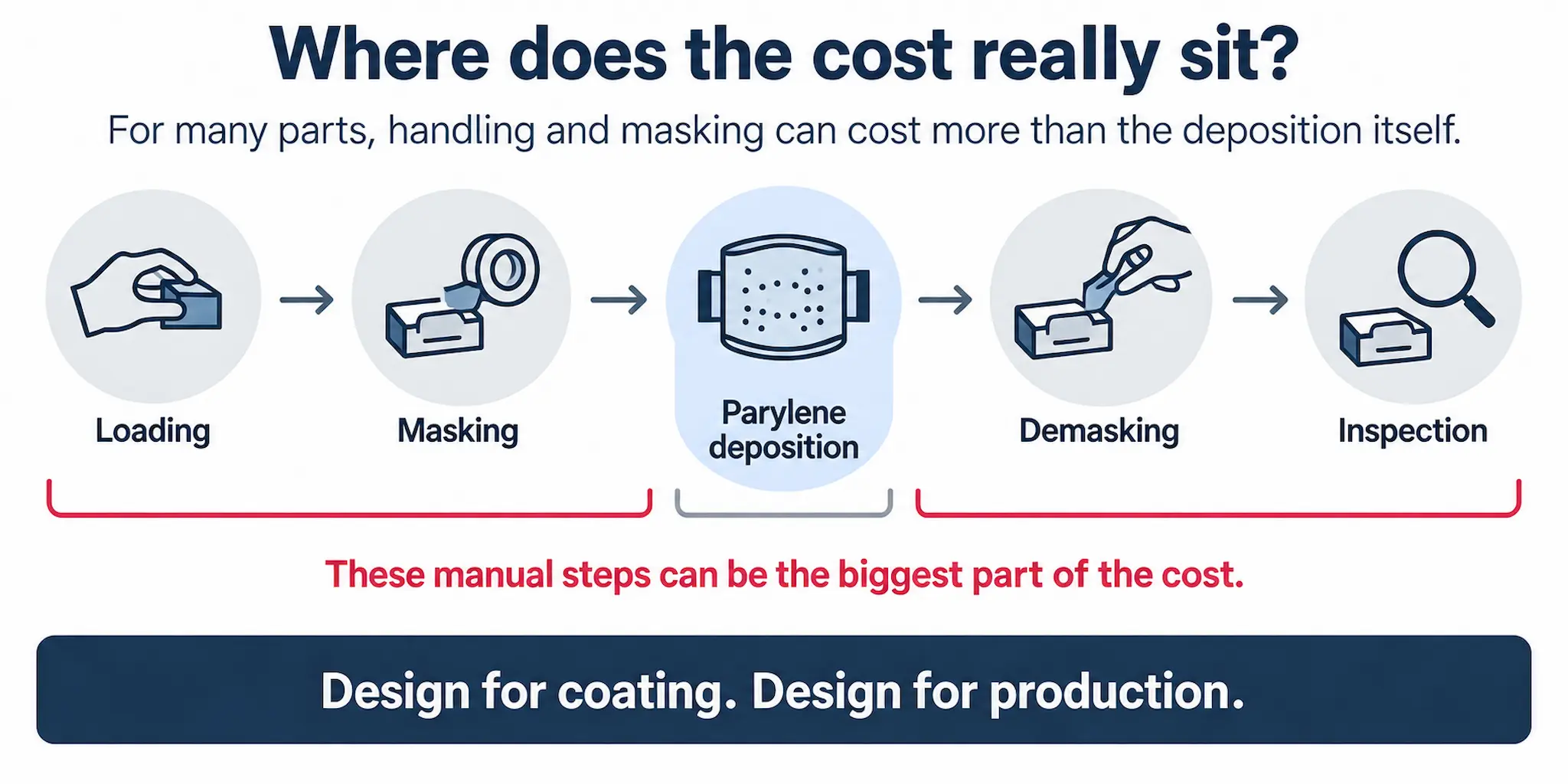
Most Parylene coating problems do not start in the chamber. They start earlier, in drawings and specifications that are too vague to control grade, thickness, adhesion route, masking intent or inspection expectations properly.

A note such as โ€œapply Parylene coatingโ€ may appear acceptable at design stage, but it leaves too much open to interpretation once the work reaches purchasing, coating, inspection and quality. That creates avoidable variation before the process even begins.

This is why some Parylene programmes drift. The coating may be capable, but the specification is not strong enough to control it.

For detailed guidance, see our guide to specifying Parylene coating.

Infographic showing why Parylene coating specifications fail and how to fix them with clear grade thickness masking and inspection requirements

Simple comparison of common Parylene specification mistakes and how to correct them for consistent coating results.

Key issue: if different teams can read the same coating note and reach different conclusions, the specification is not yet suitable for controlled production.

Where Parylene Specifications Usually Go Wrong

Most failures come from a small number of repeated mistakes rather than one major technical error.

  • No defined grade โ€“ โ€œParylene coatingโ€ is written without specifying N, C, D or AF-4.
  • Ambiguous naming โ€“ โ€œParylene Fโ€ is used without identifying the exact fluorinated grade.
  • Unclear thickness โ€“ one number is given with no tolerance, target or measurement method.
  • Missing masking intent โ€“ coated and uncoated areas are left open to interpretation.
  • Assumed adhesion route โ€“ surface preparation or adhesion promotion is not defined.
  • No acceptance criteria โ€“ inspection and release expectations are unclear.

Why This Becomes a Production Problem

Weak specifications do not just create technical uncertainty. They create misalignment between functions.

The supplier may quote based on one set of assumptions, the coater may process to another, and the quality team may inspect against something different again. That does not always lead to obvious coating failure, but it does lead to rework, delay and unnecessary disagreement.

In practice, many coating issues are specification-control issues rather than coating-process issues.

How to Fix It

A usable Parylene specification removes interpretation. It defines what is required clearly enough that engineering, coating and quality teams can work to the same intent.

At a minimum, a controlled specification should define the exact grade, the thickness requirement, any adhesion expectations, the coated and masked areas, and the acceptance or inspection route. If any of those are missing, the drawing is already carrying unnecessary risk.

For a practical step-by-step guide, see our guide to specifying Parylene coating.

Practical outcome: clear specifications reduce variation, improve repeatability and prevent disagreement between customer, supplier and quality teams.

Fix the Specification Before You Fight the Process

It is easy to treat coating issues as process problems because that is where they become visible. In many cases, the more effective fix is to strengthen the drawing before production begins.

If the grade is unclear, the thickness is vague, or the acceptance route is undefined, no amount of process discipline fully removes the underlying ambiguity. That is particularly important in higher-reliability work, where coating performance must be demonstrated, not assumed.

If the first question is still โ€œwhich Parylene type should we use?โ€, start with our guide to choosing the right Parylene dimer.

Why Choose SCH Services?

Partner with SCH Services for a complete, integrated platform: Conformal Coating, Parylene & ProShieldESD Solutions plus equipment, materials, and training. Our team brings decades of hands-on expertise.

  • โœˆ๏ธ 25+ Years of Expertise โ€“ Trusted across aerospace, medical, defence, automotive, and electronics.
  • ๐Ÿ› ๏ธ End-to-End Support โ€“ From dimer selection to masking, inspection and process optimisation.
  • ๐Ÿ“ˆ Scalable Capacity โ€“ From prototypes to high-volume production.
  • ๐ŸŒ Global Reach โ€“ Responsive support across Europe, North America, and Asia.
  • โœ… Proven Reliability โ€“ Consistent quality and strong customer satisfaction.

๐Ÿ“ž Call: +44 (0)1226 249019
โœ‰ Email: sales@schservices.com
๐Ÿ’ฌ Contact Us โ€บ

โ†‘ Back to top

Note: This article provides general technical guidance only. Final design, safety, and compliance decisions must be verified by the product manufacturer and validated against the applicable standards.

Setting Up a Conformal Coating Facility: What You Actually Need (and What Most People Miss)


A practical guide to getting up and running with conformal coating โ€” from masking to inspection

Setting up a conformal coating facility is often underestimated.

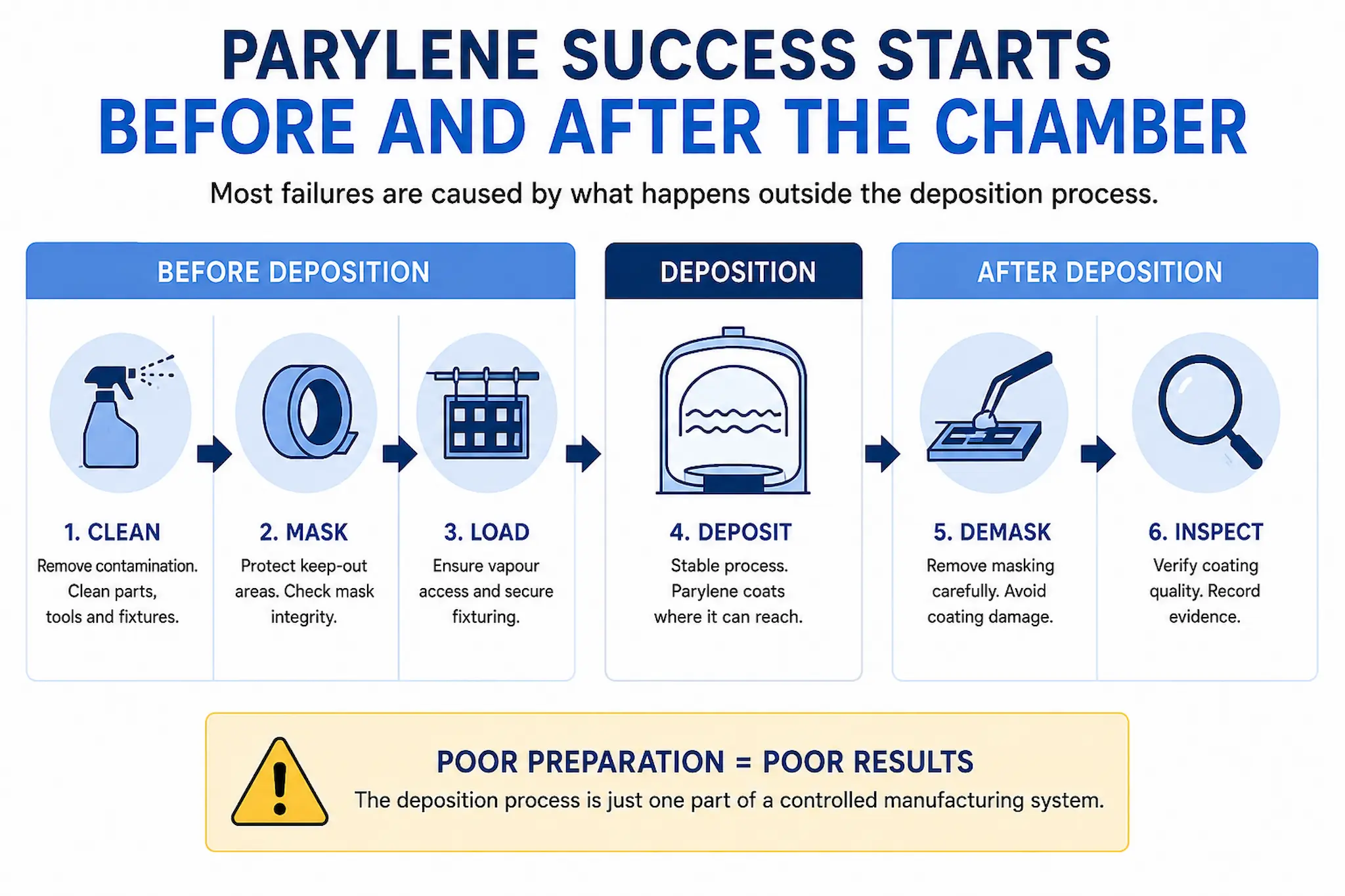
Most teams focus on the coating material and application method, but in practice, successful coating depends on a wider process including masking, cleaning, application control, inspection, and handling. Missing these elements leads to defects, rework, and inconsistent results.

This guide outlines the practical minimum required to start coating effectively, based on real production experience.

The diagram below summarises the key stages involved in setting up a controlled conformal coating process, from masking and preparation through to inspection and rework.

Infographic showing conformal coating setup process including masking cleaning application curing inspection and rework steps

Conformal coating setup process showing the key stages from masking and cleaning through to application, inspection and finishing.

1. Masking: Where Most Coating Problems Begin

Masking is one of the most critical parts of the conformal coating process.

Incorrect masking materials or methods lead directly to:

  • Coating ingress into connectors and interfaces
  • Excessive rework during de-masking
  • Inconsistent coating boundaries

Core masking consumables (correct selection matters)

  • High-quality masking tapes designed for conformal coating, clean removal, and low residue risk
  • Masking dots supplied in precision die-cut sheets for consistent masking of repeat areas
  • Custom masking sheets and die-cut masking shapes for repeatable production masking

Not all tapes, dots, and custom masking sheets are equal. General-purpose masking materials often leave residue, lift during coating, or fail during curing, which creates unnecessary rework and process instability.

If masking is treated as a low-value consumable decision, coating quality usually suffers later in the process.

For masking materials intended for conformal coating applications, see our masking solutions.

Basic tools

  • ESD-safe tweezers
  • Scalpel
  • Cutting mat
  • Overhead de-ionisers
  • Bench magnification for difficult parts

2. Cleaning & Surface Preparation

Surface preparation is one of the most misunderstood parts of conformal coating.

Assemblies are often assumed to be clean, but handling, storage, and environmental exposure mean surfaces are rarely in a controlled condition at the point of coating.

A simple IPA wipe or open solvent bath is commonly used, but this approach is inconsistent and can:

  • Redistribute contamination rather than remove it
  • Leave residues behind
  • Introduce operator variability

What matters in practice

  • A defined, repeatable cleaning method
  • Appropriate cleaning chemistry rather than reliance on generic solvents alone
  • Control of handling to avoid recontamination before coating

Typical practical approach

  • Approved PCB cleaning fluid or a controlled IPA process
  • Lint-free wipes for general surface cleaning
  • Polyester swabs for localised, controlled cleaning

Cleaning should be part of the defined process, not treated as a quick preparation step.

A spray booth and a tin of coating do not create a controlled process. The consistency comes from the consumables, handling method, inspection routine, and rework discipline around them.

3. Application: Controlling the Coating Process

Conformal coating can be applied by spraying, dipping, or brushing, but regardless of method, control of the process determines consistency.

Core process items

  • Conformal coating material
  • Compatible thinners where required
  • Mixing containers and stirrers for blending
  • Defined viscosity approach

Application setup considerations

  • Spray systems, dip tanks, or controlled brush application depending on the process
  • Clean, dry air supply for spray systems
  • Board handling fixtures or supports

Brush application

Brush coating is widely used for:

  • Localised coating application
  • Edge definition
  • Touch-up during processing

To control this properly, material handling is critical. This includes:

Poor handling leads to contamination, inconsistent viscosity, and unpredictable coating behaviour.

For precision swabs used in controlled coating and touch-up processes, see our polyester swabs.

Process control

  • Witness coupons for verifying coating behaviour and coverage
  • Consistent loading and handling method
  • Defined application parameters rather than operator judgement alone

4. Drying & Curing

Even basic coating systems require controlled drying.

Without this, issues can include:

  • Uneven finish
  • Extended tack time
  • Contamination during cure

Typical setup

  • Ambient drying racks
  • Drying cabinet or oven depending on the coating system

5. De-Masking & Finishing for Liquid Coatings

For liquid conformal coatings, de-masking and finishing must be controlled to avoid damaging the coating.

Incorrect methods can:

  • Lift coating edges
  • Tear films
  • Leave contamination at boundaries

Controlled approach

  • Careful removal of tapes and dots using tweezers
  • Use of low-lint polyester swabs to press down lifted coating edges
  • Use of low-lint polyester swabs to remove unwanted coating from defined areas where correction is needed
  • Controlled use of suitable brushes for edge correction and blending repaired areas
  • Dedicated jars for holding small volumes of coating for touch-up
  • Dedicated jars for holding thinners for controlled rework and finishing

Rework should be controlled and localised, not improvised using bulk materials or rough tools.

For an example of controlled liquid coating rework, see our Insight on repairing lifted conformal coating edges.

6. Inspection & Quality Control

Inspection confirms whether the process is under control, not just whether coating is present.

Minimum inspection setup

  • UV inspection light at 365 nm
  • Controlled inspection area
  • Magnification for detailed checks

Additional control

7. ESD & Environmental Control

Electrostatic control and environmental stability influence coating behaviour and reliability.

Typical requirements

  • ESD-safe work surfaces
  • Grounding and wrist straps
  • Controlled humidity where possible

8. COSHH & Safety Requirements

Any coating process introduces chemical handling requirements.

Minimum considerations

  • Safety Data Sheets (SDS)
  • COSHH assessments
  • Appropriate PPE including gloves, eye protection, and respiratory protection where required
  • Ventilation such as a spray booth or suitable extraction system

What Most Setups Get Wrong

From experience, the most common issues are:

  • Poor masking material selection
  • Inadequate or inconsistent cleaning
  • Lack of control in application method
  • Incorrect rework techniques
  • No defined inspection standard

These are not minor issues. They directly affect yield and long-term reliability.

A Practical Starting Point

For teams setting up a new coating process, it is often best to begin with a controlled starter set of consumables rather than attempting to define everything up front.

A typical starting point includes:

  • Masking tapes, dots, and custom masking sheets in a practical range of sizes
  • Precision cleaning and touch-up consumables such as polyester swabs
  • Small-volume handling items such as brushes, and dedicated coating & thinner jars
  • Witness coupons for basic process verification

This allows initial trials, after which requirements can be refined based on the actual assemblies being coated.

Next Steps

If you are setting up a conformal coating process and would like guidance on selecting the right consumables or refining your setup after initial trials, SCH can support with:

  • Starter consumable packs
  • Masking solutions tailored to your assemblies
  • Application and rework consumables
  • Training and process support

Why This Matters

Conformal coating is not just a material. It is a controlled process. Getting the fundamentals right at the start avoids rework, improves consistency, and reduces long-term cost.

Why Choose SCH Services?

SCH supports customers with practical conformal coating knowledge, process-led guidance, and the consumables needed to get coating operations under control from the start.

Whether you are setting up a new coating process or tightening an existing one, SCH can help you define a more controlled and repeatable approach.

โ†‘ Back to top

This article provides general technical guidance only. Final process design, material selection, and validation should be confirmed against application-specific requirements, product data, and relevant industry standards.

Environment Changes Everything โ€“ Why ESD Behaviour Depends on Where It Operates


Why electrostatic behaviour cannot be understood properly without considering the operating environment

Electrostatic behaviour is often discussed as though it is fixed and predictable. In reality, the operating environment has a major influence on how charge is generated, how it accumulates, and how it dissipates.

A surface that appears stable in one condition may behave very differently in another. Air movement, humidity, contamination, contact materials, and conductive surroundings can all change the way an electrostatic problem develops.

This is why electrostatic control should never be treated as a simple material property alone. It is a system-level behaviour shaped by where and how the material is used.

Infographic showing how electrostatic behaviour changes in dry air, humid conditions and conductive environments affecting charge accumulation and dissipation

Electrostatic behaviour changes with environment. Humidity, contamination and surrounding conductivity all influence how charge is generated, moves and dissipates.

Why the Same Surface Can Behave Differently

Charge behaviour does not happen in isolation. It is affected by the full operating context around the surface, including nearby materials, motion, geometry, and environmental conductivity.

For example, a polymer surface may hold charge in dry air, behave more predictably in controlled indoor conditions, and respond very differently again in a humid, contaminated, or conductive environment. The surface itself has not changed, but the way charge moves through and around the system has.

This is where many electrostatic problems become misunderstood. Engineers may review the material, but not the wider environment that is shaping the outcome.

Electrostatic performance is not defined by the surface alone. It is defined by the interaction between the surface and its environment.

Why Conductive Environments Need Different Thinking

In conductive or electrochemically active environments, the behaviour of charge changes again. Instead of simply building on the surface, charge may redistribute, equalise, or interact with adjacent conductive paths.

This means the challenge is no longer just about preventing accumulation. It becomes a question of managing surface potential, controlling differential charging, and avoiding instability across the wider system.

In practical terms, this matters in environments involving moisture, conductive contamination, marine exposure, or systems where sensitive electronics operate close to moving polymer or coated surfaces.

What This Means for Coating Strategy

A coating that performs well in one environment may not be suitable in another. Electrostatic control must therefore be judged by application behaviour, not by a single headline value or marketing label.

Questions worth asking include:

  • where is charge being generated in the process?
  • what surrounding materials or media influence dissipation?
  • is the environment dry, humid, contaminated, or conductive?
  • are sensitive signal paths or electronics nearby?
  • does the coating remain stable under real operating exposure?

In practice, this means considering both how charge is generated during operation and whether it is maintained within a controlled dissipative range, as both factors are influenced by the surrounding environment.

To understand how environmental factors interact with grounding, conductive and dissipative strategies, see the ESD control pyramid explanation.

A Better Way to Frame the Problem

Instead of asking whether a material is electrostatically safe, it is often better to ask whether the full system remains electrostatically stable in its real operating environment.

That distinction matters. It shifts the focus away from simplified material claims and towards practical engineering performance. It also helps explain why some electrostatic issues appear only after installation, scale-up, or field use.

The right solution is usually the one that performs consistently within the actual environment, not the one that looks strongest in isolation.

Related Reading

For further guidance on coating behaviour, inspection, and process-led engineering support, these pages may be useful:

Related insights:

Why Choose SCH Services?

SCH Services helps customers assess coating behaviour in the context of the real process and operating environment. Our approach is practical, process-led, and focused on helping engineering teams reduce instability, improve consistency, and make better coating decisions.

โ†‘ Back to top

Disclaimer: This article is provided as general technical guidance only. Electrostatic behaviour depends on the interaction between materials, coatings, movement, contamination, humidity, and surrounding operating conditions. Final decisions should be validated through application-specific testing and engineering review.

The Narrow Window โ€“ Why โ€œConductiveโ€ Is Often the Wrong Solution


Why effective electrostatic control depends on controlled dissipation, not maximum conductivity

When electrostatic problems appear, the instinctive response is to increase conductivity. If a surface is causing static issues, the assumption is that making it conductive will solve the problem.

In reality, this approach often creates new risks. Many systems do not require full conductivity. They require controlled behaviour โ€” specifically, the ability to dissipate charge in a stable and predictable way.

The difference between these two approaches is small in theory, but critical in practice. It defines whether a coating improves system stability or introduces new failure modes.

For a deeper explanation of why consistent surface behaviour is critical in real applications, see homogeneous ESD protection and consistency in static control.

Understanding the Static Dissipative Range

Effective electrostatic control typically sits within the static dissipative range, rather than at full conductivity. This range allows charge to move away from the surface in a controlled manner without creating rapid discharge paths.

Surfaces that are too insulating allow charge to accumulate. Surfaces that are too conductive can enable uncontrolled current flow, localised discharge events, or unwanted electrical interaction with nearby components.

The objective is balance โ€” not extremes. The surface must dissipate charge gradually enough to remain stable, but quickly enough to prevent accumulation.

To see how conductive, dissipative and anti-static approaches work together as a complete system, see the ESD control pyramid explanation.

The goal is not maximum conductivity. The goal is controlled, predictable charge dissipation.

Infographic comparing insulating, static dissipative and conductive coatings showing how controlled electrostatic charge dissipation prevents ESD issues

Effective electrostatic control sits within a narrow window. Static dissipative surfaces allow controlled charge flow, avoiding both charge build-up and uncontrolled discharge.

Why โ€œMore Conductiveโ€ Can Make Things Worse

Increasing conductivity without understanding the system can introduce new problems, often driven by incorrect assumptions about how ESD coatings behave in practice (see ESD paint myths explained).These may not appear immediately but can affect long-term performance and reliability.

Typical risks include:

  • uncontrolled discharge events at localised points
  • creation of unintended electrical pathways
  • increased risk of corrosion in conductive environments
  • interaction with sensitive electronics or signal paths
  • reduced process stability due to inconsistent surface behaviour

See how filler-based ESD coatings can create instability over time

Why This Is a Surface Engineering Problem

Electrostatic performance is not just a material property. It is the result of how a surface behaves under real operating conditions, including movement, environment, geometry, and interaction with other materials.

This means that selecting a coating is not simply about choosing a conductivity value. It requires understanding how that surface will behave during use, and whether it can maintain consistent performance over time.

In many applications, particularly those involving motion or sensitive electronics, stability matters more than raw conductivity.

This is particularly visible in specialist applications such as electrostatic speaker diaphragm coatings, where the surface must maintain highly controlled and uniform dissipative behaviour without introducing instability, uneven charge distribution or unwanted conductive pathways.

This becomes even more important in systems where electrostatic charge is being generated continuously through movement and friction, as the surface must manage both generation and dissipation at the same time.

A More Useful Engineering Approach

Rather than asking whether a surface should be conductive, a more useful question is whether it can control charge behaviour within a defined and stable range.

This approach leads to better outcomes because it focuses on performance, not labels. It considers how charge is generated, how it moves, and how it is dissipated during real operation.

In practice, this often leads to solutions that sit within a controlled dissipative window rather than at either extreme.

Related Reading

For further insight into coating behaviour, process stability, and inspection considerations, the following pages may be useful:

Related insights:

Why Choose SCH Services?

SCH Services supports customers in understanding how coating behaviour affects real-world performance. We focus on practical, process-led guidance to ensure electrostatic control strategies are stable, repeatable, and suited to the application.

โ†‘ Back to top

Disclaimer: This article is provided as general technical guidance only. Actual electrostatic behaviour depends on material properties, coating performance, environment, and system design. Final decisions should be validated through application-specific testing and engineering review.

0
  • Your current order total is £0.00 โ€” you must have an order with a minimum of £75.00 to place your order.
0
Your Cart
Your cart is empty
  • Your current order total is £0.00 โ€” you must have an order with a minimum of £75.00 to place your order.
Calculate Shipping
  • Your current order total is £0.00 โ€” you must have an order with a minimum of £75.00 to place your order.

Conformal Coating UK

Technical banner showing PCB and process icons representing conformal coating, masking, inspection and training on the SCH technical knowledge hub.
Conformal Coating UK
Privacy Overview

This website uses cookies so that we can provide you with the best user experience possible. Cookie information is stored in your browser and performs functions such as recognising you when you return to our website and helping our team to understand which sections of the website you find most interesting and useful.