Static Control in Hazardous Environments
Control electrostatic risk in powder, solvent and high-risk industrial processes
Hazardous environments often involve materials and processes where electrostatic charge presents a real safety risk. Powders, solvents, vapours and fine particulates can create conditions where uncontrolled static discharge may contribute to ignition, contamination or process instability.
In many cases, equipment, surfaces and structures within these environments are made from insulating materials that allow charge to accumulate during normal operation.
The ProShieldESD coating platform provides a way to convert these surfaces into controlled static-dissipative systems, reducing uncontrolled charge build-up as part of a wider static control strategy.
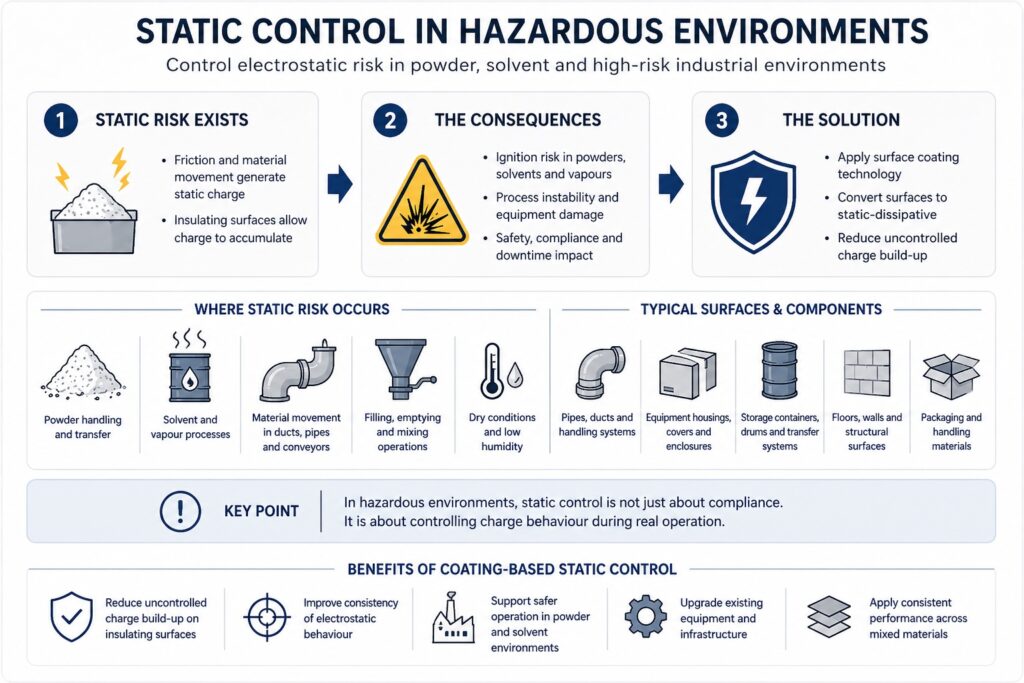
Overview of electrostatic charge generation in hazardous environments and how surface treatments reduce uncontrolled static build-up.
Where Static Risk Occurs
Electrostatic charge can be generated in a wide range of hazardous industrial processes where materials move, separate, transfer or flow.
- Powder handling and transfer systems
- Solvent-based processes and vapour environments
- Material movement through ducts, pipes and conveyors
- Filling, emptying and mixing operations
- Dry environments with low humidity
These risks are often linked to industrial equipment and work surfaces and facility areas operating within the same environment.
Typical Surfaces and Components
Static control coatings can be applied across a wide range of materials used in hazardous environments where insulating surfaces may allow charge build-up.
- Plastic ducts, pipes and handling systems
- Equipment housings, covers and enclosures
- Storage containers, drums and transfer systems
- Floors, walls and structural surfaces
- Packaging and handling materials
Many of these surfaces are also covered in anti-static coating for plastic and static control for packaging and logistics.
Why Surface Control Matters
Traditional approaches to electrostatic safety often focus on grounding and bonding. These are essential, but they do not always prevent charge build-up on insulating surfaces.
- Insulating materials can still accumulate charge even when nearby metalwork is grounded
- Charge may remain localised on plastics, coatings or non-conductive surfaces
- Hidden build-up can occur during normal production or handling
- Environmental changes can affect static behaviour and charge dissipation
This is why surface engineering using filler-free conductive polymer technology can provide a more controlled approach.
Key point: In hazardous environments, static control is not just about compliance. It is about controlling charge behaviour during real operation.
Relationship to Explosive and ATEX Environments
This page covers broad hazardous environments, including powder handling, solvent processes, vapour areas and higher-risk industrial operations.
Some sites also fall under ATEX or equivalent explosive atmosphere requirements. In those cases, electrostatic control must be considered as part of a formal risk assessment, ignition control strategy and verification process.
For the specialist explosive atmosphere page, see ProShieldESD for Explosive & ATEX Environments.
Benefits of Coating-Based Static Control
- Reduce uncontrolled charge build-up on insulating surfaces
- Improve consistency of electrostatic behaviour
- Support safer operation in powder, solvent and vapour environments
- Upgrade existing equipment and infrastructure
- Apply consistent performance across mixed materials
- Support retrofit routes where replacing equipment is not practical
These benefits are most useful where existing materials or equipment are mechanically suitable but need improved static-control behaviour.
How SCH Services Supports Hazardous Environment Projects
SCH Services can support evaluation, trial work and practical coating assessment for hazardous environment applications. The process starts with the material, operating environment, static control requirement and safety context.
- Review of surfaces, materials and operating conditions
- Assessment of coating compatibility and durability requirement
- Selection of suitable ProShieldESD chemistry
- Trial coating and resistance testing
- Support for retrofit and upgrade strategies
- Support through ProShieldESD subcontract coating services
Choosing the Right Static Control Route
Hazardous environments are only one part of the wider static control decision. The correct approach depends on where charge is generated, what surfaces are involved, and whether the problem is linked to plastics, equipment, packaging, work areas or explosive atmosphere risk.
For a structured route through the main options, see How to Choose the Right Static Control Approach.
Related ProShieldESD Solutions
Other ProShieldESD solutions support related static control requirements across plastics, equipment, packaging, work surfaces and specialist ATEX environments.
Why Choose SCH Services?
SCH Services combines coating process experience, ESD application knowledge and practical production support to help customers evaluate ProShieldESD for demanding operating environments.
- Technical guidance for coating selection and application
- Trial coating and process evaluation before wider adoption
- Support for repair, upgrade and retrofit strategies
- Experience with coatings used in industrial, electronics and safety-critical environments
- Practical guidance for inspection, maintenance and verification
Disclaimer: This page provides general technical guidance only. Hazardous environment suitability depends on process conditions, materials, ignition risk, grounding strategy, applicable regulations and verification testing. Final implementation must be validated through appropriate risk assessment and compliance checks.