Why Hydrophobic Coatings Don’t Protect Electronics
Why water repellency is not the same as moisture, corrosion or environmental protection
Hydrophobic coatings can reduce water wetting, but they do not automatically protect electronics from failure.
They change how water behaves on a surface, often causing droplets to bead or shed more easily. However, water repellency alone does not mean the assembly is sealed, insulated or protected from corrosion.
This is why hydrophobic coatings should be selected based on the real failure mechanism, not just the visual effect of water beading. Hydrophobic systems are primarily surface-function coatings rather than true environmental barrier systems. For full coating route selection, see the How to Choose the Right Coating guide, review surface-function vs barrier-function coatings, or compare hydrophobic coatings vs conformal coating.
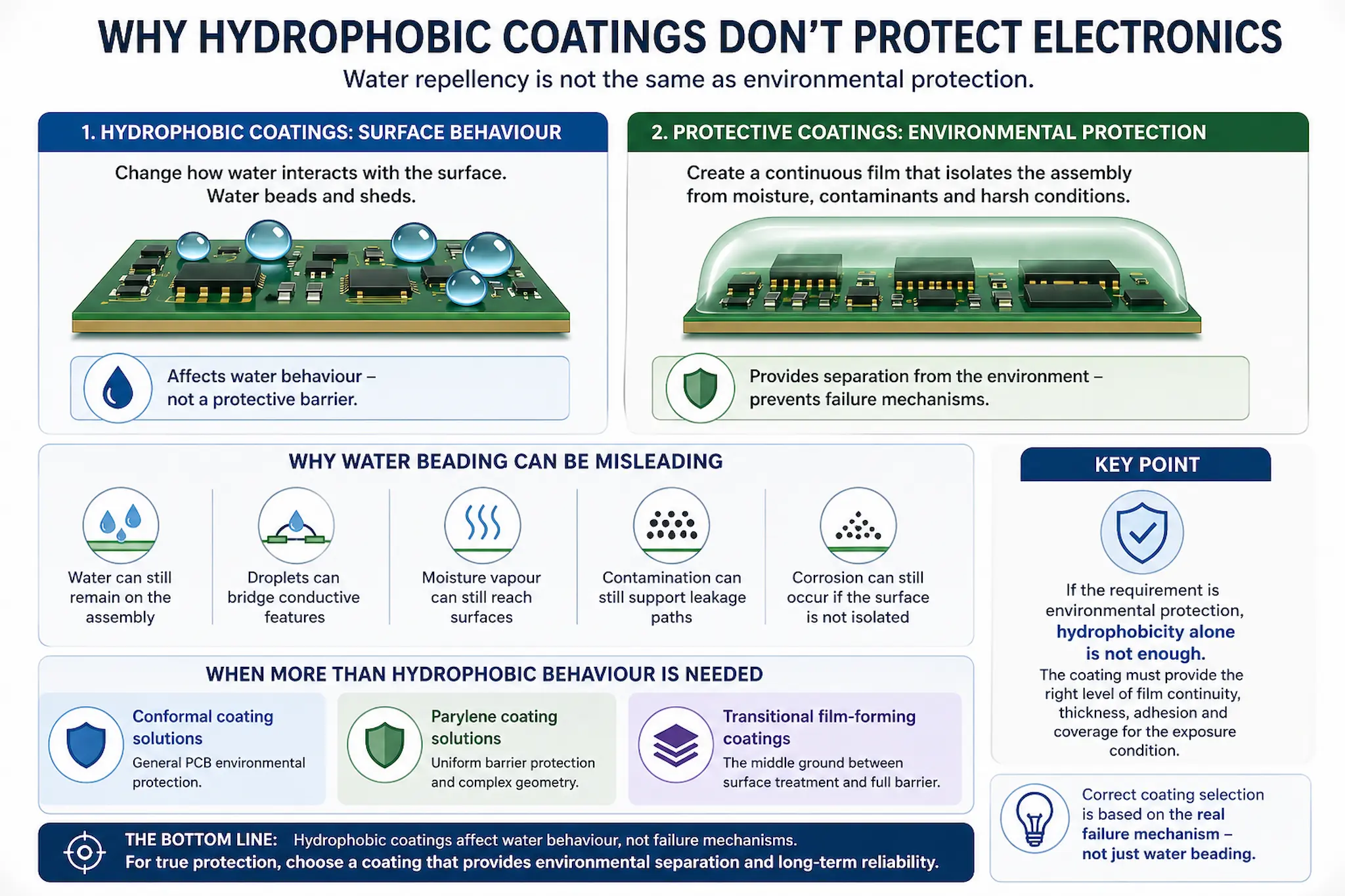
Hydrophobic coatings improve water repellency on PCB surfaces, but do not provide true environmental protection. For electronics reliability, barrier coatings such as conformal coating or Parylene are required to prevent moisture ingress, contamination build-up and corrosion failure mechanisms.
The Core Issue: Surface Behaviour vs Protection
Hydrophobicity is a surface property. It describes how water interacts with the surface, not whether the electronics beneath are protected.
For a deeper explanation, see the surface vs film vs barrier guide or compare with nano coating vs conformal coating.
In practice, many electronics applications sit between simple surface water repellency and full environmental isolation. In these cases, transitional film-forming coatings can provide an intermediate engineering approach where some film continuity is required without moving fully into traditional conformal coating thicknesses.
Why Water Beading Can Be Misleading
Water beading looks impressive, but it can create a false sense of protection.
- Water can still remain on the assembly
- Droplets can bridge conductive features
- Moisture vapour can still reach surfaces
- Contamination can still support leakage paths
- Corrosion can still occur if the surface is not isolated
A hydrophobic coating may improve drainage or reduce surface wetting, but that is different from preventing electrical failure. For boundary conditions, see limitations of hydrophobic coatings.
Key Point
If the requirement is environmental protection, hydrophobicity alone is not enough. The coating must provide the correct level of film continuity, thickness, adhesion and coverage for the exposure condition.
When Hydrophobic Coatings Can Still Be Useful
Hydrophobic coatings are not wrong. They are useful when the requirement is correctly defined.
- Reducing surface wetting
- Improving moisture shedding
- Reducing contamination retention
- Supporting cleanability
- Protecting selected low-risk areas
- Reducing coating build where thickness is critical
For correct application cases, review when to use hydrophobic coatings and hydrophobic coatings.
When You Need More Than Hydrophobic Behaviour
If the failure risk involves moisture, corrosion, leakage current or long-term environmental exposure, a more protective coating route may be required.
- For general PCB environmental protection, review conformal coating solutions
- For uniform barrier protection or complex geometry, review Parylene coating solutions
- For the middle ground between surface treatment and full barrier, review transitional film-forming coatings
Typical Failure Scenario
A PCB is coated with a hydrophobic treatment because water beads on the surface during a simple demonstration. In service, the assembly is exposed to condensation and contamination.
- Water does not form a flat film, but droplets still remain
- Contamination and moisture create conductive paths
- Unprotected areas, edges or interfaces remain exposed
- Corrosion or leakage current develops over time
The coating did not fail because it was hydrophobic. It failed because hydrophobic behaviour was used where environmental protection was required.
Related Technical Articles
Need Help Choosing the Correct Route?
If you are unsure whether your application needs hydrophobic behaviour, a film-forming coating, conformal coating or Parylene, SCH can review the exposure condition and recommend the correct coating strategy.
Why Choose SCH Services?
SCH helps customers avoid coating selection mistakes by separating surface behaviour, film-forming protection and true barrier performance.
📞 +44 (0)1226 249019 | ✉ sales@schservices.com | 💬 Discuss Your Application ›