Hydrophobic Coatings: Surface vs Film vs Barrier
Understanding how hydrophobic behaviour, film build and barrier performance differ in real applications
Hydrophobic coatings are often misunderstood. Water repellency is frequently assumed to mean protection, but in many cases it only reflects surface behaviour, not actual environmental resistance.
Some coatings only modify surface energy, without providing protection. Others form functional films that add chemical resistance. At higher build levels, coatings act as barriers, providing physical separation from moisture, contamination and chemicals.
The key mistake is not choosing the wrong coating, but choosing the wrong coating regime. This page clarifies that difference so you can select the correct approach for the application. For full route selection, see the How to Choose the Right Coating guide.
If you are starting from application requirements rather than coating behaviour, use the Advanced Functional Coatings overview to navigate by problem type, or compare hydrophobic coating vs conformal coating.
Page role: This is a behaviour guide. Use it to determine whether your coating requirement is surface modification, film-forming protection or true barrier performance.
Surface vs Film vs Barrier – The Core Model
Coating performance changes as film build increases. Hydrophobic behaviour may exist in all three regimes, but protection only increases when a continuous film or barrier is formed.
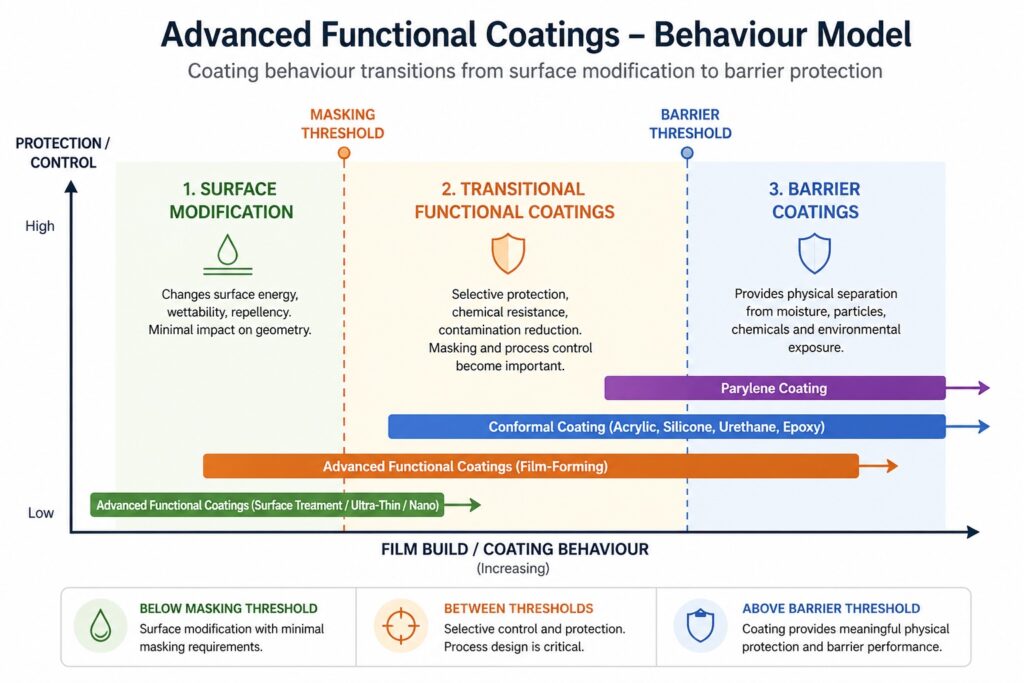
Coating behaviour transitions from surface modification to film formation and finally to barrier protection as thickness and continuity increase.
1. Surface Hydrophobic Coatings
At very low thickness, coatings act as surface modifiers. They change wetting behaviour but do not provide protection.
- Water beads and sheds from the surface
- Minimal or no masking required
- No physical barrier to moisture or contamination
- Limited resistance to chemicals, vapour or particles
Use when: the objective is wetting control or contamination reduction, not environmental protection. For correct application cases, see when to use hydrophobic coatings.
2. Film-Forming Hydrophobic Coatings
As coating build increases, performance shifts from surface modification to film-driven behaviour, enabling chemical resistance and selective protection.
- Hydrophobic surface behaviour is retained
- Chemical resistance begins to develop
- Selective protection becomes possible
- Masking and process control may be required
This is where many real-world applications sit, particularly where surface treatments are insufficient but full coating systems are not justified. Depending on chemistry and application, this may sit in a low-micron or transitional film-forming range rather than a conventional thick coating regime.
Typical examples include nano coatings and transitional film-forming coating strategies. For a comparison of ultra-thin routes against protective coating systems, see nano coating vs conformal coating.
3. Barrier-Type Hydrophobic Coatings
At higher build, coatings act as true barriers, providing physical separation from the environment.
- Continuous film blocks moisture and contaminants
- Improved resistance to chemicals and particles
- Hydrophobic behaviour may still be present
- Full process control, masking and validation required
At this stage, performance is driven by film integrity rather than surface energy.
These coatings should be assessed using similar criteria to conformal coating processes. For broader comparison across coating routes, see conformal coating vs nano coating vs Parylene.
Next step: Once the required coating behaviour is defined, move to the appropriate coating route:
- Hydrophobic coatings – surface behaviour and wetting control
- Ultra-thin coatings – where thickness is the limiting factor
- PFAS-free coatings – where regulatory or material constraints apply
- Film-forming coatings – selective protection between surface and barrier
Key Engineering Insight
Hydrophobicity is a surface property. Barrier performance is structural.
A coating can repel water without protecting the substrate. Always match coating regime to exposure conditions. For common selection errors, see why hydrophobic coatings don’t protect electronics and limitations of hydrophobic coatings.
How do you validate the correct coating regime?
Once you understand whether your requirement is surface behaviour, film-forming protection or barrier performance, the next step is proving it under real conditions.
- Surface coatings – validated through wetting behaviour, contamination testing and durability
- Film-forming coatings – require chemical resistance, adhesion and exposure testing
- Barrier coatings – require full environmental validation, inspection and process control
If you need to test, validate or apply coatings for real-world evaluation or production, SCH provides controlled coating services across surface, film-forming and barrier coating regimes.
View Coating Services →
Where Applications Typically Sit
Correct positioning prevents both under-specifying and over-engineering. If surface cleanliness, adhesion or film continuity are critical, review surface preparation and cleanliness as part of the coating selection process.
Need Help Selecting the Right Approach?
If you are unsure whether your application needs surface modification, a film-forming coating or a true barrier coating, SCH can help define the correct coating regime and support validation through practical trials.
Why Choose SCH Services?
SCH supports coating selection, validation and implementation across surface, film-forming and barrier coating regimes, ensuring the chosen approach performs under real application conditions.
📞 +44 (0)1226 249019 | ✉ sales@schservices.com | 💬 Discuss Your Application ›