Mon - Thur 7.30-15.30   Fri 7.30-14.00

Static in Motion โ€“ Why ESD Is a Continuous Process, Not a One-Time Event


Why dynamic charge generation changes how engineers should think about electrostatic control

Electrostatic discharge is often treated as a simple build-up and release problem. In practice, many systems do not just accumulate charge and then discharge it later. They generate charge continuously while the process is running.

This matters in any application where polymer surfaces move quickly, unwind under tension, rub against guides, or interact with adjacent materials. In these conditions, static is not a one-off event. It is an active, ongoing part of system behaviour.

The result is that electrostatic control must be designed around real operating conditions, not just static lab assumptions. If charge is being generated all the time, the surface must manage that charge all the time as well.

Why Static Is Often a Process Problem

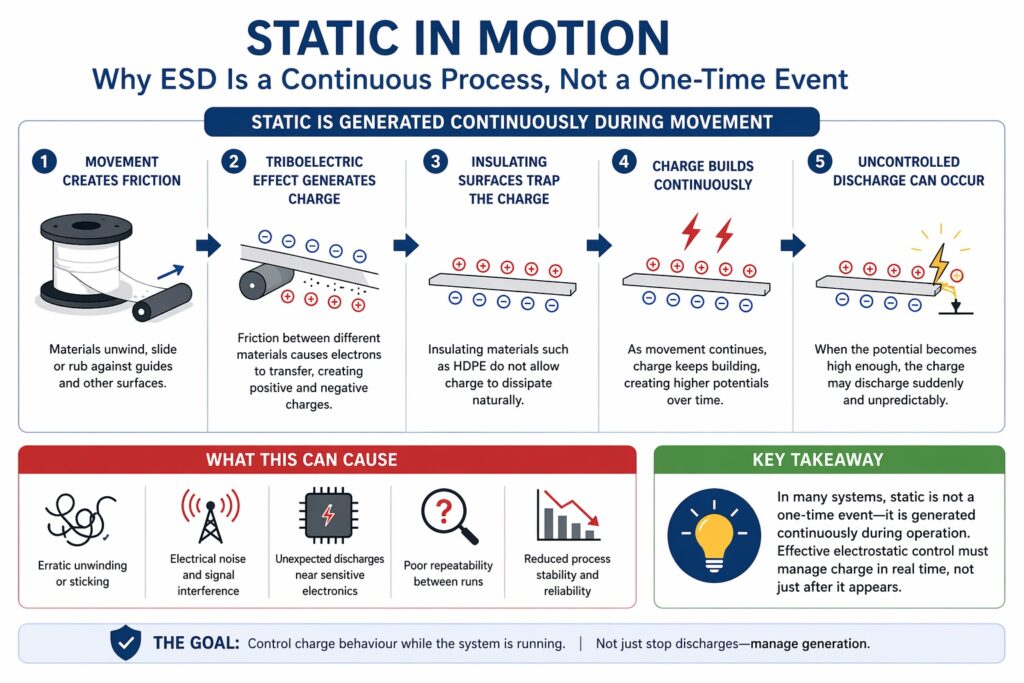
In moving systems, friction between surfaces creates charge through the triboelectric effect. This is common where plastic materials unwind, slide, separate, or move rapidly through guides and handling points.

When the base material is electrically insulating, that charge cannot dissipate in a controlled way. Instead, it builds, shifts, and discharges unpredictably. The faster the movement and the more demanding the environment, the more important this becomes.

This is why static issues are often wrongly diagnosed as isolated electrical faults. In reality, they are frequently process-generated problems that originate in material movement, surface behaviour, and equipment interaction.

The key shift is simple: static is not always something that appears after the event. In many systems, it is being created continuously during the event.

Static electricity infographic showing how friction generates continuous electrostatic charge in moving materials and leads to ESD events

Static is not a one-time event. In moving systems, charge is generated continuously through friction and must be controlled in real time.

What This Means for Real-World Performance

If charge is being generated continuously, passive thinking is not enough. A material or coating cannot just be โ€œESD safeโ€ on paper. It must be capable of controlling charge behaviour during live operation.

Where this is not understood, the symptoms can appear in several different ways:

  • erratic release or unwinding behaviour
  • surface attraction, sticking, or instability during handling
  • intermittent electrical noise or signal disturbance
  • performance instability in specialist electrostatic systems such as electrostatic speaker diaphragm assemblies where highly uniform dissipative surface behaviour is critical
  • unexpected discharge events near sensitive electronics
  • poor repeatability between apparently identical runs

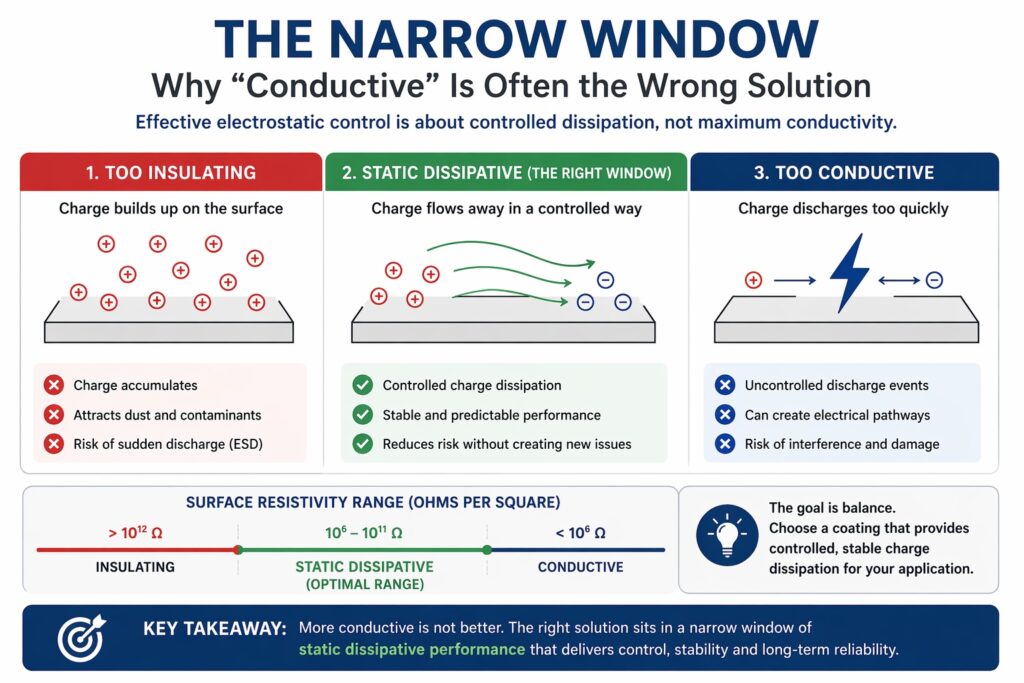
This is why electrostatic control must go beyond simple discharge. In many cases, stability depends on maintaining controlled charge dissipation within a defined electrical window, rather than allowing charge to build or discharge unpredictably.

See how coating choice affects long-term static behaviour and stability

Why Surface Engineering Matters More Than Labels

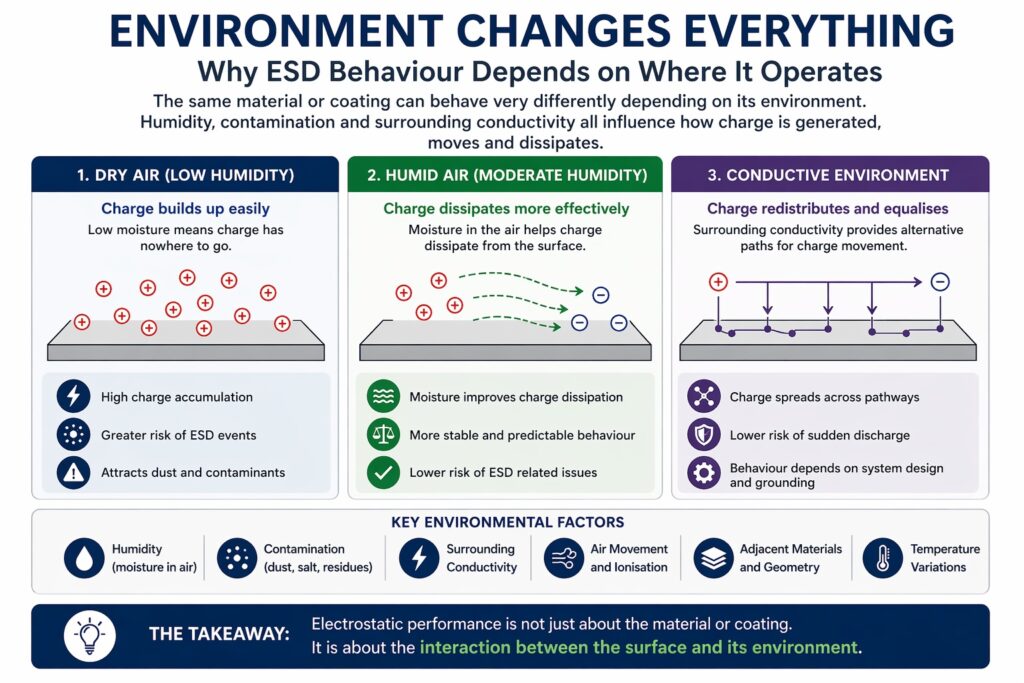
It is easy to describe a surface as insulating, conductive, or static dissipative. Those labels are useful, but they do not explain how the surface behaves when speed, friction, geometry, humidity, and environment start to interact.

That is why electrostatic control should be treated as a surface engineering question rather than a simple material label. The practical question is not whether a surface has a conductivity value. The practical question is whether it can control charge generation and dissipation in a stable, predictable way during operation.

This is particularly important in demanding environments where mechanical movement and electrical sensitivity exist together. In such cases, the wrong surface behaviour can affect both process stability and system reliability.

A Better Engineering Question

Instead of asking whether a component has an ESD problem, a better starting point is to ask where charge is being generated, how quickly it is being generated, and whether the surface can dissipate it in a controlled way under real use conditions.

That change in thinking often improves problem-solving immediately. It shifts attention away from isolated discharge events and towards the underlying interaction between movement, material, and surface performance.

In short, the objective is not simply to stop discharge. The objective is to control charge behaviour while the system is running.

Related Reading

For organisations reviewing coating performance, process stability, or inspection controls, these pages may also be useful:

Related insights:

Why Choose SCH Services?

SCH Services supports customers who need practical, process-led guidance on coating behaviour, electrostatic risk, inspection, and application control. Our focus is on helping engineering teams understand where performance problems really come from and how coating strategy fits into the wider process.

โ†‘ Back to top

Disclaimer: This article is provided as general technical guidance only. Actual electrostatic behaviour depends on material, geometry, movement, environment, and system design. Final decisions should be validated through application-specific testing and engineering review.

Incorrect Trust in Measurement Data


Why single-point readings and โ€œin specโ€ results often create false confidence in conformal coating

One of the most common mistakes in conformal coating is assuming that measurement data automatically reflects coating quality.

If a thickness reading falls within specification, it is often treated as proof that the coating is acceptable. In practice, this can be badly misleading. A number may be accurate at the exact point measured and still tell you very little about the protection achieved across the rest of the assembly.

This is why measurement data must be interpreted in context, not treated as a standalone truth. For the wider explanation of why this happens on real PCB assemblies, see Why Measuring Conformal Coating Thickness is Difficult.

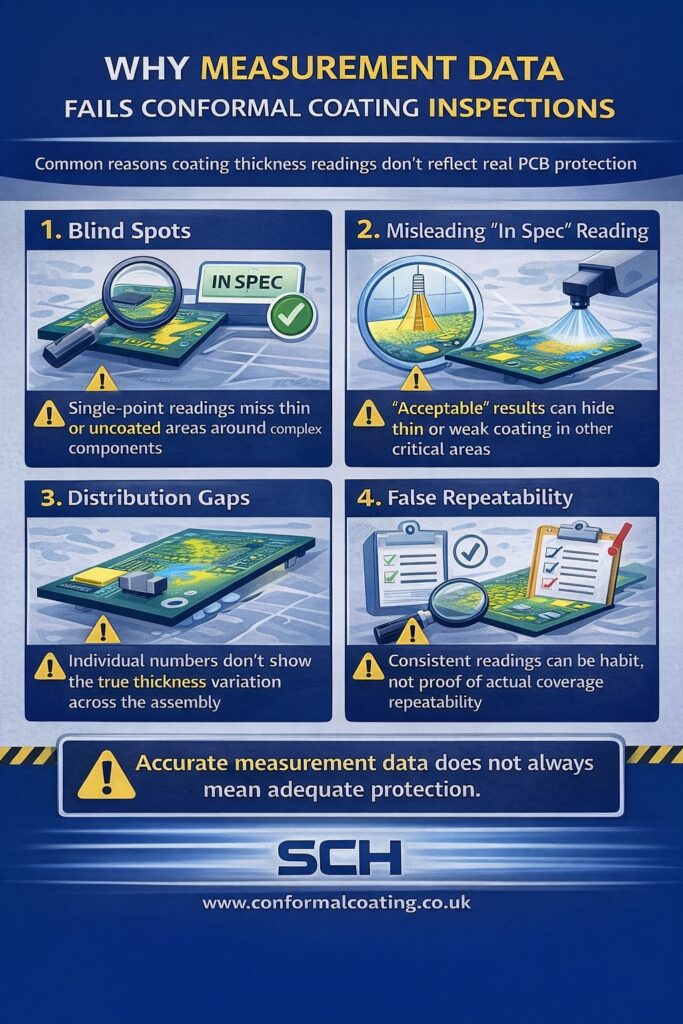
Conformal coating measurement data reliability issues showing single-point readings, misleading in-spec results and hidden thickness variation on PCBs
Why conformal coating measurement data can be misleading, including single-point readings, โ€œin specโ€ assumptions and hidden thickness variation across PCB assemblies.

1) A correct reading is not the same as a representative reading

Measurement tools only report what is happening at the location tested.

That sounds obvious, but it is often ignored in production. A reading taken on an accessible flat area may look acceptable while critical edges, leads or shadowed regions remain under-coated.

This is the central weakness in relying too heavily on isolated thickness data: the number may be valid, but the conclusion drawn from it is wrong.

Key insight: Measurement data becomes dangerous when it creates confidence without proving coverage where failure risk is highest.

2) โ€œIn specโ€ does not always mean protected

A specification range can be useful, but it also encourages oversimplification.

Once a result falls inside that band, teams often stop asking harder questions:

  • Where was the reading taken?
  • Is that location representative?
  • What does thickness look like around complex geometry?
  • Has the process drifted since the sample was measured?

This is how assemblies can pass inspection and still contain hidden reliability risks.

3) Single-point data hides distribution problems

Conformal coating thickness is not uniform. It is a distribution created by flow, geometry, application method and local surface behaviour.

That means a single-point reading can easily miss:

  • Thin coverage on sharp edges
  • Reduced build near component leads
  • Shadowing and local under-coverage
  • Pooling in low or flat areas

This is why isolated data points should never be treated as a complete picture.

Reality check: A neat measurement record can still hide a poor coating outcome.

4) Repeatability is often assumed, not proven

Measurement systems are often treated as more repeatable than they really are on complex PCB assemblies.

Probe position, surface geometry, operator technique and calibration assumptions can all influence results.

So even when data appears consistent, it may reflect a repeatable measurement habit rather than a truly repeatable coating condition. For the process factors that create this instability in the first place, see Inconsistent Coating Thickness: Why Process Control Fails.

5) Measurement methods are usefulโ€”but only within their limits

This is not an argument against measurement. Thickness checks are useful when they are applied with a clear understanding of what they can and cannot tell you.

The problem starts when measurement becomes a substitute for process understanding.

For a method-focused overview, see Conformal Coating Thickness Measurement. The issue is rarely that the method existsโ€”it is that the result is over-interpreted.

6) False confidence is the real defect

Poor data does not just create uncertainty. Worse than that, it can create confidence where caution is needed.

This is why over-trusting measurement data is so damaging in conformal coating:

  • Weak areas go unchallenged
  • Process problems stay hidden
  • Inspection appears stronger than it really is
  • Failures emerge later in use, not during review

The real problem is not the number itself. It is the assumption that the number proves more than it does.

7) What better use of data looks like

Good measurement practice is about interpretation, not blind acceptance.

In practice, that means:

  • Measuring multiple relevant locations
  • Prioritising critical risk areas
  • Comparing data against process conditions
  • Using readings to question the process, not close the case

When used properly, data supports process understanding. When used badly, it replaces it.

8) Summary

The biggest risk in measurement data is not always inaccuracy. It is misplaced trust.

A thickness reading may be valid, but that does not mean it reflects coating performance across the assembly. The wrong reading in the wrong place can still look convincing.

  • Single-point readings are limited
  • โ€œIn specโ€ can still be misleading
  • Data must be interpreted in process context

Good inspection does not come from collecting numbers. It comes from understanding what those numbers really mean.

Why Choose SCH Services?

SCH Services helps customers interpret coating performance properly by combining practical process understanding with realistic inspection and measurement strategy.

  • ๐Ÿ› ๏ธ Process-led coating strategy
  • ๐Ÿ“ˆ Scalable from trials to production
  • ๐ŸŒ Global technical support
  • โœ… Focus on real-world reliability

๐Ÿ“ž +44 (0)1226 249019 | โœ‰ sales@schservices.com | ๐Ÿ’ฌ Contact Us

โ†‘ Back to top

Note: This article provides general technical guidance only. Measurement methods, sampling strategy and acceptance criteria should be validated against the specific coating process, assembly geometry and performance requirements.

Inconsistent Coating Thickness: Why Process Control Fails


Why thickness variation is usually a process problem long before it becomes a measurement problem

Inconsistent coating thickness is rarely caused by one bad reading or one poor application pass.

In most cases, variation is built into the process itself. Changes in viscosity, equipment condition, operator setup and environmental conditions all affect how coating behaves before any measurement is taken.

This is why many coating operations look acceptable on paper but still produce unstable results in production. To understand why thickness measurement itself is so difficult on real assemblies, see Why Measuring Conformal Coating Thickness is Difficult.

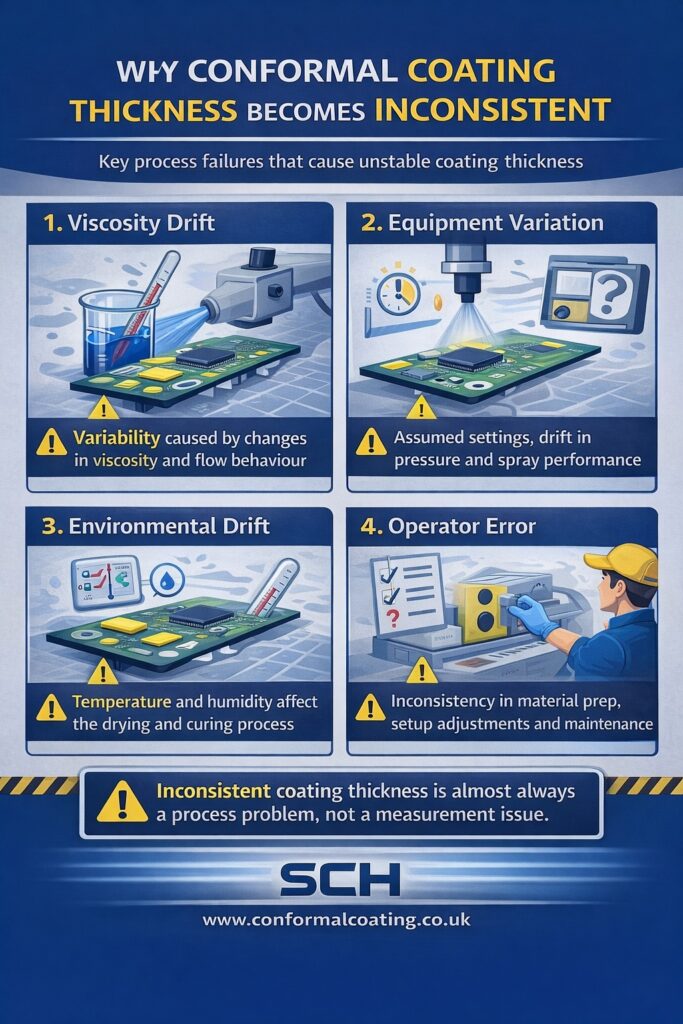
Inconsistent conformal coating thickness on PCBs caused by viscosity drift, equipment variation, environmental changes and operator setup differences
Common process-related causes of inconsistent conformal coating thickness, including viscosity drift, equipment variation, environmental factors and operator setup differences.

1) Thickness variation starts before inspection

A common mistake is to treat thickness inconsistency as an inspection issue.

By the time thickness is measured, the variation has usually already been created by the coating process itself. Inspection may reveal the problem, but it does not explain why the process produced it.

This matters because many corrective actions focus on checking more parts rather than stabilising the underlying process.

Key insight: If thickness is unstable, the process is usually unstable first. Measurement only exposes it.

2) Viscosity drift is one of the biggest hidden causes

Coating viscosity changes during normal use. Solvent loss, temperature variation and pot life all alter how material flows and levels on the board.

That means two assemblies coated with the same material can still show different thickness profiles if the process conditions have changed between runs.

  • Higher viscosity can increase local build
  • Lower viscosity can reduce edge coverage
  • Flow behaviour changes across different geometries

Unless viscosity is monitored and controlled properly, thickness consistency becomes largely reactive rather than predictable.

3) Equipment settings are often assumed, not controlled

Spray pressure, atomisation quality, dispense rate, traverse speed and nozzle condition all influence final film build.

The problem is that many processes are treated as โ€œset and forgetโ€ once a line appears to be running acceptably.

  • Nozzle wear changes spray characteristics
  • Pressure variation alters deposition behaviour
  • Application speed changes local coating build
  • Maintenance intervals affect repeatability

A process can look stable while slowly drifting out of control.

4) Operator consistency is still a major variable

Even where automated equipment is used, operator decisions still shape the process. Material preparation, setup checks, loading orientation, masking quality and acceptance decisions all affect outcome.

In manual or semi-automatic processes, the variation can be even greater.

This is why process control must be built around defined methods and repeatable conditions, not individual skill alone.

Reality check: A process that depends on operator judgement for consistency is not fully under control.

5) Environment changes coating behaviour more than many teams expect

Temperature and humidity do not just affect drying. They affect coating flow, solvent evaporation and how material spreads across surfaces.

This means the same setup can produce different results on different days, or even across different shifts.

  • Temperature affects viscosity and atomisation
  • Humidity can affect surface behaviour and cure response
  • Local environmental drift reduces repeatability

If these variables are not controlled or at least understood, thickness variation becomes inevitable.

6) Why more measurement does not fix poor control

When inconsistency appears, the instinct is often to increase inspection. More readings may give more data, but they do not make the process more stable.

This is where many operations get trapped: they measure variation repeatedly instead of reducing the conditions that create it.

For a deeper look at the limitations of measurement methods themselves, see Conformal Coating Thickness Measurement and the related hub article on why measuring conformal coating thickness is difficult.

7) What good process control looks like

A controlled coating process is not defined by occasional acceptable results. It is defined by repeatability.

In practice, that usually means:

  • Defined viscosity control and material handling
  • Routine verification of equipment condition
  • Consistent setup methods
  • Controlled environmental conditions
  • Measurement used to support process understanding, not replace it

This is why the broader Conformal Coating Processes Hub matters: thickness consistency is only one output of process control, not a standalone issue.

8) Summary

Inconsistent coating thickness is usually not a mystery. It is a sign that the process contains more variation than the measurement system can sensibly manage.

The important question is not โ€œhow many microns did we measure?โ€ but โ€œwhat changed in the process that produced this result?โ€

  • Thickness variation is process-driven
  • Measurement alone does not create control
  • Stable results come from repeatable conditions

When coating thickness is inconsistent, the right place to look first is the process itself.

Why Choose SCH Services?

SCH Services helps customers improve coating consistency by focusing on the real causes of variation, from process design and material control to practical production support.

  • ๐Ÿ› ๏ธ Process-led coating strategy
  • ๐Ÿ“ˆ Scalable from trials to production
  • ๐ŸŒ Global technical support
  • โœ… Focus on real-world reliability

๐Ÿ“ž +44 (0)1226 249019 | โœ‰ sales@schservices.com | ๐Ÿ’ฌ Contact Us

โ†‘ Back to top

Note: This article provides general technical guidance only. Final process settings, material controls and validation requirements should be confirmed against the specific coating, assembly and production environment.

How to Repair Lifted Conformal Coating Edges (Without Making It Worse)


Controlled rework methods using solvent and low-lint swabs to restore clean coating boundaries

Lifted or damaged coating edges are a common issue during conformal coating processes, particularly after masking removal. While often blamed on operator technique, the reality is that coating adhesion, film thickness, cure state, and dwell time all play a significant role in how stable the coating edge remains.

When coating edges lift, tear, or feather, the instinct is often to โ€œclean it upโ€ quickly. In practice, this is where additional defects are introduced โ€” spreading contamination, damaging adjacent coating, or making the repair more visible than the original issue.

This guide explains how to repair lifted conformal coating edges in a controlled way, without introducing further defects or compromising long-term reliability.

For upstream causes of masking damage and how to prevent it during application, see Masking Application Best Practices.

Low lint swabs for conformal coating rework showing contamination control, precise solvent application and defect prevention

Low-lint swabs enable controlled conformal coating repair by reducing fibre contamination, improving edge definition, and preventing secondary defects during rework.

Why Coating Edges Lift in the First Place

Understanding the cause is critical before attempting repair. Edge lifting is rarely random โ€” it is typically driven by a combination of material behaviour, process conditions, and operator handling.

  • Poor adhesion โ€” contamination, poor surface preparation, or incompatible substrates
  • Excessive coating thickness โ€” thicker films are more prone to tearing during masking removal
  • Cure condition โ€” partially cured coatings behave differently to fully cured films
  • Dwell time โ€” long delays between masking and removal increase edge stress
  • Operator technique โ€” peel angle, removal speed, and handling can either protect or damage coating edges

In practice, edge damage is usually the result of multiple factors interacting, not a single root cause. Even good operator technique cannot fully compensate for poor adhesion, excessive thickness, or incorrect process timing.

If these factors are not understood, repairs will only treat the symptom โ€” not the underlying process issue.

What Not to Do

Most coating damage during repair is caused by uncontrolled methods. Avoid the following:

  • Wiping with cloths or tissues โ€” introduces fibres and spreads contamination
  • Aggressive scrubbing โ€” damages surrounding coating and enlarges the defect
  • Over-applying solvent โ€” spreads dissolved coating beyond the repair area
  • Repeated reworking โ€” weakens the coating system and affects appearance

If the repair method is not controlled, the โ€œfixโ€ often becomes worse than the original defect.

Reality check: Most visible repair defects are introduced during rework rather than during the original coating process.

Correct Method for Repairing Lifted Coating

Effective repair is about control and minimal disturbance, not removal.

Recommended approach

  • Use a compatible solvent โ€” matched to the coating chemistry
  • Apply solvent locally using a low-lint swab โ€” this allows controlled application without introducing fibres or spreading contamination
  • Gently reflow or smooth the edge rather than removing large areas
  • Work in one direction to avoid spreading material
  • Allow controlled drying before inspection

Low-lint swabs play a key role in this process, allowing controlled solvent application while reducing the risk of fibre contamination โ€” a common source of secondary defects during repair.

Warning: Avoid cotton buds or high-lint swabs during repair. Fibre contamination introduced at this stage can directly affect coating performance and inspection results.

The goal is to restore a clean boundary โ€” not to rework the entire coated area.

Why Tool Selection Matters

The tool used during repair has a direct impact on contamination risk, edge control, and final finish quality.

  • Low-lint swabs reduce fibre contamination compared to cloths or paper
  • Consistent tip structure allows controlled solvent application
  • Precision handling enables localised repair without affecting surrounding areas

Poor-quality swabs or improvised materials can introduce fibres, leave residue, or damage coating edges โ€” especially on fine-pitch assemblies.

Controlled Rework in Practice

In production environments, coating repair should be treated as a defined process step โ€” not an improvised activity.

  • Use approved solvents and materials only
  • Define when repair is acceptable vs reject
  • Train operators on controlled rework techniques
  • Inspect repaired areas under appropriate lighting (white light or UV)

This ensures repairs are repeatable, acceptable to inspection, and do not introduce long-term reliability risks.

Recommended Tools for Precision Repair

For controlled coating repair, tool selection should be intentional. In our own coating and rework operations, we use low-lint polyester swabs designed for precision cleaning and localised coating correction.

Warning: Avoid cotton buds or high-lint swabs. While low cost, they can shed fibres into the coating surface, leading to contamination, de-wetting, and visible defects during inspection.

There is often a trade-off between cost and performance. Cotton buds are inexpensive but introduce risk, while specialist cleanroom swabs can be unnecessarily expensive for general coating rework.

Low-lint polyester swabs provide a practical middle ground โ€” controlled performance without excessive cost, making them suitable for everyday conformal coating repair and inspection work.

๐Ÿ‘‰ View polyester swabs for conformal coating rework

โ†‘ Back to top

Support Your Coating Process with the Right Tools

Successful conformal coating repair depends on control โ€” not just technique, but the materials and tools used during rework.

  • โœ” Low-lint materials to reduce contamination risk
  • โœ” Consistent tip structure for controlled solvent application
  • โœ” Proven performance in real coating and rework environments

๐Ÿ‘‰ View Polyester Swabs for Coating Repair

Note: This article provides general technical guidance only. Repair methods, solvent compatibility, and acceptance criteria must be validated against your specific coating system, materials, and applicable industry standards.

Why ESD protection fails in data centres


Hidden gaps in packaging, infrastructure, handling and environment often undermine static control

ESD protection in data centres often fails because the strategy is too narrow. Controls may exist at workstations or during maintenance, but static risk is still present across packaging, storage, staging areas, infrastructure and mixed-material handling environments.

The result is a familiar problem: a facility appears protected on paper, yet real-world exposure remains across the wider chain of movement and contact.

Quick take. Data centre ESD protection fails when the programme focuses on isolated control points instead of the full environment. Static risk does not begin at the bench or end with a wrist strap.

Why ESD protection fails data centres infographic showing packaging infrastructure maintenance and handling gaps causing electrostatic risk

ESD protection in data centres often fails when packaging, infrastructure, maintenance zones and handling environments are treated as separate issues instead of one connected system.

Why this matters

Data centres depend on reliable movement, installation, storage and replacement of sensitive electronics. Servers, boards, modules and replacement parts pass through multiple environments before and after live operation. Every one of those environments can affect electrostatic risk.

The problem is that ESD protection is still often framed around obvious control points such as wrist straps, mats or workstations. Those controls may be useful, but they only address part of the problem. Static can still be introduced through packaging, mixed materials, temporary holding areas, maintenance activity and infrastructure surfaces.

This means ESD protection can fail without any single dramatic mistake. It fails quietly, through fragmented assumptions and incomplete boundaries.

The pattern we see again and again

Most failures in data centre ESD strategy do not come from having no controls at all. They come from having controls that are too localised.

  • Operators are grounded, but packaging materials are not reviewed.
  • Workstations are controlled, but staging areas use mixed materials.
  • Maintenance procedures exist, but tools, carts and support surfaces vary.
  • Infrastructure is assumed neutral, even where plastics, coatings and inserts behave differently.
  • Teams focus on compliance checks rather than real movement of electronics through the site.

The outcome is a system with pockets of protection separated by practical gaps.

1. Packaging is treated as outside the ESD boundary

One of the biggest reasons ESD protection fails in data centres is that packaging is treated as a logistics issue rather than a handling issue. Yet cardboard, foam inserts, trays, cartons and temporary storage materials are often the first environment the electronics encounters.

If those materials are ignored, static risk may already have been introduced before the equipment reaches the controlled area.

For a focused look at this issue, see The Most Overlooked ESD Risk in Data Centres: Packaging.

2. Operator controls are mistaken for system protection

Wrist straps, heel straps and grounded benches all have value. The failure happens when these are treated as proof that the whole environment is safe.

In reality, operator controls manage charge on a person. They do not automatically control racks, cabinets, packaging, trays, carts, tools or support surfaces. In a data centre, electronics often move through all of these.

For more on this point, see Wrist Straps Donโ€™t Protect Data Centres.

3. Temporary areas become permanent blind spots

Data centres often include temporary environments that are not treated with the same discipline as formal maintenance benches or production-style workstations. These may include staging rooms, unpacking areas, swap-out zones, short-term shelving or transit holding points.

Because these areas are seen as temporary, they can escape detailed review. But in practice, they are often used repeatedly and play a major role in how hardware is handled.

A control strategy that ignores these spaces leaves part of the real workflow outside the protection boundary.

4. Infrastructure surfaces are assumed to be neutral

Another common weakness is the assumption that racks, shelving, support surfaces and cabinets are simply โ€œpart of the roomโ€ rather than active parts of the ESD environment. In reality, materials, finishes, inserts and attachments all influence how a space behaves.

This does not mean every surface is a problem. It means infrastructure should be reviewed as part of the full handling chain rather than treated as background.

That is why ESD protection in data centres increasingly needs a wider surface and environment perspective.

Practical warning sign. If your ESD programme is strong at the bench but weak in packaging, staging, storage and infrastructure review, the system is probably more fragmented than it appears.

5. Environmental variation is underestimated

Humidity, flooring, mixed materials, repeated movement and maintenance activity all affect how static risk appears in practice. Even where a formal programme exists, local variation can still create weak points.

This is one reason why static control that looks sufficient in theory may not behave consistently in real use. The environment itself changes how risk is expressed across the site.

A robust strategy needs to account for how the environment behaves, not just how the procedure is written.

A more reliable way to think about data centre ESD protection

A better approach is to view the data centre as one connected handling environment rather than a collection of isolated control points.

  • Map where electronics arrive, pause, move, get unpacked and are serviced.
  • Review packaging and temporary materials, not just permanent infrastructure.
  • Assess staging areas, maintenance zones and short-term storage spaces.
  • Look at how surfaces behave across the wider environment.
  • Combine operator controls with broader infrastructure and handling review.

This shifts ESD protection from narrow compliance to practical reliability.

What this means in practice

If your ESD protection has been built mainly around people, benches and formal workstations, the first step is not necessarily to add more rules. It is to look again at the actual journey the electronics takes through your site.

For a broader commercial overview, see our ESD Protection for Data Centres page.

In many cases, the biggest gains come from identifying where protection ends too early rather than from tightening the controls that already exist.

Why Choose SCH Services?

SCH supports customers with practical ESD strategy thinking across infrastructure, packaging, handling environments and surface behaviour. We help identify where static risk is actually introduced in day-to-day operation, then support a more realistic implementation approach.

This is often where a wider environmental review reveals why apparently good ESD programmes still leave practical gaps.

Back to top

Note: This article provides general technical guidance only. ESD control strategy, implementation and validation must be assessed against the specific environment, materials, equipment and applicable standards.

The Most Overlooked ESD Risk in Data Centres: Packaging


Why static risk often begins before equipment reaches the rack

Packaging is often treated as a logistics detail, not an ESD control point. In reality, cardboard, foams, trays, inserts and temporary handling materials can all influence static risk before equipment is even installed.

This creates a blind spot in many data centre environments: the electronics may enter a controlled space, but only after moving through uncontrolled packaging and staging conditions.

Quick take. If packaging, storage and staging materials are ignored, ESD protection starts too late. In many cases, the risk begins before the rack is ever opened.

Packaging ESD risk in data centres infographic showing cardboard foam trays staging areas and handling environments where static can occur

Packaging materials such as cardboard, foams, trays and staging environments can introduce hidden ESD risk before electronics reach controlled data centre areas.

Why this matters

Many ESD programmes focus heavily on workstations, operators and final handling areas. That makes sense on paper, but it can miss a critical part of the journey: how electronics are stored, shipped, unpacked and staged before use.

Servers, boards, modules and replacement parts frequently arrive in mixed packaging systems that include cardboard cartons, foam inserts, plastic trays, temporary protective films and transport aids. These materials may be practical for logistics, but they are not always neutral from an electrostatic point of view.

If packaging is not considered as part of the wider ESD strategy, static risk may already have been introduced before the equipment reaches the controlled area.

This forms part of a wider pattern where ESD protection is fragmented across environments, as explained in why ESD protection fails in data centres.

The pattern we see again and again

In many environments, packaging is seen as temporary, so it is treated as less important than permanent infrastructure. In practice, temporary materials can be involved in repeated handling and repeated risk.

  • Equipment is received in standard packaging and moved into staging areas.
  • Foams, inserts and trays remain in use during unpacking and temporary storage.
  • Components are transferred between boxes, benches, carts and racks.
  • Packaging is reused or repurposed without reviewing its ESD suitability.
  • Attention stays on the operator while the surrounding materials are ignored.

The result is a chain of small exposures that may never appear in formal process maps, but still affect real-world reliability.

Even where operator controls are in place, they do not address packaging-related risk, which is why wrist straps alone are not sufficient.

Why packaging creates hidden ESD exposure

Packaging sits at the boundary between logistics and electronics handling. That is exactly why it gets missed.

  • Cardboard and foams can contribute to charge generation during movement and contact.
  • Plastic trays and inserts vary widely in their ESD behaviour.
  • Temporary staging areas may not have the same controls as formal workstations.
  • Repeated unpacking, repacking and movement adds more handling events.

Because packaging is often short-lived, teams assume it does not matter. But short-lived materials can still create risk during the exact moments when electronics are most exposed.

Practical warning sign. If your ESD controls begin only when the equipment reaches the bench, rack or maintenance station, your real control boundary may be too late.

A better way to think about packaging

A stronger approach is to treat packaging as part of the handling environment, not just as a shipping material.

  • Review what materials sensitive electronics arrive in.
  • Assess how long those materials remain in contact with the product.
  • Look at where unpacking and staging actually happen.
  • Consider whether higher-risk materials can be reduced, replaced or better controlled.

This does not mean every box becomes an engineering project. It means recognising that packaging is often the first real ESD environment the product experiences.

What this means in practice

If packaging is outside your ESD review, there is a good chance your control strategy starts too late. This is especially relevant in data centres where replacement hardware, spares and service parts move repeatedly through temporary holding and handling areas.

For a broader view of infrastructure, staging and handling risk, see our ESD Protection for Data Centres page. To understand how these issues combine at system level, see Why ESD Protection Fails in Data Centres and Wrist Straps Donโ€™t Protect Data Centres.

In many cases, improving packaging awareness is one of the simplest ways to close practical ESD gaps without overcomplicating the wider programme.

Why Choose SCH Services?

SCH supports customers with practical ESD strategy thinking across packaging, handling environments, infrastructure and surface behaviour. We help teams look beyond formal control points and identify where risk is actually introduced in day-to-day operations.

This is often where seemingly minor packaging decisions have a bigger reliability impact than expected.

Back to top

Note: This insight provides general technical guidance only. Packaging materials, ESD control strategy and final implementation decisions must be assessed against the specific equipment, handling environment and applicable standards.

Wrist Straps Donโ€™t Protect Data Centres


Why operator-only ESD control does not address infrastructure and handling risk

Wrist straps are not a complete ESD solution in data centre environments. They control charge on a person, but they do not control the wider infrastructure, surfaces, packaging or handling routes that electronics move through.

This creates a common gap: teams assume ESD is covered because operators are grounded, while static risk continues to exist across the environment.

Quick take. Wrist straps control people. Data centres require control of surfaces, materials and infrastructure. Without that, ESD protection remains incomplete.

Wrist straps ESD data centres infographic showing packaging, racks and maintenance areas where static risk occurs

Wrist straps control operator charge, but ESD risk in data centres exists across packaging, infrastructure, maintenance areas and handling environments.

Why this matters

ESD control is often approached as a compliance task: ensure operators are grounded, provide mats, and follow procedures. In controlled bench environments, this can be effective. In data centres, it is often insufficient.

Electronics in data centres move through multiple stages โ€” unpacking, staging, storage, installation, maintenance and replacement. At each stage, different surfaces and materials are involved, many of which can generate or hold static charge.

If those surfaces are not considered, ESD risk is not removed โ€” it is simply moved to a different part of the process.

This is one example of a wider issue. In many cases, ESD protection fails due to multiple gaps across the environment, as explored in why ESD protection fails in data centres.

The pattern we see again and again

In many environments, ESD protection is focused heavily on the operator, with less attention given to the wider handling environment.

  • Wrist straps are used during installation or repair work.
  • Packaging materials such as foam and cardboard are not controlled.
  • Racks, trays and storage systems include mixed materials.
  • Maintenance zones introduce tools, carts and temporary setups.
  • Teams assume compliance equals protection.

The result is a fragmented system where some areas are controlled and others are not, even though electronics pass through all of them.

In addition, risk is often introduced before operator control even begins, particularly through packaging and staging environments, as outlined in packaging-related ESD risk.

Why wrist straps alone fall short

Wrist straps are designed as a point-control measure. They do not provide continuous protection across an environment.

  • They only control charge on the person wearing them.
  • They do not influence packaging, trays or infrastructure surfaces.
  • They rely on consistent human use and correct connection.
  • They do not address static generated before or after operator contact.

In data centre environments, where electronics move between multiple surfaces and locations, this creates unavoidable gaps.

Practical warning sign. If your ESD control relies mainly on operator grounding but does not consider packaging, storage and infrastructure surfaces, your protection is likely incomplete.

A more realistic approach

A stronger ESD strategy for data centres combines operator controls with a wider review of the environment.

  • Identify where electronics are stored, moved and handled.
  • Review materials such as packaging, foams, trays and shelving.
  • Assess maintenance and staging areas for repeated contact risks.
  • Introduce more consistent surface behaviour where appropriate.

This shifts ESD control from isolated compliance to system-level reliability.

What this means in practice

Wrist straps should still be used where appropriate. The issue is not removing them โ€” it is recognising their limits.

For a broader view of how ESD risk appears across infrastructure and handling environments, see our ESD Protection for Data Centres page. To understand how these issues combine at system level, see Why ESD Protection Fails in Data Centres and The Most Overlooked ESD Risk in Data Centres: Packaging.

In many cases, improving surface consistency and reducing environmental variation has a greater impact than adding more point controls.

Why Choose SCH Services?

SCH supports customers with practical ESD strategy development across infrastructure, packaging, handling and surface behaviour. We focus on how ESD risk appears in real environments, not just how it is defined in procedures.

This is often where moving beyond operator-only thinking improves real-world reliability.

Back to top

Note: This insight provides general technical guidance only. ESD control strategy, implementation and validation must be assessed against the specific environment, materials and applicable standards.

Measurement Reliability on PCBs: Why Eddy Current Often Fails and What to Do Instead


Measuring coating thickness on PCBs is harder than most people expect

Eddy current thickness measurement often gives unreliable results on PCBs. Ground planes, copper density, component proximity and board construction can distort readings, even when the coating itself is consistent.

This insight highlights a common issue: teams trust the number on the gauge without questioning whether the measurement method is valid for that specific PCB.

Quick take. Eddy current measurement works well on flat, conductive substrates โ€” but on complex PCBs it can be misleading. Measurement strategy matters more than the tool itself.

Infographic showing why eddy current thickness measurement on PCBs can be inaccurate due to ground planes, copper density, component proximity and measurement location

Eddy current coating thickness measurements on PCBs can be misleading due to ground planes, copper density, component proximity and measurement location โ€” making strategy more important than the tool.

Why this matters

Thickness measurement is often treated as a simple validation step: apply coating, measure thickness, confirm compliance. In reality, this step is frequently one of the weakest points in the entire process.

On PCBs, the structure beneath the coating is highly variable. Ground planes, copper layers, tracks, pads and components all influence how measurement devices respond. As a result, two readings taken a few millimetres apart can differ significantly, even when the coating thickness is consistent.

This creates a dangerous situation where good coating processes appear inconsistent, and operators begin adjusting the process to match incorrect data.

The pattern we see again and again

In many production environments, an eddy current gauge is used across the PCB surface without considering where measurements are being taken. Readings are then averaged or compared directly to specification limits.

  • Measurements taken over ground planes show different values to those over sparse copper areas.
  • Readings near components are distorted by geometry and proximity.
  • Operators see variation and assume the coating process is unstable.
  • Process adjustments are made to correct what is actually a measurement problem.

This leads to unnecessary process changes, inconsistent results and reduced confidence in the coating line.

Why eddy current struggles on PCBs

Eddy current measurement relies on electromagnetic interaction with conductive substrates. On simple, uniform surfaces, this works well. On PCBs, the situation is far more complex.

  • Internal copper planes affect signal response.
  • Track density varies across the board.
  • Component proximity alters probe behaviour.
  • Small measurement areas amplify local variation.

The result is not necessarily incorrect measurement โ€” but highly context-dependent measurement that must be interpreted carefully.

Practical warning sign. If thickness readings vary significantly across the same PCB but visual coating quality looks consistent, the issue is often measurement reliability rather than coating variation.

A more reliable way to approach measurement

Instead of relying on random PCB measurements, a more robust approach is to define a measurement strategy.

  • Use consistent measurement locations where possible.
  • Understand how PCB structure affects readings.
  • Use witness coupons to provide repeatable reference values.
  • Combine measurement methods rather than relying on one tool.

This approach separates true process variation from measurement artefacts.

What This Means in Practice

If your thickness readings do not make sense, the first step is not to adjust the coating process. It is to question whether the measurement method is appropriate for that PCB.

For related process control topics, see Conformal Coating Processes Hub, Inspection & Quality Hub, and De-wetting in Conformal Coating.

In many cases, a simple change in measurement strategy resolves what appears to be a coating problem.

Why Choose SCH Services?

SCH supports customers with practical coating process validation, measurement strategy and operator training. If your coating thickness data is inconsistent or difficult to interpret, we can help define a more reliable approach based on your specific assemblies and process.

This is often where better measurement removes unnecessary process changes.

Back to top

Note: This insight provides general technical guidance only. Measurement methods, process control and validation must be verified against the specific PCB design, coating system and applicable standards.

Delamination Despite Cleaning: Why Clean Boards Still Fail to Hold Conformal Coating


Cleaning helps, but it does not guarantee adhesion

Delamination after cleaning is often a surface chemistry problem, not simply a cleaning failure. A PCB can appear clean, pass a basic visual check, and still show widespread coating lift if the surface energy is wrong, residues remain that are incompatible with the coating, or the assembly materials do not present a stable surface for adhesion.

This matters because many teams respond by repeating the same cleaning step, using more solvent, or extending wash time, when the real issue is often compatibility, wetting behaviour or surface condition rather than visible dirt.

Quick take. If conformal coating delaminates despite apparently good cleaning, the correct response is usually to review surface energy, residue type, assembly materials, process history and coating compatibility โ€” not just to clean harder.

Infographic explaining why conformal coating delaminates after cleaning due to surface energy, residues, material compatibility and process changes on PCBs

Most conformal coating delamination issues are caused by surface chemistry, residues, material compatibility and process changes โ€” not simply poor cleaning.

Why this matters

When coating peels, lifts, or separates from a PCB after cleaning, the first assumption is often that the board was not cleaned properly. That is understandable because contamination is a common source of coating defects. However, this explanation is often too simple.

A board can be visibly clean and still be a poor surface for coating adhesion. Extremely thin residues, low surface energy materials, process changes, handling contamination, incompatible repair materials, or a mismatch between cleaning method and coating chemistry can all leave the surface looking acceptable while remaining technically unstable.

That is why โ€œcleanโ€ and โ€œready for coatingโ€ are not always the same thing.

The pattern we see again and again

This type of failure often appears on one specific product or PCB design while other assemblies run through the same coating line without obvious issue. The film may lift across a broad area, recede from the surface, peel at edges, or fail during handling, de-masking or later environmental exposure.

That pattern matters because it usually points to a surface chemistry or compatibility issue linked to the board, the residues, the solder resist, the local materials, or the process history rather than a random contamination event.

  • The board may look clean but still carry residues that interfere with wetting or adhesion.
  • The cleaning method may remove loose contamination without changing the underlying surface energy.
  • Different solder masks, finishes, labels, mould compounds and local repair materials may respond differently to the same cleaning route.
  • The coating may be acceptable in general but still be a poor match for the surface condition on that assembly.

In those situations, repeated cleaning often delays the answer rather than solving the problem.

What is usually happening underneath the failure

There are several common mechanisms behind delamination despite cleaning.

Low surface energy

Some surfaces are difficult to wet and difficult for coatings to anchor to. In practical terms, the coating may bead, recede or sit on the surface instead of spreading and bonding properly.

Residues that survive routine cleaning

Not all residues behave the same way. Some are soluble in one cleaner but not another. Others smear or redistribute. A board can therefore pass through cleaning and still carry enough residue to disrupt adhesion.

Assembly-specific material effects

One board may include solder mask changes, component mould compounds, labels, sealants, repaired areas or process residues that make it behave very differently to another assembly that appears similar.

Coating compatibility issues

A coating may perform well on many products but still struggle on a specific surface condition. This is where process understanding becomes more important than assuming the chemistry will tolerate everything.

Practical warning sign. If the same product repeatedly shows adhesion failure while other boards in the same process look fine, the issue is often the interaction between that assembly and the coating process rather than a general cleaning problem.

A more useful way to think about adhesion problems

A weak coating process does not always fail because the line is dirty. It often fails because the surface is not technically prepared for that specific coating. The better engineering question is not simply, โ€œWas it cleaned?โ€ but, โ€œWas the surface actually suitable for reliable adhesion?โ€

That means reviewing the full surface condition, including the residue type, the material set on the board, the handling route, the cleaning chemistry, the drying process and the coating selected.

This shift in thinking is often what stops teams from running in circles.

What to review before changing the whole process

Before changing the coating, reworking the line, or blaming the cleaner, it is worth stepping back and checking a few basics.

  • Has the board design, solder mask, flux, cleaning chemistry or handling route changed?
  • Is the failure limited to certain areas, materials or components?
  • Does the coating show poor wetting before cure, or only fail later?
  • Are there local repair materials, labels, sealants or other non-standard surfaces on the board?
  • Is the cleaning method genuinely suitable for the contamination or residue type present?

These questions often reveal that the problem is not random and not simply caused by insufficient wash time.

What This Means in Practice

If coating delaminates despite apparently good cleaning, the next step is not automatically to increase cleaning intensity or change coating chemistry. It is to review the surface condition in a structured way and identify whether the issue is residue, low surface energy, material incompatibility or a process change that has altered the board surface.

For related defect mechanisms, see De-wetting in Conformal Coating, Corrosion and Ionic Contamination, and Why Masking Causes Most Conformal Coating Defects.

For broader inspection and process review context, see the Conformal Coating Inspection & Quality Hub and the Conformal Coating Processes Hub.

This is also where many teams benefit from operator training, structured troubleshooting and practical process review rather than repeated trial-and-error cleaning.

Where this insight fits in the wider coating system

Delamination does not usually sit in isolation. It links directly to masking practice, process sequencing, contamination control, inspection and defect interpretation. That is why this topic is best treated as part of a wider coating reliability system rather than as a standalone cleaning question.

In practical terms, teams often improve faster when they connect adhesion failures to the full process instead of viewing them as one-off surface preparation events.

Why Choose SCH Services?

SCH supports customers with practical conformal coating troubleshooting, training and production-facing engineering support. If your coatings appear to fail despite correct cleaning, we can help review the likely causes and identify a more stable route based on the full process rather than guesswork.

Useful next steps:

This is often where a structured review saves more time than repeating the same cleaning and recoating cycle.

Back to top

Note: This insight provides general technical guidance only. Final design, material selection, surface preparation, process control and validation decisions must be verified by the product manufacturer and confirmed against the applicable standards, qualification requirements and customer specifications.

Why Low-Cost Electronics Still Need High-Performance Coatings


Why even low-cost electronics can require high-performance coating solutions

Low-cost electronics are often deployed in high-risk environments. That creates a contradiction: the product may be inexpensive, but the conditions it operates in demand high-performance protection.

This is where coating decisions become less about unit cost and more about reliability, failure risk and system performance over time.

Quick take. A ยฃ4 sensor in soil, moisture, chemicals or outdoor environments can still require advanced coating protection. The cost of failure often outweighs the cost of coating.

Visual summary. The diagram below shows why low-cost electronics often require high-performance coating in real-world environments.

Infographic explaining why low-cost electronics still require high-performance coatings due to harsh environments, failure risk and cost of failure

Low-cost electronics are often deployed in harsh environments where failure risk is high, making high-performance coatings essential for reliability despite low unit cost.

The contradiction

Many electronic devices are designed to be low-cost, high-volume products. Sensors, control boards and embedded systems are often built to tight cost targets, sometimes just a few pounds per unit.

At the same time, those same devices may be expected to operate in environments that are far from controlled:

  • soil and moisture exposure
  • condensation and humidity cycling
  • chemicals or fertilisers
  • temperature variation
  • outdoor or industrial environments

This creates a mismatch between product cost and environmental demand.

Why coating becomes critical

Without protection, even a simple electronic assembly can fail quickly in these conditions. Corrosion, leakage paths, contamination and electrical drift can all affect performance.

In these cases, coating is not a premium feature. It is often what allows the product to function reliably at all.

This is where materials such as Parylene can become relevant, even in cost-sensitive applications, because they provide consistent, uniform protection across complex geometries.

Cost vs consequence

The key question is not always โ€œhow much does the coating cost?โ€ but โ€œwhat does failure cost?โ€

Failure cost can include:

  • product replacement
  • field service visits
  • loss of data or function
  • customer dissatisfaction
  • brand or reliability impact

In many cases, those costs outweigh the incremental cost of applying a higher-performance coating.

Where it becomes more complex

In some applications, coating does more than protect. It can also influence how the device behaves. This is particularly relevant in sensor systems, where dielectric materials can affect electrical response.

For example, in capacitive sensing applications, coating can change the dielectric environment and shift performance. For more detail, see Why Parylene Coating Changes Capacitive Sensor Performance.

This reinforces the need to treat coating as part of the engineering system, not just a protective layer.

What This Means in Practice

If you are designing or manufacturing low-cost electronics for use in challenging environments, coating should be considered early rather than added as an afterthought.

The goal is not to over-specify protection, but to match the coating approach to the real operating conditions and the cost of failure.

In many cases, this leads to a more balanced decision where coating is treated as part of the product design rather than an optional extra.

Need support selecting the right coating approach?

SCH supports companies in selecting and implementing coating solutions that balance performance, cost and reliability for real-world environments.

This can include material selection, process guidance, coating trials and support for development-stage decisions.

Engineering Consultancy | Parylene Coating Services

Note: This insight provides general technical guidance only. Final design, safety, process control, and compliance decisions must be verified by the product manufacturer and validated against the applicable standards and customer requirements.
0
  • Your current order total is £0.00 โ€” you must have an order with a minimum of £75.00 to place your order.
0
Your Cart
Your cart is empty
  • Your current order total is £0.00 โ€” you must have an order with a minimum of £75.00 to place your order.
Calculate Shipping
  • Your current order total is £0.00 โ€” you must have an order with a minimum of £75.00 to place your order.

Conformal Coating UK

Technical banner showing PCB and process icons representing conformal coating, masking, inspection and training on the SCH technical knowledge hub.
Conformal Coating UK
Privacy Overview

This website uses cookies so that we can provide you with the best user experience possible. Cookie information is stored in your browser and performs functions such as recognising you when you return to our website and helping our team to understand which sections of the website you find most interesting and useful.