How to Choose the Right Static Control Approach
Practical decision guide for selecting the correct ESD solution across materials, environments and applications
Static control is often treated as a material choice, but in practice it is a behaviour problem. The correct approach depends on where charge is generated, how it moves through the system, and what level of control is required during real operation.
Different problems require different solutions. In some cases, replacing materials makes sense. In others, upgrading the surface behaviour of existing equipment, packaging, work areas or infrastructure is more practical and cost-effective.
This guide provides a structured way to identify the correct static control approach based on the application, environment, operating conditions and risk profile.
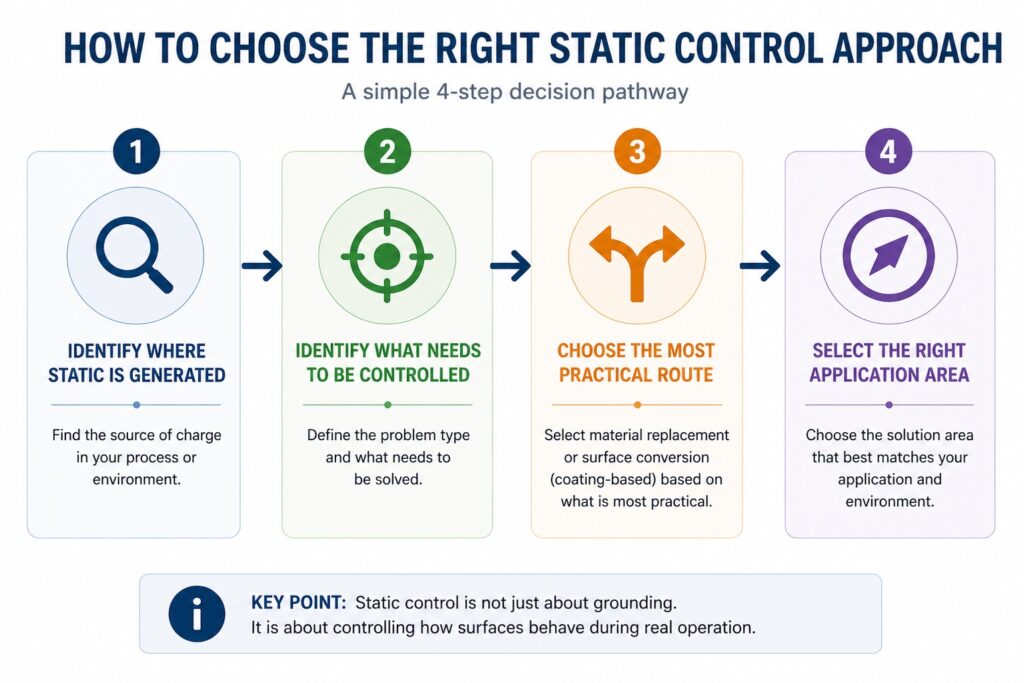
Simple decision pathway showing how to identify static generation, define the problem and select the correct ESD control approach.
Step 1 – Identify Where Static Is Generated
Static problems are solved at the source, not only at the point of failure. Charge is often generated in one location and causes problems elsewhere in the process.
- Handling and movement of parts or materials
- Airflow across surfaces or enclosures
- Friction between materials
- Separation of components or packaging
- Dry environments with low natural dissipation
Once the generation point is understood, the control strategy becomes clearer.
Step 2 – Identify What Needs to Be Controlled
Static issues generally fall into several practical categories. The dominant type defines the most effective solution.
- Surface-driven issues – charge builds on insulating materials
- Handling issues – instability during movement, storage or transport
- Work area issues – benches, floors, racks or facility surfaces affect static behaviour
- Environmental risk – powders, solvents, vapours or hazardous conditions increase the consequence of discharge
In some environments, the overlooked source of risk is not the floor or the operator, but the tooling and accessories used during handling. Our Insight article explains why non-sparking tools are not automatically electrostatically safe.
Misidentifying the problem often leads to over-engineered or ineffective solutions. For a deeper explanation of why consistent surface behaviour matters in real applications, see homogeneous ESD protection and consistency in static control.
Many of these misinterpretations come from incorrect assumptions about how coatings behave in practice. See ESD paint myths explained for a breakdown of common misunderstandings.
Step 3 – Choose the Most Practical Control Route
There are two fundamentally different approaches to static control. The correct choice depends on cost, practicality, risk level and system constraints.
To understand how these approaches fit into a complete static control system, see the ESD control pyramid explanation.
- Material replacement – using ESD plastics, conductive materials or specialist packaging
- Surface conversion – controlling the behaviour of existing materials and surfaces
Material replacement can be effective, but often introduces redesign, supply limitations, qualification work and higher replacement cost. Surface conversion provides a practical route where existing systems need to be upgraded without replacing the underlying asset.
In practice, traditional carbon-filled coatings and moulded anti-static plastics often show variability, wear-related drift and hidden contamination risks. For a practical breakdown, see why carbon-filled ESD paints and moulded anti-static plastics can fail.
Choosing a coating system is only part of the qualification process. Before electrical performance can be assessed, the coating must first demonstrate reliable adhesion to the substrate. Surface chemistry, cap layers and material compatibility can significantly influence long-term performance, making substrate validation a critical early step in any coating project. Why ESD Coatings Fail Before Their Electrical Performance Does.
For an overview of coating-based solutions, see the ProShieldESD coating platform.
To understand why long-term performance matters beyond initial resistance measurements, see what lifetime dissipation really means for permanent ESD protection.
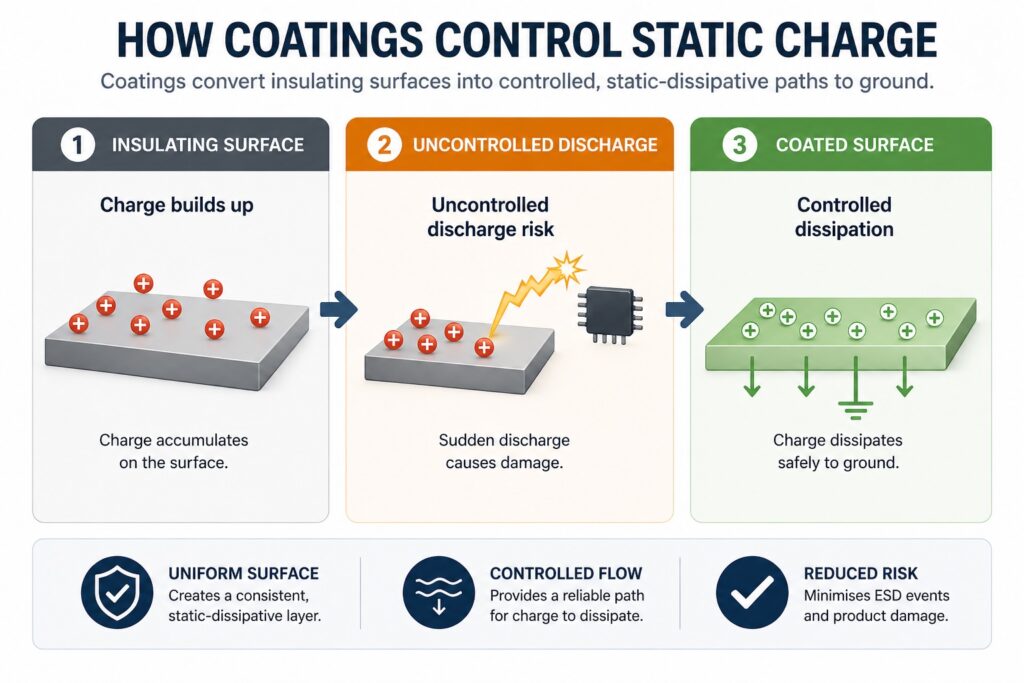
Simple diagram showing how coatings convert insulating surfaces into controlled static-dissipative paths to safely remove charge.
Key point: Static control is not just about grounding. It is about controlling how surfaces behave during real operation.
Step 4 – Select the Correct Control Layer
Most static control mistakes happen because the wrong layer of the system is controlled. The visible problem may appear at the product, operator or work area, but the source may be a plastic part, enclosure, fixture, tool, packaging material or moving surface.
The practical decision is not simply “which ESD product should be used?” It is “which surface or system layer is creating the behaviour that needs to be controlled?”
- Control the source when charge is generated on a specific material, part, fixture or contact surface
- Control the handling path when charge develops during movement, separation, storage or transport
- Control the work area when benches, racks, floors, trolleys or equipment surfaces influence behaviour
- Control the risk environment when powders, vapours, solvents or explosive atmospheres increase the consequence of discharge
This is why the same resistance target can lead to different solutions depending on where the static problem originates.
Choose the Right Application Route
Each static control problem normally has a dominant application route. Selecting the correct route helps avoid over-engineering and ensures the solution matches how the system operates in practice.
- Plastic components: use this route where insulating polymers are the main source of charge build-up → Anti-static coating for plastic
- Specialist electrostatic systems: use this route where highly controlled dissipative behaviour is required across precision surfaces such as electrostatic audio systems and diaphragm assemblies → Static dissipative coatings for electrostatic speaker diaphragms
- Industrial equipment: use this route where machinery, fixtures or production systems generate static during operation → Static control for industrial equipment
- Work surfaces and facilities: use this route where benches, floors, trolleys, racks or local work areas affect static behaviour → Static control for work surfaces and facilities
- Packaging and logistics: use this route where handling, transport or storage materials drive contamination, attraction or instability → Static control for packaging and logistics
- Hazardous environments: use this route where powders, solvents or process conditions increase electrostatic risk → Static control in hazardous environments
- Explosive / ATEX environments: use this route where ignition risk requires visible, controlled and maintainable static behaviour → Explosive and ATEX environments
When Coating-Based Static Control Is the Right Choice
Coating-based static control is strongest when the existing part, surface or system is mechanically suitable but electrically unsuitable. It is a practical route when the problem can be solved by changing surface behaviour rather than replacing the full material or assembly.
- The static source is an insulating surface that cannot easily be replaced
- The equipment, tooling, packaging or facility surface is already proven mechanically
- Multiple materials create inconsistent charge behaviour across the system
- The problem occurs during real handling, movement or operation, not only in laboratory measurement
- A visible, repairable and maintainable control layer is preferable to hidden material substitution
- Cost, supply chain or qualification limits make specialist ESD materials impractical
In these cases, controlling surface behaviour is often the most efficient and least disruptive route.
When Coating-Based Solutions May Not Be Suitable
A coating is not the correct answer for every static control problem. Disqualifying the wrong route early is important because ESD control depends on the full system, not the coating alone.
- The surface is exposed to severe abrasion and cannot be inspected, maintained or repaired
- There is no defined grounding or dissipation strategy for the controlled surface
- The substrate is contaminated, unstable or unsuitable for reliable coating adhesion
- The operating environment requires a material substitution rather than surface modification
- The regulatory or customer specification mandates a specific material construction
In these cases, the correct solution may require material replacement, grounding changes, environmental control, process redesign or a combined static control strategy.
Reality check: A surface can meet a resistance target and still fail in use if the static source, grounding path, wear behaviour or operating environment has not been considered.
Supporting Technical Guidance
The following pages provide more detail for specific parts of the decision process.
Why Choose SCH Services?
SCH Services supports static control projects by treating the application as a system problem rather than a simple product selection exercise.
- Identify where charge is generated and how it moves through the process
- Define whether the correct control layer is material, surface, equipment, packaging or environment
- Select the most practical route based on performance, durability, maintenance and cost
- Support testing, validation and implementation for development and production applications
Disclaimer: This guide provides general technical direction only. The correct static control approach depends on substrate, environment, grounding strategy, resistance requirements and verification testing. Final selection must be confirmed through application-specific evaluation.