Why dynamic charge generation changes how engineers should think about electrostatic control
Electrostatic discharge is often treated as a simple build-up and release problem. In practice, many systems do not just accumulate charge and then discharge it later. They generate charge continuously while the process is running.
This matters in any application where polymer surfaces move quickly, unwind under tension, rub against guides, or interact with adjacent materials. In these conditions, static is not a one-off event. It is an active, ongoing part of system behaviour.
The result is that electrostatic control must be designed around real operating conditions, not just static lab assumptions. If charge is being generated all the time, the surface must manage that charge all the time as well.
Why Static Is Often a Process Problem
In moving systems, friction between surfaces creates charge through the triboelectric effect. This is common where plastic materials unwind, slide, separate, or move rapidly through guides and handling points.
When the base material is electrically insulating, that charge cannot dissipate in a controlled way. Instead, it builds, shifts, and discharges unpredictably. The faster the movement and the more demanding the environment, the more important this becomes.
This is why static issues are often wrongly diagnosed as isolated electrical faults. In reality, they are frequently process-generated problems that originate in material movement, surface behaviour, and equipment interaction.
The key shift is simple: static is not always something that appears after the event. In many systems, it is being created continuously during the event.
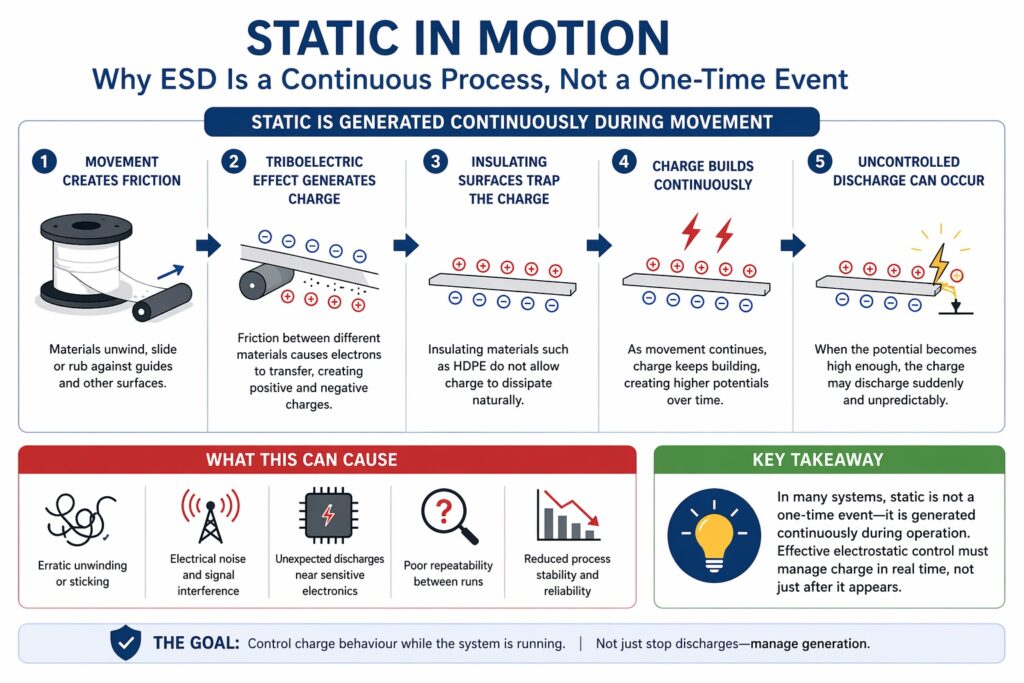
Static is not a one-time event. In moving systems, charge is generated continuously through friction and must be controlled in real time.
What This Means for Real-World Performance
If charge is being generated continuously, passive thinking is not enough. A material or coating cannot just be “ESD safe” on paper. It must be capable of controlling charge behaviour during live operation.
Where this is not understood, the symptoms can appear in several different ways:
- erratic release or unwinding behaviour
- surface attraction, sticking, or instability during handling
- intermittent electrical noise or signal disturbance
- performance instability in specialist electrostatic systems such as electrostatic speaker diaphragm assemblies where highly uniform dissipative surface behaviour is critical
- unexpected discharge events near sensitive electronics
- poor repeatability between apparently identical runs
This is why electrostatic control must go beyond simple discharge. In many cases, stability depends on maintaining controlled charge dissipation within a defined electrical window, rather than allowing charge to build or discharge unpredictably.
See how coating choice affects long-term static behaviour and stability
Why Surface Engineering Matters More Than Labels
It is easy to describe a surface as insulating, conductive, or static dissipative. Those labels are useful, but they do not explain how the surface behaves when speed, friction, geometry, humidity, and environment start to interact.
That is why electrostatic control should be treated as a surface engineering question rather than a simple material label. The practical question is not whether a surface has a conductivity value. The practical question is whether it can control charge generation and dissipation in a stable, predictable way during operation.
This is particularly important in demanding environments where mechanical movement and electrical sensitivity exist together. In such cases, the wrong surface behaviour can affect both process stability and system reliability.
A Better Engineering Question
Instead of asking whether a component has an ESD problem, a better starting point is to ask where charge is being generated, how quickly it is being generated, and whether the surface can dissipate it in a controlled way under real use conditions.
That change in thinking often improves problem-solving immediately. It shifts attention away from isolated discharge events and towards the underlying interaction between movement, material, and surface performance.
In short, the objective is not simply to stop discharge. The objective is to control charge behaviour while the system is running.
Related Reading
For organisations reviewing coating performance, process stability, or inspection controls, these pages may also be useful:
Related insights:
Why Choose SCH Services?
SCH Services supports customers who need practical, process-led guidance on coating behaviour, electrostatic risk, inspection, and application control. Our focus is on helping engineering teams understand where performance problems really come from and how coating strategy fits into the wider process.
Disclaimer: This article is provided as general technical guidance only. Actual electrostatic behaviour depends on material, geometry, movement, environment, and system design. Final decisions should be validated through application-specific testing and engineering review.