
Conformal Coating Solutions
When to use conformal coating and how to implement it successfully
Not sure if conformal coating is the right solution?
Start with the Coating Selection Guide to compare conformal coating, Parylene and advanced functional coatings.
Conformal coating is one of the most widely used protection methods for electronic assemblies. It provides a practical balance between environmental protection, process control and cost, making it suitable for a wide range of applications.
At SCH, we provide conformal coating solutions that combine services, equipment, materials, masking and training into a controlled, repeatable process. Whether you are outsourcing coating, building in-house capability or optimising an existing line, we support the full lifecycle of conformal coating implementation.
For broader comparison between conformal coating, Parylene and advanced functional coatings, see our coating selection guide.
Where a conventional coating is not the best fit, SCH also supports advanced functional coatings and Parylene coating solutions.
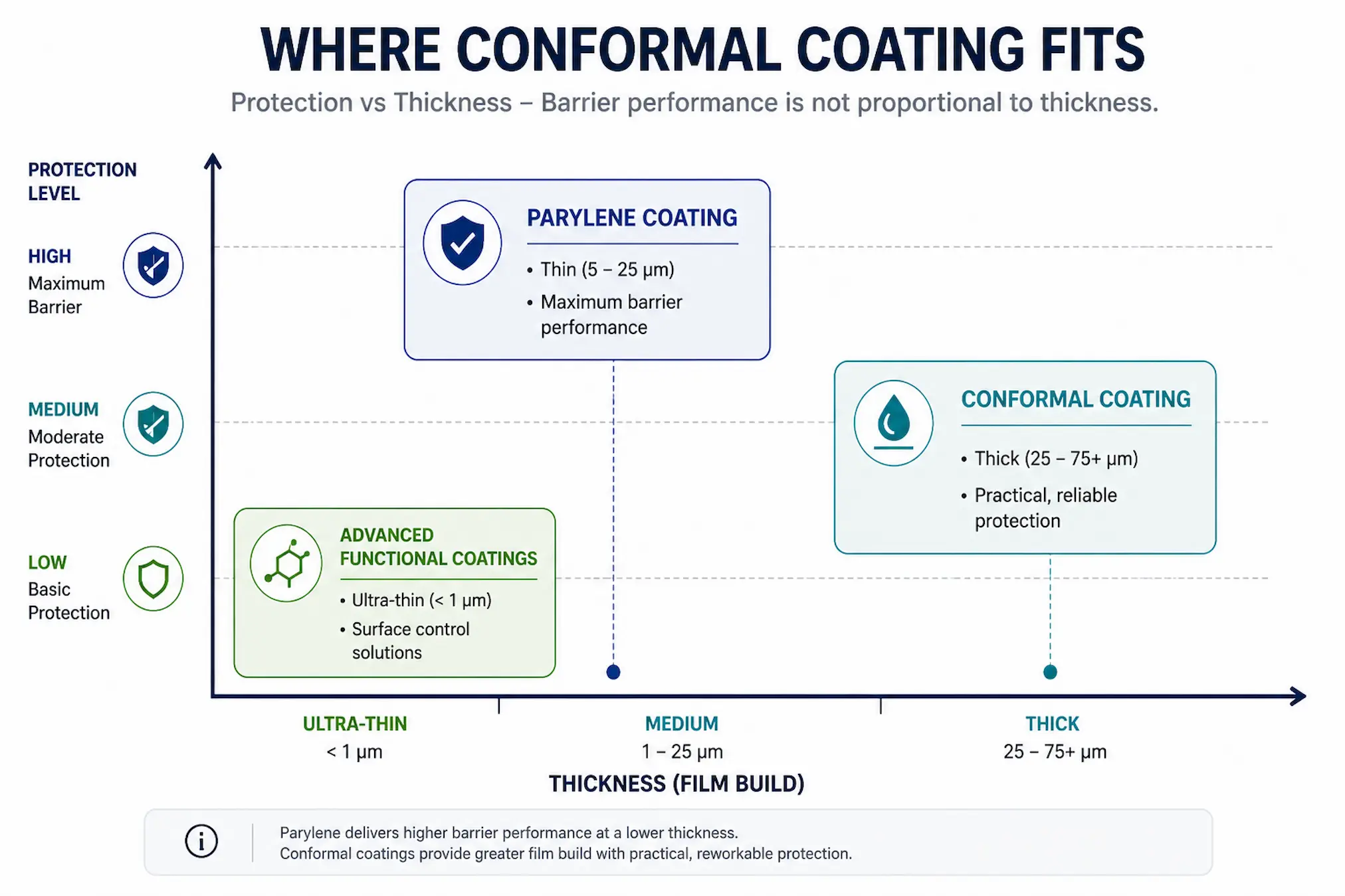
Conformal coating provides practical protection at higher film thickness, while Parylene delivers superior barrier performance at lower thickness.
Barrier performance is not directly proportional to coating thickness.
Conformal coatings provide practical protection through film build, while Parylene achieves higher barrier performance at lower thickness through a different deposition mechanism.
Where Conformal Coating Fits
Conformal coating sits between ultra-thin surface treatments and high-performance barrier coatings such as Parylene.
- Compared to advanced functional coatings – conformal coating provides greater film build and environmental protection
- Compared to Parylene – conformal coating offers lower cost, simpler processing and easier rework, but less uniform barrier performance
This makes conformal coating the preferred choice where controlled, repeatable protection is required, but full vapour-phase barrier sealing is not necessary.
When to Use Conformal Coating
- Moderate environmental exposure such as humidity, condensation or light contamination
- Assemblies requiring rework or repair access
- Applications where masking and selective coating are acceptable
- Cost-sensitive production environments
- Mixed production volumes from prototype to mass production
When Conformal Coating May Not Be the Best Choice
- Severe or continuous chemical exposure
- Applications requiring ultra-thin coatings with minimal dimensional impact
- Complex geometries requiring uniform internal coverage
- Long-term barrier performance in aggressive environments
In these cases, Parylene coating is typically used where high-performance barrier protection and complex geometry coverage are required.
Advanced functional coatings are used where ultra-thin, hydrophobic, low-build or selective surface-control solutions are needed.
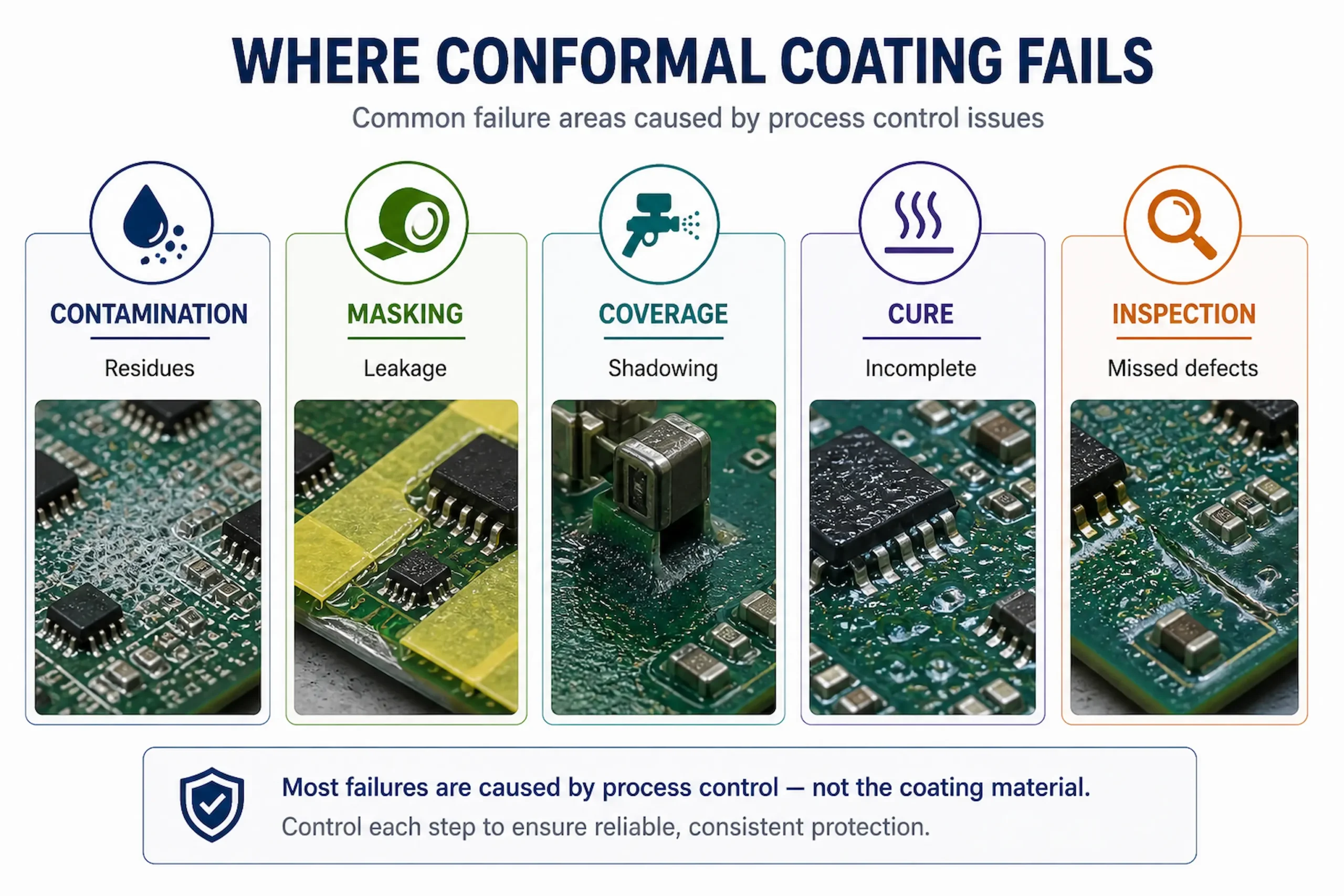
Most conformal coating failures are caused by poor process control rather than coating material selection.
Most coating defects are introduced during cleaning, masking or application rather than coating material selection.
Concerned about coating reliability or process control?
In many applications, coating performance is limited by process control rather than the material itself. Issues such as contamination, masking, thickness variation and inspection quality can significantly affect reliability.
Review Electronic Coating Process Control for Reliability
If you are experiencing coating defects or need support improving yield and consistency, you can also submit your application for review.
How Conformal Coating Is Implemented
Successful conformal coating depends on more than the material. It requires controlled processes, correct masking, appropriate thickness, inspection and operator training.
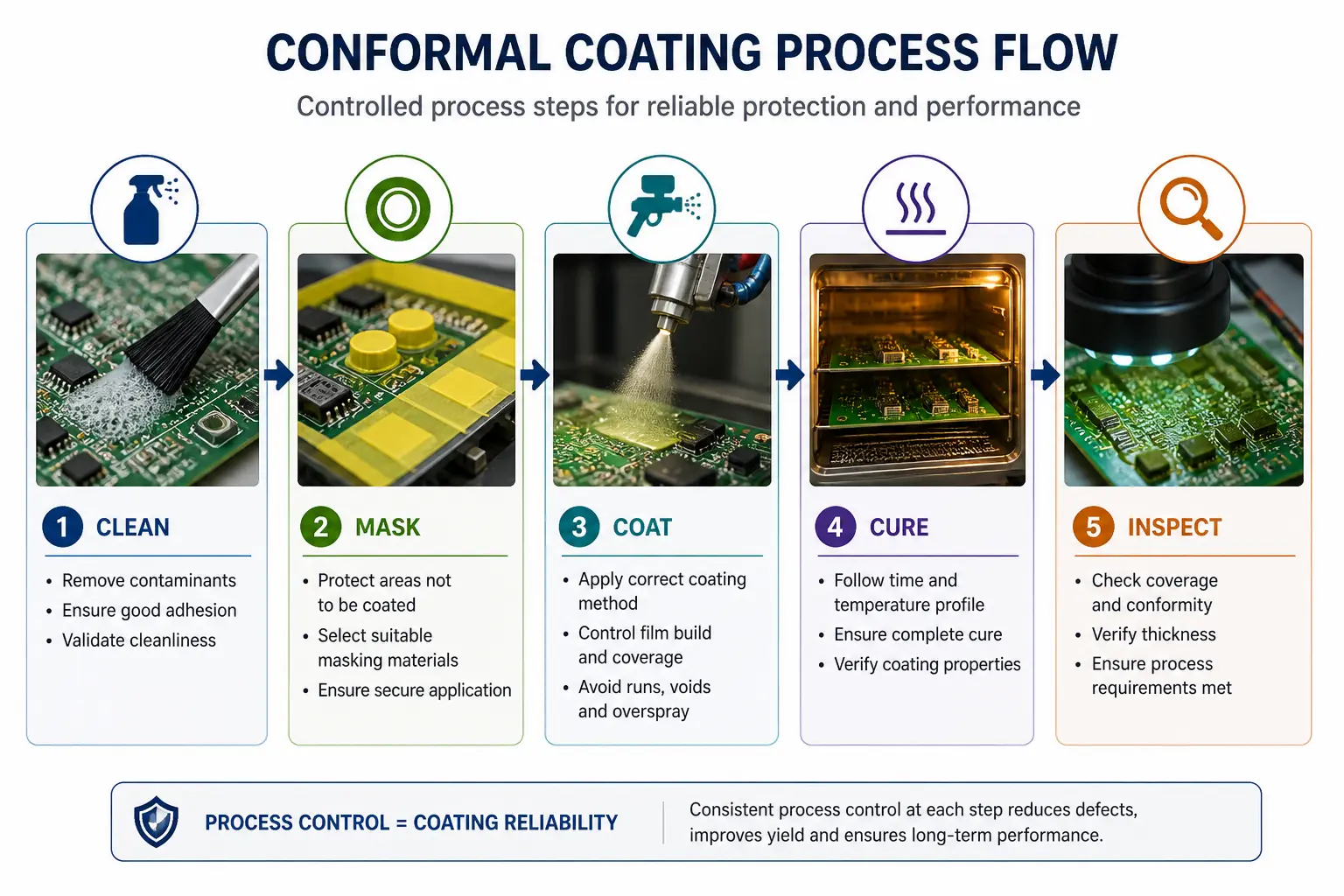
Successful conformal coating depends on controlled process steps including cleaning, masking, coating, curing and inspection.
- Surface preparation and cleanliness
- Masking strategy and material selection
- Application method, including spray, dip or selective coating
- Drying and curing control
- Inspection and thickness verification
SCH supports each stage as part of a controlled, repeatable coating process.
Choose Your Conformal Coating Route
Outsource Coating
Use SCH coating services for production, overflow or qualification work.
Build In-House Capability
Install coating equipment supported by training and process development.
Optimise an Existing Line
Improve yield, consistency and process control through consultancy and training.
Supporting Elements of a Complete Solution
- Masking solutions – reduce variability and improve repeatability
- Training – operator and engineer capability development
- Consultancy – troubleshooting and process optimisation
- Support equipment – inspection, drying and process control tools
Still comparing coating options?
Use the Coating Selection Guide to confirm whether conformal coating, Parylene or an advanced functional coating is the correct route for your application.

Conformal coating provides a controlled protective layer while maintaining access, repairability and process flexibility.
Why Choose SCH Services?
SCH provides practical, process-led conformal coating support built on real production experience. We help you select the correct coating route, implement stable processes and maintain long-term performance.
Reliable coating results depend on more than material selection. They require trained operators, controlled processes and practical technology. Learn more about the SCH way of working.
📞 +44 (0)1226 249019 | ✉ sales@schservices.com | 💬 Discuss Your Application ›
