Conformal Coating Masking Tapes
Validated silicone-free masking tape trusted in SCH coating production
Masking tape selection is one of the most overlooked causes of conformal coating defects.
Poor tape performance can lead to coating leakage, adhesive residue, silicone contamination, de-wetting, poor edge definition and unnecessary rework.
SCH supplies the same silicone-free masking tape specification used within our own conformal coating services operation. After years of production use across acrylic, polyurethane, silicone and UV coating processes, this remains the only tape specification we routinely trust for liquid conformal coating applications.
Rather than offering multiple interchangeable tape products, SCH standardises on a proven masking tape specification that has demonstrated reliable sealing, clean removal and predictable process behaviour in real coating environments.
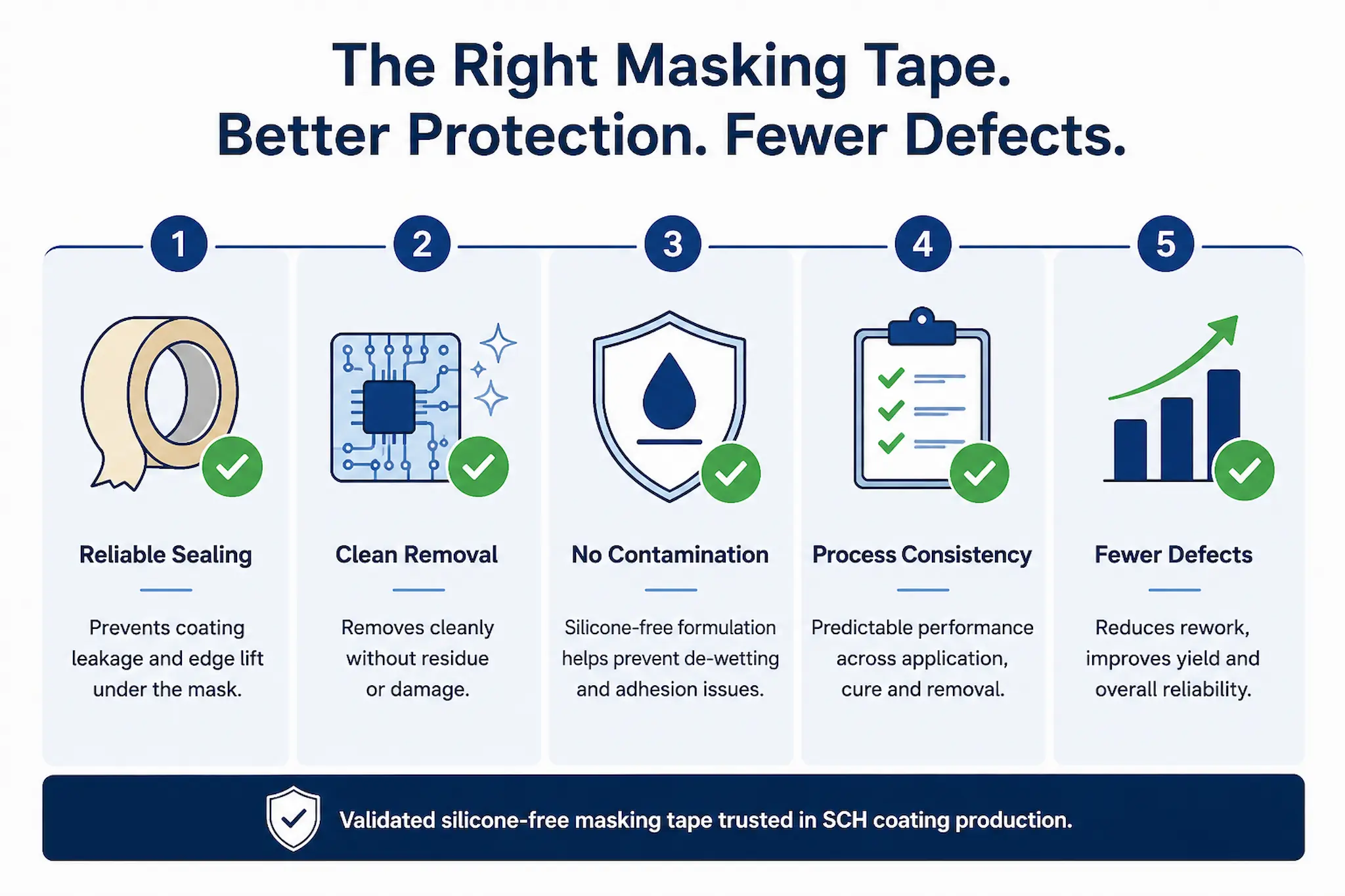
Validated silicone-free masking tape helps prevent leakage, residue, contamination and masking defects during conformal coating processes.
Why does SCH only recommend one tape specification? Because it is the same silicone-free masking tape used within our own coating services operation. Over many years of production use, it has consistently delivered reliable sealing, clean removal and predictable behaviour across a wide range of liquid conformal coating processes. We trust it on our own customer assemblies before recommending it to anyone else.
Do you use ESD masking tape for ESD-sensitive assemblies?
Not automatically. SCH selects masking tape primarily for reliable sealing, conformability, clean removal and consistent operator handling. In our production experience, the ESD masking tapes we have evaluated have not provided the same overall masking performance as our established silicone-free tape specification.
Where insulating masking materials are required, electrostatic charge is controlled as part of the wider ESD process, including the use of ionisation at appropriate masking workstations. This allows us to control electrostatic risk without introducing an increased risk of masking failure. We therefore evaluate the complete manufacturing risk rather than selecting tape on its ESD classification alone.
Read why SCH does not automatically use ESD masking tape for conformal coating →
Why Masking Tape Selection Matters in Conformal Coating
Masking tape performance directly affects coating quality, inspection yield and rework rates. Tapes that are not suitable for conformal coating environments often introduce defects rather than prevent them.
Common issues caused by unsuitable masking tapes include:
- Adhesive residue that leads to de-wetting or poor coating adhesion
- Edge lift or coating leakage under the mask boundary
- Tearing or fragmentation during removal
- Silicone contamination that interferes with coating coverage
- Inconsistent boundary definition between operators or production batches
Engineering bulletin: One of the most common masking failures occurs during tape removal rather than coating application.
If the coating bridges onto the tape edge, cure timing is incorrect or removal technique is poorly controlled, the masking tape can lift or tear the conformal coating during de-mask. See Masking Tape Removes Conformal Coating During De-Mask for practical production examples and prevention guidance.
Process note: Masking defects are rarely just cosmetic. Leakage, residue and poor boundary control can create coating defects, inspection failures and unnecessary rework later in the process.
For this reason, SCH masking tapes are selected based on material behaviour in real coating conditions, not just temperature ratings or generic tape classifications.
Masking Tape Material Characteristics
The SCH conformal coating masking tape specification is based on a controlled material combination designed for liquid coating environments.
- Paper backing — provides controlled conformability and predictable tear behaviour for PCB assemblies
- Rubber-based pressure-sensitive adhesive — selected for stable adhesion during coating and clean removal after cure
- Silicone-free formulation — helps prevent coating repellence, de-wetting and adhesion defects
- Clean removal behaviour — reduces residue risk and post-coating rework
This material combination has been proven through long-term use in SCH coating production with common liquid conformal coating chemistries, including solvent-based acrylics, polyurethanes, silicones and UV-curable systems.
The key advantage is process control: consistent sealing during application, compatibility with dwell time and cure exposure, and removal without residue or damage.
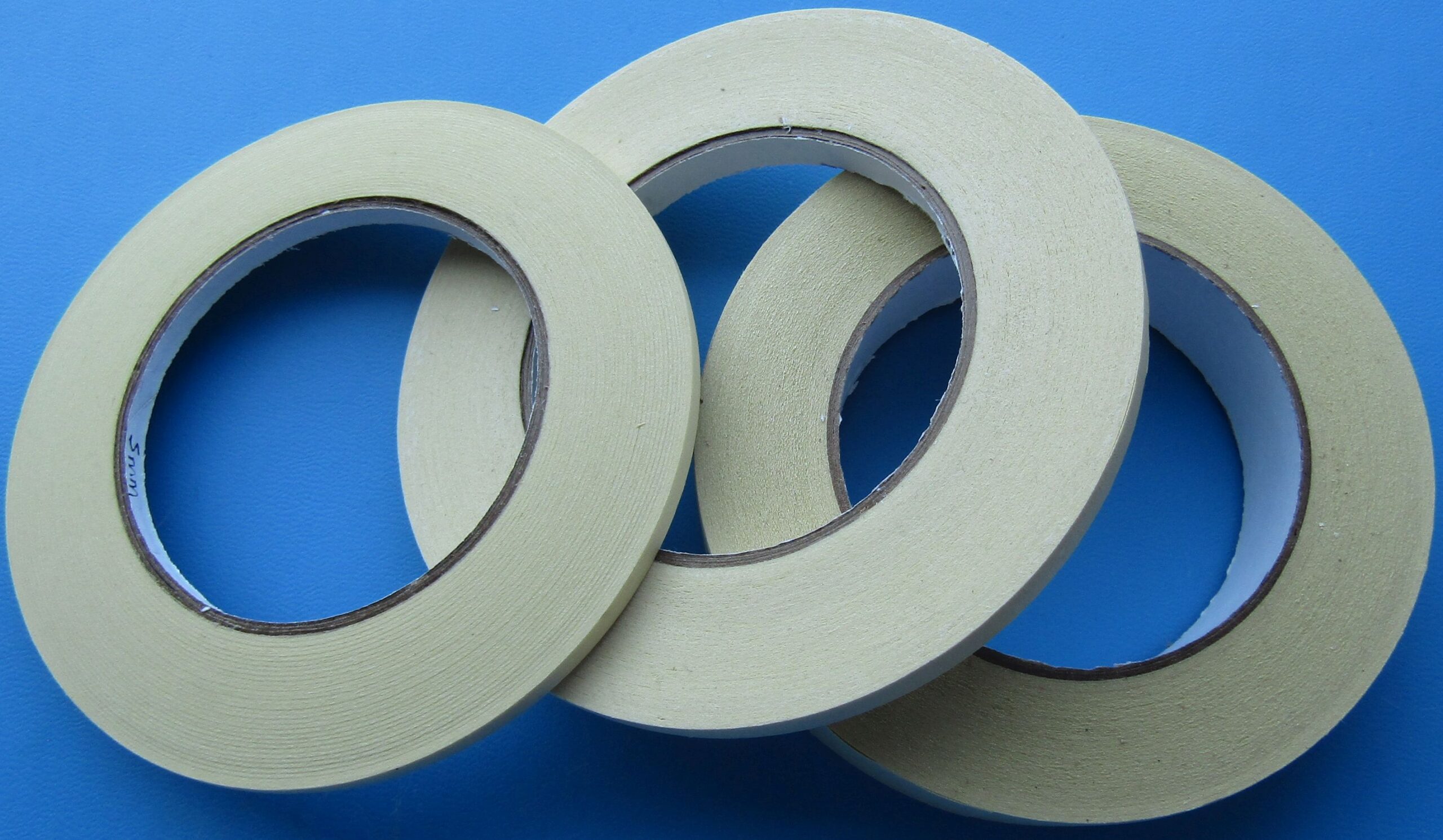
Conformal coating masking tape provides reliable protection for connectors, components and critical areas during coating, helping achieve clean edges and controlled coverage.
Masking Tape Use in Liquid Conformal Coating
For liquid conformal coating processes, SCH supplies a validated silicone-free paper masking tape with a controlled rubber adhesive system, selected to provide predictable behaviour across application, coating, cure and removal.
It is used wherever tape-based masking is appropriate, including:
- PCB edges and defined keep-out zones
- Grounding areas and planar surfaces
- Local masking around components where boots or dots are not suitable
- Temporary masking during trials, NPI and low-volume production
The emphasis is not on constantly switching tape types, but on maintaining process consistency. Once a masking tape has been proven to seal reliably, tolerate cure conditions and remove cleanly without residue, it should be standardised and controlled.
When Masking Tape Is the Right Solution
Masking tape is most effective where simple, controlled boundaries are required and the masking geometry remains accessible.
- PCB edges and coating boundaries
- Large flat keep-out zones
- Grounding and earthing areas
- Prototype and low-volume production
- Applications requiring fast masking setup
Reality check: Where masking becomes highly repetitive or involves complex connector geometries, masking boots, dots or liquid latex may provide better long-term process control than tape alone.
Why Using the Correct Masking Tape Reduces Defects
Correct masking ensures that conformal coating is applied only where required, protecting connectors, test points, sockets, grounding areas and other functional features.
Using inappropriate tapes often results in:
- Coating migration into keep-out areas
- Electrical failures caused by partial masking breakdown
- Increased rework due to residue or coating removal
- Higher long-term reliability risk
By using masking tapes specifically selected and trusted for conformal coating production, these risks are reduced at source. Our tapes are also compatible with hybrid masking approaches, including liquid latex barrier systems, where enhanced ingress protection is required.
Next step: View our range of conformal coating masking materials, including validated masking tapes, dots, shapes and boots used in liquid coating processes.
Request a Masking Sample Pack
To support validation in your own process, SCH offers a free masking sample pack containing tapes, dots, boots and pre-cut shapes. This allows you to evaluate adhesion, clean removal, boundary definition and compatibility with your coating and cure conditions before committing to production use.
Build a Complete Masking System
Masking tape is only one part of an effective conformal coating masking strategy. Most production environments achieve the best results by combining multiple masking methods according to the geometry being protected.
- Masking tape — straight boundaries, PCB edges and larger keep-out zones
- Masking dots — circular pads, vias and test points
- Custom masking boots — connectors and high-value components
- Liquid latex — irregular shapes and complex masking transitions
Used together, these materials help:
- Improve consistency and repeatability
- Reduce labour time and rework
- Prevent common masking-related coating defects
- Support repeatable masking across operators and production batches
For deeper technical guidance, see the Conformal Coating Masking Hub.
Conformal Coating Masking Training
Masking is one of the most defect-sensitive stages of conformal coating. SCH provides hands-on training covering masking tapes, boots, dots and shapes, with a focus on repeatability, inspection discipline and defect prevention.
Training can be delivered standalone or as part of a complete conformal coating programme, using real production examples and practical masking challenges.
Why Choose SCH Services?
SCH combines practical conformal coating production experience with masking materials, reusable masking solutions, training and process support.
- Masking tape specification used and trusted in SCH’s own coating services
- Validated masking materials proven in real coating operations
- Support for tapes, dots, shapes, boots and hybrid masking approaches
- Practical guidance on reducing masking defects and rework
- Training and consultancy for coating and masking process control
Disclaimer: This page provides general technical and product guidance only. Masking material selection, coating compatibility, cure exposure and removal behaviour should always be validated against the specific assembly, coating material, process conditions and customer requirements.