
Common specification mistakes that create risk in coating, quality and production — and how to avoid them
Most Parylene coating problems do not start in the chamber. They start earlier, in drawings and specifications that are too vague to control grade, thickness, adhesion route, masking intent or inspection expectations properly.
A note such as “apply Parylene coating” may appear acceptable at design stage, but it leaves too much open to interpretation once the work reaches purchasing, coating, inspection and quality. That creates avoidable variation before the process even begins.
This is why some Parylene programmes drift. The coating may be capable, but the specification is not strong enough to control it.
For detailed guidance, see our guide to specifying Parylene coating.
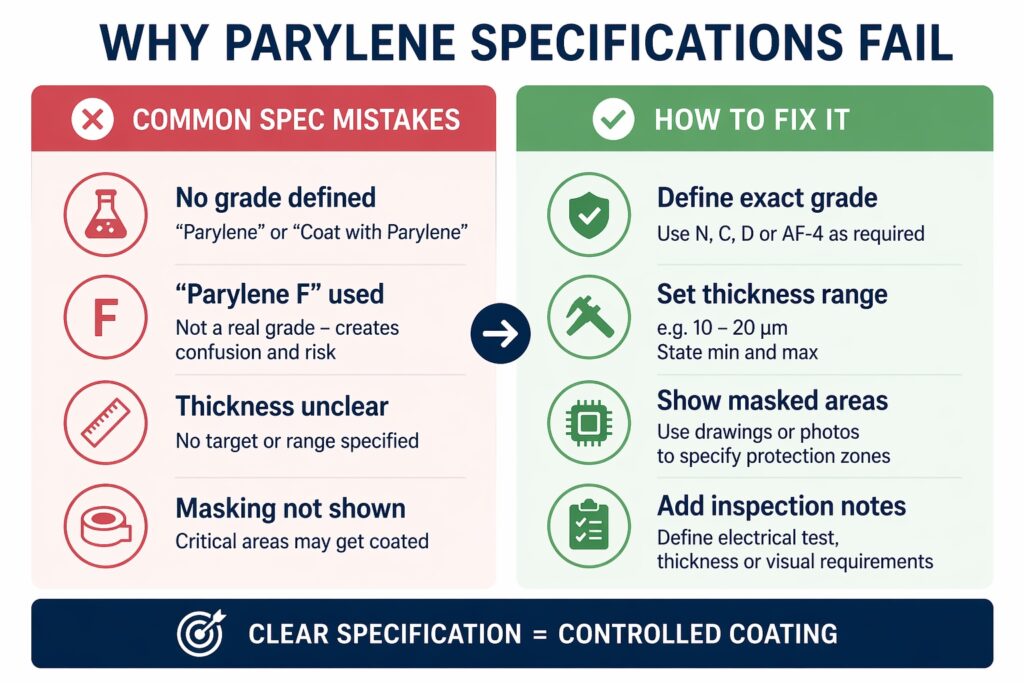
Simple comparison of common Parylene specification mistakes and how to correct them for consistent coating results.
Key issue: if different teams can read the same coating note and reach different conclusions, the specification is not yet suitable for controlled production.
Where Parylene Specifications Usually Go Wrong
Most failures come from a small number of repeated mistakes rather than one major technical error.
- No defined grade – “Parylene coating” is written without specifying N, C, D or AF-4.
- Ambiguous naming – “Parylene F” is used without identifying the exact fluorinated grade.
- Unclear thickness – one number is given with no tolerance, target or measurement method.
- Missing masking intent – coated and uncoated areas are left open to interpretation.
- Assumed adhesion route – surface preparation or adhesion promotion is not defined.
- No acceptance criteria – inspection and release expectations are unclear.
Why This Becomes a Production Problem
Weak specifications do not just create technical uncertainty. They create misalignment between functions.
The supplier may quote based on one set of assumptions, the coater may process to another, and the quality team may inspect against something different again. That does not always lead to obvious coating failure, but it does lead to rework, delay and unnecessary disagreement.
In practice, many coating issues are specification-control issues rather than coating-process issues.
How to Fix It
A usable Parylene specification removes interpretation. It defines what is required clearly enough that engineering, coating and quality teams can work to the same intent.
At a minimum, a controlled specification should define the exact grade, the thickness requirement, any adhesion expectations, the coated and masked areas, and the acceptance or inspection route. If any of those are missing, the drawing is already carrying unnecessary risk.
For a practical step-by-step guide, see our guide to specifying Parylene coating.
Practical outcome: clear specifications reduce variation, improve repeatability and prevent disagreement between customer, supplier and quality teams.
Fix the Specification Before You Fight the Process
It is easy to treat coating issues as process problems because that is where they become visible. In many cases, the more effective fix is to strengthen the drawing before production begins.
If the grade is unclear, the thickness is vague, or the acceptance route is undefined, no amount of process discipline fully removes the underlying ambiguity. That is particularly important in higher-reliability work, where coating performance must be demonstrated, not assumed.
If the first question is still “which Parylene type should we use?”, start with our guide to choosing the right Parylene dimer.
Why Choose SCH Services?
Partner with SCH Services for a complete, integrated platform: Conformal Coating, Parylene & ProShieldESD Solutions plus equipment, materials, and training. Our team brings decades of hands-on expertise.
- ✈️ 25+ Years of Expertise – Trusted across aerospace, medical, defence, automotive, and electronics.
- 🛠️ End-to-End Support – From dimer selection to masking, inspection and process optimisation.
- 📈 Scalable Capacity – From prototypes to high-volume production.
- 🌍 Global Reach – Responsive support across Europe, North America, and Asia.
- ✅ Proven Reliability – Consistent quality and strong customer satisfaction.
📞 Call: +44 (0)1226 249019
✉ Email: sales@schservices.com
💬 Contact Us ›
