A surface can repel droplets and still leave electronics vulnerable
Water beading is visually persuasive. When droplets sit on a coated surface instead of spreading, it is easy to assume the electronics underneath are protected.
That assumption can be risky. Electronics protection is not proven by a surface effect alone. Real protection depends on contamination, coverage, edge behaviour, coating continuity, operating voltage, exposure time and the environment around the assembly.
Hydrophobic and ultra-thin coatings can be useful, but water repellency should not be confused with full conformal coating performance or long-term reliability validation.
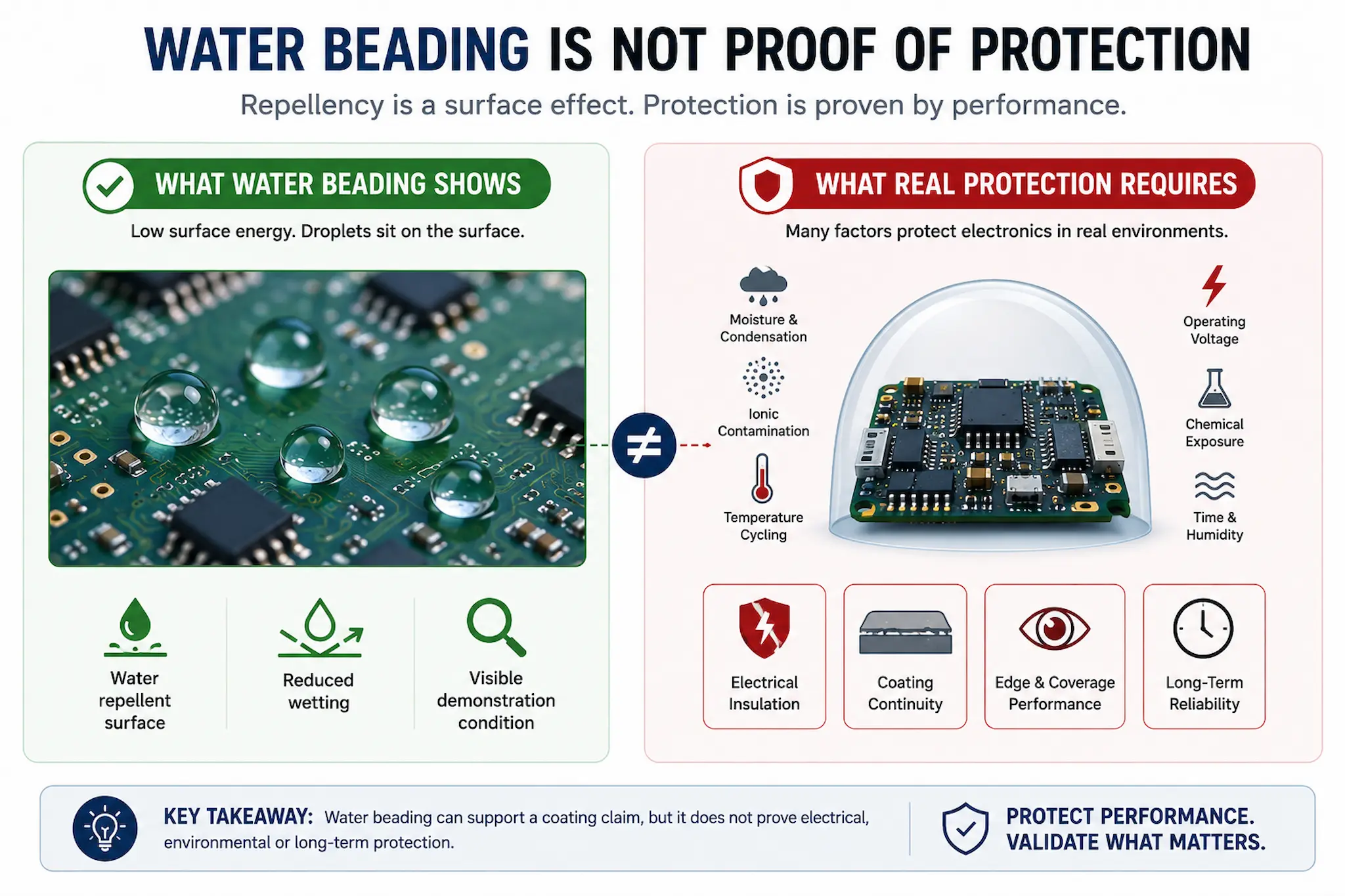
Water repellency may look impressive, but real electronics protection depends on electrical, environmental and long-term reliability performance.
Why water beading can mislead
Water beading shows that a surface has low surface energy. It does not automatically show that the coating is thick, continuous, electrically protective or suitable for long-term exposure.
A droplet test is also usually clean, short and controlled. Electronic assemblies in service may face condensation, ionic contamination, flux residues, humidity cycling, chemical exposure, particulates, trapped moisture and voltage bias.
A coating can make water bead and still fail to prevent leakage currents, corrosion or localised failure if the real exposure conditions are different.
This is why droplet behaviour is useful as an observation, but weak as a standalone proof of protection.
The difference between repellency and protection
Repellency describes how a liquid interacts with the surface. Protection describes whether the assembly continues to operate reliably when exposed to the actual environment.
Water repellency
Shows droplet behaviour on the coating surface under visible test conditions.
Electrical protection
Requires control of leakage paths, insulation performance and contamination effects.
Environmental reliability
Depends on exposure time, humidity, temperature, chemicals, residues and field conditions.
These are connected, but they are not the same thing. A coating may show excellent water beading while still needing proper electrical, environmental and process validation.
This is why the distinction between surface function and barrier function coatings matters when selecting protection for electronics. For a deeper explanation of why low surface energy and environmental barrier performance are different engineering behaviours, see surface energy vs environmental barrier protection.
Where hydrophobic coatings are still useful
This does not mean hydrophobic coatings are ineffective. It means they must be used for the right reason and tested against the right failure mode.
Hydrophobic and ultra-thin coatings can be valuable where low film build, reduced masking, optical clarity, low surface energy or reduced wetting are important. They can be especially useful when conventional coating thickness creates a performance or production problem.
The practical question is not whether water beads. The better question is whether the coating solves the specific risk on the specific assembly. For the broader reliability distinction between short-term water behaviour and long-term electronics protection, see why water resistance is not corrosion protection.
For further technical context, see When to Use Hydrophobic Coatings, Why Hydrophobic Coatings Do Not Always Protect Electronics, What Is an Ultra-Thin Functional Coating? and Hydrophobic Coatings.
What should be validated instead
Protection should be assessed using tests and observations that match the real application. That may include electrical performance, insulation resistance, powered exposure, humidity testing, chemical resistance, visual coverage checks and process repeatability.
For electronics, contamination is particularly important. A clean water droplet on a demonstration board is not the same as moisture interacting with residues, flux, salts or process contamination on a powered assembly.
Water beading can support a coating claim, but it should not be the claim.
The strongest coating decisions are made by connecting surface behaviour to real reliability evidence.
For a related discussion on thickness assumptions, see Why Thin Coatings Can Sometimes Protect Better Than Thick Ones.
Why Choose SCH Services?
SCH Services supports coating selection, coating trials, process development and production coating for electronics where protection, reliability and manufacturability all need to be considered together.
- Practical coating experience: SCH works across conformal coating, Parylene and advanced functional coating processes.
- Process-led decision support: coating selection is based on application risk, production method and validation requirements.
- Trial and production capability: SCH can support early evaluation, sample coating, process definition and subcontract coating routes.
Disclaimer: This article is provided as general technical guidance only. Coating selection, process design and product suitability must be validated against the relevant application requirements, operating environment, customer specifications and qualification tests.