Think Beyond the Application Equipment
A practical guide to building a controlled coating process around the complete production flow
Setting up a conformal coating facility is often underestimated.
It is easy to focus on the coating material and the application equipment. In practice, an application machine or workstation and a container of coating do not create a controlled conformal coating process. A successful facility has to support the complete production flow: preparation, cleaning, masking, application, drying or curing, de-masking, inspection, rework and controlled movement of assemblies between each stage.
This Insight looks at the practical elements that are often overlooked when a coating operation is established and explains why the surrounding process can be just as important as the application equipment itself.
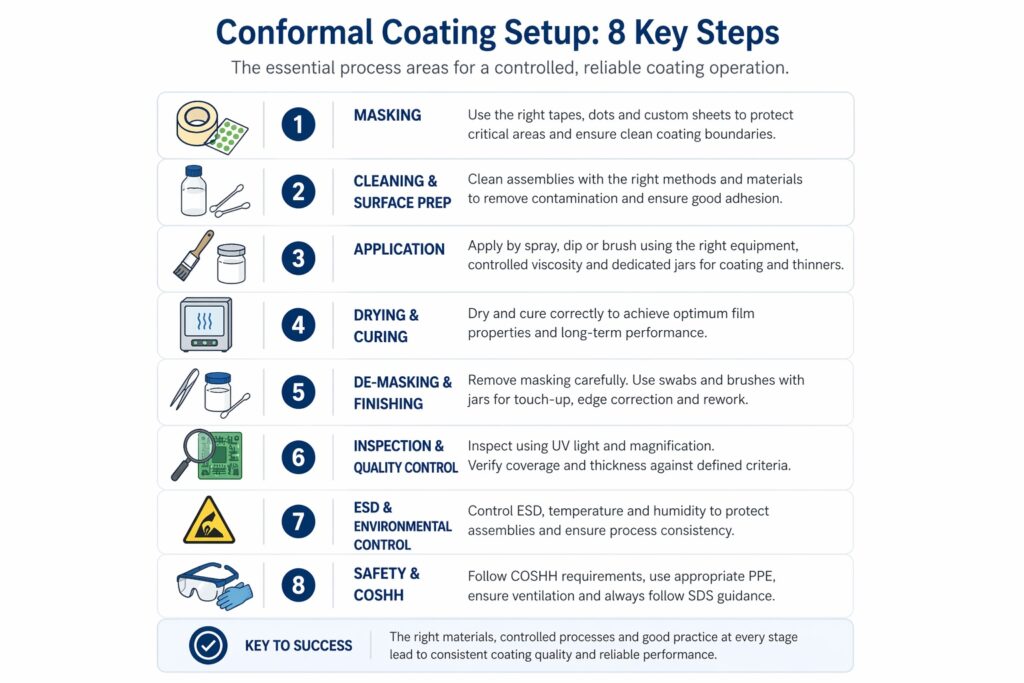
Conformal coating should be considered as a complete production process rather than an isolated application operation.
Practical reality: The consistency of a conformal coating operation comes from the equipment, consumables, handling methods, material control, inspection routine and production discipline working together.
Think About the Product Flow First
Before selecting application equipment, consider how assemblies will physically move through the complete coating operation. A typical process may include: Incoming / Preparation → Cleaning → Masking → Application → Drying / Curing → De-Masking → Inspection → Release The exact sequence will vary with the coating material, assembly and application method, but each required stage needs appropriate working space, equipment and a controlled method of moving work to the next operation. Boards should not simply accumulate on benches between processes. Suitable trays, racks or trolleys can provide controlled work-in-progress storage and reduce unnecessary handling as assemblies move through preparation, masking, application, drying and inspection.
A useful design principle is to plan the facility around the movement of the product, not simply around the footprint of the coating equipment.
1. Cleaning & Surface Preparation
Surface preparation is one of the most misunderstood parts of conformal coating. Assemblies may be exposed to contamination from manufacture, handling, storage and the surrounding environment before they reach the coating process. The required cleaning method therefore needs to be defined for the assembly and coating process rather than assumed.
What matters in practice
- A defined and repeatable preparation or cleaning method
- Appropriate cleaning chemistry where cleaning is required
- Lint-free cleaning materials suitable for the process
- Controlled handling after cleaning to reduce recontamination
- A defined location for prepared assemblies before masking or coating
Cleaning should be treated as a process stage with defined requirements, not simply as a quick wipe before coating.
For deeper guidance, see the Conformal Coating Surface Preparation Hub.
2. Masking: A Production Process in Its Own Right
Where masking is required, it can represent a significant proportion of the labour in a conformal coating operation. It deserves a properly equipped workstation rather than whatever bench space happens to be available. Incorrect masking materials or methods can lead directly to coating ingress, residue, poor coating boundaries and excessive de-masking or rework.
A practical masking workstation may require
- Suitable bench space and task lighting
- ESD controls where required
- Cutting mats
- Scalpels or precision cutting tools with controlled blade disposal
- ESD-safe tweezers
- Magnification for difficult masking operations
- Masking tapes and dots
- Masking boots, caps and plugs
- Custom masking sheets or shapes for repeat production
- Local storage for frequently used consumables
- Space for the trays or trolleys carrying the production batch
Frequently used masking materials should be available at the point of use. Operators repeatedly leaving the workstation to find tapes, tools or consumables creates unnecessary production time and variability.
For conformal coating masking materials and options, see our masking solutions.
3. Coating Material Control
The condition of the coating at the point of application matters regardless of whether the material is being sprayed, dipped, selectively applied or brushed. Working directly from large bulk containers or leaving excessive quantities of coating exposed for long periods can make material control more difficult. Depending on the chemistry and application process, solvent loss, contamination or changes in viscosity can affect coating behaviour.
Good working practice may include
- Controlled decanting from bulk material where appropriate
- Appropriately sized working containers or material reservoirs
- Separate containers for coating and compatible thinner where required
- Clear identification of coating type and batch or lot
- Controlled mixing and viscosity management where specified by the process
- Protecting working material from unnecessary exposure or contamination
- Defined arrangements for unused material and waste
The objective is simple: the material presented to the application process should remain within the defined process condition throughout production.
4. Application: The Equipment Is Only One Part of the System
Conformal coating can be applied by manual spray, selective coating, dipping, brushing or other controlled application methods. The equipment and facility requirements will vary, but the application stage still has to integrate with the wider production process.
Manual spray
A manual spray process may require a suitable extracted spray booth, spray equipment, clean and dry compressed air, controlled material feed or working containers, appropriate lighting and suitable board, panel or tray support. See the CB100 Conformal Coating Spray Booth for an example of a dedicated manual spray-coating workstation.
Selective coating
Selective coating introduces different considerations including machine footprint, material feed, board loading and unloading, programming, fixturing, extraction where required, maintenance access and the movement of assemblies into and out of the automated process.
Dip coating
A dip process needs suitable coating containment, controlled immersion and withdrawal, drainage, material condition control, board or assembly fixtures and appropriate ventilation or extraction where required. Space also needs to be considered for loading, unloading and the movement of coated assemblies into the drying or curing stage. For more detail, see Conformal Coating Dipping: Process Controls.
Brush coating
Brush application can be suitable for localised coating, low-volume work, touch-up or applications where other methods are inappropriate. Controlled working quantities, suitable brushes, defined application techniques and appropriate ventilation or extraction still need to be considered.
The application method changes the equipment, but it does not remove the need for a controlled surrounding process.
5. Drying & Curing Need Capacity Too
Drying and curing are frequently underestimated when a coating facility is planned. A fast application process is of little benefit if there is nowhere controlled to place coated assemblies afterwards. Depending on the coating system, facilities may include:
- Controlled ambient drying
- Protected drying racks
- An extracted drying cabinet
- Oven curing where permitted and required by the coating process
- UV curing or other dedicated curing equipment where required by the specific coating chemistry
The drying or curing stage should protect coated assemblies from unnecessary handling and environmental contamination while providing enough capacity for the expected production batches.
Drying and curing capacity should therefore be considered against production throughput and required dwell time, not simply against the speed of the application equipment.
See SCH’s conformal coating drying and curing equipment for examples of controlled drying solutions.
6. De-Masking, Finishing & Rework
Where masking has been used, de-masking is another controlled production stage. The assembly is now coated, so poor handling can damage an otherwise acceptable coating. Incorrect methods can lift coating edges, tear films, contaminate boundaries or create unnecessary rework.
Typical workstation requirements
- Good task lighting
- Tweezers and suitable removal tools
- Controlled support for the PCB or tray
- Low-lint polyester swabs for localised work where appropriate
- Suitable brushes for controlled touch-up
- Small working quantities of coating or compatible thinner where required for approved rework
- Defined waste disposal
Rework should be controlled and localised rather than improvised using bulk materials or unsuitable workshop tools.
For an example of controlled liquid coating rework, see our Insight on repairing lifted conformal coating edges.
7. Inspection: Seeing Coating Is Not the Same as Controlling It
Inspection confirms whether the coating process has produced the required result. It should therefore have a defined workstation and acceptance criteria.
A typical inspection setup may include
- Controlled white-light inspection
- UVA inspection where the coating contains a suitable fluorescent tracer
- Magnification for detailed checks
- Defined coverage and keep-out requirements
- Reference samples or documented acceptance criteria where appropriate
- Thickness measurement where required by the specification or process
UVA fluorescence can be extremely useful for assessing coating presence, continuity and boundaries, but fluorescence alone should not be treated as proof that coating thickness or every aspect of coating quality is acceptable.
For controlled UVA inspection, see our UV conformal coating inspection booths.
For coating thickness measurement equipment and methods, see our conformal coating thickness measurement guidance.
8. Work-in-Progress, Trays & Handling
One of the easiest aspects of a coating facility to overlook is where the assemblies actually go between operations. Suitable trays, racks and mobile trolleys can be used to keep production batches together as they move through preparation, masking, application, drying, de-masking and inspection.
A controlled WIP system should help
- Reduce unnecessary PCB handling
- Keep batches and job identification together
- Prevent assemblies at different process stages becoming mixed
- Provide defined staging before and after application
- Protect coated assemblies while they are awaiting the next operation
This infrastructure may appear less important than the application equipment, but it can have a major influence on production efficiency and process discipline.
9. Consumables & Point-of-Use Organisation
A well-designed facility also considers the everyday consumables that operators need to complete the process. Depending on the operation, these may include:
- Masking tapes, dots, boots, caps and plugs
- Cutting mats, scalpels, tweezers and precision tools
- Lint-free wipes and polyester swabs
- Suitable conformal coating brushes
- Working coating and thinner containers
- Gloves and other required PPE
- Cleaning materials
- Witness coupons
- Labels and batch identification materials
For precision swabs used in cleaning, controlled coating and touch-up processes, see our polyester swabs. Suitable coating brushes are available in our conformal coating brush range, and witness coupons can support basic process verification.
Frequently used items should be organised at the point of use rather than relying on operators to repeatedly search for tools and consumables during production.
10. ESD, Utilities, Airflow & Environmental Requirements
The coating facility also needs the supporting infrastructure required by the assemblies, materials and application equipment being used.
Typical considerations include
- ESD-safe work surfaces, grounding and operator controls where required
- Appropriate electrical supplies
- Clean and dry compressed air where required by the application process
- General and task lighting
- Temperature and humidity considerations where relevant to the coating process
- Ventilation and extraction appropriate to the materials and equipment being used
- Suitable extraction discharge arrangements where required
- Provision for suitable replacement or make-up air where air is being extracted
- Airflow through the coating area and the potential movement of dust or contamination
- Segregation from nearby sources of dust, aerosols, silicone contamination or other manufacturing process emissions where appropriate
- Access for equipment maintenance, cleaning and filter replacement
Extraction and airflow should be considered together
Extraction removes air from the coating area, so replacement air has to enter from somewhere. If this is not considered when the facility is planned, air may be drawn in from surrounding production areas, potentially bringing dust, aerosols or other contamination with it. Poorly controlled airflow can also create unwanted air movement around wet assemblies. The objective is not necessarily to create a cleanroom. It is to provide a controlled coating environment appropriate to the assemblies, materials and processes being used. Where extraction is required, the location of the extraction, the source and cleanliness of replacement air, and the general direction of airflow through the working area should therefore be considered together.
These requirements are easier and normally less expensive to incorporate when the facility is planned than when they are added after production has started.
11. Safety Should Be Designed Into the Facility
Conformal coating processes can involve flammable liquids, solvents, vapours, aerosols, compressed air, UV and UVA equipment, electrical equipment and contaminated waste. The actual risks depend on the coating chemistry, application method, inspection method and curing process being used, but safety requirements need to be considered as part of the facility design rather than after equipment has been installed.
Questions to address before commissioning
- What do the coating, thinner and cleaning-material Safety Data Sheets require?
- What COSHH assessments are required?
- What vapours, aerosols or other emissions are generated by the selected application, cleaning and curing processes?
- What ventilation or extraction is required for the materials and equipment?
- Where will extracted air be discharged where extraction is required?
- What examination, testing and maintenance are required for local exhaust ventilation?
- How will flammable coatings, solvents and working quantities be stored where applicable?
- What fire and flammability risks need specialist assessment?
- How will spills be controlled?
- How will waste coating, solvent and contaminated consumables be stored and disposed of?
- What PPE is required?
- What ESD controls are required for the assemblies?
- Is UVA lighting being used for coating inspection and how will operator exposure be controlled?
- Is UV radiation being used as part of the coating curing process and what shielding, enclosure, interlocking or other exposure controls are required for that equipment?
- Are the electrical, compressed-air and other utility installations suitable for the intended equipment and environment?
Important: Coating-process knowledge does not replace competent safety, fire, electrical, environmental or LEV assessment. Appropriate specialists should be used where formal assessment, design, testing or statutory compliance is required.
What Most New Coating Setups Get Wrong
From practical production experience, the biggest mistake is often treating the application equipment as the complete process. Common weaknesses include:
- Choosing an application method before understanding the product and production requirements
- Insufficient space for preparation, masking and de-masking
- Poor masking material selection
- Inadequate or inconsistent cleaning
- No defined WIP or board-handling method
- Poor control of working coating quantities and material condition
- Insufficient drying or curing capacity
- Inadequate segregation between incompatible materials or processes
- No defined inspection standard
- Consumables and tools not organised at the point of use
- Extraction, waste and safety requirements considered too late
These are not peripheral details. Together they determine how repeatable, productive and controllable the coating operation becomes.
From Application Equipment to a Complete Coating Facility
The best starting point is to define the complete process before deciding what application equipment to purchase. Start with the assemblies, coating requirements, production volumes and required quality controls. Then define the production flow, identify the workstations and supporting infrastructure required at each stage, and select the application method that best fits those requirements. This also creates a scalable operation. If masking becomes the bottleneck, masking capacity can be increased. Where drying or curing becomes constrained, that capacity can be expanded. As application demand increases, additional or more automated application equipment can be introduced without redesigning the entire process.
Build the process first. Then select and scale the equipment around it.
For the next level of technical detail, see Setting Up a Conformal Coating Production Line.
Related Guidance
This Insight provides the practical overview. For deeper guidance on facility requirements and production process development, continue with:
Need Help Setting Up or Improving a Coating Process?
SCH operates conformal coating processes as well as supplying equipment, materials and consumables. This means our guidance is based on the practical realities of preparation, masking, application, drying, inspection, rework and production control. SCH can support organisations establishing a new coating facility or improving an existing process through application-method selection, equipment selection, masking solutions, consumables, process guidance and training.
Why Choose SCH Services?
SCH’s conformal coating knowledge comes from operating coating processes in production, developing equipment and process methods, training operators and helping customers solve practical coating problems.
Whether you are establishing a new coating operation, introducing dip, spray or selective coating, or developing a more controlled production line, SCH can help you understand what the complete process requires before you commit to equipment or facility decisions.
This article provides general technical guidance only. Final facility design, process design, application-method selection, material selection, extraction, electrical installation, fire safety, environmental controls and compliance requirements should be confirmed against the specific application, equipment and materials being used and, where required, by appropriately competent specialists.