Transitional & Film-Forming Coatings for Electronics
When surface treatments are not enough, but full barrier coatings may be excessive
Transitional and film-forming coatings sit between ultra-thin surface treatments and full protective barrier coatings. They are used where the application needs more than water repellency or surface modification, but may not require the thickness, masking complexity or validation burden of conventional conformal coating or Parylene.
Film-forming coatings for electronics create a controlled physical layer that can provide selective protection, chemical resistance or contamination resistance while avoiding the thickness and complexity of a full barrier coating.
This page helps you decide whether a transitional film-forming coating is the right route for your application, or whether you should instead consider hydrophobic coatings, ultra-thin coatings, conformal coating or Parylene coating.
For full coating route comparison across conformal coating, Parylene and advanced functional coatings, see the How to Choose the Right Coating guide. For the behaviour model behind this page, see surface vs film vs barrier.
Selection check: If the application needs only water repellency or minimal thickness, review when to use hydrophobic coatings or nano coating vs conformal coating. If it needs corrosion protection, dielectric isolation or long-term environmental protection, review conformal coating or Parylene instead. If you are comparing CytoPel film-forming options against ultra-thin, PFAS-free, hard or UV-curable coating routes, use the CytoPel coating selection matrix.
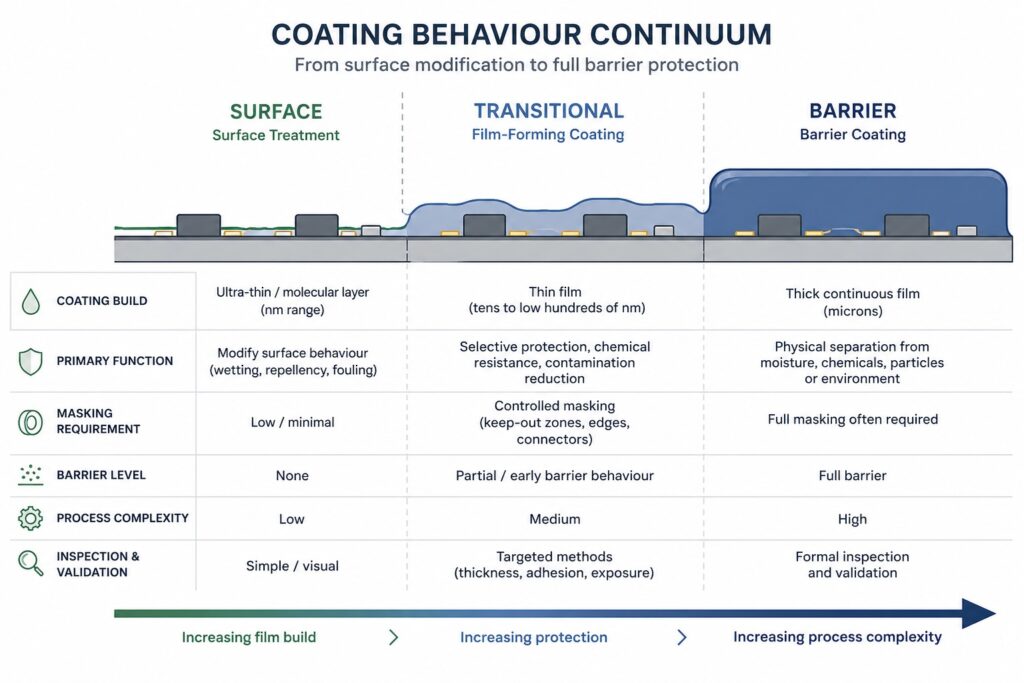
Simple comparison of coating behaviour from ultra-thin surface treatments to film-forming coatings and full barrier protection.
You Are in the Right Place If…
- A surface treatment such as hydrophobic or ultra-thin coating is not providing enough functional performance
- Chemical resistance or contamination resistance is part of the requirement
- You need a controlled coating film, but not necessarily full conformal coating or Parylene
- Selective protection is needed without coating the entire assembly heavily
- Masking is acceptable, but coating thickness and process burden still need to be controlled
- The application sits between surface behaviour and full barrier protection
If the requirement is only water repellency or minimal thickness, a hydrophobic or ultra-thin coating may be enough. If the requirement is full environmental sealing, dielectric isolation or long-term barrier protection, conformal coating or Parylene may be more appropriate. For common boundary errors, see limitations of hydrophobic coatings.
Where Transitional Coatings Fit
A surface treatment mainly changes how a liquid, contaminant or surface interacts with the part. A full barrier coating creates physical separation from the operating environment. Transitional coatings sit between these two positions.
The value of the transitional category is that it prevents over-simplified coating selection. The right answer may not be “nano coating” or “conformal coating”; it may be a controlled film-forming functional coating.
Next step: If this level of coating behaviour matches your requirement, continue with evaluation or compare adjacent routes:
- Hydrophobic coatings – for surface-only behaviour
- Ultra-thin coatings – where thickness is critical
- PFAS-free coatings – where regulatory constraints apply
- Conformal coating or Parylene – for full barrier protection
When Film-Forming Coatings Are the Right Route
Film-forming coatings are usually considered when a surface-only coating cannot provide enough functional performance, but a full barrier coating would add unnecessary thickness or process complexity.
- Chemical resistance is required beyond simple water repellency
- Contamination, residue or particle protection is part of the requirement
- Surface modification alone is not enough for the operating environment
- Selective protection is needed without heavily coating the full assembly
- Masking is acceptable, but full conformal coating may be excessive
- The process needs a controlled coating film rather than only a surface treatment
These applications often need practical trials, because the boundary between surface behaviour and protective film behaviour depends on chemistry, film build, component geometry and exposure conditions. For the difference between surface effect and true protection, see hydrophobic coating vs conformal coating.
When Film-Forming Coatings Are Not the Right Answer
Film-forming coatings are useful in the middle ground, but they are not always the correct route.
The correct route depends on whether the requirement is surface behaviour, thickness control, controlled film performance or full barrier protection. For common examples of under-specification, see why hydrophobic coatings don’t protect electronics.
Typical Coating Routes
Transitional coatings may be delivered through several technology routes depending on the performance target.
The correct route depends on whether the coating must primarily modify the surface, form a controlled functional film, or act as a true protective barrier.
Key point: Transitional coatings are not a compromise category. They are a deliberate strategy for applications where surface treatment is too weak and full barrier coating is too much.
Process Considerations
Unlike surface treatments or full barrier coatings, transitional coatings require careful definition to ensure they deliver the intended level of protection. Once a coating begins to form a functional film, process control becomes more important. Film build, edge definition, pooling, drainage and masking behaviour can all affect performance.
- Masking may be required around connectors, contacts or keep-out zones
- Drainage and pooling must be controlled on complex geometry
- Film build must be repeatable enough to support the claimed function
- Surface preparation can strongly influence wetting, adhesion and durability
- Inspection methods may need to be defined because very low-build films can be difficult to see
- Validation should reflect real exposure, not just simple water beading or contact angle tests
Transitional coatings sit at the boundary between surface behaviour and barrier performance, which makes them highly sensitive to process definition, film build and real exposure conditions.
- Film build sensitivity – small changes can shift performance from surface effect to functional protection
- Process dependence – application method directly affects coating behaviour
- Validation requirement – surface tests alone do not confirm real-world performance
For this reason, transitional coatings are typically evaluated through controlled trials before being implemented in production. SCH provides advanced functional coating services for application, validation and scale-up to confirm performance under real conditions.
This is why SCH treats transitional coatings as a process development decision, not just a material choice.
Common Failure Modes
- Assuming hydrophobic behaviour equals environmental protection
- Using an ultra-thin coating where chemical resistance requires a real film
- Expecting nano coating behaviour to match conformal coating protection
- Ignoring masking, pooling or drainage once film build increases
- Testing only surface wetting without validating chemical, particle or contamination exposure
Many coating failures happen because the coating regime was misunderstood. The material may not be wrong; the selected category may be wrong.
Need Help Choosing the Correct Route?
If you are unsure whether your application needs surface behaviour, ultra-thin coating, film-forming protection, conformal coating or Parylene, SCH can review the part, exposure conditions and performance requirement before recommending a coating route.
Why Choose SCH Services?
SCH helps customers choose coating strategies based on real application behaviour, not coating labels. This is especially important where surface treatments, film-forming coatings and barrier systems all appear technically possible.
- 🧭 Coating Route Selection – Clear distinction between surface behaviour, controlled film performance and barrier protection
- 🛠️ Process Development Support – Practical support with material selection, film build, masking and application control
- 🔬 Feasibility & Sample Trials – Evaluation of whether the coating route performs under realistic exposure conditions
- 🔗 Integrated Coating Strategy – Linking hydrophobic coatings, ultra-thin coatings, conformal coating and Parylene where required
📞 +44 (0)1226 249019 | ✉ sales@schservices.com | 💬 Discuss Your Application ›