When to Use Hydrophobic Coatings in Electronics
Where surface behaviour control is the correct coating strategy
Hydrophobic coatings are highly effective when the requirement is surface behaviour control, not environmental protection.
They are used to manage how liquids interact with a surface, helping water bead, shed or drain more easily. When applied correctly, this can reduce contamination, improve cleanability and support reliable operation in specific conditions.
The key is to use hydrophobic coatings for the right problem. For full coating route selection, see the How to Choose the Right Coating guide or compare hydrophobic coating vs conformal coating.
Need help comparing advanced coating routes? Use the CytoPel Coating Selection Matrix to compare ultra-thin, hydrophobic, PFAS-free and film-forming coating strategies before selecting between nano coating, conformal coating or Parylene.
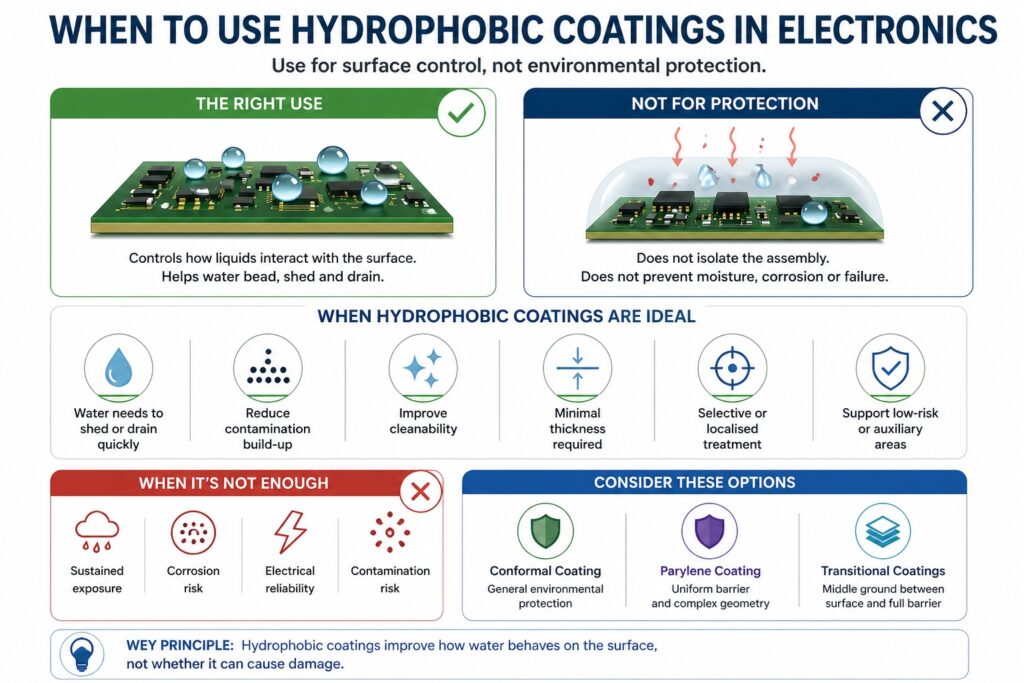
Hydrophobic coatings are used to control surface behaviour such as water shedding and contamination, but do not provide environmental protection for electronics.
The Correct Use Case
Hydrophobic coatings should be selected when controlling surface interaction is more important than isolating the assembly from the environment.
Where the requirement goes beyond ordinary water repellency and specifically needs extreme droplet shedding or reduced water film formation, a superhydrophobic coating may be the more appropriate surface-function route.
Hydrophobic performance is created through a combination of low surface energy and microscopic surface structure, which changes how water droplets interact with the surface. For a simplified explanation of contact angle, surface texture and the “blades of grass” effect, see why some coatings cause water to bead and roll off.
For more detail on how coatings transition between behaviours, see the surface vs film vs barrier guide. For broader ultra-thin coating comparisons, see nano coating vs conformal coating.
Typical Applications
- Condensation-prone environments where drainage matters
- Surfaces exposed to intermittent moisture or splashing
- Connector-adjacent areas where full coating is not possible
- Optical or sensor components requiring low contamination
- Precision assemblies where coating thickness must be minimal
- Products requiring improved cleanability or reduced residue retention
These applications benefit from surface control, not full environmental isolation. To understand the boundary between useful surface control and misapplication, see limitations of hydrophobic coatings.
Key Principle
Hydrophobic coatings improve how water behaves, not whether it can cause damage. For more detail, see why hydrophobic coatings don’t protect electronics.
When Hydrophobic Coatings Are Not Enough
If the application involves sustained exposure, contamination, corrosion risk or electrical reliability requirements, hydrophobic coatings alone may not be sufficient.
- For extreme water repellency, rapid droplet shedding or reduced water film formation on antennas, radomes and exposed surfaces, review superhydrophobic coatings
- For general environmental protection, review conformal coating solutions
- For uniform barrier protection and complex geometry, review Parylene coating solutions
- For a controlled middle ground, review transitional film-forming coatings
Process Considerations
- Surface preparation strongly influences performance
- Application method affects coverage and consistency
- Validation must reflect real exposure conditions
- Durability depends on chemistry and environment
- Inspection can be difficult due to very low film thickness
Hydrophobic coatings are simple in concept, but performance depends on correct process control and validation. For process stability guidance, see Electronic Coating Process Control for Reliability.
Need Help Choosing the Correct Route?
If you are unsure whether your application needs hydrophobic coating, ultra-thin coating, conformal coating or Parylene, SCH can review your requirements and recommend the correct coating strategy.
Why Choose SCH Services?
SCH helps customers apply hydrophobic coatings where they deliver real value, and avoid using them where a protective coating system is required.
📞 +44 (0)1226 249019 | ✉ sales@schservices.com | 💬 Discuss Your Application ›