
How to Specify Parylene Coating on a Drawing
Defining grade, thickness, adhesion and control notes clearly enough for coating, quality and supplier control
Many Parylene coating problems start long before deposition. They start with drawings and specifications that are too vague to control grade, thickness, adhesion route, masking intent, or inspection expectations properly.
A note such as “apply Parylene coating” may look acceptable at drawing stage, but it leaves too much room for interpretation once the job reaches purchasing, process engineering, coating operations and quality control. That creates avoidable risk in quotation, qualification and production release.
This guide explains how to write a clearer Parylene specification, what details normally need to be included, and where teams commonly create ambiguity without realising it.
Many of the issues addressed here originate from poor specification control. See our insight on why Parylene specifications fail for common root causes.
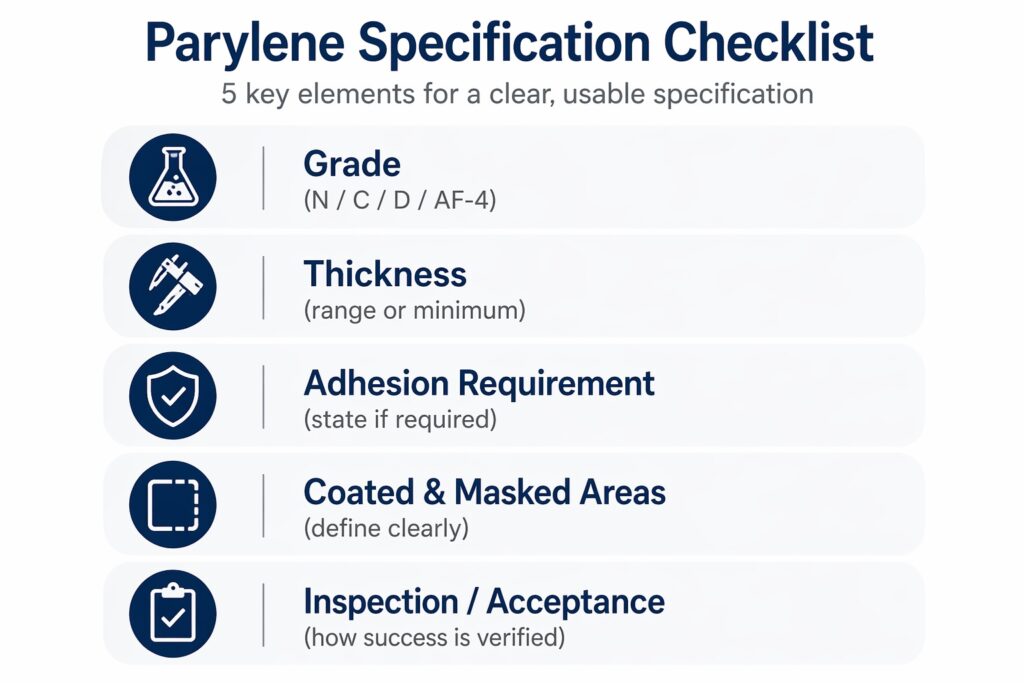
Simple checklist showing the key elements required to correctly specify a Parylene coating on a drawing.
Not sure which grade to specify? See our guide to choosing the right Parylene dimer.
What a Usable Parylene Specification Needs to Do
A usable specification does more than name a coating type. It should allow the coater, supplier and quality team to understand exactly what is required and how success will be judged.
- Define the material clearly so the correct dimer grade is used.
- Define the thickness properly so the coating target is measurable and repeatable.
- Define any adhesion expectations so the process route is controlled rather than assumed.
- Define the coated and uncoated areas so masking, keep-out zones and inspection are aligned.
- Define the acceptance route so quality checks match the drawing intent.
Reality check: if a supplier cannot tell from the drawing which grade, thickness range and process expectations apply, the specification is not yet strong enough for controlled production.
Start by Defining the Exact Parylene Grade
The first job is to define the correct chemistry. “Parylene coating” on its own is too broad, because different grades behave differently in service and in process.
Parylene N
Parylene N is usually considered where penetration into fine geometry, electrical insulation performance and uniform thin-film behaviour are strong priorities.
Parylene C
Parylene C is usually the baseline choice for many electronics applications because it offers a practical balance of moisture resistance, chemical barrier performance and manufacturability.
Parylene D
Parylene D is generally considered where additional thermal capability is required beyond the normal working range of C.
Fluorinated grades such as AF-4
Fluorinated grades should be defined precisely. Avoid writing only “Parylene F” unless the exact fluorinated chemistry is already controlled and understood by all parties. If the intent is AF-4, the drawing should say AF-4, not rely on shorthand naming.
If you are unsure which grade to define, see our Parylene dimer selection guide.
Temperature-driven selection: where the application involves sustained heat exposure, thermal cycling, or elevated operating temperatures, grade selection becomes a thermal decision as much as a material one. See our high-temperature protective coatings for electronics guide for how thermal requirements influence Parylene selection and alternatives.
Important: “Parylene F” is often used loosely in industry, but it is not always specific enough for drawing control. If the fluorinated grade matters, name the exact grade.
Define Thickness Properly
Thickness is one of the most common weak points in Parylene specifications. A single number on its own often does not tell the coater or the quality team enough.
Nominal value versus acceptable range
A note such as “10 µm Parylene” may still leave open whether 10 µm is a target, a minimum, or an allowable range. In most cases, a range or a controlled nominal with tolerance is stronger than a single isolated value.
Critical surfaces and real geometry
Assemblies with edges, cavities, standoffs, connectors and shadowed features can produce local variation in effective thickness. If certain areas are especially critical, the drawing or process note should make that clear.
Measurement method
Thickness becomes much easier to control if the specification also states how it will be verified, for example by witness coupon, sectioned sample, calibrated measurement technique or another agreed method.
For guidance on selecting the correct thickness range, see our Parylene thickness guide.
Call Out Adhesion Requirements Explicitly
Adhesion should not be treated as an invisible assumption. If the application requires a defined adhesion-promotion route, that expectation should be stated clearly in the specification or controlled process documentation.
When adhesion promotion matters
Adhesion promotion becomes especially important where the substrate is difficult, where downstream handling is demanding, or where later operations such as bonding, printing or environmental exposure put extra stress on the coating interface.
Do not assume “standard process” means the same thing everywhere
Different coaters may use different pre-cleaning, drying, surface preparation and adhesion-promotion methods. If those steps are critical, they should be controlled rather than left open to interpretation.
Where plasma preparation is required, the drawing or controlled process note should avoid vague wording such as “plasma clean” without defining the intent. Oxygen, argon, nitrogen and mixed-gas plasma processes can affect cleaning, activation, oxidation and material compatibility differently. For a deeper explanation, see How Plasma Gas Chemistry Changes PCB Surface Preparation Before Parylene.
Define Coated Areas, Masked Areas and Acceptance Notes
The coating note should not exist in isolation from the rest of the drawing. A strong specification also makes it clear where coating is required, where it must be excluded, and how acceptability will be judged.
Coated and uncoated zones
If connectors, test pads, threads, optical windows, earth points or mating surfaces must remain uncoated, that should be shown clearly rather than assumed during masking review.
Inspection expectations
Inspection can include visual coverage checks, UV verification where relevant, thickness confirmation, adhesion checks, coupon review or customer-specific release requirements. The more critical the application, the less useful vague acceptance language becomes.
Related standards or internal process references
If the programme depends on internal work instructions, customer coating standards, qualification protocols or drawing note libraries, the specification should point to those controlled references rather than relying on informal knowledge transfer.
Common Specification Mistakes
These are some of the most common problems that create avoidable confusion in quoting, coating and quality release.
- Writing “apply Parylene coating” with no grade defined.
- Using “Parylene F” without naming the exact fluorinated grade.
- Giving one thickness number with no indication of target, minimum or tolerance.
- Leaving masked areas undefined and expecting coating personnel to infer intent.
- Assuming adhesion promotion without stating whether it is required.
- Omitting inspection or acceptance notes in higher-reliability applications.
Example Specification Formats
The exact wording should always match the customer’s own document control system, but the examples below show the level of clarity normally worth aiming for.
Example 1 – General electronics baseline
Parylene C coating, thickness 8–12 µm, apply to defined coated areas only, exclude all masked features shown on drawing, use approved adhesion-promotion route where required by controlled process, verify thickness by agreed coupon method.
Example 2 – Fine-feature electronic assembly
Parylene N coating, thickness 3–6 µm, selected for fine-feature coverage and dielectric performance, apply to all designated areas, protect no-coat zones per masking drawing, verify release by visual coverage and defined thickness control method.
Example 3 – Specialist fluorinated application
Parylene AF-4 coating, thickness 5–10 µm, fluorinated grade selected for defined electrical and environmental performance, adhesion-promotion route to controlled work instruction, coating acceptance subject to approved qualification plan and thickness verification method.
When to Involve the Coater Early
If the assembly contains difficult geometry, mixed materials, tight keep-out zones, later bonding steps, unusual temperature exposure or customer-specific qualification requirements, it is usually better to involve the coating team before the drawing is frozen.
That allows grade selection, masking logic, thickness targets and inspection methods to be reviewed while change is still easy, rather than after the design has been released and ambiguity has become expensive.
This is typically where external coating expertise can prevent specification errors before they become qualification or production issues. Where masking, preparation, thickness or acceptance requirements still need to be demonstrated on the actual assembly, a Parylene engineering run can be used to verify the proposed process before production release.
Related Articles and Product Pages
Use these pages alongside your drawing review and specification work.
- Engineering Runs for Parylene Coating: Proving the Process Before Production
- Choosing the Right Parylene Dimer
- Parylene Dimer Comparison (N, C, D & AF-4)
- How Dimer Purity Affects Coating Quality
- Parylene N Dimer
- Parylene C Dimer
- Parylene D Dimer
- Parylene F / AF-4 Dimer
If the application is still unclear at drawing stage, it is usually better to resolve the grade and specification logic first than to leave it for production release.
Why Choose SCH Services?
Partner with SCH Services for a complete, integrated platform: Conformal Coating, Parylene & ProShieldESD Solutions plus equipment, materials, and training. Our team brings decades of hands-on expertise.
- ✈️ 25+ Years of Expertise – Trusted across aerospace, medical, defence, automotive, and electronics.
- 🛠️ End-to-End Support – From dimer selection to masking, inspection and process optimisation.
- 📈 Scalable Capacity – From prototypes to high-volume production.
- 🌍 Global Reach – Responsive support across Europe, North America, and Asia.
- ✅ Proven Reliability – Consistent quality and strong customer satisfaction.
📞 Call: +44 (0)1226 249019
✉ Email: sales@schservices.com
💬 Contact Us ›
