Why ESD coatings should be selected as part of a controlled static management system
Static control paints are often misunderstood. In practice, they should be viewed as ESD control coatings: engineered surface treatments used to control electrostatic behaviour on plastics, metals, floors, fixtures, packaging and industrial equipment.
Some coatings provide useful static control. Others can suffer from poor durability, inconsistent conductivity, filler separation or limited long-term performance. The key is understanding how the coating works, how it is grounded or verified, and whether it forms part of a wider ESD control strategy.
For a broader overview, see the ProShieldESD coating platform and the guide to choosing the right static control approach.
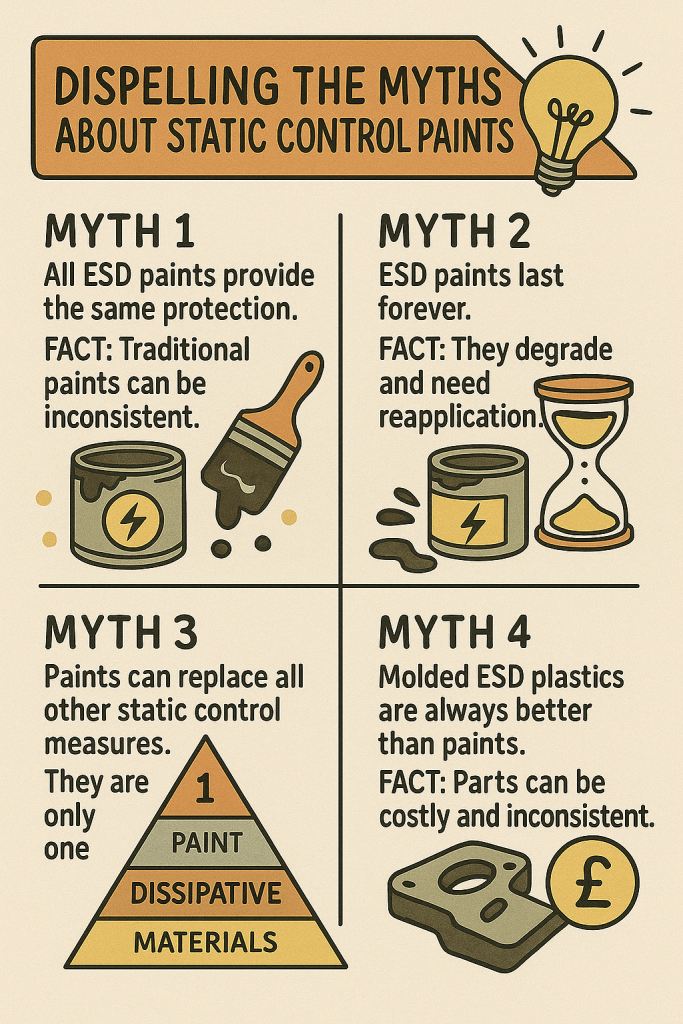
Myth 1: All ESD Paints Provide the Same Protection
Fact: Not all ESD paints or coatings behave in the same way. Traditional systems often rely on carbon, graphite or metal fillers to achieve conductivity. These fillers can create variation in surface performance if they are not evenly distributed, properly dispersed or maintained during application.
ProShieldESD position: ProShieldESD is based on intrinsically conductive polymer technology rather than conventional particulate filler loading. This helps create a more uniform coating layer with controlled static-dissipative or conductive behaviour across the treated surface.
See why filler-based ESD coatings can become inconsistent over time
Myth 2: ESD Paints Last Forever Without Verification
Fact: No static control coating should be assumed to perform indefinitely without inspection or verification. Abrasion, cleaning, chemical exposure, contamination and mechanical wear can all affect surface performance over time.
ProShieldESD position: ProShieldESD coatings are designed as durable, repairable ESD control surfaces. Their performance should still be verified using appropriate resistance testing, especially where the coating is used in an EPA, process control area or higher-risk industrial environment.
Myth 3: Paints Can Replace All Other Static Control Measures
Fact: ESD coatings are one part of a wider static control system. They do not replace good grounding, suitable footwear, ESD-safe work practices, ionisation where needed, humidity awareness, packaging control or process verification.
Effective ESD control programmes are normally designed around recognised standards such as IEC 61340 and ANSI/ESD S20.20. Within that framework, coatings can provide a controlled surface layer, but they must be used correctly.
ProShieldESD position: The ProShieldESD coating platform can be used to create conductive or static-dissipative surfaces depending on the application. This allows it to support layered ESD strategies rather than acting as a standalone “paint solves everything” solution.
Myth 4: Moulded ESD Plastics Are Always Better Than Coatings
Fact: Moulded ESD plastics can be effective, but they are not always the most practical solution. They may require tooling, minimum production quantities, material changes and design requalification. Some filled plastics can also show variation depending on filler distribution, moulding conditions and part geometry.
ProShieldESD position: Applying an ESD coating to an existing plastic component can be a practical alternative where the base part already works mechanically but needs improved static control. This is especially useful for covers, housings, guards, trays, fixtures, ducts and equipment surfaces.
When coatings are applied to plastics, successful performance depends on more than achieving the correct resistance value. Surface chemistry, cap layers, primers and substrate compatibility can all influence long-term adhesion and durability. Understanding the material being coated is often the first step in a successful ESD coating project. Why ESD Coatings Fail Before Their Electrical Performance Does.
For plastic-specific applications, see anti-static coating for plastic.
The Practical Truth About Static Control Coatings
The best ESD coating is not simply the most conductive coating. It is the coating that delivers the correct electrical behaviour for the application, remains stable in the operating environment, can be tested, can be maintained, and fits the wider ESD control system.
- Use conductive coatings where a low-resistance pathway is required.
- Use static-dissipative coatings where controlled charge decay is needed without creating an uncontrolled conductive surface.
- Verify performance with appropriate resistance testing.
- Consider wear, cleaning, contamination and grounding strategy before specifying the coating.
- Choose repairable systems where long-term operational maintenance matters.
Where ProShieldESD Fits
The ProShieldESD coating platform is used where existing materials need to be upgraded into controlled ESD surfaces without redesigning the base part. Typical applications include plastics, metal equipment, floors, fixtures, work surfaces, packaging systems and hazardous environment surfaces.
Related pages:
Important note: This article provides general technical guidance only. Final ESD coating selection should be validated against the operating environment, substrate, grounding strategy, cleaning regime, resistance targets and applicable customer or industry standards.