Why uniform dissipative behaviour is critical for reliable ESD protection across real surfaces
Homogeneous ESD protection matters because static control only works when the whole surface behaves consistently. A material or coating that performs well in one area but fails in another can still leave weak points where charge accumulates, discharges or causes process instability.
In electronics manufacturing, medical devices, aerospace, automotive, packaging and industrial environments, the objective is not simply to make a surface “conductive”. The objective is to create controlled, repeatable static-dissipative behaviour across the full working area.
The ProShieldESD coating platform is designed to support this requirement by creating permanent, filler-free static control across real substrates, surfaces and operating environments.
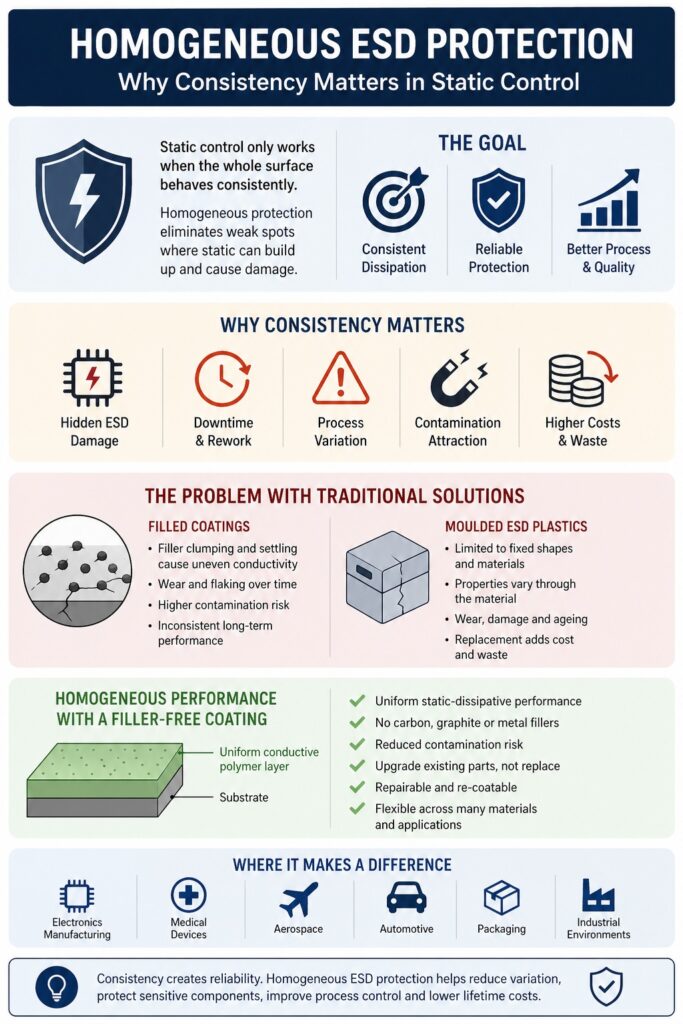
Why Consistency Matters in Static Control
Static control failures often occur at the weakest point in the system. A surface may appear acceptable overall, but local areas of poor dissipation can still allow charge to accumulate.
That inconsistency can create practical risks, including hidden ESD damage, contamination attraction, nuisance discharge, process variation, rework and premature replacement of parts or equipment.
This is why effective ESD control should be assessed as surface behaviour across the application, not just as a single material claim or isolated resistance reading.
The Problem with Filled Coatings and Moulded ESD Plastics
Many traditional ESD materials rely on carbon, graphite, metal or other conductive fillers. These systems can work, but they introduce practical limitations. Filler distribution, settling, agglomeration, surface wear and contamination risk can all affect long-term consistency.
Moulded ESD plastics can also be useful, but they are normally limited to fixed shapes, specific materials and replacement-based control. Once a moulded item wears, becomes damaged or no longer meets the application requirement, the usual solution is replacement rather than repair or upgrade.
For many real-world applications, coating the existing surface with a controlled static-dissipative layer is more flexible than replacing the whole item or relying on moulded material alone.
Homogeneous Performance with ProShieldESD
ProShieldESD is based on a filler-free conductive polymer approach. Instead of depending on dispersed particles to create a conductive pathway, the coating is designed to provide controlled static behaviour through the coating system itself.
This makes it suitable for upgrading a wide range of surfaces, including plastics, foams, packaging, floors, fixtures, housings, industrial equipment and other substrates where uncontrolled static behaviour creates operational risk.
- Uniform static-dissipative performance across coated surfaces
- No carbon black, graphite or metal filler requirement
- Reduced contamination risk compared with particle-filled approaches
- Ability to upgrade existing parts instead of replacing them
- Repairable and re-coatable surface control strategy
- Flexible use across multiple materials and application types
Consistency Creates Reliability
In controlled environments, ESD protection must remain stable during handling, cleaning, wear, environmental change and repeated use. A surface that only performs under ideal conditions is not enough.
Homogeneous ESD protection helps reduce variation by creating predictable dissipative behaviour across the surface. This supports better process control, lower replacement cost and improved confidence in long-term ESD performance.
For applications involving plastics, packaging, industrial equipment or hazardous environments, ProShieldESD provides a practical route to convert existing insulating surfaces into controlled static-dissipative systems.
Related ProShieldESD Guidance
Talk to SCH About Static Control Coatings
If you need to improve static control on plastic, packaging, floors, fixtures, equipment or other surfaces, SCH can help review the application and identify whether a ProShieldESD coating route is suitable.
Contact SCH Services to discuss your ESD coating requirement.
Note: This article provides general technical guidance only. Final material selection and ESD performance requirements should be validated against the relevant application, environment, test method and acceptance criteria.