Ultra-Thin Coatings for Electronics, PCBs & Precision Components
Low-build coating strategies where thickness, tolerance and functional performance must be controlled
Ultra-thin coatings for electronics are used where surface performance or limited protection is required without adding significant thickness to PCBs, connectors or precision components.
They help avoid interference with tolerances, contacts and functional interfaces while still delivering targeted performance. These coatings are typically used where thickness itself becomes the limiting factor rather than environmental protection.
Ultra-thin coatings are generally selected for surface-function behaviour, dimensional control or specialist functional performance rather than full environmental barrier protection.
This page helps you decide whether an ultra-thin coating is the right route for your application, or whether you should instead consider conformal coating, Parylene coating, hydrophobic coatings or another route within SCH’s Advanced Functional Coatings platform.
For broader route comparison, see the Coating Selection Guide. For ultra-thin coating comparison against conventional protection routes, see nano coating vs conformal coating.
Selection check: If the main constraint is thickness or tolerance, ultra-thin coating may be the right route. If the main requirement is environmental protection, start with conformal coating, Parylene or the surface vs film vs barrier guide. If you are comparing specific ultra-thin CytoPel options against PFAS-free, hard or UV-curable coating routes, use the CytoPel coating selection matrix.
The diagram below shows how ultra-thin coatings provide functional performance while minimising thickness impact in electronics and precision components.
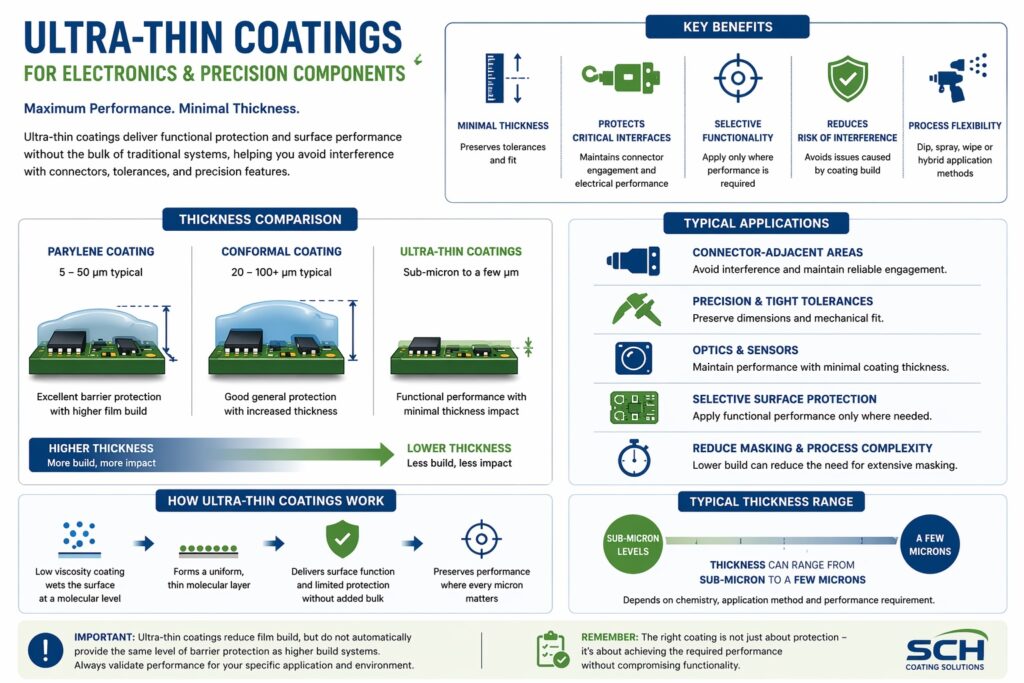
Ultra-thin coatings provide functional performance with minimal thickness, helping avoid interference with connectors, tolerances and precision features.
You Are in the Right Place If…
- Coating thickness is the primary constraint
- Connectors, contacts, optics, surfaces or interfaces cannot tolerate build-up
- Dimensional change must be minimal or tightly controlled
- You need surface functionality without full encapsulation
- Conformal coating or Parylene introduces risk due to thickness
Where Ultra-Thin Coatings Fit
Ultra-thin coatings are selected when thickness itself becomes a technical constraint. They are not intended to replace coating systems designed for environmental protection, corrosion resistance or barrier performance.
Correct selection depends on whether the application needs minimal film build, surface behaviour control, chemical resistance, RF transparency or a true protective barrier.
For the wider engineering distinction between functional surface behaviour and environmental isolation, see surface-function vs barrier-function coatings.
If water repellency is the main driver, review when to use hydrophobic coatings. For key selection boundaries, see surface energy vs environmental barrier protection, RF transparent coatings for electronics & antennas and why water resistance is not corrosion protection.
When Ultra-Thin Coatings Are the Right Solution
- Film build must remain minimal around connectors, contacts, optics or precision features
- Dimensional change must be avoided or tightly controlled
- Surface performance is required without full encapsulation
- Masking complexity needs to be reduced where the application allows
- Conventional conformal coating or Parylene would add unnecessary thickness or process risk
When Ultra-Thin Coatings Are Not the Right Answer
- Full moisture or corrosion protection is required
- Salt-spray or harsh environmental exposure is expected
- Dielectric barrier performance is critical
- Waterproofing or sealing is required
In these cases:
→ For general PCB protection, corrosion resistance or environmental durability, use conformal coating solutions
→ For high-performance barrier protection and complex geometry coverage, use Parylene coating solutions
→ For common selection boundaries, see limitations of hydrophobic coatings.
What Ultra-Thin Coatings Actually Do
Ultra-thin coatings provide a functional surface layer without significantly affecting dimensions or interfaces.
Control Dimensional Impact
Ultra-low film build avoids interference with tolerances and fit.
Preserve Functional Interfaces
Contacts, optics and interfaces remain usable without obstruction.
Reduce Masking Complexity
Lower build can reduce masking requirements depending on application.
Enable Coating of Sensitive Components
Suitable for sensors, fine geometries and precision assemblies where conventional coating thickness may interfere with function or tolerances. For examples involving stent frames, delicate metallic structures and complex micro-geometries, see Parylene coating for stent frames and micro metal structures.
Introduce Surface Behaviour
Depending on chemistry, coatings may provide hydrophobicity, oleophobicity, RF transparency or improved cleanability. For how surface energy, contact angle and droplet roll-off behaviour work, see why some coatings cause water to bead and roll off. For the difference between water repellency and protection, see why water resistance is not corrosion protection.
Key point: Ultra-thin coatings solve thickness problems but do not replace coating systems designed for environmental protection or barrier performance.
Ultra-thin vs hydrophobic coatings
Ultra-thin coatings are selected when thickness is the limiting factor. Hydrophobic coatings are selected when surface behaviour, such as wetting, contamination or fluid interaction, is the primary requirement.
- If your problem is water behaviour, review hydrophobic coatings
- If your problem is thickness or tolerance, ultra-thin coatings are the correct route
- If you are comparing ultra-thin coatings against full protective systems, review nano coating vs conformal coating
Implementation Pathways
Ultra-thin coatings are not a plug-and-play solution — performance depends heavily on how the coating is applied and controlled.
- Customer-Led Application – Materials evaluated and applied in-house
- SCH-Enabled Implementation – Support with material selection, process development and training
- SCH Coating Services – Controlled coating application for consistent results
Ultra-thin coatings are highly sensitive to surface preparation, application method and process control. Small variations in handling or deposition can significantly affect performance, durability and consistency.
- Surface condition sensitivity – cleanliness and preparation directly influence performance
- Application method variation – different processes produce different results at low film build
- Durability limitations – wear, handling and environment must be validated
For customers who need to confirm performance before committing to materials, equipment or production processes, SCH provides advanced functional coating services for controlled application, validation trials and production coating support.
Need Help Choosing the Correct Route?
We can assess whether your requirement is driven by thickness, surface behaviour, chemical resistance or protection level.
Why Choose SCH Services?
- 📏 Thickness control expertise
- 🛠️ Process development support
- 🔬 Precision application understanding
- 📈 From feasibility to production