
UV-Cure Ultra-Thin Fluoropolymer Coatings for Electronics (UVX)
Rapid-curing ultra-thin coatings for hard, low-build surface performance on glass, metal, and plastic
UVX is a UV-cure fluoropolymer coating used within SCH’s wider Nano Coatings platform, designed for applications where fast processing, hard surface performance, and minimal coating build are required.
Why UVX Is Used
UVX is typically selected where conventional conformal coating or Parylene would introduce unnecessary thickness, increase masking complexity, or fail to deliver the curing speed and surface durability required in production.
For electronics and precision components, UVX provides hydrophobic and oleophobic surface behaviour combined with a hard cured layer, making it particularly suitable for glass, metal, and plastic substrates.
This makes it relevant where optical clarity, scratch resistance, contamination control, and high-throughput processing must be achieved without introducing heavy coating build.
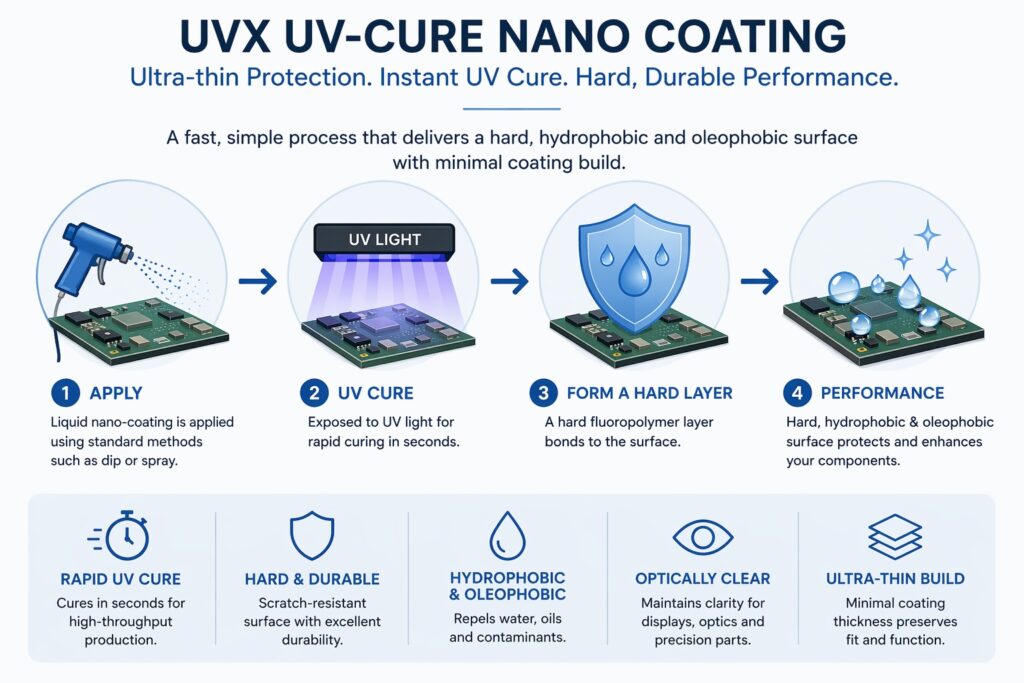
UVX UV-cure nano coatings provide rapid processing and a hard, ultra-thin surface for electronics, combining hydrophobic performance with minimal coating build.
You Are in the Right Place If…
- You need a hard, durable surface with minimal coating thickness
- Fast curing and high-throughput processing are critical
- The substrate is glass, metal, or plastic rather than complex PCB geometry
- You require hydrophobic or oleophobic behaviour combined with surface durability
- You have UV curing capability or are open to using a coating service
If the requirement is full environmental protection, corrosion resistance or coverage of complex geometries, UVX alone is unlikely to be sufficient. In these cases, conformal coating or Parylene should be considered.
How This Fits Within SCH’s Coating Platform
Within SCH’s wider structure, UVX sits alongside Hydrophobic Coatings, Ultra-Thin Coatings, and the broader Advanced Functional Coatings platform.
Where fluorinated chemistry is not preferred, SCH can also support evaluation of PFAS-free alternatives.
Process Positioning
UVX is best suited to applications where curing speed, surface hardness, and controlled film thickness must be achieved within a practical and repeatable production process.
UVX is a process-driven coating route within SCH’s nano coatings platform, defined by UV curing, hard surface performance and controlled film build rather than by coating thickness alone.
Where UVX Fits
UVX is not a replacement for conformal coating or Parylene. It is selected where surface performance, curing speed, and minimal film build are more important than full environmental protection.
In practical terms, UVX is the fast-cure, hard-surface route within SCH’s broader advanced functional coatings and nano coatings offering.
Why UVX Is Often Chosen
UVX is selected where hard surface performance must be delivered in a low-build format within a fast production environment.
- Rapid UV curing for high-throughput processing
- Harder surface compared to room-temperature fluoropolymer systems
- Low film build preserving geometry and functionality
- Strong fit for display, optical, and touch-surface applications
- Useful where scratch resistance and contamination control are required together
Application and Processing Advantages
High-Speed UV Cure
- Rapid curing under UV light enables short cycle times
- Supports scalable and repeatable production processes
- Reduces process bottlenecks compared to slower curing systems
Standard Application Methods
- Compatible with dip and spray application routes
- Integrates into straightforward process flows where UV curing is available
- Supports controlled low-build coating strategies
Low-Build Surface Protection
- Thin film preserves fine features and surface functionality
- Suitable for optical surfaces, displays, and precision geometries
Performance Characteristics
UVX provides a hard, functional surface layer rather than a thick protective barrier.
Hard Protective Film
Designed to create a durable surface on glass, metals, and plastics where scratch resistance and surface robustness are required.
Hydrophobic and Oleophobic Behaviour
Provides water and oil repellency, supporting contamination control and cleanability. This aligns with SCH’s Hydrophobic Coatings approach.
Chemical and Heat Resistance
Offers resistance to chemicals, heat, and environmental exposure in a low-build format.
Optical Clarity
Transparent coating suitable for displays, optical components, and light-sensitive applications.
Customisable Formulation
Can be tuned to balance hardness, adhesion, and surface performance depending on substrate and application.
Important: UVX provides a hard surface layer, not a full environmental barrier. Surface durability does not equal moisture protection, corrosion resistance or electrical isolation. If these are required, a conformal coating or Parylene system must be evaluated.
Typical Applications
- Displays, screens, and optical components requiring hard, clear surface protection
- Glass, metal, and plastic substrates needing low surface energy behaviour
- Electronics requiring rapid processing and contamination resistance
- Touch surfaces where cleanability and durability are important
- Applications where conventional coatings would introduce excessive thickness
For common misunderstandings around surface coatings and protection levels, see why hydrophobic coatings don’t protect electronics.
When to Engage SCH
- When a hard low-build surface is required but conventional coatings are too thick
- When UV curing can improve throughput and process consistency
- When optical, display, or touch surfaces require both clarity and durability
- When the trade-off between UVX, LT Series, OPX, and PFAS-free alternatives needs to be assessed
- When coating performance must be validated before committing to production
Outsource Coating Instead of Building the Process
UVX coating does not require internal process development in every case. Many projects are delivered faster and with lower risk by outsourcing coating to SCH as a controlled service.
- No need to invest in UV equipment, materials, or process setup
- Coatings applied under controlled production conditions
- Rapid transition from sample evaluation to repeatable output
- Scalable from prototype batches through to volume production
This approach is particularly effective where surface preparation, cure control, and consistency are critical to final performance.
Why Choose SCH Services?
SCH supports UVX projects from initial evaluation through to process development, validation, and production coating. The focus is on ensuring curing behaviour, coating thickness, and surface performance are aligned with real application requirements.
- ⚡ Fast cure process understanding for high-throughput environments
- 🛡️ Hard surface performance for durability and scratch resistance
- 💧 Low surface energy behaviour for contamination control and cleanability
- 📈 Structured support from feasibility through to production
- 🔗 Integration with wider coating strategies including conformal coating and Parylene
📞 +44 (0)1226 249019 | ✉ sales@schservices.com | 💬 Discuss Your Application ›
