Fluoropolymer Coatings for Electronics
Ultra-thin fluorinated coating technologies for hydrophobic, oleophobic and low surface energy performance
Fluoropolymer coatings for electronics are a chemistry route used to deliver ultra-thin hydrophobic, oleophobic and low surface energy performance on PCBs, connectors and precision components.
They are commonly used where water repellency, contamination resistance, chemical resistance or reduced surface wetting is required, but where conventional conformal coating or Parylene may add unnecessary thickness or interfere with functional interfaces.
Within SCH’s Advanced Functional Coatings platform, fluoropolymer coatings are best understood as a specific material chemistry option that may sit within nano coatings, hydrophobic coatings or ultra-thin coatings, depending on the application.
Fluoropolymer coatings can be highly effective, but they are not a universal replacement for conformal coating, Parylene or PFAS-free alternatives. For route comparison, start with the Coating Selection Guide. For behaviour classification, use the surface vs film vs barrier guide.
Selection check: Choose fluoropolymer coatings when fluorinated low surface energy behaviour is technically useful and acceptable. If the project requires PFAS-free chemistry, full barrier protection or proven environmental isolation, review PFAS-free coatings, conformal coating or Parylene instead. If you are comparing specific CytoPel hydrophobic and advanced functional coating options, use the CytoPel coating selection matrix.
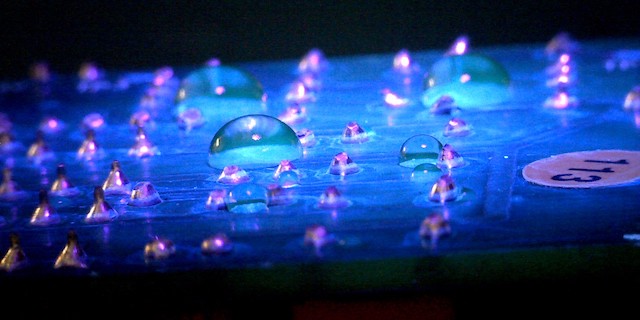
Fluoropolymer coatings can create highly water-repellent surfaces at very low film thicknesses.
You Are in the Right Place If…
- You need hydrophobic or oleophobic behaviour at very low coating thickness
- Water, oils, contamination or chemical exposure are key concerns
- Low surface energy performance is required on a PCB, connector-adjacent area or precision component
- Conventional conformal coating may add too much thickness or masking burden
- A fluorinated chemistry is technically acceptable for the project
- You need to compare fluoropolymer coating against hydrophobic, nano, conformal coating, Parylene or PFAS-free routes
If the project requires PFAS-free chemistry, full environmental barrier protection or a specified conformal coating thickness, fluoropolymer coating may not be the correct route. For common boundary errors, see limitations of hydrophobic coatings.
What Is a Fluoropolymer Coating?
A fluoropolymer coating is a coating system based on fluorinated chemistry. These materials are associated with low surface energy, which can create strong water, oil and contamination-repellent behaviour.
In electronics, fluoropolymer coatings are often applied as ultra-thin films. Depending on the material system and application method, they may also be described as nano coatings for electronics.
Typical reasons for using fluoropolymer coatings on electronics
- Improved water repellency on PCB surfaces
- Reduced wetting from condensation, splashes or handling contamination
- Oil repellency and low surface energy behaviour
- Lower coating thickness than many traditional conformal coatings
- Potential reduction in masking requirements
- Fast application and drying compared with some thicker coating systems
The chemistry can be powerful, but performance must be validated against the actual exposure condition rather than assumed from the fluoropolymer label alone. For broader ultra-thin route comparison, see nano coating vs conformal coating.
Where Fluoropolymer Coatings Fit
Fluoropolymer coatings are best understood as a chemistry route within a wider coating decision system. They are often considered where the required behaviour is low surface energy rather than full barrier encapsulation.
Correct selection depends on whether the priority is low surface energy, coating thickness, chemical resistance, regulatory strategy, or true protective barrier performance.
When Fluoropolymer Coatings Are the Right Route
- Hydrophobic or oleophobic surface behaviour is a primary requirement
- Very low film thickness is required
- Low surface energy performance is technically valuable
- Oil, water, handling contamination or chemical wetting must be reduced
- Conformal coating thickness creates excessive process or masking burden
- Fluorinated chemistry is acceptable for the product, customer and regulatory position
Fluoropolymer coatings are typically most useful when the coating requirement is functional surface behaviour rather than full encapsulation. If the main question is whether hydrophobic behaviour is enough, review when to use hydrophobic coatings.
When Fluoropolymer Coatings Are Not the Right Answer
Fluoropolymer coatings should not be selected only because they are thin or water-repellent. The chemistry, performance requirement and regulatory position must all be considered. For the difference between water repellency and protection, see why hydrophobic coatings don’t protect electronics.
Hydrophobic and Oleophobic Performance
The key benefit of many fluoropolymer coatings is low surface energy behaviour. Water, oils and some contaminants do not wet the treated surface as easily, which can help reduce spreading, retention or contamination build-up.
This behaviour is closely linked to hydrophobic coating technologies, although not every hydrophobic coating must be fluoropolymer-based.
Important: Hydrophobic behaviour is not the same as full environmental sealing. A water-repellent surface and a true protective barrier are different coating regimes. To understand how coatings transition between these behaviours, see the surface vs film vs barrier guide.
For some applications, hydrophobic fluoropolymer coatings are used as part of a broader protection strategy rather than as a complete substitute for thicker coating systems. For direct comparison, see hydrophobic coating vs conformal coating.
Fluoropolymer Coating Properties Relevant to Electronics
Different fluoropolymer coatings have different properties. Selection should be based on the operating environment, substrate, coating thickness, application method and qualification requirements.
Possible properties include:
- High water repellency
- Oil and contamination repellency
- Chemical resistance
- Low surface energy
- Thin-film dielectric performance in selected applications
- Reduced friction or improved lubricity
- Improved corrosion resistance in selected environments
- Fast drying compared with some thicker coating systems
Not every fluoropolymer coating provides all of these benefits. The coating must be selected and tested for the specific electronics application.
Can Fluoropolymer Coatings Reduce Masking?
One reason fluoropolymer coatings are considered for PCB protection is the potential reduction in masking.
Traditional conformal coatings are typically applied at higher thickness and often require masking around connectors, switches, contacts, test points and other keep-out areas. Ultra-thin fluoropolymer coatings may be thin enough for some assemblies to be processed with reduced or minimal masking.
When can fluoropolymer coatings be used with reduced masking?
- The coating is applied at very low dry film thickness
- Connectors and contacts are not highly sensitive to thin-film exposure
- The assembly design avoids tight capillary paths into critical interfaces
- Functional testing confirms that performance is not affected after coating
However, this must be checked carefully
- Some connectors and contact systems may still require protection or validation
- Capillary flow into tight interfaces can still occur
- Electrical contact performance must be confirmed after coating
- Customer acceptance criteria may still require defined keep-out areas
- Process testing should be completed before production release
For this reason, SCH treats masking reduction as a process development decision, not a blanket assumption.
How should fluoropolymer coatings be validated?
Fluoropolymer coatings can deliver strong low surface energy performance, but the result depends on chemistry, surface condition, application method and the sensitivity of the assembly.
- Surface behaviour – hydrophobic, oleophobic and contamination performance must be confirmed on the real substrate
- Masking impact – reduced masking is possible only where connectors, contacts and interfaces remain functional after coating
- Regulatory position – fluorinated chemistry must be acceptable for the product, customer and compliance route
For customers who need to prove fluoropolymer coating performance before committing to materials, equipment or production release, SCH provides advanced functional coating services for controlled application, validation trials and scale-up support.
Typical Applications for Fluoropolymer Coatings
Fluoropolymer coatings are used across electronics and engineering applications where moisture, contamination, oil or chemical exposure may affect reliability or performance.
- PCB assemblies requiring low-build hydrophobic or oleophobic surface behaviour
- Connector-adjacent areas where conventional coating build creates risk
- Optical and sensor assemblies requiring low surface energy or contamination control
- Industrial electronics exposed to handling contamination, humidity or intermittent wetting
- Medical, diagnostic, automotive, aerospace, telecommunications and commercial electronic assemblies
- Projects where fluoropolymer chemistry is being compared with nano, hydrophobic, ultra-thin, conformal coating or Parylene routes
The coating choice depends on assembly design, exposure type, inspection method, regulatory position and required validation route.
How SCH Supports Fluoropolymer Coating Projects
SCH supports customers by helping assess whether an ultra-thin fluoropolymer, nano coating, hydrophobic coating, conformal coating or Parylene route is suitable for the product, process and reliability requirement.
- Review of the PCB or assembly protection requirement
- Comparison with conventional conformal coating and Parylene options
- Trial coating and process development
- Assessment of masking reduction opportunities
- Guidance on hydrophobic and oleophobic coating behaviour and limitations
- Support for PFAS-free alternatives where fluorinated chemistry is not preferred
- Support for production coating routes, coating services, training and consultancy
Where required, SCH can help position fluoropolymer coatings within a wider coating strategy rather than treating them as a simple drop-in replacement.
Related Coating Options
Fluoropolymer coatings sit within a wider group of advanced functional coating technologies. The correct route depends on whether the priority is hydrophobicity, oleophobicity, ultra-thin coverage, PFAS-free chemistry, conventional coating protection or full vapour-deposited coverage.
Common Questions About Fluoropolymer Coatings
Do fluoropolymer coatings replace conformal coatings?
No. They are typically used for different protection requirements. Fluoropolymer coatings provide low surface energy behaviour at very low thickness, while conformal coatings provide thicker environmental protection.
Do fluoropolymer coatings require masking?
In some cases masking can be reduced or removed, but this must always be validated based on assembly design, connector sensitivity and electrical requirements.
How thick are fluoropolymer coatings?
They are typically applied at very low dry film thickness, often in the low-micron or sub-micron range depending on the coating system and application method.
Are fluoropolymer coatings PFAS-free?
Fluoropolymer coatings are based on fluorinated chemistry. If PFAS-free or non-fluorinated chemistry is required, a separate PFAS-free coating route should be reviewed.
Why Choose SCH Services?
SCH helps customers select, trial and apply protective coating systems for electronics, including fluoropolymer coatings, nano coatings, hydrophobic coatings, conformal coatings, Parylene and PFAS-free alternatives.
- 🧪 Chemistry Route Selection – Support in deciding whether fluoropolymer chemistry is technically and commercially appropriate
- 💧 Hydrophobic & Oleophobic Performance – Practical understanding of low surface energy behaviour on electronics and precision parts
- 🛠️ Process Development Support – Assessment of masking, application route, film build, drying and validation requirements
- 🔗 Integrated Coating Strategy – Ability to compare fluoropolymer coatings against nano, hydrophobic, ultra-thin, conformal coating, Parylene and PFAS-free routes
📞 +44 (0)1226 249019 | ✉ sales@schservices.com | 💬 Discuss Your Application ›
Disclaimer: This page provides general technical guidance only. Coating selection, process suitability and final protection performance must be validated against the product design, operating environment, applicable standards and customer qualification requirements before production use.