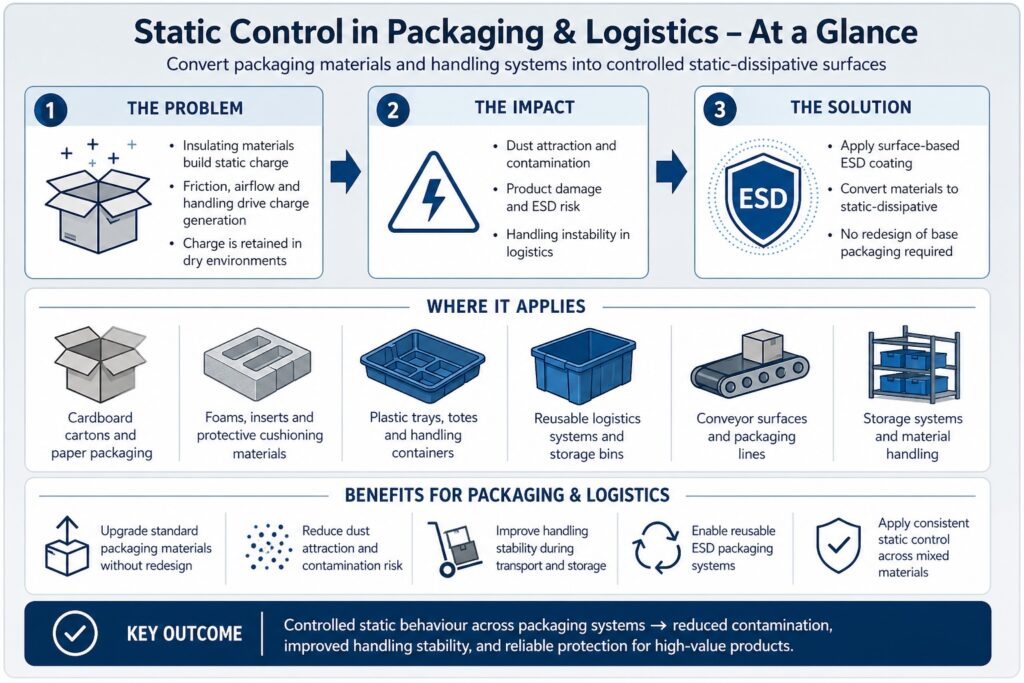
Convert packaging materials and handling systems into controlled static-dissipative surfaces
Packaging and logistics systems are often built from insulating materials that allow static charge to accumulate during handling and transport. Cartons, foams, trays, totes and handling equipment can generate and retain electrostatic charge through friction, airflow and movement.
This can lead to contamination, dust attraction, product damage and handling instability, particularly in electronics, cleanroom and high-value manufacturing environments.
Using the ProShieldESD coating platform, packaging materials and logistics systems can be converted into controlled static-dissipative surfaces without replacing the base material.
These challenges are addressed across different application routes within the ProShieldESD solutions structure.
Overview of how static is generated in packaging systems and how surface coatings convert standard materials into controlled static-dissipative solutions.
Where Static Occurs in Packaging Systems
Static generation is common throughout packaging and logistics processes, particularly where materials are lightweight and insulating.
Friction between packaging materials during packing and transport
Airflow across cartons, trays and protective covers
Handling and movement of products through logistics systems
Separation of materials during unpacking
Dry storage environments with low natural dissipation
Key point: Static control in packaging is not just about buying specialist packaging. It can also involve upgrading the surface behaviour of existing materials.
Benefits for Packaging and Logistics
Upgrade standard packaging materials without redesign
Reduce dust attraction and contamination risk
Improve handling stability during transport and storage
Enable reusable ESD packaging systems
Apply consistent static control across mixed materials
These benefits are useful where packaging and logistics materials are already suitable mechanically, but need improved electrostatic behaviour.
How SCH Services Supports Packaging Applications
SCH Services can support static control for packaging and logistics from early feasibility through to repeat coating work. The process starts with the material, handling conditions and required ESD performance.
Review of packaging material and handling process
Assessment of coating compatibility and durability requirement
Packaging and logistics systems are a major source of static generation, but they form part of a wider process. The correct approach depends on how materials are handled, how charge is generated, and whether the issue extends into plastics, equipment, work surfaces, facility areas or higher-risk environments.
SCH Services combines coating process experience, ESD application knowledge and practical production support to help customers evaluate and apply ProShieldESD correctly.
Technical guidance for packaging material assessment and coating selection
Trial coating and process evaluation before wider adoption
Support for reusable logistics and retrofit strategies
Experience with coatings used in industrial, electronics and controlled environments
Practical guidance for inspection, handling and verification
Disclaimer: This page provides general technical guidance only. Packaging suitability depends on material type, environment, handling conditions and required ESD performance. Final suitability must be confirmed through appropriate testing and validation.
0
Your current order total is £0.00 — you must have an order with a minimum of £75.00 to place your order.
0
Your Cart
Your cart is empty
Your current order total is £0.00 — you must have an order with a minimum of £75.00 to place your order.
Calculate Shipping
Your current order total is £0.00 — you must have an order with a minimum of £75.00 to place your order.