De-wetting in Conformal Coating
Why conformal coating pulls back into craters, islands and bare patches
De-wetting occurs when the wet conformal coating film refuses to wet the surface evenly and pulls back into craters, islands, fisheyes or bare patches.
In production this is most commonly driven by surface energy and contamination effects rather than thickness or cure alone.
This page explains how de-wetting forms, how to isolate the likely mechanism, and how to prevent recurrence. For the complete index of defect types, use the Conformal Coating Defects Hub.
Related article: De-wetting is often blamed on the coating itself, but repeated wetting failure usually points to wider weaknesses in cleaning, contamination control, handling, masking discipline or material preparation. For the broader process view, see Why Conformal Coating Processes Fail.
📄 Download: De-wetting defect bulletin (PDF)
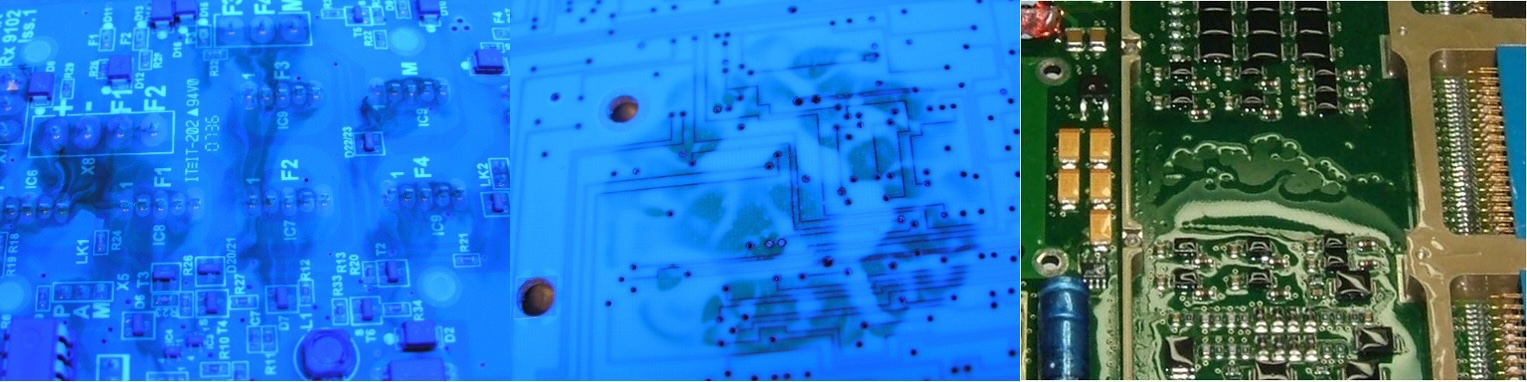
De-wetting in conformal coating: the wet film pulls back from low-surface-energy or contaminated areas, forming fisheyes, craters, islands of coating and exposed bare patches.
Article Quicklinks
| Topic | More |
|---|---|
| Definitions: what de-wetting is and why it matters | 🔗 |
| How it forms: mechanisms and tell-tale signs | 🔗 |
| Root Causes: contamination, materials, handling and PCB factors | 🔗 |
| Prevention: control window and upstream discipline | 🔗 |
| Troubleshooting: isolate the mechanism | 🔗 |
| Repair: when to touch-up vs strip and recoat | 🔗 |
What is De-wetting in Conformal Coating?
- Definition: the coating pulls away from the surface during application or flow to form craters, fisheyes, islands or exposed “windows”.
- Why it matters: exposed areas allow moisture and contamination onto the PCB, increasing the risk of corrosion and electrochemical migration in service.
- Common production reality: de-wetting is often intermittent because surface energy and contamination sources can change by batch, lot, shift or handling route.
How De-wetting Forms
- Low surface energy repulsion: the wet film avoids areas contaminated with oils, silicones, surfactants, plasticisers or release agents.
- Scavenging or migration: the coating preferentially wets higher-energy regions and pulls away from lower-energy regions.
- Substrate chemistry variation: solder mask or legend ink cure state, additives or lot variation can alter wetting response.
- Dynamic surface energy: temperature, dwell time, solvent exposure and humidity can shift wetting behaviour.
Surface energy note: De-wetting is the opposite of controlled hydrophobic surface behaviour. Low-energy surfaces can be useful when they are deliberately engineered to make water bead and roll off, but they can create coating problems when a liquid conformal coating is expected to wet and bond to the same type of surface. For the surface science behind this behaviour, see How Hydrophobic Coatings Work.
Pattern clue: if de-wetting mirrors text, ink, fiducials or specific solder mask regions, suspect PCB material or cure. If it appears as isolated fisheyes that do not track board features, suspect local contamination.
Root Causes of De-wetting
Contamination and handling
- Silicones: sprays, lubricants, release agents, RTV vapours, some masking products and certain gloves or creams.
- Oils and grease: fingerprints, machining oils, process oils, conveyor contamination or fixture contamination. See Fingerprints and Handling Contamination Before Conformal Coating for practical guidance on handling-related contamination before coating.
- Flux residues and soldering chemistry: particularly where cleaning and rinsing are marginal or inconsistent. For a practical production example, see Flux Residues Causing Conformal Coating Failure.
- Contaminated cleaning baths: contamination may be redistributed rather than removed.
A board can appear clean and still fail later through poor adhesion rather than immediate wetting failure. For a practical production example, see our insight Cleaning helps, but it does not guarantee adhesion. For the underlying mechanism, see why cleaning improves conformal coating adhesion.
PCB fabrication factors
- Solder mask cure state: under-cure can leave unreacted materials; over-cure can leave a glassy low-energy surface.
- Legend inks and screen print: incompatible binders, cure variation or additives can repel coating.
- Fabrication residues: processing aids, surfactants and release agents from PCB manufacture can be lot-related.
Process interactions that make it worse
- Pre-heat and temperature sensitivity: heat can mobilise contaminants or change wetting response.
- Solvent exposure and dwell time: wiping, partial cleaning or prolonged dwell can redistribute low-energy contamination.
- Masking as a trigger: masking choices can introduce low-surface-energy contamination or transfer agents. See masking causes most conformal coating defects. For a practical production example, see silicone contamination from masking materials.
- Correct masking does not prevent de-wetting: even where keep-out areas are properly protected, de-wetting, fisheyes, craters and thin coverage can still occur within the coated area if surface energy, contamination control or coating process stability is poor. See Why Perfect Masking Still Produces Conformal Coating Defects.
Common look-alikes
- If you see voids, bubbles or pits rather than coating pull-back, route to pinholes, bubbles and foam.
- If you see lifting or peeling after cure, route to delamination.
- If the surface is uniformly textured rather than showing bare patches, route to orange peel.
How to Prevent Conformal Coating De-wetting
Eliminate contamination sources
- Segregate silicones: ban silicone sprays and RTV handling near coating; control maintenance products and define no-silicone zones.
- Glove discipline: use consistent glove types, avoid powders and hand creams, and control handling between clean and coat.
- Masking discipline: qualify masking products for transfer risk and standardise approved materials.
Stabilise cleaning and dry-out
- Validated cleaning process: use effective rinsing and controlled dry-out.
- Bath control: monitor chemistry, contamination loading, change intervals and rinse performance.
- Witness coupons: run known-clean coupons or boards alongside production to catch upstream contamination shifts early.
Control PCB-related contributors
- Supplier escalation: if defects mirror solder mask or ink features, request cure verification, lot traceability and material review.
- Surface energy checks: where appropriate, use dyne pens or contact-angle testing on suspect regions.
For upstream controls that prevent multiple defect types, see Surface Preparation & Cleanliness for Reliable Coating. For the adhesion side of the same issue, see why cleaning improves conformal coating adhesion.
Troubleshooting and Diagnosis
1) Confirm the pattern
- Map where it occurs: compare solder mask, copper and legend ink. Good wetting on copper but not mask or ink indicates surface energy effects.
- Check whether it mirrors PCB features: if it tracks text, fiducials or mask regions, suspect ink, mask cure or fabrication residues.
- Observe the wet film: de-wetting is often easier to see during application and flash-off than after cure.
2) Test the likely drivers
- Surface energy check: use dyne or contact-angle methods on suspect regions.
- Thermal sensitivity: lightly pre-heat and observe changes, as contamination mobilisation and wetting shifts are common.
- Masking audit: review tapes, boots, dots, adhesives and nearby silicone sources.
- Cleaning audit: verify bath chemistry, rinse effectiveness, drag-out control and dry-out.
3) Separate board, process and application effects
- Witness coupons: run known-clean coupons alongside production. If coupons wet well but boards do not, the root cause is usually incoming PCB or component surface chemistry.
- Lot traceability: tie defects to PCB lot, supplier, date or process changes.
- Manual application check: where poor flow is only seen during brush coating, also consider whether viscosity has drifted during use. See our insight on controlled viscosity in brush conformal coating.
Inspection note: de-wetting is frequently missed if relying on UV fluorescence alone. White-light inspection during wet film and early flash-off is often more revealing. See the Inspection & Quality Hub.
If the surface appears clean but the coating later fails through lifting or poor bond strength, compare this with our related insight on adhesion failure after cleaning.
📄 If you want the condensed version for your team: download the PDF bulletin.
Repair: When to Touch-Up vs Strip and Recoat
- Small isolated craters: if the contamination source is removed and the surface can be re-cleaned or activated, local repair may be possible.
- Feature-tracking de-wetting: if the defect follows ink or mask patterns, local touch-up often repeats; strip and recoat after corrective action is usually required.
- Unknown contamination source: assume recurrence risk is high until the source is found and controlled.
For removal workflows and best-fit methods, see the Removal & Rework Hub.
Looking for Other Defect Types?
This page covers de-wetting, which is primarily a surface energy and contamination defect. For the complete index of defect types and links to each technical article, use the Defects Hub.
Industry Standards We Work To
SCH Services aligns coating services, training, equipment supply and materials to relevant IPC standards, including:
- IPC-A-610 – Acceptability of Electronic Assemblies
- IPC-CC-830 – Qualification and Performance of Conformal Coatings
- IPC-HDBK-830 – Conformal Coating Handbook
For further details on IPC standards: electronics.org/ipc-standards ↗
Explore Topic Hubs
Conformal Coating Processes Hub
Conformal Coating Equipment Hub
Conformal Coating Masking Hub
Conformal Coating Design Hub
Conformal Coating Defects Hub
Inspection & Quality Hub
Removal & Rework Hub
Why Choose SCH Services?
You gain a complete, integrated platform for Conformal Coating, Parylene and ProShieldESD, plus equipment, materials and training, backed by decades of hands-on process support.
- 🛠️ End-to-End Support – Selection, masking, inspection and troubleshooting.
- ✅ Process Discipline – Recipes, control windows and repeatability.
- 🌍 Global Reach – Support across Europe, North America and Asia.
📞 Call: +44 (0)1226 249019 | ✉ Email: sales@schservices.com | 💬 Contact Us ›