Mon - Thur 7.30-15.30   Fri 7.30-14.00

Permanent ESD Protection: What Lifetime Dissipation Really Means


Why long-term static control depends on stable dissipative behaviour, not short-term surface conductivity

Electrostatic discharge control is often treated as a product choice: apply an ESD paint or coating, achieve a resistance reading, and assume the surface is protected. In real applications, the more important question is whether that dissipative behaviour remains stable throughout the working life of the part, surface or environment.

This is where the idea of lifetime dissipation matters. A surface may pass an initial resistance test but still become unreliable if conductivity changes through wear, cleaning, contamination, humidity variation or breakdown of the conductive pathway.

For ProShieldESD applications, permanent protection does not mean dismissing ESD paints or ignoring validation. It means using an engineered static-dissipative coating approach where long-term stability, substrate compatibility and real operating conditions are central to the decision.

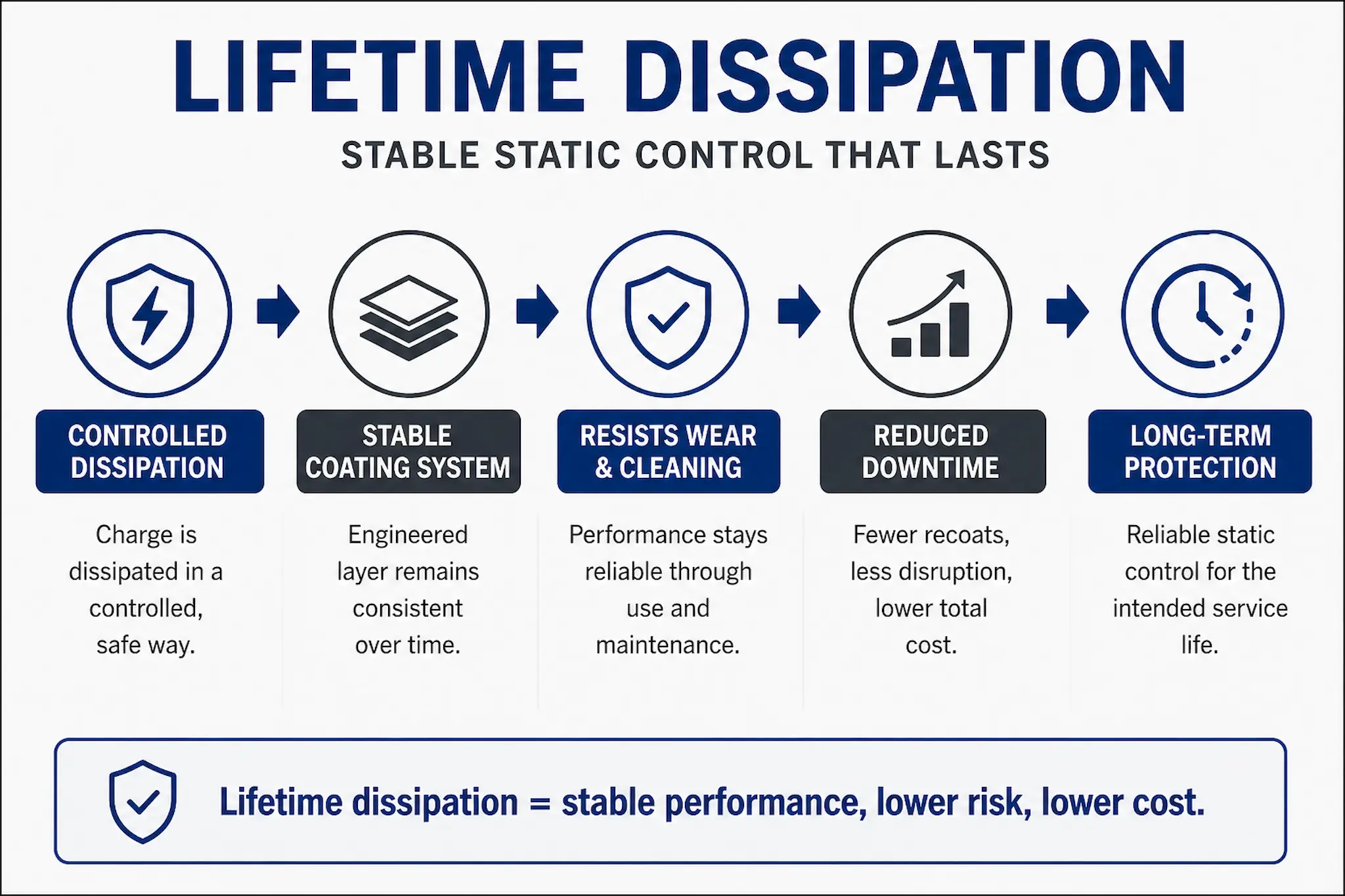
This diagram shows the difference between short-term surface conductivity and engineered lifetime dissipation in ESD coating systems.

Lifetime dissipation infographic showing stable ESD protection versus short term conductive coating performance

Lifetime dissipation focuses on stable, controlled static behaviour over time rather than short-term surface conductivity.

In practice, long-term ESD protection depends on maintaining controlled dissipative behaviour, not just achieving an initial resistance reading.

The Real Issue Is Not Paint vs Coating

The word paint is often used by customers because it is familiar. In many markets, โ€œESD paintโ€ simply means a surface-applied static-control coating. That language should not be ignored, because it reflects how people search, buy and describe the problem.

However, paint language can also make static control sound simpler than it really is. The technical question is not whether the product is called a paint or a coating. The real question is how the electrical behaviour is created, how stable it remains, and whether it is suitable for the application risk.

Key point: ESD paints, conductive coatings and engineered dissipative systems can all have a place. The difference is how reliable the static-control behaviour remains in real use.

The Problem with Short-Term Surface Conductivity

Traditional ESD paints and conductive coatings can be useful in the right application, especially where the risk is controlled, the environment is not aggressive and the surface can be inspected or maintained. The problem comes when an initial surface resistance reading is treated as proof of long-term protection.

Many conventional systems rely on conductive fillers such as carbon or metal particles. If the filler network becomes disrupted, uneven or exposed to wear, the surface can become inconsistent. In some environments, that creates both performance risk and maintenance cost.

Reality check: An ESD surface is only useful if its dissipative behaviour remains controlled where the risk actually exists.

  • Performance drift can occur if the conductive pathway changes over time.
  • Reapplication cycles increase cost, downtime and process disruption.
  • Wear and cleaning can affect surface resistance and consistency.
  • Filler-based systems may create contamination concerns in sensitive environments.
  • Low initial cost can become expensive if maintenance is frequent.

What Lifetime Dissipation Means

Lifetime dissipation means maintaining useful, repeatable static-dissipative behaviour for the intended working life of the coated item or surface. It is not just about making a surface conductive on day one.

In practical terms, lifetime dissipation means the coating system, substrate and operating environment must work together. The surface must stay within the required resistance range, dissipate charge in a controlled way and avoid becoming either too insulating or too conductive for the application.

  • Stable surface resistance over the intended service period
  • Controlled dissipation rather than uncontrolled conductivity
  • Reduced dependence on repeated repainting or reactivation
  • Compatibility with the substrate and operating environment
  • Validation against the required ESD performance target

How ProShieldESD Supports Permanent Static Control

The ProShieldESD coating platform is designed to create static-dissipative surfaces without relying on unstable filler distribution as the main performance mechanism. This allows controlled ESD behaviour to be engineered into a wide range of surfaces where long-term consistency matters.

That does not mean one coating specification is right for every application. Plastics, industrial equipment, floors, packaging, tools, fixtures and hazardous-area components all place different demands on adhesion, durability, cleaning resistance, flexibility and surface resistance.

The correct approach is to define the ESD target, understand the substrate, assess the environment and then validate the coating system under realistic conditions.

Permanent Does Not Mean Universal

Permanent ESD protection must be understood correctly. It does not mean that every coated surface becomes indestructible, maintenance-free or suitable for all environments. It means the dissipative behaviour is designed to remain stable for the defined application when the coating is correctly selected, applied and validated.

Some applications may still require abrasion testing, chemical resistance checks, cleaning validation, UV exposure assessment or periodic resistance monitoring. This is especially important where the surface is exposed to outdoor conditions, aggressive cleaning, mechanical wear or ATEX-related risk.

Important: Lifetime dissipation should be treated as an engineered performance requirement, not a marketing claim.

  • Substrate adhesion must be proven.
  • The required resistance range must be defined.
  • Cleaning and wear conditions must be understood.
  • Environmental exposure must be considered.
  • Critical applications should be tested before rollout.

ESD Paints, Coatings and Lifetime Dissipative Systems

Factor ESD Paint / Basic Conductive Coating Engineered Lifetime Dissipative Approach
Typical selection focus Achieving an initial surface resistance reading Maintaining controlled resistance over real use
Customer language Often searched for and described as ESD paint Better described as an engineered static-control coating system
Conductive mechanism Often filler dependent Designed around controlled dissipative behaviour
Risk point Performance may drift with wear, cleaning or environmental exposure Selected and validated around long-term stability
Maintenance May require repeated reapplication depending on use Aims to reduce reapplication cycles through stable performance
Best use case Simple, lower-risk or maintainable static-control areas Applications needing durable, validated ESD behaviour

Where Lifetime Dissipation Matters Most

Lifetime dissipative coatings are most useful where static-control failure would create reliability, safety, handling or production risk. The higher the consequence of ESD failure, the less sensible it becomes to rely only on a short-term surface reading.

Plastics

Useful where moulded or fabricated plastic parts need controlled static behaviour without changing the base material.

Industrial equipment

Supports static-control upgrades for surfaces, guards, housings, tooling and process equipment.

Packaging and handling

Helps reduce charge accumulation on trays, containers, boards, inserts and handling aids.

Hazardous areas

Requires careful assessment where static electricity may contribute to ignition risk or ATEX-related concerns.

Related ProShieldESD Guidance

For a broader explanation of the coating system, start with the ProShieldESD coating platform. For practical application routes, review the ProShieldESD applications page. For the difference between dissipative and conductive behaviour, see Static Dissipative vs Conductive Coating.

For selection guidance, see How to Choose the Right Static Control Approach. For substrate-specific applications, review anti-static coating for plastic components and ESD coating for explosive and ATEX environments.

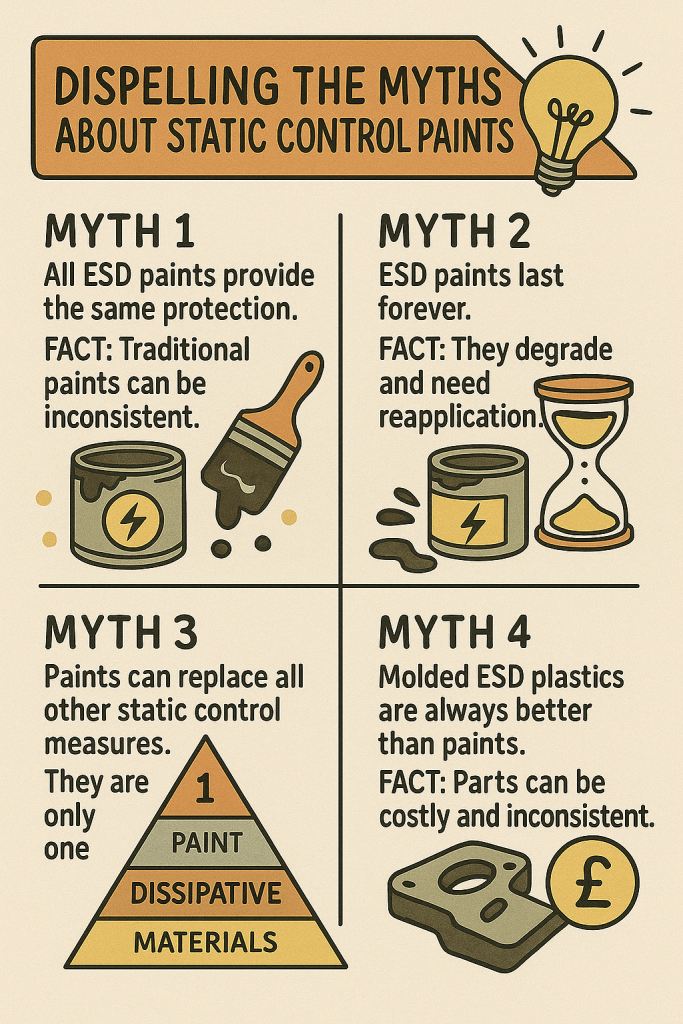
For supporting insight articles, see Dispelling the Myths About Static Control Paints and Why Carbon-Filled ESD Paints and Moulded Anti-Static Plastics Can Fail.

Why Choose SCH Services?

SCH Services helps customers select, test and apply coating systems where static control, coating durability and process reliability matter. We support projects from initial substrate review through sample evaluation, application development and production coating.

  • Technical support for ESD coating selection and validation
  • Experience with plastics, industrial equipment, packaging and specialist surfaces
  • Practical assessment of resistance targets, adhesion, wear and environmental exposure
  • Subcontract coating, development trials and process support available

Contact SCH Services to discuss a ProShieldESD coating application, sample evaluation or static-control requirement.

โ†‘ Back to top

Disclaimer: This article provides general technical guidance only. ESD coating selection, resistance targets, durability expectations and suitability for safety-critical or regulated environments must be validated against the relevant standards, substrate conditions, operating environment and qualification tests for the specific application.

Beyond Boxes and Fillers: Rethinking Static Control with ProShieldESD


Why traditional ESD approaches fail in real environments and how coating-based systems change the model

Electrostatic discharge (ESD) protection is essential across electronics manufacturing, aerospace, automotive and medical environments. However, many traditional solutions are designed to meet specifications in isolation rather than maintain stable performance during real use.

Common approaches such as carbon-filled moulded products and filler-based ESD paints can appear effective initially, but often introduce variability, wear-related degradation and limitations when scaled across full systems.

This creates a gap between compliance and real-world reliability โ€” particularly where surfaces, environments and usage conditions vary over time.

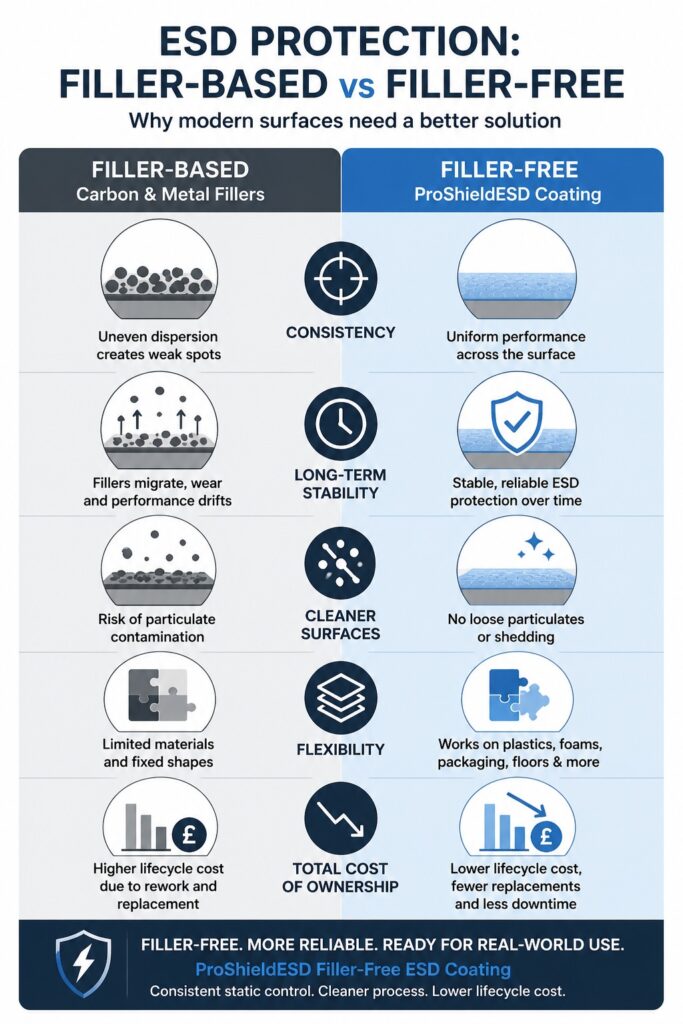
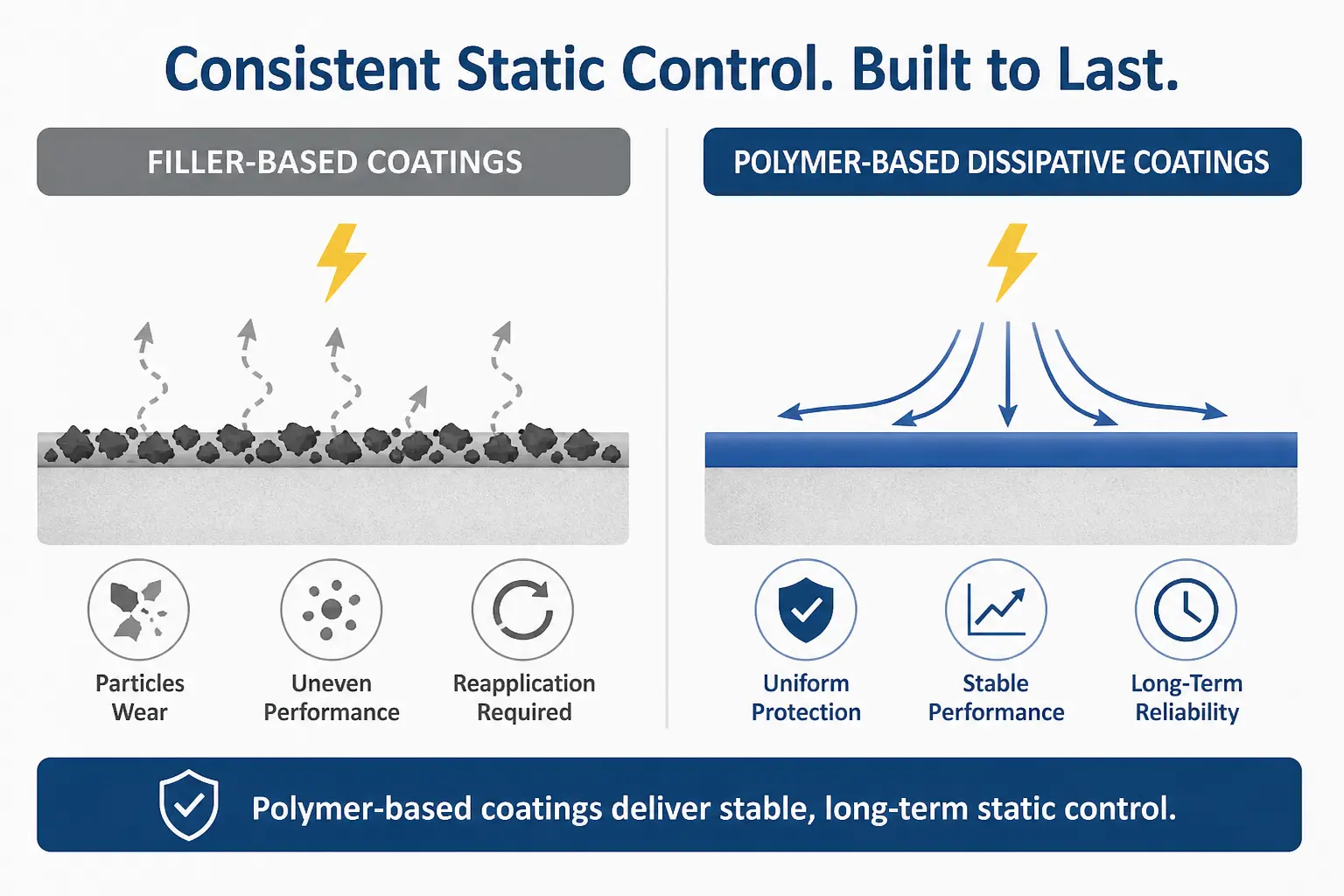
ESD coating comparison showing filler-based coatings vs polymer-based dissipative coating performance and stability

Filler-based ESD coatings rely on particle contact and can degrade over time, while polymer-based coatings provide stable, uniform static control

The Limitations of Traditional ESD Solutions

1) Moulded carbon-filled plastics

Carbon-filled boxes and moulded components provide fixed geometry solutions with embedded conductivity. While effective in controlled use cases, they are inherently inflexible and difficult to adapt across varied applications.

Surface performance can change with wear, contamination or handling, and scaling this approach across complex systems often results in inconsistent control.

2) Filler-based ESD coatings

Most ESD paints rely on carbon or metal fillers to create conductive pathways. These systems are mechanically dependent โ€” meaning performance is influenced by particle distribution, surface wear and environmental exposure.

Over time, fillers can migrate, wear or become unevenly distributed, leading to patchy conductivity, contamination risk and the need for reapplication.

3) Lack of system-wide compatibility

Traditional approaches struggle to provide consistent performance across plastics, foams, packaging, equipment and structural surfaces. This makes it difficult to standardise ESD control across an entire facility.

Most ESD failures are not immediate โ€” they emerge over time as materials wear, environments change and surface behaviour drifts outside controlled ranges.

A Different Approach: Polymer-Based Dissipative Coatings

ProShieldESD uses a polymer-based dissipative system rather than relying on conductive fillers. Instead of creating conduction through dispersed particles, the coating forms a controlled, uniform surface layer designed to maintain stable electrical behaviour.

This shifts ESD protection from a product-based approach to a surface engineering approach โ€” allowing static control to be applied directly where it is needed, rather than constrained by predefined shapes or materials.

Key characteristics

  • Uniform behaviour โ€“ consistent surface performance without dependence on filler distribution.
  • Reduced drift โ€“ designed to maintain stability under wear and environmental exposure.
  • Substrate flexibility โ€“ applicable across plastics, foams, packaging, equipment and floors.
  • Clean surface profile โ€“ avoids particle shedding associated with filler-based systems.

What This Means in Practice

Moving from discrete ESD products to coating-based surface control enables a more consistent and scalable approach to static management.

  • Reduced need for replacement of moulded ESD items.
  • Lower maintenance compared to repaint cycles.
  • Improved consistency across mixed materials and surfaces.
  • Greater control over how and where static behaviour is managed.

This is particularly relevant in environments where multiple materials, handling processes and environmental conditions interact.

Continue Exploring

Understanding ESD control requires looking beyond materials to behaviour and system design. The following resources expand on key concepts and solution pathways:

Why Choose SCH Services?

  • Process-led approach to static control, not just product supply
  • Capability across coatings, substrates and application methods
  • Support from concept through to implementation and validation
  • Integration with wider coating and surface engineering expertise

โ†‘ Back to top

This content is provided as general technical guidance. Final material selection and process validation should be confirmed through application-specific testing and relevant industry standards.

Why Parylene Coating Training Is Critical for Process Control and Reliability


Understanding why successful Parylene coating depends on people, process knowledge and controlled production behaviour

Parylene coating is often viewed as a machine-led vacuum deposition process. In practice, many of the problems seen in production are caused before or after deposition, not inside the chamber itself.

Adhesion failure, masking leakage, poor fixture design, uneven coating results, contamination and difficult rework are usually process-control problems. Training is therefore not just about learning how to operate a Parylene system. It is about understanding how each stage affects coating reliability.

This post explains why structured Parylene training is important for organisations building in-house capability or improving an existing process.

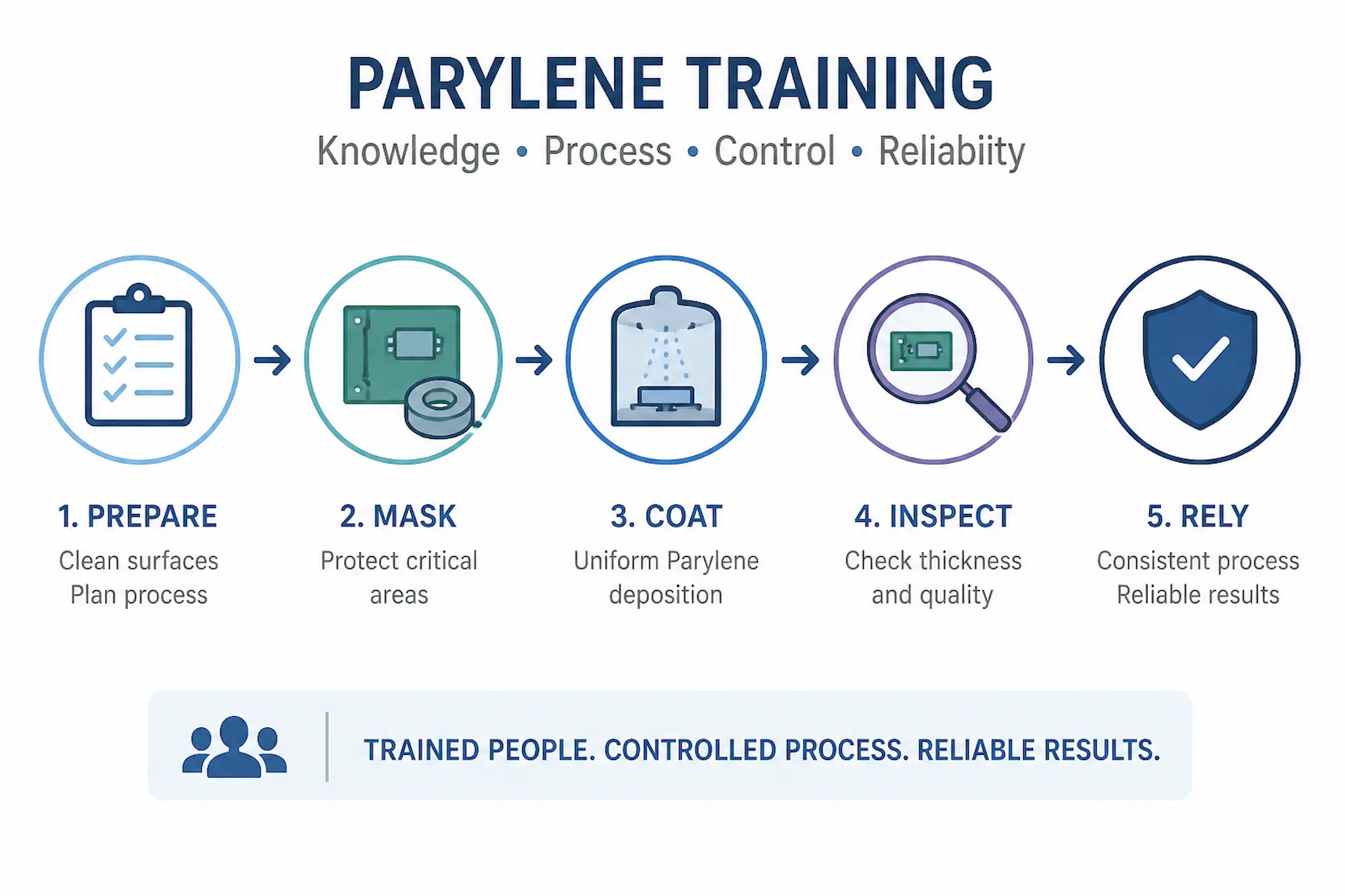
This simplified Parylene coating training model shows how each stage of the process contributes to final coating reliability.

Parylene coating training process showing preparation masking coating inspection and process control steps

Parylene coating training focuses on controlling each stage of the process, from preparation and masking through to inspection and repeatable production.

Where Parylene Processes Typically Go Wrong

Parylene is a high-performance coating, but it is not forgiving when the surrounding process is poorly controlled. Small weaknesses in preparation, handling or masking can create large reliability problems later.

Reality check: A good Parylene machine does not automatically create a good Parylene process. The process depends on preparation, masking, loading, inspection and operator judgement.

  • Surface contamination can reduce adhesion even when deposition parameters are correct.
  • Poor masking design can cause leakage, shadowing, difficult removal or component damage.
  • Incorrect fixturing can restrict vapour access or create inconsistent coating distribution.
  • Weak inspection methods can miss defects until qualification or field use.
  • No defined rework route can turn small production issues into expensive scrap.

Why Training Matters

Effective Parylene training helps operators, engineers and quality teams understand the full coating route rather than treating deposition as an isolated step.

Good training should connect the practical decisions made on the shop floor with the final coated result. This includes how parts are cleaned, how masking is selected, how fixtures are loaded, how coating thickness is checked and how defects are investigated.

For organisations introducing Parylene in-house, this reduces the learning curve. For established users, it helps identify process weaknesses before they become repeat production failures.

Core Areas a Parylene Training Programme Should Cover

A useful training programme should be practical, process-led and matched to the parts being coated. It should not only explain Parylene chemistry, but also how to control the process in real production.

Process Understanding

Parylene chemistry, vapour deposition principles, chamber behaviour and process limitations.

Preparation and Masking

Cleaning, handling, adhesion control, tapes, boots, plugs, fixtures and barrier strategies.

Inspection and Quality

Thickness measurement, visual inspection, defect recognition, documentation and process checks.

Rework and Repair

Controlled coating removal, local repair, restoration methods and risk management.

Training at Your Site or in a Controlled Facility

Parylene training can be delivered in different ways depending on the maturity of the process and the needs of the team.

Training at a specialist facility

Facility-based training allows operators and engineers to learn in a controlled production-style environment. This is useful when teams need to understand the complete coating workflow before applying the knowledge to their own products.

Training at the customer site

On-site training is often the stronger option when a team already has equipment installed, specific product families to coat or live process issues to solve. It allows training to be connected directly to the equipment, assemblies, masking methods and quality expectations used in production.

For organisations planning in-house capability, SCH provides dedicated Parylene training and support covering practical process control, operator knowledge and production readiness.

Training Should Continue After the Course

Parylene capability is built over time. The first training session gives the team a foundation, but real process strength comes from applying that knowledge to production parts, reviewing results and improving controls.

Ongoing support may include troubleshooting, process review, masking improvements, inspection guidance, fixture development and support for unusual or sensitive assemblies.

Where the process is still being developed, it is also useful to connect training with wider Parylene coating solutions, including coating services, equipment support, masking and process development.

Why Choose SCH Services?

SCH Services supports manufacturers with practical coating knowledge, process development and hands-on production experience across conformal coating, Parylene and advanced functional coatings.

  • Practical support from coating engineers, not generic classroom-only training.
  • Experience with masking, inspection, rework, repair and process control.
  • Support for organisations developing or improving in-house coating capability.
  • Clear route from training into process support, coating services or equipment implementation.

To discuss a Parylene coating training requirement, contact SCH Services through the contact page.

โ†‘ Back to top

Disclaimer: This article is general technical guidance only. Parylene process decisions, training requirements and production controls should be assessed against the specific assembly, coating specification, reliability requirements and applicable qualification standards.

Why Does Cleaning Improve the Adhesion of a Conformal Coating?


Understanding how surface condition controls coating adhesion

For conformal coatings to perform effectively, good adhesion to the substrate is essential. Without it, coatings can delaminate, allow moisture ingress, or fail under thermal or environmental stress.Adhesion is not governed by a single mechanism. Instead, it is the result of several interacting effects at the interface between the coating and the substrate. Cleaning plays a critical role because it directly influences all of these mechanisms.

The three primary mechanisms that contribute to conformal coating adhesion are:

  1. Adsorption (wetting and surface contact)
  2. Chemical bonding
  3. Mechanical interlocking

Adsorption (Wetting and Surface Contact)

Adsorption occurs when the conformal coating wets the substrate surface and spreads to form intimate contact. At this interface, weak intermolecular forces (van der Waals forces) create adhesion.

This mechanism is highly sensitive to contamination. Even very thin films of residue can prevent proper wetting, leading to de-wetting, poor coverage and weak adhesion.

Cleaning removes these barriers, allowing the coating to spread uniformly and maximise contact with the substrate.

Chemical Bonding

Chemical bonding occurs when molecular interactions form at the interface between the coating and the substrate. These bonds provide stronger adhesion than adsorption alone.

If contaminants such as flux residues, oils or cleaning by-products remain on the surface, they can block or interfere with these reactions.

By removing contamination, cleaning enables the coating to interact directly with the substrate, improving the likelihood of effective chemical bonding.

Mechanical Interlocking

Mechanical interlocking occurs when the liquid coating flows into microscopic surface features and anchors itself as it cures.

Surface condition plays a key role. A completely smooth or contaminated surface reduces the effectiveness of this mechanism, while a clean surface with appropriate micro-roughness improves anchoring.

Cleaning ensures that surface features are accessible to the coating rather than being filled or masked by residues.

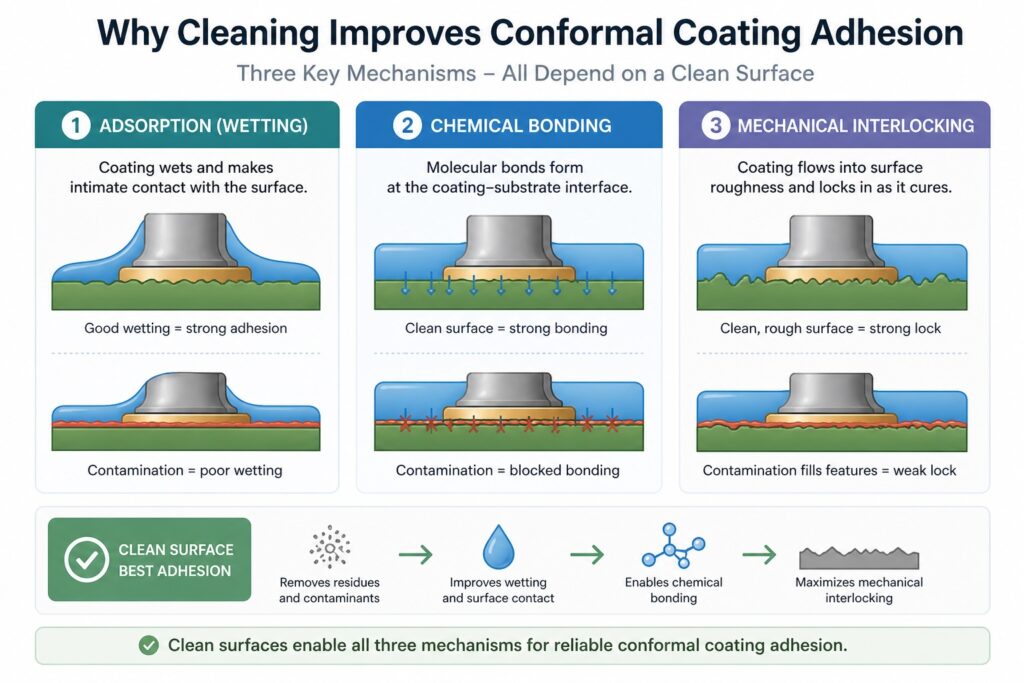
How cleaning improves conformal coating adhesion through wetting, chemical bonding and mechanical interlocking
Cleaning improves conformal coating adhesion by enCleaning enables wetting, chemical bonding and mechanical interlocking, improving conformal coating adhesion.

Why Cleaning Has Such a Strong Effect on Adhesion

All three adhesion mechanisms are influenced by surface cleanliness. Contamination can:

  • Prevent wetting and reduce surface contact
  • Block chemical interactions at the interface
  • Fill surface features, reducing mechanical anchoring

As a result, even surfaces that appear visually clean may still exhibit poor adhesion if invisible residues remain.

In most cases, adhesion failures are not coating problems โ€” they are surface preparation problems.

Achieving Reliable Conformal Coating Adhesion

Not all adhesion mechanisms need to be dominant in every system. Depending on the coating chemistry, substrate and application method, different mechanisms may contribute more strongly.

However, good wetting (adsorption) is almost always a prerequisite for effective adhesion.

For this reason, the most reliable approach is simple:

If in doubt, improve surface cleanliness before adjusting coating parameters.

Learn More About Surface Preparation and Adhesion

Effective surface preparation and cleanliness are critical for conformal coating reliability. Contaminants such as flux residues, oils and ionic salts can lead to adhesion loss, corrosion or electrical leakage.

For a detailed guide, see Surface Preparation & Cleanliness for Reliable Conformal Coating, covering cleaning methods, cleanliness testing, adhesion promoters and industry standards.

If you need support with coating adhesion or process development, contact us to discuss your application.

Plasma Cleaning for Conformal Coating & Parylene: What It Actually Fixes (and What It Doesnโ€™t)


When plasma cleaning improves coating adhesion โ€” and when it doesnโ€™t

Plasma cleaning is widely promoted as a universal solution for adhesion โ€” but in practice, its effectiveness depends entirely on the underlying failure mechanism. Used correctly, plasma is one of the most effective tools available for improving coating adhesion and surface performance. Used incorrectly, it adds cost and complexity without solving the underlying problem.
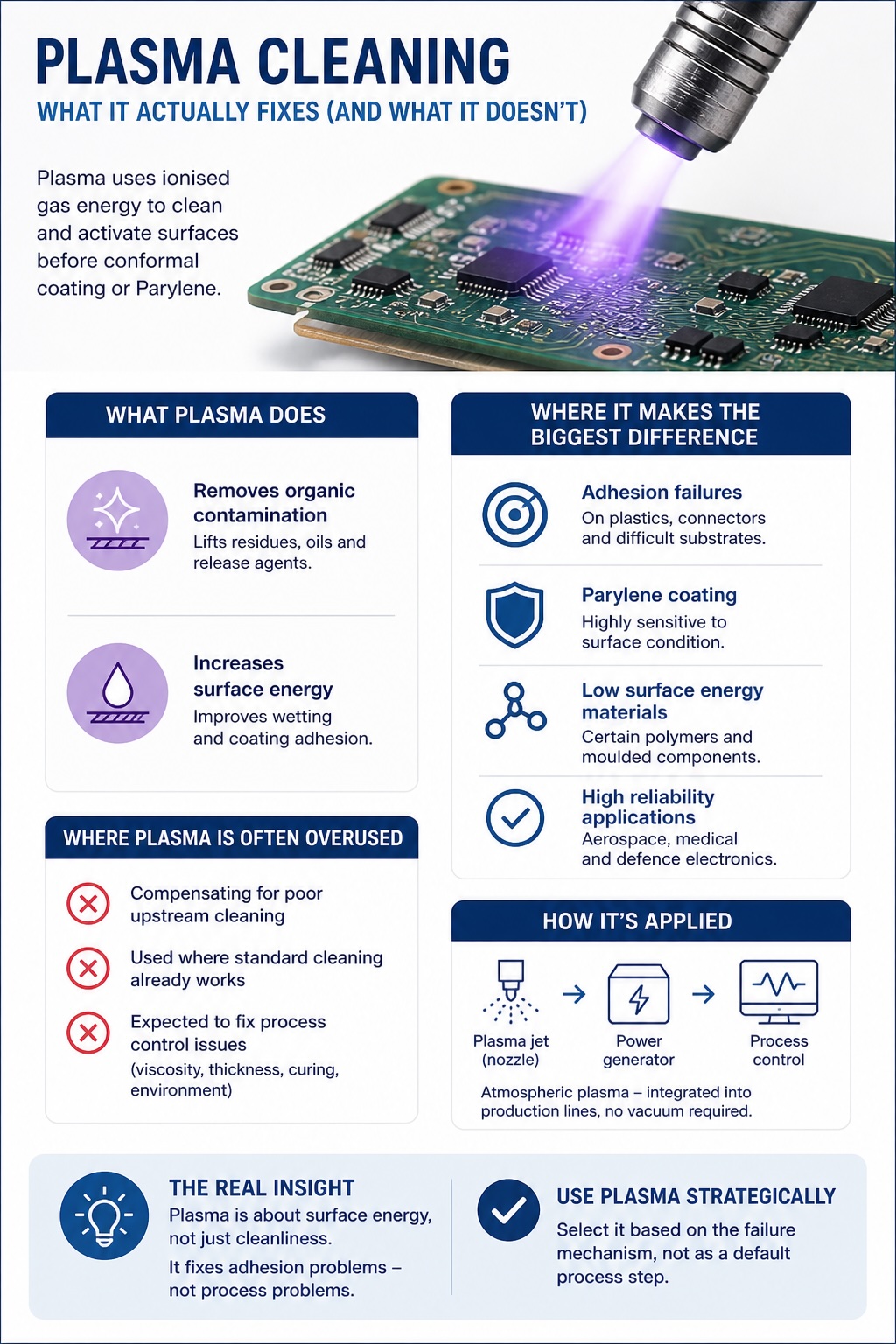
Plasma cleaning infographic showing surface activation, contamination removal and its role in improving conformal coating and Parylene adhesion on PCB assemblies
Plasma cleaning improves surface energy and removes contamination, enabling reliable adhesion for conformal coating and Parylene processes

Quick Takeaway

  • Plasma improves adhesion by increasing surface energy, not just cleaning
  • It is most effective on low-energy materials and adhesion-critical applications
  • It does not fix process instability (viscosity, thickness, curing)
  • Use plasma based on failure mechanism โ€” not as a default step

What Plasma Cleaning Actually Does

Plasma is an energy-rich ionised gas (often referred to as the fourth state of matter) created by applying electrical energy to a gas. When applied to a surface, it interacts at a molecular level. In conformal coating and Parylene processes, plasma does two key things:

  • Removes organic contamination โ€“ including light residues, oils and some release agents that interfere with coating adhesion (see surface preparation and cleanliness)
  • Increases surface energy โ€“ making the surface more โ€œwettableโ€, allowing coatings to spread and bond more effectively

This second effect โ€” surface activation โ€” is often more important than the cleaning itself.

Different plasma gases can produce very different cleaning, activation and oxidation effects. Oxygen, argon, nitrogen and mixed-gas plasma processes do not behave the same way on PCB assemblies or polymer surfaces. For a deeper technical explanation, see How Plasma Gas Chemistry Changes PCB Surface Preparation Before Parylene.

Why Plasma Works When Solvent Cleaning Doesnโ€™t

Traditional cleaning methods (IPA wipes, solvent washes) remove bulk contamination, but they do not fundamentally change the surface energy of a material. This is why coatings can still fail after โ€œcleanโ€ processing:

  • Low surface energy plastics resist wetting
  • Thin contamination layers remain undetected
  • Surface chemistry prevents proper bonding

Plasma addresses these limitations by modifying the surface at a molecular level, not just removing visible contamination.

Where Plasma Cleaning Makes the Biggest Difference

Plasma treatment is most valuable in specific, high-risk scenarios:

  • Adhesion failures โ€“ particularly on plastics, connectors and difficult substrates
  • Parylene coating โ€“ where adhesion is highly sensitive to surface condition
  • Low surface energy materials โ€“ such as certain polymers and moulded components
  • High-reliability applications โ€“ aerospace, medical and defence electronics

In these cases, plasma can significantly improve coating consistency and long-term reliability.

Where Plasma Cleaning Is Often Overused

Plasma is not a universal solution. In many cases, it is introduced without addressing the real root cause of coating issues. Common misapplications include:

  • Using plasma to compensate for poor upstream cleaning
  • Applying plasma where standard cleaning already provides sufficient adhesion
  • Expecting plasma to fix process control issues (viscosity, thickness, curing, environment)

If the coating process itself is unstable, plasma will not fix it. Issues such as viscosity control, curing behaviour and thickness variation must be addressed at a process level (see process control fundamentals).

Atmospheric Plasma vs Vacuum Plasma

For conformal coating and Parylene pre-treatment, atmospheric plasma is commonly used because it can be integrated directly into production lines. Typical systems include:

  • Plasma jets or nozzles (manual or robotic)
  • Power generators controlling plasma energy
  • Process control systems for repeatability

This allows targeted treatment of specific areas without the need for vacuum chambers. For further technical background on plasma physics and ionisation processes, see plasma (physics).

The effectiveness of both atmospheric and vacuum plasma systems also depends heavily on the selected gas chemistry and the interaction with the substrate materials being treated. Different gases can produce very different activation and oxidation behaviour during preparation.

The Real Insight: Plasma Is About Surface Energy, Not Just Cleanliness

The biggest misunderstanding in plasma cleaning is treating it as a โ€œbetter cleaning methodโ€. In reality, its primary role is surface activation โ€” changing how a coating interacts with the substrate. This is why plasma can transform coating performance in some cases, while making little difference in others. If the failure mechanism is adhesion-related, plasma can be critical. If the failure mechanism is process-related, plasma is irrelevant.

Need Help Understanding Whether Plasma Is Required?

Plasma cleaning should be selected based on the failure mechanism, not added as a default process step. If you are seeing adhesion issues, de-wetting, or inconsistent coating behaviour, we can help determine whether plasma is the right solution โ€” or whether the issue sits elsewhere in the process (see common coating failure causes). Contact us to discuss your application.

This content is provided for general technical guidance only. Coating performance depends on specific materials, design, environment and process controls. All solutions should be validated through testing and qualification before production use.

Hybrid ALD/CVD Coatings for LED Protection โ€“ Where Do They Really Fit?


Understanding the role of ultra-thin coatings in LED protection without the hype

Protecting LEDs from long-term exposure to harsh environments is becoming increasingly critical, particularly for outdoor and high-reliability applications. Moisture, salt, UV exposure and thermal cycling all create failure risks that must be managed through coating selection.

There are already multiple established protection strategies including Parylene, liquid conformal coatings, ultra-thin fluoropolymers and encapsulation. Each offers advantages, but all involve trade-offs between protection level, process complexity, optical performance and cost.

Hybrid ALD (Atomic Layer Deposition) / CVD (Chemical Vapour Deposition) coatings are often presented as a new alternative. The key question is not whether they are interesting, but where they realistically fit alongside existing coating technologies.

What is a Hybrid ALD/CVD Coating?

Hybrid coatings combine two thin-film deposition techniques into a layered structure.

  • CVD (used in Parylene) deposits a conformal coating in a vacuum environment
  • ALD deposits extremely thin, controlled layers at atomic scale

In hybrid systems, these layers are applied sequentially to build a multi-layer film. The structure is fundamentally different from traditional coatings, as properties can be engineered layer-by-layer rather than relying on a single material.

The result is an ultra-thin coating system, typically in the nanometre range, with tailored barrier, adhesion and surface properties.

Compare this with traditional coating approaches โ†’

Why is this approach relevant for LEDs?

LED protection introduces constraints that are not always present in standard PCB coating.

  • Optical clarity โ€“ coatings must not reduce light output
  • UV stability โ€“ long-term outdoor exposure
  • Moisture resistance โ€“ prevention of corrosion and failure
  • Thermal stability โ€“ cycling and elevated temperatures

Hybrid coatings are often positioned as suitable because they are extremely thin, highly transparent and can provide good barrier performance relative to thickness.

In applications where traditional coatings create optical or masking challenges, this type of approach becomes more attractive.

Masking Reduction โ€“ Not Elimination

One of the most common claims is that hybrid coatings do not require masking due to their extremely low thickness.

Reality check: Ultra-thin coatings can reduce masking requirements, but they do not remove interface risks completely. Connectors, contact surfaces and critical electrical interfaces still require validation.

Whether masking can be reduced depends on:

  • Connector design and contact force
  • Electrical sensitivity of interfaces
  • Long-term wear and fretting behaviour
  • Customer acceptance criteria

In practice, masking strategy becomes an engineering decision rather than being eliminated entirely.

Performance Compared to Established Coatings

Hybrid coatings are often compared with Parylene and liquid conformal coatings. The comparison is not simply performance-based, but application-dependent.

  • Hybrid coatings โ€“ ultra-thin, optically clear, engineered film structure
  • Parylene โ€“ proven barrier performance and long-term reliability
  • Liquid coatings โ€“ scalable, robust and well understood processes

Hybrid coatings can offer advantages in specific LED applications, particularly where optical performance is critical. However, established coatings still dominate in many applications due to proven reliability and process maturity.

The decision is not which coating is โ€œbestโ€, but which is most appropriate for the application and risk profile.

Process and Cost Considerations

Hybrid ALD/CVD processes are often described as low cost due to reduced masking and simple operation. However, real cost depends on the full system.

  • Equipment investment and process control requirements
  • Throughput and batch size limitations
  • Cycle time and scalability
  • Validation and qualification requirements

While operator interaction may be simple, the overall process must be evaluated at production scale rather than individual step level.

For surface preparation prior to coating, see plasma cleaning for conformal coating, which explains how plasma is used to improve adhesion and surface energy.

Where Hybrid Coatings Actually Fit

From a practical engineering perspective, hybrid ALD/CVD coatings are best positioned as a specialist solution rather than a universal replacement.

  • Suitable for optically sensitive applications such as LEDs
  • Useful where ultra-thin coatings provide a design advantage
  • Complementary to existing coating technologies

For most applications, coating selection remains driven by environment, geometry, process capability and reliability requirements.

In many cases, structured coating strategies using established materials remain the most robust approach.

Final Perspective

Hybrid ALD/CVD coatings represent a technically interesting development, particularly for LED protection where optical and environmental requirements must be balanced.

However, they should be viewed as part of a broader coating strategy rather than a direct replacement for Parylene or conformal coatings.

The key is selecting the right coating approach for the application, not chasing a single โ€œbestโ€ material.

Need support selecting the right coating approach?

SCH supports coating selection, process design and validation across conformal coatings, Parylene and hybrid strategies.

Contact us to discuss your application.

โ†‘ Back to top

Note: This article provides general technical guidance only. Final design, safety and compliance decisions must be validated against application requirements and relevant standards.

What is Plasma Coating?


Where plasma-deposited nano films fit in surface engineering and electronics protection

Plasma coating is a surface treatment process in which a reactive coating precursor is introduced into a plasma and deposited onto a substrate as an ultra-thin functional film. It is typically used where very low film thickness, tailored surface behaviour or specialist adhesion performance is required.

In practical terms, plasma coating is not the same as traditional conformal coating and it is not the same as Parylene deposition. It belongs more to the world of surface engineering, where the goal is often to modify how a surface behaves rather than build a thick physical barrier.

That makes plasma coating interesting, but also easy to misunderstand. The key question is not whether it is advanced, but where it actually fits and what problems it is designed to solve.

Plasma treatment of the surface of a circuit board before conformal coating

How plasma coating works

In a plasma coating process, a precursor material is introduced into a plasma zone, often through a jet nozzle or controlled gas-phase system. The plasma activates the chemistry, increasing its reactivity and allowing it to bond to the substrate surface more effectively.

This process can be adjusted for different materials including metals, glass, ceramics and plastics. Depending on the chemistry used, the resulting film can be tailored to create different surface properties such as water repellence, improved adhesion or barrier enhancement.

Because the film is extremely thin, plasma coating is usually used to change surface function rather than build the kind of thick protective layer associated with conventional conformal coatings.

Important: Plasma coating should not be confused with plasma surface preparation. Plasma preparation activates or cleans a surface before coating, while plasma coating deposits a functional film onto the surface itself.

What plasma coatings can do

Plasma-deposited coatings are typically used to alter surface behaviour in a very targeted way. Depending on the chemistry and process design, they can be made hydrophobic or hydrophilic and can improve how a surface performs in later manufacturing or service.

  • Barrier improvement for selected plastic or functional surfaces
  • Adhesion improvement for bonding or paint application
  • Release properties for tooling and mould-related applications
  • Corrosion resistance support where ultra-thin barrier behaviour is beneficial
  • Surface energy modification to improve how a material interacts with liquids, adhesives or later coatings

These are specialist functions. They are not direct equivalents to the role of a conventional PCB conformal coating.

Where plasma coating fits in electronics

In electronics, plasma coating is best understood as a niche or specialist surface engineering option rather than a mainstream replacement for conformal coating. It may be relevant where very thin deposited functionality is needed, but it does not automatically replace the insulation, thickness or physical protection provided by traditional coating systems.

That is why it is important to compare it in the right way. If the real need is full electrical insulation, environmental barrier performance or robust film build, then conventional conformal coatings or Parylene may still be the more appropriate technologies.

For a broader comparison of established protection strategies, see Parylene vs Conformal Coating: How to Choose the Right Protection for Electronics.

What plasma coating does not replace

Plasma coating is often interesting because it is thin, highly engineered and flexible at surface level. But those same features also mean it should not be overstated.

  • It does not automatically replace conformal coating where thickness and dielectric protection are required
  • It does not automatically replace Parylene where true conformal vapour-deposited coverage is needed
  • It does not remove the need for proper process selection, testing and validation

Like other advanced thin-film technologies, it is best viewed as a specialist tool for specific problems rather than a universal answer.

Reality check: If the requirement is mainstream PCB protection in a harsh environment, plasma coating is usually not the first question to ask. The first question is what level of barrier, insulation, coverage and process control the product actually needs.

Final perspective

Plasma coating is a legitimate and highly specialised surface engineering technology. Its value lies in controlled surface modification, ultra-thin deposited functionality and application-specific performance tuning.

For most electronics users, the important thing is understanding where it fits relative to better-known technologies such as conformal coating and Parylene. The goal is not to use the most advanced process available, but to select the process that matches the product, environment and manufacturing reality.

If you are trying to choose between different protection strategies, it is usually better to start with the function required and then work back to the most appropriate coating technology.

Need help reviewing a coating or surface protection problem?

SCH supports customers with coating selection, process review and technical guidance across conformal coating, Parylene and specialist protection strategies.

Contact us to discuss your application.

โ†‘ Back to top

Note: This article provides general technical guidance only. Final design, process and compliance decisions must be validated against the actual substrate, coating chemistry and application requirements.
0
  • Your current order total is £0.00 โ€” you must have an order with a minimum of £75.00 to place your order.
0
Your Cart
Your cart is empty
  • Your current order total is £0.00 โ€” you must have an order with a minimum of £75.00 to place your order.
Calculate Shipping
  • Your current order total is £0.00 โ€” you must have an order with a minimum of £75.00 to place your order.

Conformal Coating UK

Technical banner showing PCB and process icons representing conformal coating, masking, inspection and training on the SCH technical knowledge hub.
Conformal Coating UK
Privacy Overview

This website uses cookies so that we can provide you with the best user experience possible. Cookie information is stored in your browser and performs functions such as recognising you when you return to our website and helping our team to understand which sections of the website you find most interesting and useful.