Mon - Thur 7.30-15.30   Fri 7.30-14.00

De-Wetting Seen After Cleaning โ€” When โ€œCleanโ€ Isnโ€™t Clean Enough


Why De-Wetting Occurs After Cleaning

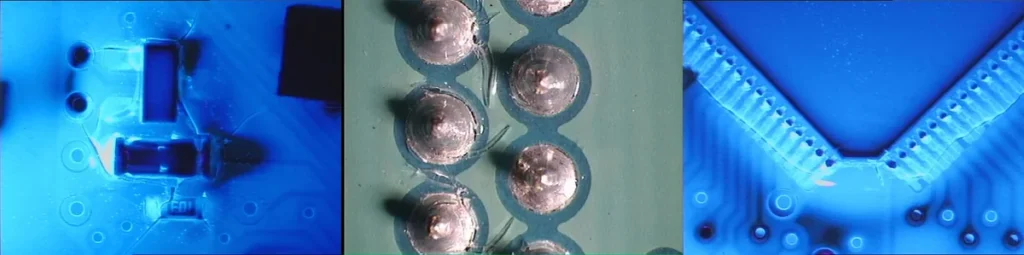
A common inspection finding is localised de-wetting of conformal coating, particularly on solder joints or around component leads, even when a cleaning process has been applied beforehand.

This behaviour, commonly referred to as conformal coating de-wetting, is not caused by poor application technique. Instead, it is typically driven by surface energy inconsistencies at the substrate level.

When โ€œCleanโ€ Isnโ€™t Actually Clean

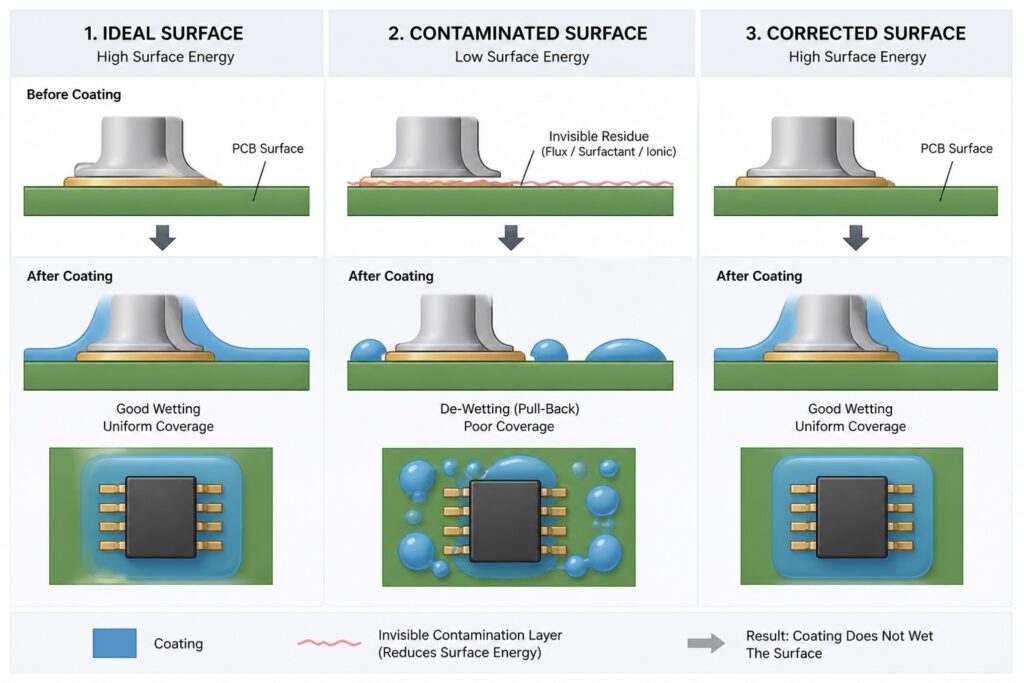
In many cases, the boards are genuinely clean in a visual sense. However, de-wetting is often caused by residues that are invisible to the naked eye โ€” including low-level ionic contamination, surfactant residues from aqueous cleaning, or incompatible cleaning chemistries that leave behind thin boundary films.

Typical Signs of De-Wetting

  • Circular pull-back around solder joints
  • Patchy coating coverage on ENIG or HASL finishes
  • Repeatable locations across multiple assemblies
Conformal coating de-wetting caused by surface contamination and low surface energy
De-wetting occurs when invisible contamination reduces surface energy, causing coating pull-back rather than uniform wetting.

Why Process Control Matters More Than Application

From a process perspective, this is not something that can be corrected through spray parameters alone. Surface preparation, cleaning chemistry selection and rinse quality are far more influential than coating application settings.

Not a Cosmetic Issue

Crucially, de-wetting should never be treated as cosmetic. It is a clear indicator of a surface energy problem and should always trigger escalation and investigation rather than acceptance.

Most de-wetting issues originate upstream of coating โ€” in cleaning, handling or material compatibility โ€” not within the coating process itself.

For detailed causes, acceptance criteria and corrective actions, see our Defects Hub guidance on de-wetting in conformal coating.

Understand how process control influences coating performance and defect formation.

Why Conformal Coating Wicks Along Wire Strands โ€” A Field Observation


During inspection of coated assemblies, we occasionally observe conformal coating creeping along exposed wire strands well beyond the intended coated area. This is often flagged as โ€œover-applicationโ€, but in practice the root cause is usually more subtle.

This behaviour, commonly referred to as conformal coating wicking, is driven by capillary action rather than excessive application.

In this scenario, the coating is not flowing excessively during application. Instead, capillary forces draw low-viscosity material along fine wire strands, braid structures, or conductor interfaces after deposition. This effect is amplified where flux residues, incomplete cleaning, or high surface energy materials are present.

We most often see this behaviour:

  • At wire terminations and soldered pigtails
  • Where insulation stripping exposes fine conductor bundles
  • When low-viscosity acrylics or urethanes are used without sufficient flash-off

From a process perspective, this is not something that can be โ€œsprayed outโ€. Masking strategy, cleanliness, and controlled flash times are far more influential than spray parameters alone.

For definitive technical guidance on this phenomenon, see our Defects Hub page on capillary wicking in conformal coating.

ProShieldESD Live ESD Testing Results at Productronica


Measured ESD coating performance across floors, packaging, tools, mats, plastics and handling materials

ProShieldESD is a filler-free conductive polymer ESD coating designed to create repeatable static-control behaviour across a wide range of materials.

Live testing at Productronica 2025 provided practical evidence of how the coating performs on real substrates including tile, PP flute board, carton, EVA foam, PVC matting, plastic cases, storage bins, brushes and pens.

This page summarises the measured results and shows where ProShieldESD can support controlled ESD-safe environments beyond conventional benches and mats.

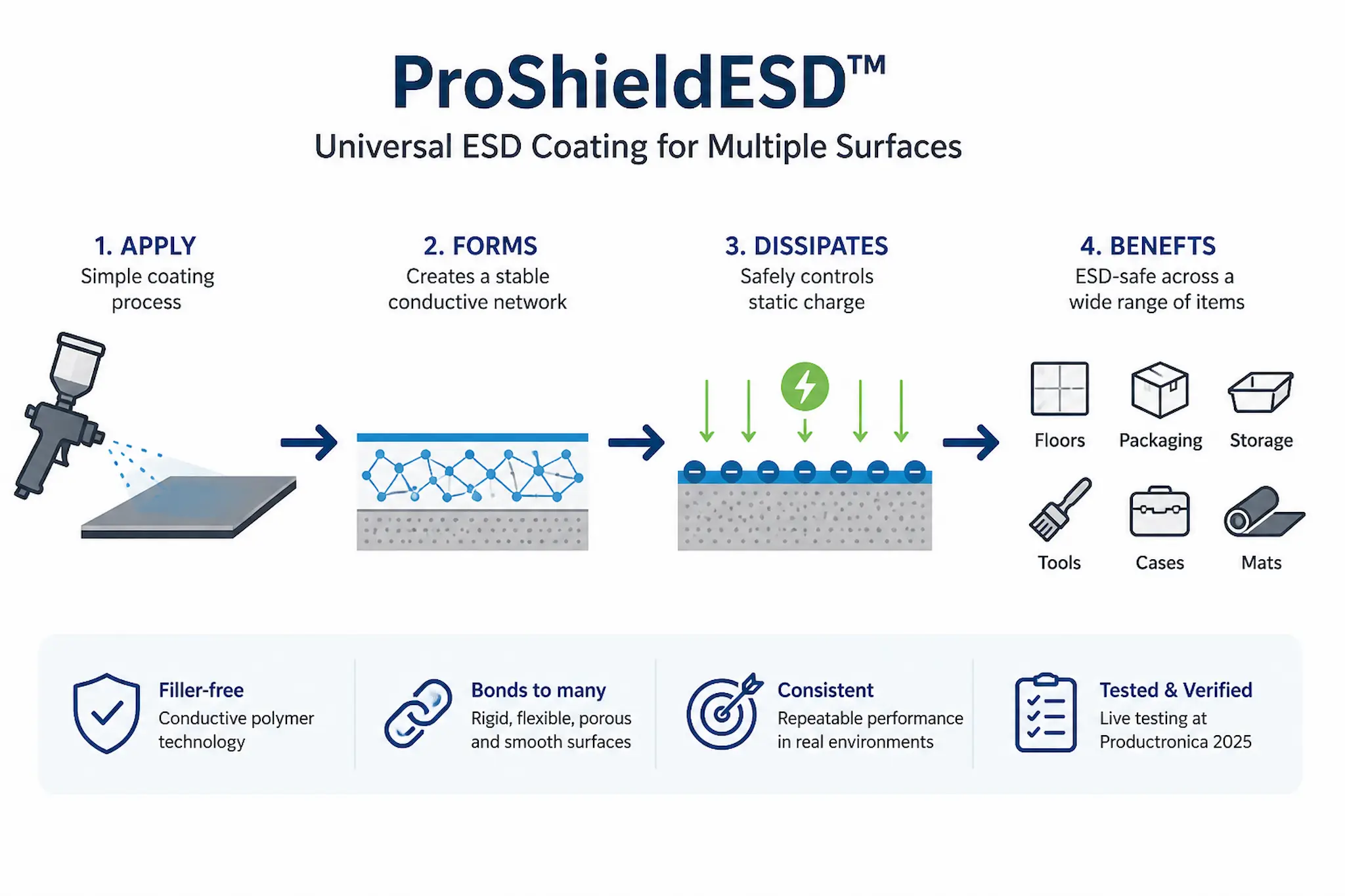
ProShieldESD coating process showing application, conductive network formation and static dissipation across multiple materials

Simple overview showing how ProShieldESD forms a conductive network and dissipates static charge across different materials

Why this testing matters

Many ESD control systems rely on specialist materials, filled plastics, carbon-loaded coatings or temporary surface treatments. These approaches can work, but they often behave differently depending on substrate, wear, environment and application method.

ProShieldESD is designed as a single coating platform that can convert ordinary materials into controlled static-dissipative surfaces.

This makes it useful where manufacturers need to upgrade packaging, flooring, handling aids, storage, fixtures, tools or plastic components without redesigning the whole environment.

Key point: the value of ProShieldESD is not only that it makes one surface dissipative, but that it can create controlled ESD behaviour across many different workplace materials.

Live testing method

The Productronica demonstration used the sparktrapยฎ EPA SafeAssureยฎ from Keinath Electronic GmbH, Germany.

The instrument was used to evaluate coated and reference materials under controlled exhibition conditions using standards-oriented ESD measurement methods.

Measurement capability

  • Flat weight probe for surface resistance
  • Concentric ring probe for surface resistivity
  • Precision 2-point probe for small objects
  • Integrated temperature, humidity and voltage monitoring
  • High-stability 100 V measurement mode
  • IEC 61340 and ANSI/ESD S20.20 oriented evaluation

Environmental conditions

  • Temperature: 22โ€“23 ยฐC
  • Relative humidity: 53โ€“55% RH
  • Test voltage: 100 V

Measured ProShieldESD results

The results show controlled dissipative behaviour across a broad range of coated materials.

Most materials measured within the practical static-dissipative range used for ESD-safe environments, packaging, handling systems and workplace accessories.

Material Average resistance Scientific notation Assessment Technical note
Flooring tile with ProShieldESD 1.501 Mฮฉ 1.5 ร— 10โถ ฮฉ Excellent Strong ESD floor range for controlled discharge.
PP flute board 4.778 Mฮฉ 4.8 ร— 10โถ ฮฉ Very good Stable dissipative range suitable for packaging and handling.
Coated carton box 741.9 Mฮฉ 7.4 ร— 10โธ ฮฉ Very good Higher dissipative value suitable for packaging applications.
EVA foam 65.35 Mฮฉ 6.5 ร— 10โท ฮฉ Very good Consistent dissipative behaviour for protective inserts.
PVC mat 964.3 kฮฉ 9.6 ร— 10โต ฮฉ Excellent Classic ESD mat range around 10โถ ฮฉ.
ESD linbin 1.699 Mฮฉ 1.7 ร— 10โถ ฮฉ Very good Suitable range for ESD-safe component storage.
Plastic carry case 1.644 Mฮฉ 1.6 ร— 10โถ ฮฉ Excellent Uniform dissipation for handling aids.
ESD brush handle 3.009 Mฮฉ 3.0 ร— 10โถ ฮฉ Excellent Provides a safe discharge path during tool use.
ESD brush bristles 317.0 kฮฉ 3.1 ร— 10โต ฮฉ Excellent Lower resistance supports contact discharge behaviour.
ESD pen 2.113 Mฮฉ 2.1 ร— 10โถ ฮฉ Excellent Helps prevent charge accumulation during handling.
Metal reference surface 88.19 kฮฉ 8.8 ร— 10โด ฮฉ Conductive Expected conductive reference surface.

What the results show

The testing confirmed that ProShieldESD can generate useful static-control behaviour across very different material types.

This is important because ESD risk is rarely limited to one bench, mat or floor. Charge generation and discharge paths can involve packaging, tools, storage, handling aids, plastics, foam, boards and workplace accessories.

Practical implications

  • Floors and mats can be upgraded into controlled dissipative surfaces.
  • Plastic handling items can be converted for ESD-safe use.
  • Packaging and cartons can be made more suitable for ESD-controlled handling.
  • Foams, inserts and flute board can support controlled storage and transport.
  • Brushes, pens and small tools can be treated as part of the wider ESD system.

For plastic-specific applications, see anti-static coating for plastic components.

Why filler-free ESD coating is different

Traditional ESD paints and coatings often rely on carbon, graphite, metal particles or conductive fillers. These can affect appearance, surface finish, handling, flexibility, consistency and long-term behaviour.

Filler-free ESD coating uses a different approach by forming a conductive polymer network rather than depending on dispersed particulate fillers.

This can be especially useful where the substrate needs to retain its practical function while gaining controlled static-dissipative behaviour.

Reality check: ESD performance should always be validated on the actual substrate, coating build, environment and cleaning regime used in production.

Where ProShieldESD fits

ProShieldESD is suitable where manufacturers need to create or improve static-control behaviour across multiple surfaces within a working environment.

It is particularly relevant when standard ESD products are not available, are too expensive, do not fit the geometry, or cannot be adapted easily to the application.

Typical application areas

  • ESD flooring and local floor zones
  • Plastic components, cases and housings
  • Handling aids, trays and fixtures
  • Cartons, packaging and flute board
  • Foam inserts and protective storage
  • Tools, pens, brushes and accessories
  • Industrial areas requiring controlled static behaviour

For industrial flooring and higher-risk static-control environments, see ProShieldESD for explosive, ATEX and ESD flooring applications.

Testing does not replace application validation

The Productronica results provide strong evidence that ProShieldESD can produce controlled ESD behaviour across many substrates.

However, each real application still needs practical validation because ESD performance can be influenced by substrate condition, surface preparation, coating thickness, cure, wear, cleaning chemicals, humidity and measurement method.

For production applications, SCH can support substrate trials, resistance testing, coating process development and practical validation through ProShieldESD coating services.

Why Choose SCH Services?

SCH Services supports customers with practical coating selection, substrate evaluation, ESD coating trials, process development and production coating services.

For ProShieldESD applications, we can help assess the substrate, define the target resistance range, prepare test samples, measure performance and develop a practical coating route for production use.

โ†‘ Back to top

This page provides general technical guidance based on live demonstration testing and practical ESD coating experience. Final material selection, resistance targets, coating process parameters and acceptance criteria should be validated against the relevant standards, customer specifications, environmental conditions and production qualification tests for the intended application.

The SCH Way: Training, Trust and Technology


How SCH builds reliable coating results through people, process control and practical technology

At SCH Services Ltd, excellence does not happen by accident. It is built deliberately through consistent processes, clear thinking, and the right people doing the right things.

At the core of how we work are three simple pillars: training, trust and technology.

In the world of conformal coating, Parylene deposition and ESD control, the smallest details matter. Coating performance, long-term reliability and process consistency do not come from materials alone. They come from the people and systems behind them.

This approach is designed to improve coating process reliability, reduce defects, and ensure consistent results across production.

infographic showing training trust and technology improving coating process reliability and reducing defects

Simple model showing how training, trust and technology combine to improve coating consistency, reduce defects and deliver reliable results.

Training: Building Real Capability

Reliable coating results start with people who understand both the process and the reason behind it.

At SCH, training is not treated as a one-off exercise. It is built into how we operate day to day, developing practical capability across coating, masking, demasking, inspection and Parylene application.

  • Structured training pathways that build skills progressively
  • Competency tracking to support consistency across operators and processes
  • Cross-functional awareness so each stage of the process is understood, not isolated

The outcome is simple: fewer defects, better repeatability and operators who understand what good work actually looks like.

Trust: Creating Ownership, Not Just Activity

Process control does not come from supervision alone. It comes from ownership.

At SCH, trust is built into how teams work. People are given responsibility for outcomes, not just instructions to follow.

  • Clear accountability at each stage of the process
  • Open communication between production, quality and engineering
  • A working environment where problems are surfaced and solved, not hidden

When people take ownership of quality, consistency improves naturally. That shows in delivery performance, reliability and the ability to handle complex or high-risk coating work.

Technology: Supporting Precision and Consistency

The third pillar is technology, but not for its own sake.

From selective coating systems and UV inspection through to Parylene vacuum deposition and ProShield ESD control, technology at SCH is used to support process control, not replace it.

  • Reducing variation across batches and operators
  • Tracking performance through measurable quality and efficiency data
  • Maintaining consistency even under production pressure

The focus is always the same: use the right tools to make the process more stable, more repeatable and easier to control.

Key point: Good coating work is not just a material choice. It depends on trained people, controlled systems and a culture where quality is owned at every stage.

Where It Comes Together

The real value comes when training, trust and technology work together.

  • Trained operators use equipment correctly and consistently
  • Trusted teams take responsibility for quality at every stage
  • Controlled systems reduce variation and support repeatable outcomes

That combination is what enables SCH to deliver reliable coating performance across a wide range of applications, from complex electronics to high-reliability industrial environments.

The SCH Way

At its core, SCH is a practical, process-driven business.

Whether the requirement is conformal coating, Parylene or ESD control, the approach remains consistent: train properly, trust people to deliver, and use technology to support control, not replace it.

That is what sits behind consistent results, and why customers rely on SCH for work where reliability matters.

Why Choose SCH Services?

SCH supports customers with coating services, process development, training and technical support across conformal coating, Parylene, advanced functional coatings and ESD control. Our approach is practical, process-led and focused on consistent results.

  • ๐Ÿ›ก๏ธ Process-Led Coating Support โ€“ Practical support built around real production requirements.
  • ๐Ÿ“ Controlled Application Knowledge โ€“ Experience across masking, coating, inspection, Parylene and ESD control.
  • ๐Ÿ“ˆ Training and Capability Building โ€“ Support for operators, engineers and production teams.
  • ๐Ÿ”— Integrated Coating Strategy โ€“ Ability to connect materials, processes, equipment and production needs.

๐Ÿ“ž Call: +44 (0)1226 249019 | โœ‰ Email: sales@schservices.com | ๐Ÿ’ฌ Discuss Your Requirement โ€บ

โ†‘ Back to top

Disclaimer: This content is provided for general technical and business guidance only. Coating selection, process design and production decisions should be validated against the specific application, operating environment and relevant customer or industry requirements.

Rework in Conformal Coating and Parylene: Why Removal Method Matters More Than Most Teams Realise


What coating services experience teaches about speed, control and damage risk in real PCB rework

Rework is not just unavoidable โ€” it is one of the biggest hidden cost drivers in conformal coating and Parylene processing.

In practice, the method used for rework often determines whether a defect is corrected in seconds or becomes a multi-step process involving stripping, cleaning, drying and re-inspection.

Across both liquid conformal coating services and Parylene services, the same pattern appears repeatedly: the real limitation is rarely whether the coating can be removed. The real limitation is how controlled, repeatable and localised the removal method is.

This matters because rework is where many otherwise stable coating processes lose time, create board damage, or introduce new variability. For a broader overview of removal options, see our guide to conformal coating removal methods.

Quick take. The biggest rework problem is not whether removal is possible. It is whether the removal method gives consistent control without damaging pads, solder mask, plated surfaces or adjacent components. That is why micro-abrasive removal has become so important in both conformal coating and Parylene rework.

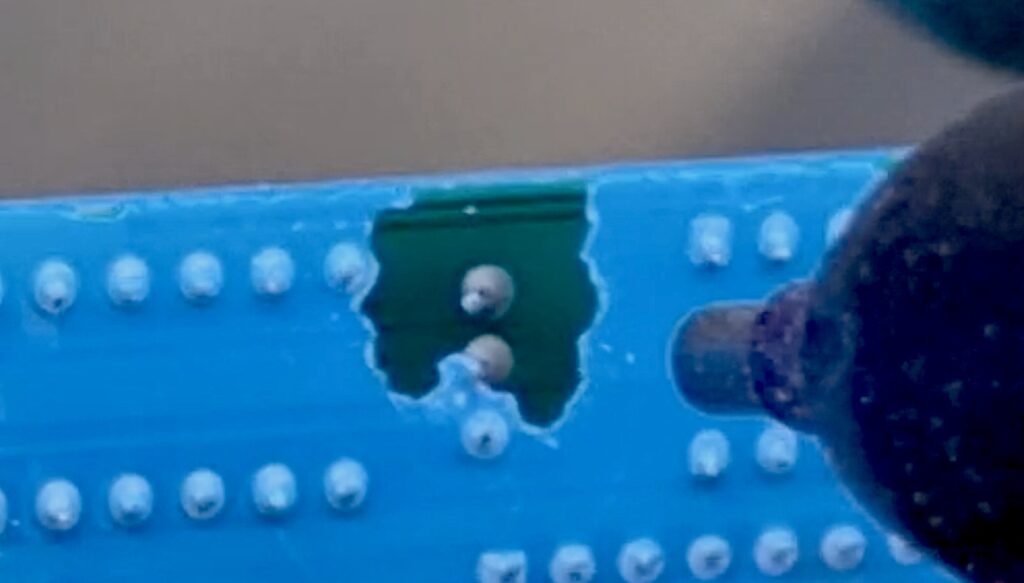
Micro-abrasive removal of conformal coating from PCB showing precise localised stripping without damaging solder mask or components

Precision removal of conformal coating using micro-abrasive blasting, demonstrating clean exposure of the PCB without substrate damage or chemical processing.

What we see in real production

Across coating services, rework typically falls into two broad categories:

  • Liquid coatings such as acrylic, polyurethane and silicone โ€” often removable, but time is lost in softening, cleaning, rinsing, drying and local touch-up.
  • Parylene โ€” chemically resistant and extremely thin, which makes traditional removal slow, inconsistent and highly operator-dependent when done manually.

In both cases, rework can be triggered by missed masking, exposed keep-out areas, engineering changes, inspection findings, soldering access requirements or local repair work. The problem is not unusual. It is routine.

The engineering challenge is therefore not โ€œhow do we avoid rework completely?โ€ but โ€œhow do we make rework fast, localised, safe and repeatable?โ€

Why traditional rework methods slow the process down

In practice, most liquid conformal coating rework is carried out using chemical stripping, while Parylene removal often falls back to manual methods due to its chemical resistance. Both approaches can work, but they introduce limitations in control, consistency and process time.

Wet chemical stripping (liquid coatings)

  • Primary method for acrylics and polyurethanes using local or full stripping processes
  • Requires dwell time for softening, followed by cleaning and rinse stages
  • Introduces risk of under-component ingress if not tightly controlled
  • Can affect labels, plastics, adhesives and connector materials
  • Adds process steps (strip โ†’ clean โ†’ dry โ†’ inspect) which increase cycle time

Manual removal (primarily Parylene and localised cases)

  • Parylene is highly resistant to chemical stripping, so manual removal is often used
  • Knives and fibre pens tend to drag rather than create clean exposure areas
  • High risk of damaging pads, plating or solder mask
  • Strong operator dependency and poor repeatability
  • Time increases rapidly on fine-pitch or dense assemblies

Local scraping on liquid coatings (limited use cases)

  • Sometimes used for small local repairs or silicone coatings where stripping is less practical
  • Generally avoided for production rework due to damage risk and inconsistency

Across all methods, removal is usually achievable โ€” but control, repeatability and process efficiency are often the real limitations.

Practical warning sign. If rework time varies dramatically between operators, boards or shifts, the issue is often not the coating chemistry itself. It is the removal method and how much operator judgement it depends on.

Why micro-abrasive blasting changes the equation

Micro-abrasive blasting addresses a specific bottleneck that appears across both liquid and Parylene rework: controlled, localised removal without chemical soak, blade pressure or thermal stress.

Using systems such as the Vaniman ProBlast 3 ESD, operators can expose solder joints, connector edges, test points and local repair areas by eroding the coating layer rather than softening it chemically or cutting it mechanically.

This matters because the rework step becomes much closer to a controlled process than an operator-dependent workaround.

For structured guidance on where micro-abrasion sits alongside chemical and manual methods, see the Removal & Rework Hub.

What the Vaniman ProBlast actually does well

The ProBlast is not an industrial sandblaster. It is a controlled micro-abrasion system intended for delicate removal work on electronics. In practice, its value comes from a few specific advantages:

  • Foot-pedal control for consistent on/off blasting
  • Adjustable pressure and media flow for local process tuning
  • Dry removal with integrated debris extraction
  • No heat and no solvent exposure
  • Applicability across both liquid coatings and Parylene removal workflows

The key point is not that it removes coatings. It is that it can remove them locally, quickly and with much better repeatability than manual scraping or wet stripping in many rework situations.

Why rework fails in practice

The biggest rework issue is not removal. It is control.

  • Over-removal damages solder mask or pads
  • Under-removal leaves contamination or poor surfaces for re-coating
  • Wet methods introduce ingress, drying and residue risks
  • Manual methods create strong operator-to-operator variation
  • Slow rework encourages โ€œgood enoughโ€ decision-making under production pressure

This is why rework often becomes one of the least stable parts of the coating process. It sits outside the main recipe but still has a major effect on yield, labour cost and downstream reliability.

For a wider process view of how repeatability is lost in coating operations, see Why Conformal Coating Processes Fail.

ProBlast vs wet stripping vs scraping

Feature ProBlast Chemical Stripping Manual Scraping
Works on Parylene? Yes Usually no / limited Yes, but slow
Time per rework Fast Medium to slow Slow
Risk of board damage Low when controlled properly Medium High
Cleanliness Dry, extracted Wet, requires post-cleaning Debris and fibres possible
Operator dependence Lower Medium High
Safety burden No solvents Chemical handling and waste Blade injury / debris risk

Where the time saving actually comes from

When people say micro-abrasive blasting can cut rework time by up to 50%, the value is not just in faster coating removal. The time saving usually comes from eliminating secondary steps:

  • No soak time waiting for chemical softening
  • No rinse and dry stage after local stripping
  • Less manual cutting and local board handling
  • Cleaner transition into re-soldering, repair or inspection

In other words, the gain is process simplification, not just media speed.

What This Means in Practice

Rework is no longer a side issue in coating operations. It is part of the real process architecture. The removal method chosen will strongly influence labour time, operator consistency, local damage risk and the quality of the recovered surface.

For liquid coatings, this often means deciding when wet stripping is still justified and when dry local removal is the better route. For Parylene, it often means recognising that manual scraping may be technically possible but operationally poor.

This is how modern coating operations move from โ€œrework as a workaroundโ€ to rework as a controlled process step.

Where this fits in the wider coating system

Rework links directly to masking quality, inspection effectiveness, local defect interpretation and removal method selection. That is why it should not be treated as an isolated repair function.

In practice, teams get better results when rework is planned as part of the coating process rather than left to operator improvisation after defects are found.

For the wider technical structure around removal, local stripping and process selection, use the Removal & Rework Hub.

Why Choose SCH Services?

SCH works across both liquid conformal coating and Parylene processing, so our view of rework is based on real production behaviour rather than theory alone. We support customers with coating removal strategy, process review, micro-abrasive removal systems, training and practical rework support.

  • ๐Ÿ› ๏ธ Removal method selection โ€“ choosing the right route for liquid coatings, Parylene and local repair tasks.
  • ๐ŸŽ“ Training and process support โ€“ helping operators make rework more repeatable and less damaging.
  • ๐Ÿ”ง Equipment and service support โ€“ including Vaniman ProBlast systems and practical coating removal guidance.

๐Ÿ“ž Call: +44 (0)1226 249019 | โœ‰ Email: sales@schservices.com | ๐Ÿ’ฌ Contact Us โ€บ

โ†‘ Back to top

Note: This insight provides general technical guidance only. Final removal method, process controls, board-level risk and validation decisions must be confirmed against the coating type, component sensitivity, customer specification and applicable standards.

ESD paint myths and static control coating behaviour explained

Dispelling the Myths About Static Control Paints


Why ESD coatings should be selected as part of a controlled static management system

Static control paints are often misunderstood. In practice, they should be viewed as ESD control coatings: engineered surface treatments used to control electrostatic behaviour on plastics, metals, floors, fixtures, packaging and industrial equipment.

Some coatings provide useful static control. Others can suffer from poor durability, inconsistent conductivity, filler separation or limited long-term performance. The key is understanding how the coating works, how it is grounded or verified, and whether it forms part of a wider ESD control strategy.

For a broader overview, see the ProShieldESD coating platform and the guide to choosing the right static control approach.

Myth 1: All ESD Paints Provide the Same Protection

Fact: Not all ESD paints or coatings behave in the same way. Traditional systems often rely on carbon, graphite or metal fillers to achieve conductivity. These fillers can create variation in surface performance if they are not evenly distributed, properly dispersed or maintained during application.

ProShieldESD position: ProShieldESD is based on intrinsically conductive polymer technology rather than conventional particulate filler loading. This helps create a more uniform coating layer with controlled static-dissipative or conductive behaviour across the treated surface.

See why filler-based ESD coatings can become inconsistent over time

Myth 2: ESD Paints Last Forever Without Verification

Fact: No static control coating should be assumed to perform indefinitely without inspection or verification. Abrasion, cleaning, chemical exposure, contamination and mechanical wear can all affect surface performance over time.

ProShieldESD position: ProShieldESD coatings are designed as durable, repairable ESD control surfaces. Their performance should still be verified using appropriate resistance testing, especially where the coating is used in an EPA, process control area or higher-risk industrial environment.

Myth 3: Paints Can Replace All Other Static Control Measures

Fact: ESD coatings are one part of a wider static control system. They do not replace good grounding, suitable footwear, ESD-safe work practices, ionisation where needed, humidity awareness, packaging control or process verification.

Effective ESD control programmes are normally designed around recognised standards such as IEC 61340 and ANSI/ESD S20.20. Within that framework, coatings can provide a controlled surface layer, but they must be used correctly.

ProShieldESD position: The ProShieldESD coating platform can be used to create conductive or static-dissipative surfaces depending on the application. This allows it to support layered ESD strategies rather than acting as a standalone โ€œpaint solves everythingโ€ solution.

Myth 4: Moulded ESD Plastics Are Always Better Than Coatings

Fact: Moulded ESD plastics can be effective, but they are not always the most practical solution. They may require tooling, minimum production quantities, material changes and design requalification. Some filled plastics can also show variation depending on filler distribution, moulding conditions and part geometry.

ProShieldESD position: Applying an ESD coating to an existing plastic component can be a practical alternative where the base part already works mechanically but needs improved static control. This is especially useful for covers, housings, guards, trays, fixtures, ducts and equipment surfaces.

For plastic-specific applications, see anti-static coating for plastic.

The Practical Truth About Static Control Coatings

The best ESD coating is not simply the most conductive coating. It is the coating that delivers the correct electrical behaviour for the application, remains stable in the operating environment, can be tested, can be maintained, and fits the wider ESD control system.

  • Use conductive coatings where a low-resistance pathway is required.
  • Use static-dissipative coatings where controlled charge decay is needed without creating an uncontrolled conductive surface.
  • Verify performance with appropriate resistance testing.
  • Consider wear, cleaning, contamination and grounding strategy before specifying the coating.
  • Choose repairable systems where long-term operational maintenance matters.

Where ProShieldESD Fits

The ProShieldESD coating platform is used where existing materials need to be upgraded into controlled ESD surfaces without redesigning the base part. Typical applications include plastics, metal equipment, floors, fixtures, work surfaces, packaging systems and hazardous environment surfaces.

Related pages:

Important note: This article provides general technical guidance only. Final ESD coating selection should be validated against the operating environment, substrate, grounding strategy, cleaning regime, resistance targets and applicable customer or industry standards.

Back to top โ†‘

How ProShield ESD Fits Into the ESD Control Pyramid


Understanding how grounding, conductive materials, dissipative surfaces and anti-static measures work together

Controlling electrostatic discharge is not achieved by one product, coating or material. It is normally built as a system of layers: grounding, conductive pathways, dissipative working surfaces and anti-static measures that reduce charge generation.

The ESD Control Pyramid is a useful way to visualise this. Grounding forms the base, conductive and dissipative materials provide controlled charge movement, and anti-static measures help reduce charge build-up at the top of the system.

The ProShieldESD coating platform fits into this structure by converting existing surfaces into controlled conductive or static-dissipative materials, depending on the application requirement.

ESD control pyramid showing grounding, conductive materials, dissipative surfaces and anti-static measures

The ESD Control Pyramid illustrates how grounding, conductive and dissipative materials work together to provide controlled static behaviour.

The Base: Grounding and Conductive Materials

At the base of the pyramid is grounding. Conductive materials provide a low-resistance path that allows charge to move towards a defined ground point.

In practical ESD control, the aim is not simply to make everything as conductive as possible. The aim is to create a controlled discharge path that avoids uncontrolled charge accumulation while also avoiding damaging rapid discharge events.

Grounding and verification are normally managed within a wider ESD control programme, often using standards such as IEC 61340 or ANSI/ESD S20.20 as part of the control framework.

How ProShieldESD Helps

ProShieldESD can be engineered into conductive-range coatings where a defined pathway to ground is required. This can be useful for fixtures, housings, equipment surfaces, floors or other components where replacing the base material with a conductive alternative would be expensive or impractical.

The Middle: Static-Dissipative Materials

The middle of the pyramid is where many real ESD control applications sit. Static-dissipative materials are used to control how charge moves, rather than allowing it to remain trapped or discharge too quickly.

This is especially important in electronics manufacturing, precision assembly, aerospace, medical device production, packaging, handling systems and other environments where uncontrolled electrostatic behaviour can create quality, safety or reliability problems.

For many applications, dissipative behaviour is more useful than maximum conductivity. This is why understanding the difference between static-dissipative and conductive surfaces is important before selecting a coating strategy.

How ProShieldESD Helps

ProShieldESD coatings provide controlled dissipative performance across a wide range of substrates. Unlike conventional filler-loaded systems, the platform is based on intrinsically conductive polymer technology, reducing the risks associated with filler distribution, uneven behaviour and performance drift.

The Top: Anti-Static Measures

Anti-static measures sit at the top of the pyramid. Their role is to reduce charge generation, often by minimising friction, separation and triboelectric charging.

Anti-static measures can be useful, but they do not always provide a complete control system on their own. If charge is still generated, the system must still provide a route for controlled dissipation or grounding.

How ProShieldESD Helps

ProShieldESD supports anti-static strategies by giving surfaces a controlled electrical behaviour. If charge appears during handling, airflow, movement or contact, the coated surface can help dissipate or conduct that charge as part of the wider ESD control system.

Why the Pyramid Matters

The pyramid helps prevent a common mistake: assuming that higher conductivity automatically means better static control.

In reality, different parts of an ESD control system need different behaviours. Some areas need a defined path to ground. Some need controlled dissipation. Some need reduced charge generation. The wrong choice can create new risks, especially where sensitive electronics, powders, solvents, plastics or moving equipment are involved.

For a wider decision framework, see how to choose the right static control approach.

The operating environment also matters. Humidity, contamination, wear, cleaning, substrate type and grounding design can all influence ESD performance. This is why electrostatic behaviour depends on the environment, not only the coating material.

Why ProShieldESD Is Different from Traditional ESD Paints and Plastics

Traditional ESD paints and moulded conductive plastics can be useful, but both have limitations.

  • Filler-loaded paints can suffer from uneven filler distribution, surface variation, appearance issues and performance drift.
  • Moulded ESD plastics can require expensive tooling, minimum order quantities and design changes.
  • Topical anti-static treatments may depend on migration, humidity or repeated reapplication.

ProShieldESD provides a different route by upgrading the surface behaviour of existing materials. This can reduce the need for specialist moulded materials and allows ESD control to be added to plastics, foams, housings, fixtures, work surfaces, packaging and industrial equipment.

This approach also supports retrofit projects where the existing part, surface or process is already fixed and cannot easily be redesigned.

Where ProShieldESD Fits in the Pyramid

ProShieldESD can support several layers of the ESD Control Pyramid:

  • Conductive-range coatings for defined grounding pathways.
  • Static-dissipative coatings for controlled charge movement across working surfaces.
  • Surface upgrades for plastics, foams, fixtures, packaging and equipment.
  • Retrofit ESD control where replacing the base material is not practical.
  • Support for anti-static environments by giving surfaces controlled electrical behaviour.

This makes ProShieldESD a practical engineering option where static control must be added to real products, production equipment or industrial surfaces without redesigning the complete system.

Need Help Selecting the Right ESD Coating Strategy?

SCH can help assess where static charge is being generated, how it needs to be controlled, and whether the surface should be conductive, static-dissipative or supported by other ESD control measures.

Use the ProShieldESD coating platform to explore the technology, or contact SCH to discuss a specific surface, material or operating environment.

Contact SCH Services

Back to top โ†‘

Technical note: This article provides general technical guidance only. Final ESD control decisions should be validated against the application, substrate, grounding design, operating environment and relevant site or industry standards.

Applications of the ProShieldESD Coating Platform


Permanent static-control coating applications across electronics, plastics, packaging, hazardous areas and industrial surfaces

Electrostatic discharge is not limited to one industry or one material type. It can damage electronics, attract contamination, disturb production processes, create ignition risks and reduce control in sensitive environments. The ProShieldESD coating platform provides a practical way to upgrade existing surfaces with permanent static-dissipative or conductive behaviour without redesigning the base component.
Infographic showing ESD coating applications across industries including electronics, aerospace, healthcare, packaging and hazardous environments using a single coating platform
One coating platform used across multiple industries to provide controlled static-dissipative performance

Why Application Matters

Different applications create different electrostatic risks. Electronics need protection from damaging discharge events. Packaging must remain stable through changing humidity. Hazardous environments need controlled charge movement to reduce ignition risk. Plastic components often need static control without changing the moulding or base material. ProShieldESD is useful because it is not a single paint for one surface. It is a coating platform that can be adapted across materials, chemistries and performance requirements.

Key Industry Applications

Electronics and Semiconductor

ProShieldESD can be used on tools, fixtures, work surfaces, floors, enclosures and packaging where stable electrostatic behaviour is required around sensitive assemblies. Unlike many conventional ESD paints or filled systems, the platform is designed around controlled static behaviour rather than simple maximum conductivity.

Aerospace and Defence

Aerospace and defence applications often require durable static control on composites, racks, test infrastructure, housings and support equipment. A coating-based approach can reduce the need for redesign while adding controlled ESD performance to existing surfaces.

Military and Ruggedised Systems

Field electronics, housings, protective cases and support equipment can accumulate charge during handling, transport or operation. ProShieldESD provides a route to upgrade existing equipment with static-control behaviour without changing the underlying design.

Pharmaceutical, Healthcare and Cleanroom Areas

Static control supports cleanliness by reducing dust attraction and helping surfaces behave more predictably. ProShieldESD can be considered for walls, ceilings, equipment, furniture and process areas where surface charge contributes to contamination or process instability.

Automotive, EV and Battery Manufacturing

EV and battery production environments involve sensitive electronics, plastic handling equipment, racks, floors and enclosures. ProShieldESD can support controlled static behaviour across these surfaces as part of a wider ESD management strategy.

Energy, Chemicals and Process Industries

Powders, vapours, solvents and volatile materials can create higher-risk conditions where uncontrolled charge accumulation is undesirable. ProShieldESD can be applied to selected drums, vessels, pipes, covers, work surfaces and process equipment where a controlled discharge path is required.

RF and Antenna Systems

Some RF-related applications require static control without heavy conductive fillers that may interfere with signal behaviour. ProShieldESDโ€™s filler-free conductive polymer approach can be useful where static dissipation is needed on radomes, antenna housings or related enclosures, subject to application testing.

Packaging and Logistics

Packaging moves through changing humidity, handling and transport conditions. ProShieldESD can be used on cartons, foams, crates, trays and handling systems to reduce reliance on fully moulded or inherently ESD-rated materials.

Explosives, Pyrotechnics and Hazardous Areas

In explosive or pyrotechnic environments, uncontrolled electrostatic discharge can be a serious concern. ProShieldESD can be considered for bins, crates, work surfaces, plastic parts and handling equipment where controlled static dissipation is required. For hazardous environments, always validate the coating system as part of the full site risk assessment.

Why ProShieldESD Is a Platform, Not Just a Paint

ProShieldESD is a platform technology based on filler-free conductive polymer behaviour. It can be developed across different coating chemistries and substrates, including plastics, metals, composites, flooring, packaging and industrial equipment. This allows static control to be engineered into existing materials rather than always replacing them with specialist ESD alternatives. For selection guidance, see how to choose the right static control approach.

Discuss an Application

If you have an existing plastic, metal, packaging, floor or industrial surface that needs controlled static behaviour, SCH can help review the substrate, environment, resistance target and practical coating route.

Call: +44 (0)1226 249019
Email: sales@schservices.com
Contact: Contact Us

Back to top โ†‘

Homogeneous ESD Protection: Why Consistency Matters in Static Control


Why uniform dissipative behaviour is critical for reliable ESD protection across real surfaces

Homogeneous ESD protection matters because static control only works when the whole surface behaves consistently. A material or coating that performs well in one area but fails in another can still leave weak points where charge accumulates, discharges or causes process instability.

In electronics manufacturing, medical devices, aerospace, automotive, packaging and industrial environments, the objective is not simply to make a surface โ€œconductiveโ€. The objective is to create controlled, repeatable static-dissipative behaviour across the full working area.

The ProShieldESD coating platform is designed to support this requirement by creating permanent, filler-free static control across real substrates, surfaces and operating environments.

Infographic showing homogeneous ESD protection and why consistent static dissipative behaviour across surfaces improves reliability and reduces failure risk
Homogeneous ESD protection ensures consistent static control across surfaces, reducing failure risk and improving reliability

Why Consistency Matters in Static Control

Static control failures often occur at the weakest point in the system. A surface may appear acceptable overall, but local areas of poor dissipation can still allow charge to accumulate.

That inconsistency can create practical risks, including hidden ESD damage, contamination attraction, nuisance discharge, process variation, rework and premature replacement of parts or equipment.

This is why effective ESD control should be assessed as surface behaviour across the application, not just as a single material claim or isolated resistance reading.

The Problem with Filled Coatings and Moulded ESD Plastics

Many traditional ESD materials rely on carbon, graphite, metal or other conductive fillers. These systems can work, but they introduce practical limitations. Filler distribution, settling, agglomeration, surface wear and contamination risk can all affect long-term consistency.

Moulded ESD plastics can also be useful, but they are normally limited to fixed shapes, specific materials and replacement-based control. Once a moulded item wears, becomes damaged or no longer meets the application requirement, the usual solution is replacement rather than repair or upgrade.

For many real-world applications, coating the existing surface with a controlled static-dissipative layer is more flexible than replacing the whole item or relying on moulded material alone.

Homogeneous Performance with ProShieldESD

ProShieldESD is based on a filler-free conductive polymer approach. Instead of depending on dispersed particles to create a conductive pathway, the coating is designed to provide controlled static behaviour through the coating system itself.

This makes it suitable for upgrading a wide range of surfaces, including plastics, foams, packaging, floors, fixtures, housings, industrial equipment and other substrates where uncontrolled static behaviour creates operational risk.

  • Uniform static-dissipative performance across coated surfaces
  • No carbon black, graphite or metal filler requirement
  • Reduced contamination risk compared with particle-filled approaches
  • Ability to upgrade existing parts instead of replacing them
  • Repairable and re-coatable surface control strategy
  • Flexible use across multiple materials and application types

Consistency Creates Reliability

In controlled environments, ESD protection must remain stable during handling, cleaning, wear, environmental change and repeated use. A surface that only performs under ideal conditions is not enough.

Homogeneous ESD protection helps reduce variation by creating predictable dissipative behaviour across the surface. This supports better process control, lower replacement cost and improved confidence in long-term ESD performance.

For applications involving plastics, packaging, industrial equipment or hazardous environments, ProShieldESD provides a practical route to convert existing insulating surfaces into controlled static-dissipative systems.

Talk to SCH About Static Control Coatings

If you need to improve static control on plastic, packaging, floors, fixtures, equipment or other surfaces, SCH can help review the application and identify whether a ProShieldESD coating route is suitable.

Contact SCH Services to discuss your ESD coating requirement.

Note: This article provides general technical guidance only. Final material selection and ESD performance requirements should be validated against the relevant application, environment, test method and acceptance criteria.

Back to top

Why Carbon-Filled ESD Paints and Moulded Anti-Static Plastics Can Fail


Why filler-based static control systems often drift, contaminate or become unreliable in real production environments

For decades, industries have relied on carbon-filled paints, metal-loaded coatings and moulded ESD plastics to manage electrostatic discharge. These legacy systems can appear effective at first, but many depend on conductive fillers such as carbon black, graphite or metal powders to create a discharge path.

In real use, that filler-based approach can create inconsistent behaviour, wear-related drift and contamination risk. This is why the ProShieldESD filler-free ESD coating platform provides a different route to long-term static control.

Carbon filled ESD coating vs filler free ESD coating comparison showing consistency, stability and contamination differences

Filler-based ESD coatings vs filler-free coating behaviour in real use conditions

Modern electronics, medical, aerospace and industrial applications need static control surfaces that remain stable over time, across humidity changes, cleaning cycles, abrasion and daily handling. Traditional filler-based coatings and moulded carbon-loaded components can struggle to deliver uniform and repeatable performance at scale.

The Problem With Carbon and Metal Fillers

1) Inconsistent Conductivity

Fillers rarely disperse perfectly through a coating, and moulded anti-static plastics can show variation through the material or across the surface. This can result in patchy resistivity, localised weak areas and unpredictable static behaviour.

2) Performance Drift Over Time

In coatings, filler particles can wear, migrate, clump or become exposed unevenly at the surface. In moulded parts, surface behaviour can change as the material abrades, becomes contaminated or is repeatedly handled. What initially passed inspection may not behave the same way after prolonged use.

3) Contamination Risk

Carbon and metal-filled systems can introduce particulate concerns, especially where surfaces are handled, rubbed, cleaned or abraded. In sensitive electronics, clean manufacturing, medical and precision assembly environments, loose conductive contamination can become a quality and reliability risk.

4) Limited Substrate Flexibility

Filler-based paints often behave differently on plastics, foams, packaging materials, fixtures, floors and equipment surfaces. Moulded ESD plastics are also limited by material choice, tooling, geometry and availability. This can force companies to buy special parts instead of upgrading the surfaces they already use.

5) Higher Lifecycle Cost

Low initial cost can be misleading. Once replacement parts, rework, repeat inspection, downtime, cleaning problems and revalidation are included, legacy filler-based static control systems can become expensive to maintain.

The Filler-Free Alternative

ProShieldESD filler-free ESD coating is designed to provide stable static dissipative or conductive behaviour without relying on carbon, graphite or metal filler particles.

Instead of using particulate fillers to create a discharge path, ProShieldESD uses a filler-free conductive polymer approach. This allows existing surfaces to be upgraded while reducing the risks associated with particle shedding, uneven filler distribution and wear-related drift.

  • Uniform surface behaviour โ€” helps reduce weak spots caused by filler clustering or uneven dispersion.
  • Long-term static control โ€” supports stable performance through normal operational use.
  • Cleaner surface technology โ€” avoids loose carbon or metal particulate systems in sensitive areas.
  • Precision electrostatic surface control โ€” useful in specialist applications such as electrostatic speaker diaphragm coatings where stable and uniform dissipative behaviour is critical to system performance.
  • Broad application flexibility โ€” suitable for plastics, fixtures, equipment, packaging, work areas and floors.
  • Lower lifecycle risk โ€” reduces reliance on replacement moulded parts or repeated reapplication cycles.

Where This Matters Most

Filler-free static control becomes especially useful where the surface must continue performing after cleaning, handling, movement, abrasion or environmental change.

The Future of Static Control

As industries demand higher reliability, cleaner processes and more flexible implementation, filler-based paints and moulded ESD products increasingly show their limitations. A filler-free coating platform offers a more controlled way to specify static control across existing parts, surfaces and environments.

For many applications, the question is no longer simply whether a material is labelled anti-static or conductive. The more important question is whether the surface will continue to behave correctly during real use.

Choosing the Right Static Control Route

Not every ESD problem requires the same solution. Some applications need conductive behaviour, others need static dissipative control, and some need a practical way to upgrade existing materials without replacing them.

For a structured comparison of the available routes, see How to Choose the Right Static Control Approach, or explore the full ProShieldESD coating platform.

Note: Static control performance should always be validated against the relevant application, substrate, environment and applicable ESD standards. Final coating selection should be confirmed by testing under representative operating conditions.

0
  • Your current order total is £0.00 โ€” you must have an order with a minimum of £75.00 to place your order.
0
Your Cart
Your cart is empty
  • Your current order total is £0.00 โ€” you must have an order with a minimum of £75.00 to place your order.
Calculate Shipping
  • Your current order total is £0.00 โ€” you must have an order with a minimum of £75.00 to place your order.

Conformal Coating UK

Technical banner showing PCB and process icons representing conformal coating, masking, inspection and training on the SCH technical knowledge hub.
Conformal Coating UK
Privacy Overview

This website uses cookies so that we can provide you with the best user experience possible. Cookie information is stored in your browser and performs functions such as recognising you when you return to our website and helping our team to understand which sections of the website you find most interesting and useful.