Conformal Coating Bulletin Library
Rapid technical notes for production issues, coating risks and process troubleshooting
The SCH Conformal Coating Bulletin Library provides short, practical engineering guidance for common coating, masking, inspection and process-control issues seen in production.
These Bulletins are intended as rapid operational references rather than full SOPs, validation packages or engineering knowledge-transfer documents. They help engineers recognise risks, understand likely causes and identify when deeper support may be required.
The aim is simple: useful technical guidance that supports better coating decisions without replacing proper process review, validation or specialist engineering input.
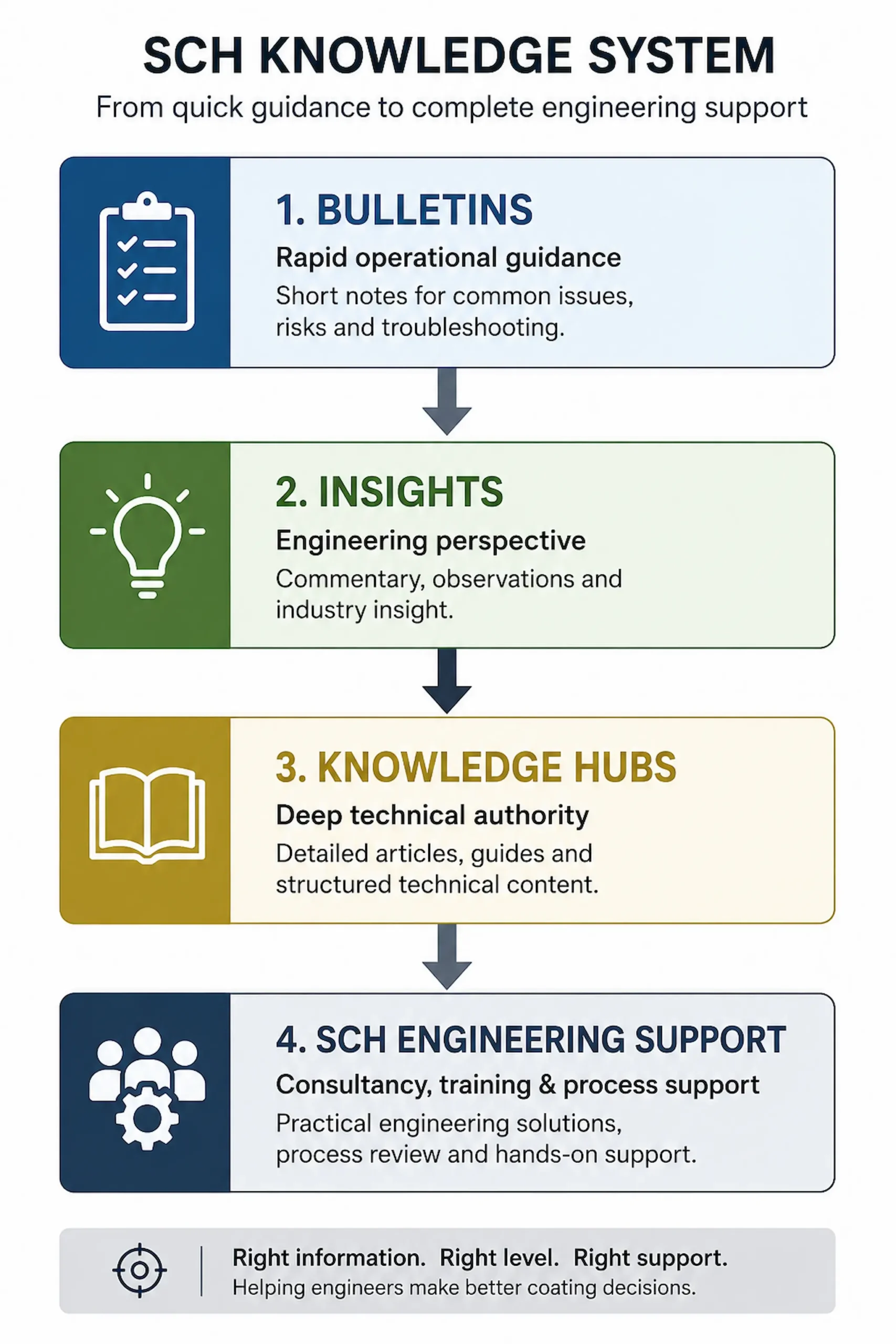
The SCH Knowledge System showing how practical Bulletins, engineering Insights, technical Knowledge Hubs and engineering support work together.
How to Use This Bulletin Library
Use these Bulletins when you need a quick engineering reference for a specific coating issue, production observation or reliability concern.
Bulletins are designed to help identify and frame a problem. They are not a substitute for process validation, customer-specific testing or formal production controls.
- Use Bulletins for quick troubleshooting and process awareness.
- Use Technical Articles and Knowledge Hubs for deeper technical explanation.
- Use SCH engineering support where failures are recurring, unclear or production-critical.
Bulletin Categories
The library is organised around practical engineering problems rather than document types.
Adhesion & Surface Problems
Guidance on coating adhesion, surface energy, substrate compatibility, wetting behaviour and surface condition.
Coating Flow & Coverage
Operational notes on bubbles, pinholes, de-wetting, orange peel, capillary flow and edge coverage.
Masking & Handling
Practical references for connector protection, masking failures, handling damage and process repeatability.
Inspection & Validation
Guidance on UV inspection, coating thickness checks, visual defects and production control points.
Process Control & Stability
Practical guidance on viscosity drift, coating thickness variation, cure consistency, process drift and production repeatability.
Corrosion & Reliability
Notes on ionic contamination, environmental exposure, coating failure mechanisms and reliability risks.
Parylene Process Stability
Short guidance on Parylene masking, adhesion, deposition control, defects and process reliability.
Cleaning & Contamination
Production-focused notes on cleaning choices, residues, surface condition and coating readiness.
Functional Coating Behaviour
Guidance on hydrophobic coatings, ultra-thin coatings, surface energy and barrier-function limitations.
Latest Technical Bulletins by Category
SCH technical Bulletins are grouped by practical engineering issue so engineers can quickly find guidance relevant to coating defects, masking, inspection and process-control risks.
Bulletins are intentionally concise. Their purpose is to help engineers quickly recognise issues, understand likely causes and identify where deeper process review may be required.
Adhesion & Surface Problems
- Why Conformal Coating Adhesion Can Fail Even on a Clean Surface — Practical engineering guidance explaining why conformal coating adhesion failure can occur even on apparently clean surfaces due to surface energy, substrate compatibility, cure state, hidden contamination and previous process history.
Masking & Handling
- Connector Masking Failures — Practical guidance explaining why coating can reach protected connector contact areas through masking gaps, wicking and masking movement.
- Protecting Connector Interfaces Without Conformal Coating Them — Technical guidance covering connector keep-out requirements, masking strategy selection, connector reliability risks and practical methods used to prevent coating ingress into electrical contact areas.
- Why a Connector Masking Boot Does Not Always Prevent Coating Ingress — Practical guidance explaining the difference between sealing and shielding, why coating can still reach protected areas and how masking boot performance should be evaluated in real production processes.
- Masking Tape Removes Conformal Coating During De-Mask — Practical guidance explaining why conformal coating can lift with masking tape during removal, how de-masking damage occurs and the process controls used to reduce coating edge defects and touch-up requirements.
- Masking Dots Lift During Conformal Coating — Practical guidance explaining why masking dots can lift during coating, how edge leakage and surface condition affect dot performance, and what process checks reduce repeat masking failures.
- Why Perfect Masking Still Produces Conformal Coating Defects — Practical guidance explaining why correct masking does not guarantee a defect-free coating, and how de-wetting, contamination, fisheyes, craters, thin coverage and adhesion failures can still occur within correctly masked areas.
Cleaning, Contamination & Surface Problems
- Flux Residues Causing Conformal Coating Failure — Practical guidance explaining how residual flux can affect coating adhesion, wetting, appearance and long-term reliability even when assemblies appear visually acceptable.
- Common Causes of De-Wetting After Cleaning — Practical guidance explaining why visually clean PCB assemblies can still reject conformal coating due to contamination, residues and surface-energy issues.
- Silicone Contamination from Masking Materials — Practical guidance explaining how masking tapes, dots, boots and handling materials can transfer low-surface-energy contamination that causes de-wetting, fisheyes and local adhesion failures.
- Boards Look Clean but Still Fail Conformal Coating — Practical guidance explaining why visually clean PCB assemblies can still suffer conformal coating defects due to hidden contamination, residues, moisture, handling contamination and surface-condition issues that are not obvious during normal inspection.
- Cleaning Process Changes Causing New Conformal Coating Defects — Practical guidance explaining how seemingly minor changes to cleaning chemistry, wash parameters, rinsing, drying, maintenance routines or process control can introduce new conformal coating defects.
- Fingerprints and Handling Contamination Before Conformal Coating — Practical guidance explaining how fingerprints, glove residue, handling marks and other contact contamination can create localised de-wetting, adhesion problems, appearance defects and reliability risks.
- Moisture Trapped Before Conformal Coating — Practical guidance explaining how residual moisture trapped within PCB assemblies before coating can lead to white residues, corrosion, adhesion loss, electrical leakage and premature reliability failures.
- Conformal Coating Surface Preparation and Cleanliness — Technical guidance covering contamination control, cleaning effectiveness, surface preparation requirements and the role of cleanliness in reliable coating performance.
Corrosion & Reliability
- Why Conformal Coating Does Not Stop Corrosion If Contamination Is Trapped Underneath — Practical engineering guidance explaining why corrosion under conformal coating can develop when ionic contamination, flux residues or moisture remain trapped against the PCB surface.
Inspection & Validation
- Why UV Trace Does Not Guarantee Correct Coating Coverage — Practical inspection guidance explaining why fluorescent response alone does not confirm correct coating thickness, continuity or protection.
- Why UV Inspection Can Give False Pass Results — Practical inspection guidance explaining how boards can appear acceptable under UV light while still containing thin coating, missed coverage, contamination or other reliability risks.
- Coating Thickness Passes but Coverage Still Fails — Practical guidance explaining why assemblies can meet thickness requirements while still containing shadowed areas, missed features, poor edge coverage or local protection gaps.
Coating Flow & Coverage
- Why Conformal Coating Pulls Away from Component Edges — Practical engineering guidance explaining why conformal coating edge coverage can become thinner around sharp component edges due to surface tension, component geometry, viscosity, drainage and application method.
Process Control & Stability
- Do I Have the Latest VanAcrylic Configuration? — Practical guidance for checking whether a VanAcrylic blasting setup uses the current tank, purple nozzle tip, correct VanAcrylic media and recommended operating configuration before production use.
- Why One Coating Thickness Reading Can Be Misleading — Practical guidance explaining why one thickness reading may not represent the whole PCB assembly and how local geometry, drainage and process conditions affect coating build.
- Conformal Coating Viscosity Drift: The Hidden Cause of Process Variation — Practical guidance explaining how viscosity drift can affect coating thickness, coverage, application consistency and production stability.
- Why Conformal Coating Thickness Changes During Production Runs — Practical guidance explaining why coating thickness can drift during production due to material condition, temperature, replenishment practice, equipment behaviour and operator variation.
Parylene Process Stability
- Why There Can Be Parylene Thickness Variation Across a Batch — Practical engineering guidance explaining how batch loading, component geometry, chamber position, masking, deposition conditions and witness coupon use can influence Parylene coating thickness and process repeatability.
Functional Coating Behaviour
- Why a Hydrophobic Coating Does Not Make an Assembly Waterproof — Practical engineering guidance explaining the difference between hydrophobic water repellency, barrier protection and waterproofing, including how gaps, connectors, edges and other ingress paths can still allow moisture to reach an electronic assembly.
Where Bulletins Fit in the SCH Knowledge System
Bulletins are part of a wider technical structure designed to help engineers move from quick issue recognition to deeper understanding and practical support.
Bulletins
Fast operational guidance for practical coating and process issues.
Knowledge Hubs
Deep evergreen technical authority and structured technical education.
Engineering Support
Consultancy, training, process review, coating services and production support.
Related Technical Resources
For deeper technical explanation, use the relevant SCH Knowledge Hubs and process guides alongside the Bulletin Library.
When a Bulletin Becomes an Engineering Issue
A Bulletin can help identify a likely issue, but recurring defects, field failures, inconsistent inspection results or production drift normally require deeper process review.
SCH Services can support coating process troubleshooting, failure investigation, operator training, masking review, coating trials, Parylene process support and coating service projects.
Why Choose SCH Services?
SCH Services combines practical coating production experience with technical consultancy, training, process engineering and specialist coating support.
Our work covers conformal coating, Parylene, masking, coating removal, inspection, process troubleshooting and advanced functional coating applications.
This allows us to support customers not only with coating knowledge, but with the practical controls needed to make coating processes repeatable, inspectable and production-ready.
Disclaimer: The information provided in this Bulletin Library is general technical guidance only. Coating selection, process settings, inspection methods and production controls should always be validated against the specific assembly, material set, operating environment, applicable standards and reliability requirements.