Fingerprints and Handling Contamination Before Conformal Coating
Why small handling marks can create local conformal coating defects and reliability risks
Bulletin Category: Cleaning, Contamination & Surface Problems | Typical Environments: PCB handling, coating preparation, inspection benches, manual masking, rework areas, subcontract coating and production release.
Fingerprints and handling contamination are easy to underestimate because they are often small, localised and difficult to see under normal production lighting.
However, conformal coating responds to the true surface condition of the PCB. Oils, salts, skin residues, glove transfer, packaging contamination and handling marks can interfere with wetting, adhesion and long-term reliability even when the board appears visually acceptable.
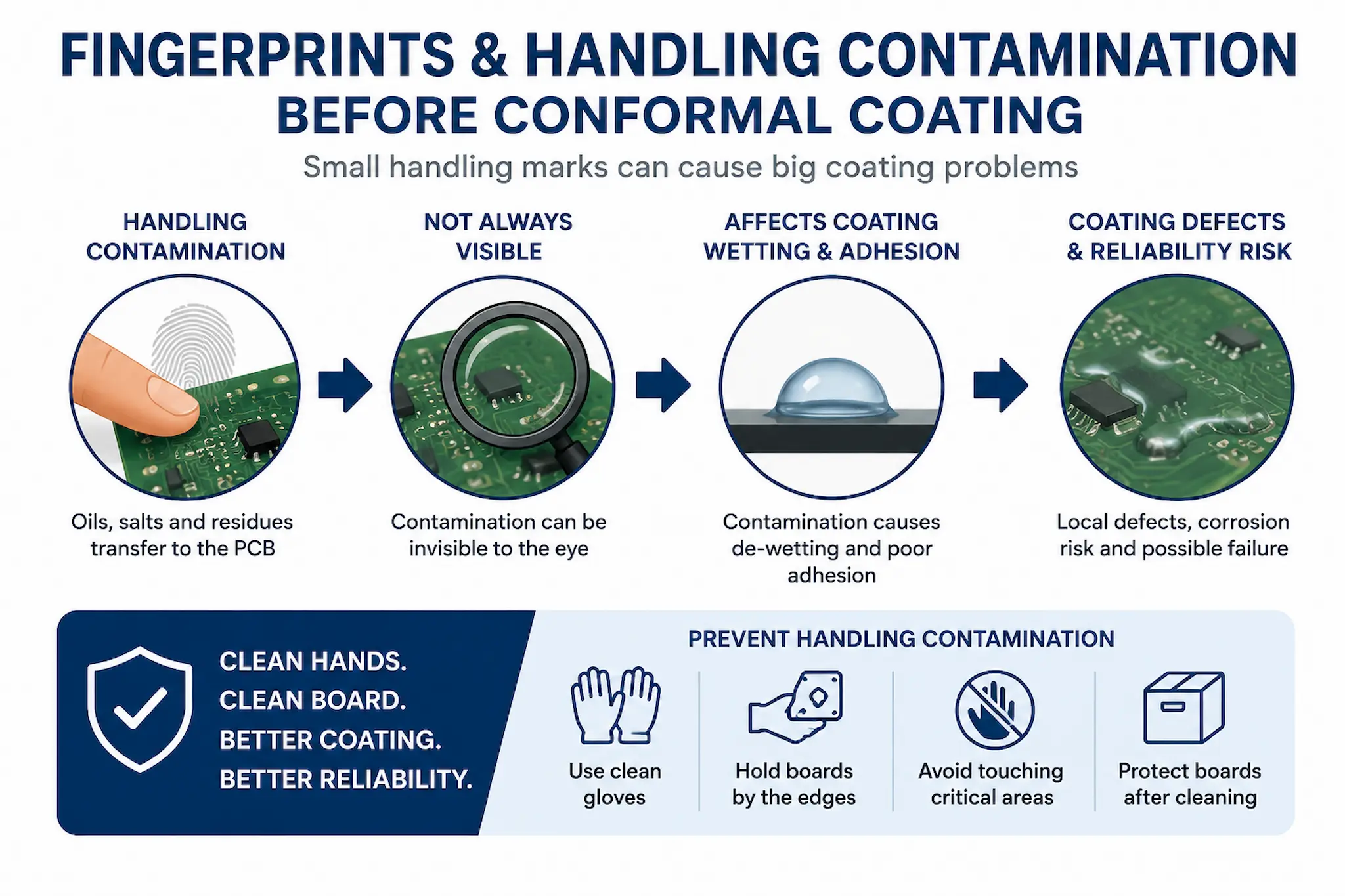
Small handling marks can create major conformal coating defects.
Engineering observation
Handling contamination usually creates local defects rather than a whole-board failure. This can make the problem harder to identify because most of the assembly may coat correctly while one area shows coating pull-back, poor adhesion, dull patches, residue, corrosion risk or inconsistent fluorescence.
The most common locations are board edges, connector areas, masking zones, rework areas, hand-soldered sections, inspection contact points and places where operators naturally hold the PCB during movement or loading.
Why it happens
1. Bare fingers transfer oils and salts
Skin oils and salts can remain on the PCB surface and change how the coating wets the board. This can lead to local de-wetting, reduced adhesion or corrosion risk under the coating.
2. Gloves are not automatically clean
Gloves can transfer powder, plasticiser, silicone, previous contamination or general production residue if they are reused, stored poorly or used across multiple tasks.
3. Manual masking increases contact risk
Masking operations require close handling of the PCB. If handling control is weak, contamination can be introduced immediately before coating, after cleaning has already been completed.
4. Rework and inspection can re-contaminate cleaned boards
Boards may leave cleaning in an acceptable condition but become contaminated during inspection, repair, packing, unpacking, storage or movement to the coating area. They may also absorb or retain residual moisture during storage or after cleaning if drying is incomplete. See Moisture Trapped Before Conformal Coating for guidance on identifying moisture-related coating failures before production.
Practical findings
A handling-related coating defect is often mistaken for a coating material problem because it appears after application. In reality, the coating may simply be revealing a contamination event that happened earlier in the process.
Process note: A board should not be considered coat-ready just because it has passed cleaning. The handling route after cleaning is just as important as the cleaning process itself.
Where failures appear in hand-contact areas, board edges, masking zones or inspection contact points, handling contamination should be treated as a serious candidate cause.
Recommended actions
- Define how boards should be handled after cleaning and before coating.
- Avoid bare-hand contact with any area that will be coated.
- Use clean, suitable gloves and replace them before they become a contamination source.
- Control where operators are allowed to hold the PCB.
- Review masking, inspection and rework steps as possible contamination points.
- Keep cleaned boards protected during storage and movement to coating.
- Investigate whether local coating defects match natural handling positions.
The aim is to protect the cleaned surface all the way through to coating, not only to clean the board once and assume it remains clean.
Escalation point
If local coating defects repeat in similar positions, SCH can help review the handling route, masking process, cleaning controls and coating results to identify where contamination may be entering the process.
This is especially useful when boards pass visual inspection but still show local de-wetting, adhesion loss or residue after coating.
Related guidance
Need support with contamination-related coating failures?
SCH Services supports customers with conformal coating process review, contamination troubleshooting, masking control, coating trials, inspection guidance and production coating services.
Why Choose SCH Services?
SCH Services works with conformal coating processes in real production environments, including cleaning, handling, masking, coating, inspection, rework and defect investigation.
This practical experience helps customers identify whether a coating issue is caused by the coating material, the application method, the cleaning process, handling contamination or another upstream process condition.
This bulletin is general technical guidance only. Final coating, cleaning, handling, inspection and reliability decisions should be validated against the relevant customer specification, product risk, production process, qualification testing and applicable standards.