Advanced Functional Coatings Hub
Ultra-thin, hydrophobic and RF-transparent coatings require different selection logic from conventional conformal coatings
Advanced functional coatings are used when the coating must do more than simply form a visible environmental barrier. In many electronics applications, the coating also needs to control surface energy, reduce water retention, preserve RF performance, avoid optical interference or protect sensitive features without adding significant thickness.
These coatings can be highly useful, but they are often misunderstood. A surface may bead water, remain optically clear or add very little build, but that does not automatically mean it provides the same corrosion protection, edge coverage or long-term reliability as a conventional conformal coating or Parylene system.
This hub brings together SCH technical articles on ultra-thin coatings, nano coatings, hydrophobic coatings, RF-transparent coatings and surface-function coating strategies so engineers can select the right protection route for the actual failure mechanism.
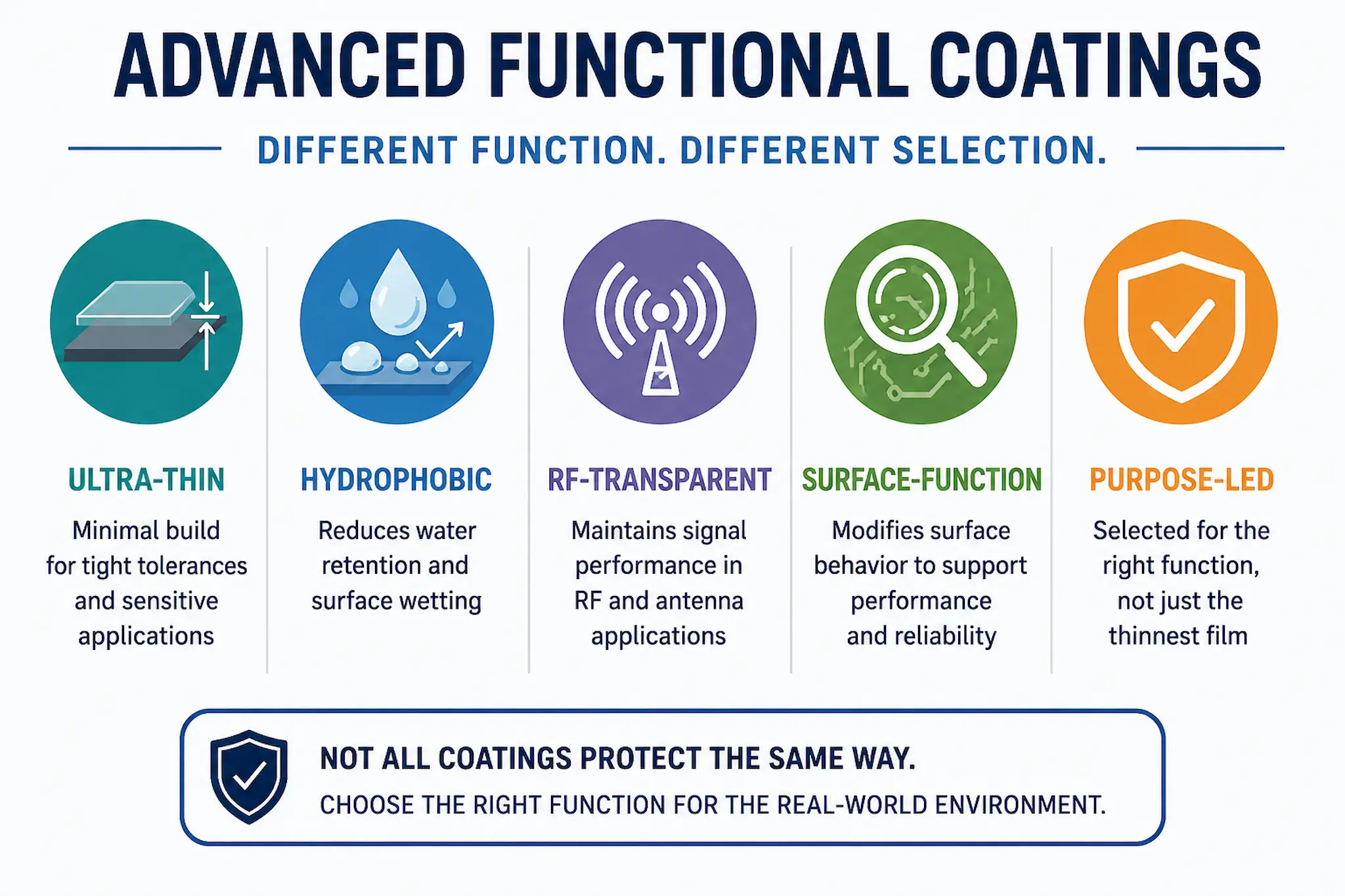
Different advanced functional coatings solve different electronics protection problems.
Where to start
If you are comparing coating types, start with the surface-function and barrier-function articles. If your design is limited by thickness, optics, RF behaviour or water retention, move into the ultra-thin, hydrophobic and application-specific articles below.
Selection logic
Understand whether the coating needs to act as a barrier, modify a surface, preserve performance or support a specific operating condition.
Technology boundaries
Identify where ultra-thin, nano and hydrophobic coatings are useful, and where they should not be used as full environmental protection systems.
Application examples
Review coating choices for LEDs, optics, antennas, radomes, sensors, meshes, membranes and other performance-sensitive electronics.
Technical article index
This index groups advanced functional coating articles by behaviour, application and limitation rather than by coating name alone.
| Topic | Use when you need to understand | Article |
|---|---|---|
| Core Selection Logic | ||
| Functional coating logic | The difference between coatings that act as environmental barriers and coatings that change how a surface behaves. | Surface Function vs Barrier Function Coatings |
| Surface energy | Why water beading, wetting behaviour and environmental barrier protection are different coating functions. | Surface Energy vs Environmental Barrier Protection |
| Ultra-thin functional coatings | Where very low coating build can protect or modify surfaces without creating tolerance, optical or functional problems. | What Is an Ultra-Thin Functional Coating? |
| Application-Specific Coatings | ||
| Optical electronics | How to protect LEDs and optical electronics where coating thickness, clarity and light transmission matter. | LED and Optical Electronics Need Protection Without Optical Interference |
| RF-transparent coatings | How coating thickness, dielectric behaviour and water retention can affect antennas, RF electronics and wireless performance. | RF Transparent Coatings for Electronics & Antennas |
| Antennas and radomes | Where superhydrophobic surface behaviour may help reduce water retention while preserving RF performance. | Superhydrophobic Coatings for Antennas & Radomes |
| Sensors, meshes and membranes | How to protect sensitive interfaces without blocking pores, meshes, membranes or sensing surfaces. | Protective Coatings for Sensors, Meshes & Membranes |
| Hydrophobic Coating Behaviour & Limits | ||
| Hydrophobic behaviour | How hydrophobic coating behaviour depends on surface energy, surface structure and contact behaviour. | How Hydrophobic Coatings Work |
| Hydrophobic coating limits | Why water repellency alone is not proof of electronics protection, corrosion control or long-term reliability. | Why Hydrophobic Coatings Don’t Protect Electronics |
| Hydrophobic coating selection | When hydrophobic coatings may be appropriate and when another protection route may be required. | When to Use Hydrophobic Coatings |
| Hydrophobic coating limitations | Where hydrophobic coatings struggle to provide adequate environmental protection, contamination tolerance or long-term durability. | Limitations of Hydrophobic Coatings |
| Nano Coating Behaviour & Limits | ||
| Nano coating limits | When nano coatings should not be selected as replacements for full environmental protection systems. | When Nano Coatings Should NOT Be Used |
| Nano coating limitations | Why nano coatings can fail when the real requirement is barrier protection, edge coverage or contamination tolerance. | Nano Coating PCB Limitations |
| Nano versus conformal coating | How nano coatings compare with conventional conformal coatings for electronics protection. | Nano Coating vs Conformal Coating for Electronics |
| Failure & Misuse Warnings | ||
| Ultra-thin coating failure | Why ultra-thin coatings can fail when they are expected to behave like thick environmental barriers. | Why Ultra-Thin Coatings Fail |
Supporting insight articles
These supporting insight articles explain common misconceptions around water beading, thin coatings and corrosion protection. They are useful background reading before specifying an advanced functional coating.
Why Ultra-Thin Coatings Change the Protection Conversation
Explains why protection should not always be judged by coating thickness alone.
Why Water Beading Is Not Proof of Electronics Protection
Explains why hydrophobic behaviour is not the same as verified electronics reliability.
Why Thin Coatings Can Sometimes Protect Better Than Thick Ones
Explains where low-build coatings can reduce risk compared with thicker films.
Why Water Resistance Is Not Corrosion Protection
Explains why short-term water performance must not be confused with corrosion control.
How to use this hub
This hub is designed as a selection pathway, not just a list of articles. The most important question is not “which coating sounds best?” but “which failure mechanism, surface behaviour or design limitation needs to be controlled?”
A coating that changes how water behaves on a surface may still need process validation, contamination control, edge coverage assessment and reliability testing before it can be treated as an electronics protection system.
For broader comparison with conventional coating routes, use the conformal coating solutions, Parylene coating solutions and advanced functional coatings sections alongside these technical articles.
Browse related technical hubs
Advanced functional coatings often sit between coating selection, surface behaviour, production control and reliability validation. These related hubs help connect specialist coating behaviour back to the wider electronics protection process.
Need help selecting an advanced functional coating?
Advanced functional coating selection depends on the substrate, geometry, required coating behaviour, exposure environment, process limitations and validation route. SCH Services can help compare coating options, review practical risks and support coating trials where the application requires more than a simple material choice.
Explore SCH advanced functional coating solutions
Contact SCH Services to discuss coating selection, coating trials or process support.
Why Choose SCH Services?
- Specialist coating experience: SCH Services works across conformal coating, Parylene coating, nano coating and advanced functional coating applications.
- Process-led support: We help customers consider coating selection, surface preparation, masking, application control, inspection and validation.
- Practical production knowledge: Our advice is based on coating process behaviour, production limitations and real electronics protection requirements.
- Application-focused support: SCH can help evaluate advanced functional coatings where thickness, RF behaviour, optical performance, surface energy or water retention affect the protection strategy.
Useful starting points include advanced functional coatings, conformal coating services, Parylene coating solutions and technical enquiries.
This article is provided as general technical guidance only. Coating selection, coating thickness, process conditions and acceptance criteria should always be validated against the relevant product requirements, operating environment, customer specifications and applicable standards before production use.