Why a Hydrophobic Coating Does Not Make an Assembly Waterproof
Practical guidance on water repellency, barrier protection, ingress paths and realistic coating performance
A hydrophobic coating does not automatically make an electronic assembly waterproof. Hydrophobic coatings can make water bead and roll away from a surface, but this behaviour should not be confused with complete waterproof protection.
Hydrophobic behaviour should therefore be considered alongside the wider advanced functional coatings performance required by the application.
A coating may provide excellent water repellency while still allowing moisture to reach uncoated surfaces, connector interfaces, component gaps, damaged areas or other potential ingress paths.
Understanding the difference between water repellency, moisture protection and waterproofing is important when evaluating functional coatings for electronics and other exposed assemblies.
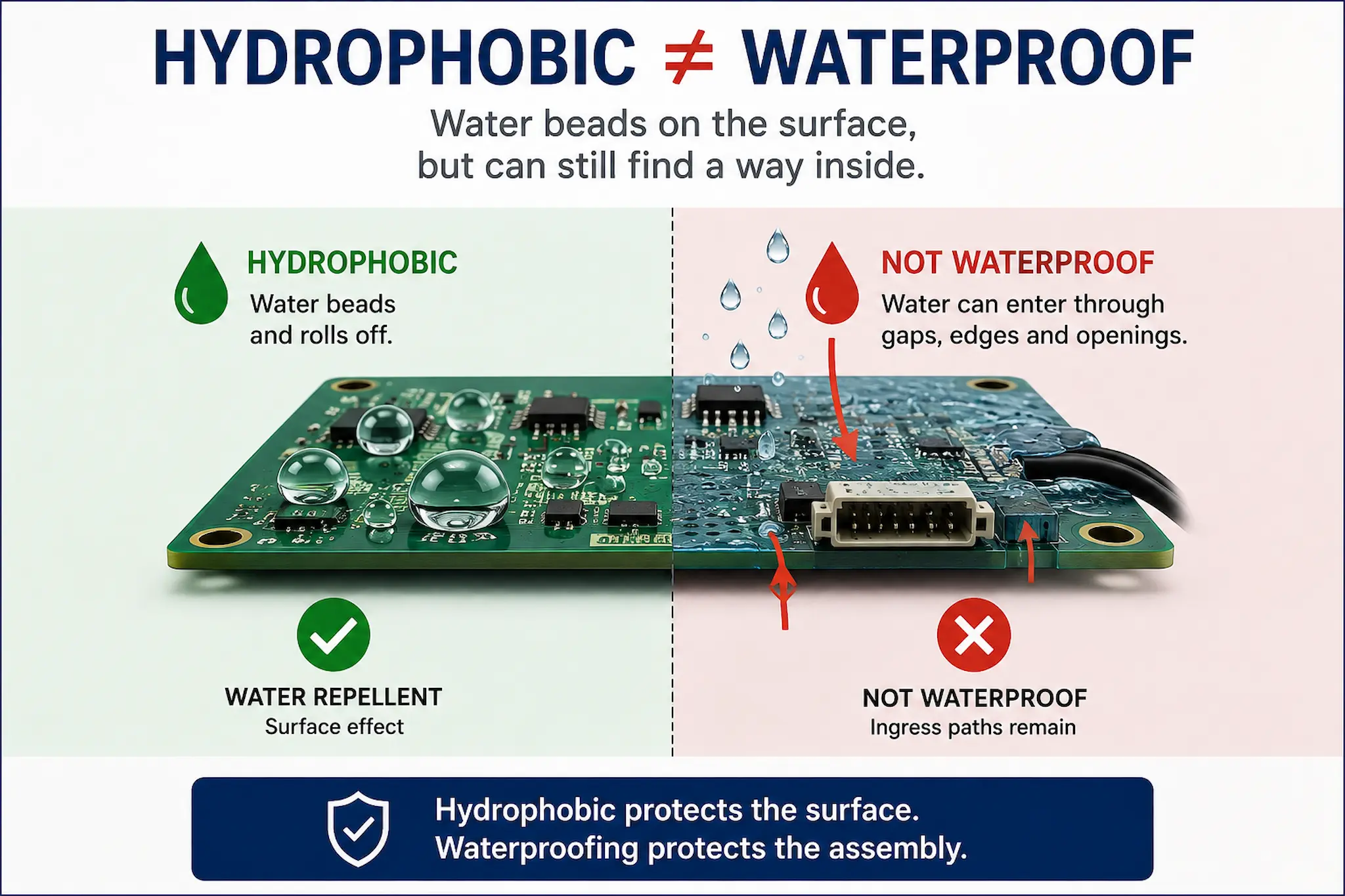
Hydrophobic coatings can repel water from treated surfaces, but gaps, edges and other ingress paths can prevent an assembly from being waterproof.
Engineering Observation
A common demonstration of a hydrophobic coating is to place water onto the treated surface and observe droplets forming a high contact angle or rolling away easily.
This demonstrates useful surface behaviour, but it does not prove that the complete assembly is waterproof.
Why Hydrophobic Does Not Mean Waterproof
Water Repellency Is a Surface Effect
Hydrophobic coatings reduce the tendency of liquid water to wet a treated surface. Water can form droplets rather than spreading across the surface, making it easier for water to move or roll away.
This can be extremely useful, particularly where reducing water retention or surface wetting improves performance or reliability.
However, the behaviour describes the interaction between water and the coated surface. It does not automatically describe the protection of the complete assembly.
Water Can Find Other Ingress Paths
An electronic assembly normally contains many features other than exposed flat surfaces. Connectors, component interfaces, cable entries, mechanical joints, edges, vias, mounting points and uncoated areas can all create alternative routes for moisture.
If these areas are not protected by the coating or by another part of the product design, water may still reach vulnerable surfaces. Component edges and changes in geometry can also create local protection weaknesses, particularly where conformal coating pulls away from component edges.
Very Thin Coatings Have Different Functions
Some hydrophobic and functional coatings are intentionally extremely thin. Their purpose may be to modify surface energy and reduce wetting rather than create a thick physical barrier.
That can provide valuable protection without significantly changing component dimensions, weight or other functional characteristics, but it should not be assumed to behave like an enclosure, encapsulant or thick barrier coating.
Damage and Coverage Still Matter
Any coating can only influence the surfaces it actually protects. Missed areas, handling damage, abrasion, masking boundaries or later mechanical changes to the assembly can create locations where the intended surface behaviour is absent.
Coverage therefore remains important even when the coating is extremely thin and difficult to see.
Water Repellency and Barrier Protection Are Different
Hydrophobic behaviour and barrier performance should be treated as related but different properties.
- Hydrophobicity describes how readily water wets a surface.
- Barrier protection describes the ability of a coating or protection system to restrict the movement of moisture or other environmental contaminants toward the protected substrate.
- Waterproofing normally describes a complete product or enclosure-level capability to prevent unacceptable water ingress under defined conditions.
A coating can therefore be highly hydrophobic without the complete assembly being waterproof.
Practical Findings
- Water beading is useful evidence of hydrophobic surface behaviour but is not a waterproofing test.
- Coating performance should be considered alongside component geometry and potential ingress paths.
- Connector interfaces, cable entries and mechanical joints may require separate protection.
- Ultra-thin functional coatings may provide useful moisture resistance without acting as thick physical barriers.
- Coverage, handling and damage remain important even where a coating is difficult to see.
- The protection requirement should be defined before deciding whether hydrophobic behaviour alone is sufficient.
Process Note: Define the Protection Requirement
Before specifying a hydrophobic coating, define what the product actually needs to survive.
Protection from occasional droplets, condensation, high humidity, rain exposure, splash, temporary immersion and continuous immersion are different engineering requirements.
Actions When Evaluating a Hydrophobic Coating
- Define the expected water or moisture exposure.
- Identify the surfaces that actually require protection.
- Identify connectors, joints, edges and other potential ingress paths.
- Determine whether the requirement is water repellency, moisture resistance or a complete waterproofing solution.
- Consider whether other protection methods are required alongside the coating.
- Evaluate coating coverage on representative production assemblies.
- Test the completed product against realistic environmental conditions rather than relying only on water-beading demonstrations.
Escalation Point
A hydrophobic coating should be evaluated more closely where the product will experience severe environmental exposure, safety-critical operation, repeated wetting, condensation, salt contamination, pressure-driven water ingress or immersion.
In these applications, protection should normally be considered at complete product level. Coating selection, enclosure design, connector sealing, coverage and environmental validation may all contribute to the final reliability of the assembly.
Related Guidance
- Advanced Functional Coatings Hub — Deeper technical guidance covering specialist surface treatments and functional coating behaviour.
- Conformal Coating Bulletin Library — Short operational guidance covering coating behaviour, defects, masking, inspection, contamination and production issues.
Need Help Evaluating a Functional Coating?
SCH Services can support coating selection, application trials, process development and engineering review where hydrophobic behaviour, environmental protection or functional coating performance needs to be evaluated against a specific application.
Why Choose SCH Services?
SCH Services combines practical coating experience with technical consultancy, process engineering and specialist knowledge of conformal coatings and advanced functional surface treatments.
Our approach considers the complete protection requirement rather than judging coating performance from a single property such as water beading or contact angle.
This allows coating behaviour to be evaluated in the context of actual product geometry, environmental exposure, application method and reliability requirements.
Technical Guidance Disclaimer
The information provided in this bulletin is general technical guidance only. Hydrophobic coating performance, environmental protection, coverage requirements and validation methods should always be assessed against the specific assembly, substrate, product design, operating environment and reliability requirements.
SCH Services can provide application-specific engineering support where coating selection, testing, validation or process development is required.