Silicone Contamination from Masking Materials
Why masking products can transfer contamination and create conformal coating defects
Bulletin Category: Cleaning, Contamination & Surface Problems | Typical Environments: PCB masking, masking boots, masking tapes, masking dots, conformal coating preparation, manual masking, selective coating, rework areas and production troubleshooting.
Silicone contamination from masking materials can cause coating defects even when the masking method appears correct.
Some masking boots, tapes, dots, caps or handling materials may transfer low levels of silicone or other low-surface-energy residues onto the PCB surface. These residues can interfere with coating wetting, adhesion and film formation.
The result is often blamed on coating material, spray technique or operator error, but the real cause may be contamination introduced during the masking process.
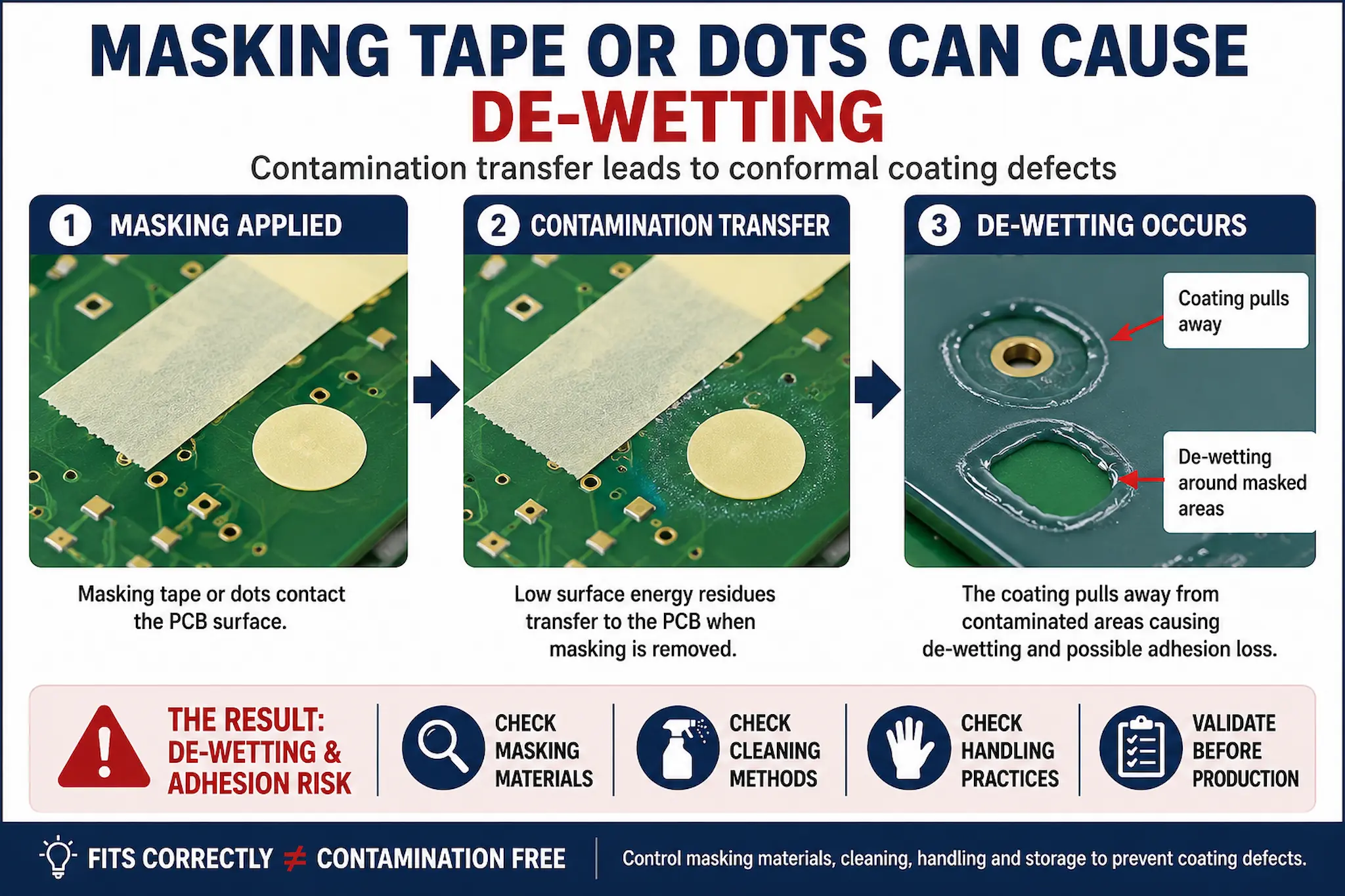
Masking tape and masking dots can transfer contamination to PCB surfaces, causing local de-wetting and conformal coating adhesion defects.
Why this matters
Conformal coating relies on the coating liquid wetting the PCB surface correctly before it cures. If a small amount of silicone or release-agent residue is present, the coating may pull away, thin out, crater, fisheye or fail to adhere locally.
This can be especially difficult to diagnose because the contamination may not be visible before coating.
Typical symptoms
- Local de-wetting around masked areas
- Fish-eyes, craters or circular coating pull-back
- Poor coating adhesion near keep-out zones
- Random-looking defects that repeat near the same masking features
- Good coating coverage elsewhere on the same assembly
- Defects appearing after a change of masking material, supplier or cleaning method
For wider defect background, see de-wetting in conformal coating and why masking is the leading cause of conformal coating defects.
Key point: A masking material can fit correctly and still create coating defects if it transfers contamination to the surface.
Related masking warning: Even when masking products fit correctly and keep-out areas are protected, coating defects can still appear elsewhere if contamination, surface energy, wetting, cure or film-build control are not stable. See Why Perfect Masking Still Produces Coating Defects.
Common causes
- Silicone-based masking boots or caps: some materials may transfer residues during fitting, compression or removal.
- Release agents: moulded masking products may contain surface residues from manufacture.
- Handling transfer: gloves, tools, benches or storage bags can move contamination onto parts. See Fingerprints and Handling Contamination Before Conformal Coating for practical guidance on identifying handling contamination introduced during masking, inspection, storage and movement before coating.
- Repeated-use masking: reusable boots or plugs may collect coating, oils, dust or cleaning residues over time.
- Incompatible cleaning methods: cleaning the masking material may leave residues or change surface behaviour. Process changes in cleaning, rinsing, drying or maintenance can also introduce new coating defects. See Cleaning Process Changes Causing New Conformal Coating Defects for practical troubleshooting guidance.
- Material changes: a new tape, boot, dot or supplier can change contamination risk even if the geometry is identical.
- Flux residues: no-clean fluxes may still affect coating adhesion and wetting. See Flux Residues Causing Conformal Coating Failure for practical examples of contamination-related coating defects and Boards Look Clean but Still Fail Conformal Coating for examples where contamination remains hidden despite assemblies appearing visually clean.
What to check first
-
- Did the defect appear after changing masking material or supplier?
- Does the defect appear close to masked zones?
- Are reusable masking products being cleaned, stored and handled consistently?
- Do defects follow the masking operation rather than the coating path?
- Can the same board area coat correctly when masking is changed or removed?
- Are operators touching coating areas after handling masking materials? See Fingerprints and Handling Contamination Before Conformal Coating for guidance on contamination introduced during handling, inspection and movement before coating.
A simple comparison trial using alternative masking materials can often identify whether masking contamination is involved.
How to reduce the risk
Use masking materials that have been evaluated with the coating process, not just selected by fit. Surface preparation and cleanliness controls should also be reviewed where contamination is suspected. See surface preparation and cleanliness for conformal coating.
- Avoid uncontrolled silicone materials near coating areas unless they have been validated.
- Store reusable boots, caps and plugs cleanly between uses.
- Control how masking products are cleaned and dried.
- Keep masking handling separate from final coating surfaces where possible.
- Run small validation trials before changing masking material, supplier or cleaning method.
- Inspect defect patterns against masking location, not only against spray or dip direction.
Production note: Silicone contamination is usually a process-control problem, not just a material problem. The masking product, cleaning route, handling method and storage condition all need to be controlled together.
Related masking bulletins
Need help investigating coating defects?
Contamination-related coating failures are often misdiagnosed as application, curing or material problems. SCH can review defect patterns, masking materials, handling methods and process controls to help identify the underlying cause.
Where masking materials are suspected, it is often useful to review both the masking method and the masking product itself, particularly following supplier, material or cleaning-process changes.
Submit your coating issue for review
For applications requiring repeatable masking, see our custom masking boot solutions.
Why Choose SCH Services?
SCH Services supports customers with conformal coating process troubleshooting, masking strategy, defect reduction and subcontract coating support.
Practical coating experience: direct production experience with masking boots, tapes, dots and complex keep-out features.
Process-led approach: defect analysis based on coating behaviour, masking sequence and production reality.
Training and support: practical guidance for operators, engineers and quality teams.
📞 +44 (0)1226 249019 | ✉ sales@schservices.com | 💬 Contact SCH ›