Masking Tape Removes Conformal Coating During De-Mask
Why conformal coating can lift with the tape and how to reduce edge damage during masking removal
Typical Environments: Manual masking, selective spray, batch coating, tape-defined keep-out zones, edge masking and repeat production coating
Engineering observation: A conformal coating process can appear successful until masking tape is removed. During de-mask, the tape can pull coating away from the board edge, solder joints, component bodies or protected boundary areas.
This is often treated as a simple tape problem, but the real cause is usually a combination of masking material, coating cure state, film thickness, adhesion, peel angle and operator technique.
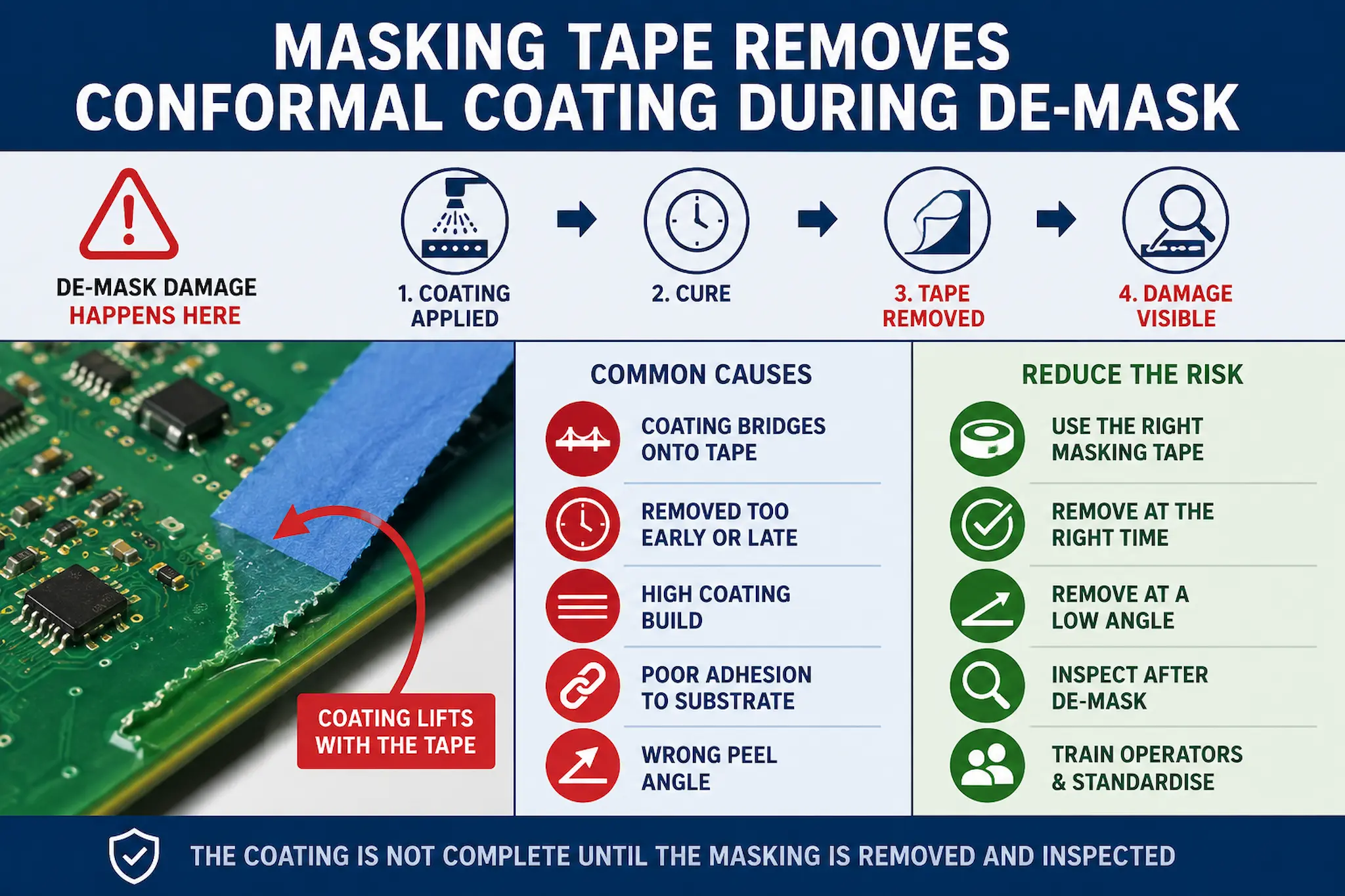
Conformal coating can lift with masking tape during de-mask if coating bridges onto the tape, cure timing is incorrect or removal technique is poorly controlled.
Why coating lifts during de-mask
Masking tape creates a physical boundary. If the coating bridges across that boundary, bonds strongly to the tape edge, cures too far before removal or has poor adhesion to the assembly, the tape can pull the coating film with it during removal.
Common causes
- Coating bridge at the tape edge: the coating forms a continuous film from the PCB surface onto the masking tape.
- Incorrect removal timing: removing tape too early can smear or disturb wet coating; removing it too late can tear a cured film.
- High coating build: thick coating at the tape edge increases the chance of tearing or lifting during removal.
- Poor adhesion to the substrate: contamination, residues or surface condition can allow coating to release from the assembly before it releases from the tape.
- Wrong peel angle: pulling tape upwards can lift the coating edge instead of shearing the mask away cleanly.
- Unsuitable tape or adhesive: excessive tack, adhesive transfer, silicone contamination or poor coating compatibility can increase removal damage.
- Operator variation: speed, direction, angle and support of the assembly all influence the de-masking result.
Practical findings during production
De-masking damage is often discovered late because the coating may look acceptable before the tape is removed. The defect only becomes visible when the tape pulls, tears or disturbs the coating boundary.
Where the same defect repeats, the solution is rarely simply “remove the tape more carefully”. The masking method, coating thickness, cure window and removal sequence normally need to be reviewed together.
It is also important to recognise that not all masking-related defects originate during de-masking. Small masking dots can lift, move or release during coating, allowing contamination to reach protected test points, vias or keep-out areas before tape removal even begins. See Masking Dots Lift During Conformal Coating.
Process note: De-masking should be treated as a controlled production step. The coating is not complete until the masking has been removed, the boundary inspected and any required touch-up or escalation completed.
What the defect usually looks like
- Lifted coating edges along tape-defined boundaries.
- Ragged or torn coating lines after tape removal.
- Coating removed from solder joints, component edges or PCB features next to the mask line.
- Thin or exposed areas next to a keep-out zone.
- Small flakes or stringing of coating at the tape edge.
- Inconsistent results between operators or production batches.
Recommended actions
- Define the correct de-masking timing for the coating material and application method.
- Remove tape at a low angle rather than lifting directly away from the board.
- Control coating build-up at the tape edge to reduce film bridging.
- Inspect masked boundaries immediately after tape removal.
- Use a masking tape that has been validated with the coating chemistry and cure process.
- Train operators to remove tape consistently using the agreed direction, speed and angle.
- Record whether damage occurs only on specific assemblies, coatings, operators or cure windows.
- Escalate repeated edge lifting rather than accepting repeated touch-up as normal production behaviour.
When to escalate the issue
De-masking damage should be escalated when coating is removed from required protection areas, when exposed conductors or solder joints are created, when repeated touch-up is needed, or when the result varies significantly between operators.
If the defect affects inspection acceptance, customer specification, electrical spacing or long-term environmental protection, the masking and coating process should be reviewed before further production release.
Related guidance
Need help reducing de-masking defects?
SCH Services supports masking material selection, de-masking process review, operator training and conformal coating troubleshooting for production coating processes.
Where tape removal is repeatedly damaging coating, the most reliable approach is to review the masking material, coating build, removal timing and inspection method as one controlled process.
Why Choose SCH Services?
- Production experience: masking tapes and materials are selected from real coating-service use, not catalogue suitability alone.
- Process understanding: SCH works across masking, coating, inspection, rework and operator training.
- Practical support: evaluation can include sample trials, process review, masking method recommendations and de-masking guidance.
- Coating expertise: support is available for liquid conformal coating, Parylene coating and advanced functional coating applications.
Note: This bulletin provides general technical guidance only. Masking materials, coating removal timing, de-masking method and repair decisions should always be validated against the specific assembly, coating material, production process, inspection criteria and customer requirements.