Boards Look Clean but Still Fail Conformal Coating
Why visual cleanliness does not always prove a PCB is ready for conformal coating
Bulletin Category: Cleaning, Contamination & Surface Problems | Typical Environments: PCB assembly, cleaning, rework, conformal coating, selective coating, inspection and production troubleshooting
A PCB can look clean and still fail during conformal coating. Visual inspection is useful, but it does not prove that the surface is chemically ready for coating.
Thin residues, ionic contamination, fingerprints, cleaning chemistry, flux activators, silicone traces and other surface films may be invisible by eye but still affect wetting, adhesion and long-term coating reliability.
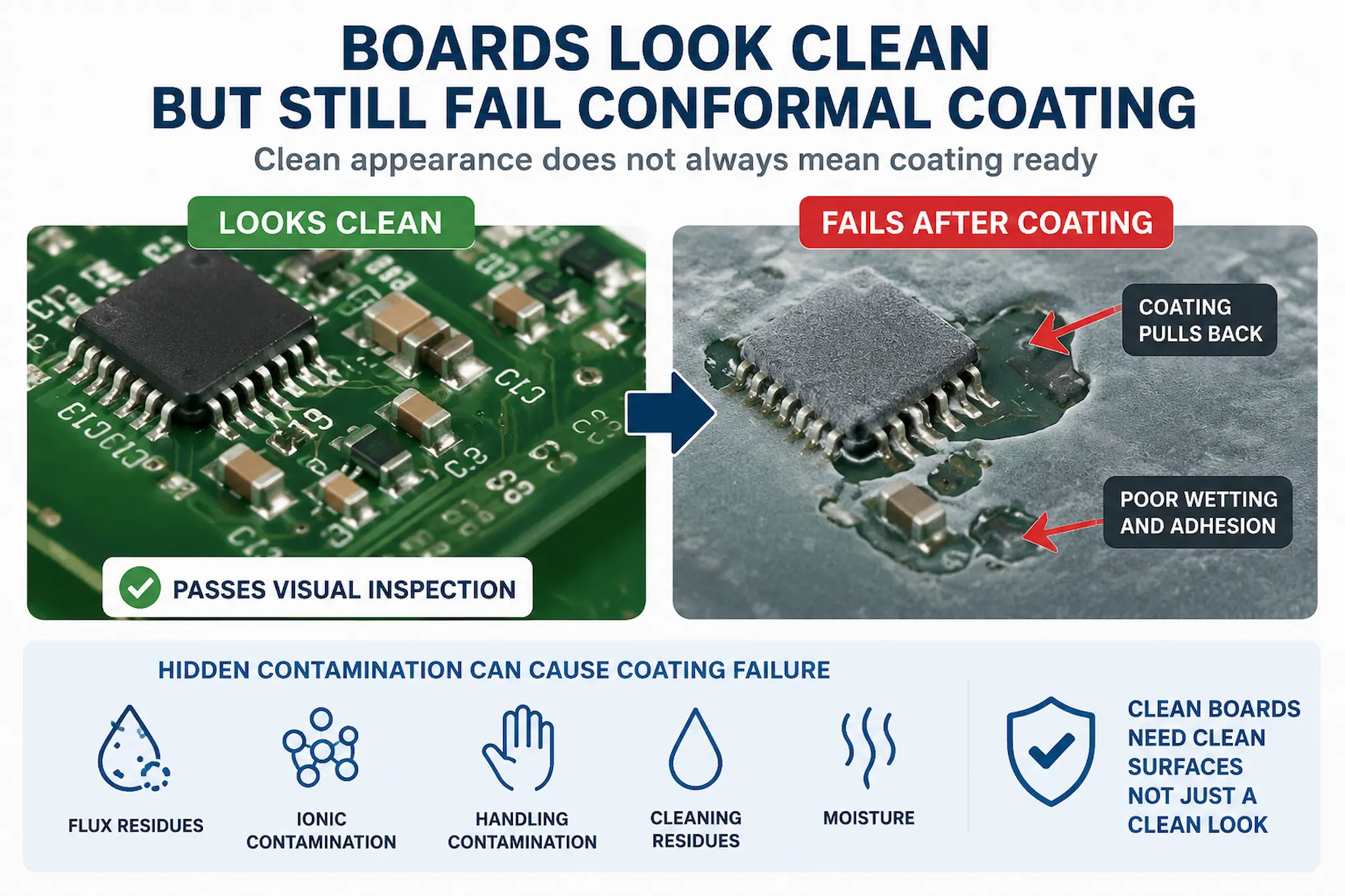
A clean-looking PCB can still suffer conformal coating defects if hidden contamination remains on the surface.
Engineering observation
One of the most misleading coating problems is a board that appears clean before coating but shows defects afterwards. The defect may only become visible once the coating wets the surface, cures, shrinks, reflects light differently or highlights residue around solder joints and component terminations.
This often leads to the assumption that the coating process has changed. Sometimes it has. However, in many cases the root cause is a change in the incoming surface condition rather than the coating application itself.
Why it happens
Conformal coating performance depends on the condition of the surface at the coating interface. A board may pass normal visual inspection but still carry contamination that changes surface energy, blocks adhesion or interferes with coating flow.
Common hidden causes
- Flux residues: activators or residues left around solder joints, leads and reworked areas.
- Ionic contamination: contamination that may not be visible but can still affect reliability and corrosion risk.
- Cleaning residues: poorly rinsed or trapped cleaning chemistry left under components or around dense areas. Small changes in cleaning chemistry, rinsing, drying or process settings can create unexpected coating defects. See Cleaning Process Changes Causing New Conformal Coating Defects for practical troubleshooting guidance.
- Handling contamination: fingerprints, skin oils, gloves, packaging contact or manual handling marks. See Fingerprints and Handling Contamination Before Conformal Coating for practical guidance on identifying and controlling contamination introduced after cleaning.
- Silicone contamination: low-level transfer from materials, tools, masking products or nearby processes.
- Moisture: trapped moisture under components, inside gaps or within porous residues. Even boards that appear clean and dry can retain residual moisture that later causes white residues, corrosion, adhesion loss or electrical leakage after coating. See Moisture Trapped Before Conformal Coating for practical guidance on identifying and controlling moisture-related coating failures.
- Surface finish changes: board finish, solder mask, supplier or assembly process changes affecting coating behaviour.
The board can therefore look acceptable but still behave differently when coating is applied.
Practical findings
- Defects are often localised: coating failures may appear around specific solder joints, connectors, components or reworked areas rather than across the whole board.
- Previous good batches do not prove the next batch is the same: small upstream changes can create a different surface condition.
- Residues can become visible after coating: coating can highlight contamination that was not obvious before application.
- Cleaning validation matters: a cleaned board is not automatically a coating-ready board.
- Inspection must focus on risk areas: dense areas, low standoff components, hand-soldered joints and rework zones usually deserve closer review.
Process note
A visually clean PCB is not the same as a coating-ready PCB. Visual cleanliness checks appearance. Coating readiness depends on surface chemistry, residue control, moisture control and compatibility with the coating process.
Recommended actions
- Compare affected and unaffected boards from the same batch.
- Check whether the flux, soldering profile, solder paste, rework activity or PCB supplier has changed.
- Review cleaning chemistry, wash time, rinse quality, drying time and board loading method.
- Inspect solder joints, component edges, connectors and reworked areas under magnification and suitable lighting.
- Review cleaning chemistry, wash time, rinse quality, drying time and board loading method. Confirm that assemblies are fully dry before coating, as residual moisture can remain beneath components or within dense PCB layouts even when boards appear clean. See Moisture Trapped Before Conformal Coating for practical guidance.
- Use ionic contamination testing, UV inspection, surface energy checks or residue analysis where the risk justifies it.
- Review whether boards are being stored, handled or packaged in a way that can re-contaminate the surface before coating.
Escalation point
If coating defects appear after a board has passed visual inspection, do not treat visual cleanliness as final proof that the board was suitable for coating.
Escalate the issue when defects repeat, appear around the same component areas, follow specific assembly routes, occur after rework, or appear after changes in cleaning, soldering, storage or supplier process.
Related guidance
Need help investigating coating failures?
SCH Services supports conformal coating failure investigation, cleaning process review, contamination assessment, process development and practical production troubleshooting.
We can help assess whether a coating issue is linked to surface cleanliness, flux residues, masking, handling, cleaning, application method or upstream assembly changes.
Why Choose SCH Services?
SCH Services works with conformal coating processes in real production environments, including cleaning, masking, coating application, inspection, rework and failure investigation.
This practical experience helps us identify whether coating problems are caused by the coating material, the application method, the PCB surface condition or the wider assembly process.
Disclaimer: This bulletin provides general technical guidance only. The correct investigation route depends on the PCB design, coating material, cleaning process, contamination type, inspection method and end-use reliability requirements. Production processes should be validated against the relevant customer specification, industry standard and operating environment.