Why Conformal Coating Does Not Stop Corrosion If Contamination Is Trapped Underneath
Practical guidance on ionic contamination, trapped residues, moisture and long-term reliability
Corrosion under conformal coating can occur when contamination remains on a PCB before the coating is applied. Conformal coating can provide valuable protection against moisture and environmental exposure, but it cannot make a contaminated PCB assembly clean.
If ionic residues, flux contamination, salts, handling contamination or other conductive materials are already present on the surface before coating, they can remain trapped beneath the coating system.
Under suitable environmental conditions, especially when moisture is present, these residues can contribute to corrosion, electrochemical migration, leakage currents and long-term reliability failures even though the assembly appears fully coated.
This is closely linked to flux residues causing conformal coating failure, particularly where ionic material remains active beneath the coating.
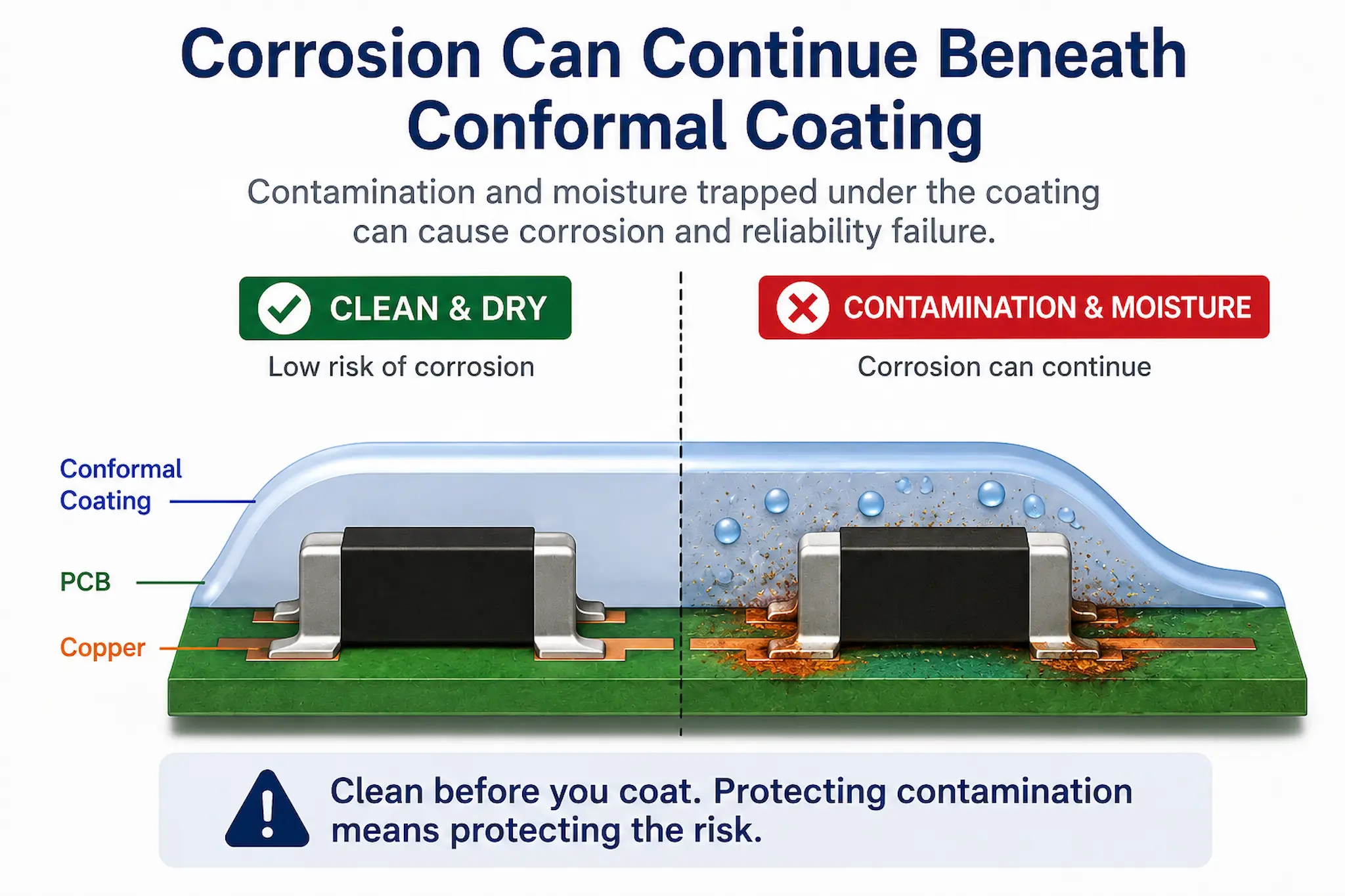
Corrosion can continue under conformal coating when contamination and moisture are trapped against the PCB surface before coating.
Engineering Observation
A coated PCB can look visually acceptable and still fail later because contamination remained beneath the coating from the beginning.
This is particularly important because the coating itself may hide the original surface condition, making the root cause less obvious once corrosion or electrical failure begins.
Why Corrosion Can Continue Beneath Conformal Coating
Ionic Contamination Remains on the Surface
Flux residues, salts and other ionic contamination can remain electrically active when moisture is present.
If these materials are not removed before coating, the conformal coating may simply seal them against the PCB surface rather than eliminate the risk they create.
Moisture Can Still Reach the Contaminated Area
Conformal coatings provide environmental protection, but they should not be assumed to create an absolute barrier to all moisture movement under every condition.
Moisture may enter through coating defects, exposed interfaces, damaged areas, edges, connector regions or by gradual permeation through the coating material itself.
Once moisture reaches ionic contamination, conductive pathways and corrosive reactions can develop.
The risk increases further where moisture is already trapped before conformal coating or where drying before coating is incomplete.
Electrical Bias Can Accelerate Failure
Where voltage exists between adjacent conductors, contamination and moisture can create conditions for electrochemical activity.
This can lead to leakage currents, dendritic growth or electrochemical migration between conductive features, creating intermittent or permanent electrical failures.
Coating Can Make the Failure Less Obvious
Uncoated contamination may sometimes be visible or easier to clean during production. Once coated, residues can be difficult to detect and may remain hidden until corrosion products, electrical instability or field failure become evident.
Practical Findings
- Conformal coating does not replace effective cleaning or contamination control.
- Ionic residues can remain active beneath a cured coating.
- Moisture and electrical bias can turn trapped contamination into a reliability risk.
- A visually complete coating does not prove that the underlying PCB surface was clean before application.
- Corrosion beneath coating can appear long after the original coating process was completed.
- Repeated failures in similar locations may indicate contamination associated with a particular component, cleaning process or manufacturing stage.
- Cleaning effectiveness should be considered part of the coating process, not a separate unrelated activity.
Process Note: Clean Before You Protect
The reliability of a conformal coating system depends partly on the condition of the surface beneath it.
Where cleaning appears satisfactory but coating performance is still poor, it may also be necessary to investigate adhesion failure on apparently clean surfaces.
Cleaning requirements should therefore be based on the actual contamination risk, materials used in assembly, product reliability requirements and expected service environment.
Actions When Corrosion Is Found Beneath Coating
- Identify whether the corrosion is localised or widespread.
- Check for evidence of flux residues, salts or other contamination beneath or around the affected area.
- Review the cleaning process used before coating.
- Check whether cleaning chemistry, wash parameters, rinsing, drying or maintenance practices have changed.
- Review handling controls between cleaning and coating.
- Check whether moisture could have been trapped before the coating was applied.
- Review coating coverage, exposed edges, masking boundaries and other possible moisture ingress paths.
- Consider whether electrical bias and conductor spacing may be contributing to electrochemical migration.
- Where possible, compare failed assemblies with known-good production from the same process.
Escalation Point
Further engineering review is appropriate where corrosion is recurring, field-related, safety-critical, associated with electrical leakage or migration, or where the contamination source cannot be identified.
In these situations, review the complete process chain including assembly materials, flux chemistry, cleaning effectiveness, rinsing, drying, handling, coating application, coating coverage and the environmental conditions experienced by the product.
Related Guidance
- Flux Residues Causing Conformal Coating Failure — Practical guidance explaining how residual flux can affect adhesion, wetting, appearance and long-term coating reliability.
- Moisture Trapped Before Conformal Coating — Guidance explaining how residual moisture can contribute to corrosion, adhesion loss, electrical leakage and premature reliability failures.
- Cleaning Process Changes Causing New Conformal Coating Defects — Practical guidance on how changes in cleaning chemistry and process control can introduce new coating failures.
- Conformal Coating Surface Preparation and Cleanliness — Technical guidance covering contamination control, cleaning effectiveness and surface preparation before coating.
- Conformal Coating Bulletin Library — Practical guidance covering coating defects, contamination, masking, inspection and process-control issues.
Need Help Investigating Corrosion or Contamination?
SCH Services can support coating failure investigation, cleaning and contamination review, coating trials and process troubleshooting where corrosion or reliability problems are occurring beneath conformal coating.
Why Choose SCH Services?
SCH Services combines practical conformal coating production experience with process engineering, contamination control, cleaning knowledge and coating troubleshooting.
Our approach looks beyond the visible coating layer and considers the complete process that determines long-term reliability, including surface condition, cleaning, moisture control, coating application and environmental exposure.
This helps identify whether corrosion is being driven by trapped contamination, moisture ingress, coating coverage or a wider manufacturing-process issue.
Technical Guidance Disclaimer
The information provided in this bulletin is general technical guidance only. Cleaning requirements, contamination limits, coating selection, inspection methods and reliability controls should always be validated against the specific assembly, materials, electrical design, operating environment and product requirements.
SCH Services can provide application-specific engineering support where contamination assessment, coating failure investigation, testing or process development is required.