Superhydrophobic Coatings for Antennas, Radomes & Advanced Surfaces
Extreme water repellency for applications where water film formation, rain, ice or snow can interfere with surface performance
Superhydrophobic coatings are used when ordinary water repellency is not enough. They are designed to create very high water contact angles and encourage droplets to bead and roll away from the surface rather than spreading into a continuous water film.
This behaviour can be particularly valuable on antennas, radomes, RF equipment, sensors and exposed precision surfaces, where retained water, rain, ice or snow may interfere with operation.
SCH works with Cytonix CytoThane superhydrophobic coating technologies, including systems developed specifically for telecommunications and exposed outdoor surfaces. The available coating routes include single-part and multi-part materials, spray and roll application, fluorinated and fluorine-free options, and formulations developed for different durability, colour and application requirements.
The key engineering question is not simply “how hydrophobic is the coating?” It is whether the surface needs extreme water shedding and whether that behaviour can be maintained under the actual environmental, handling and durability conditions of the application.
For applications needing conventional water repellency rather than extreme droplet shedding, first review Hydrophobic Coatings. For broader coating selection, return to Advanced Functional Coatings.
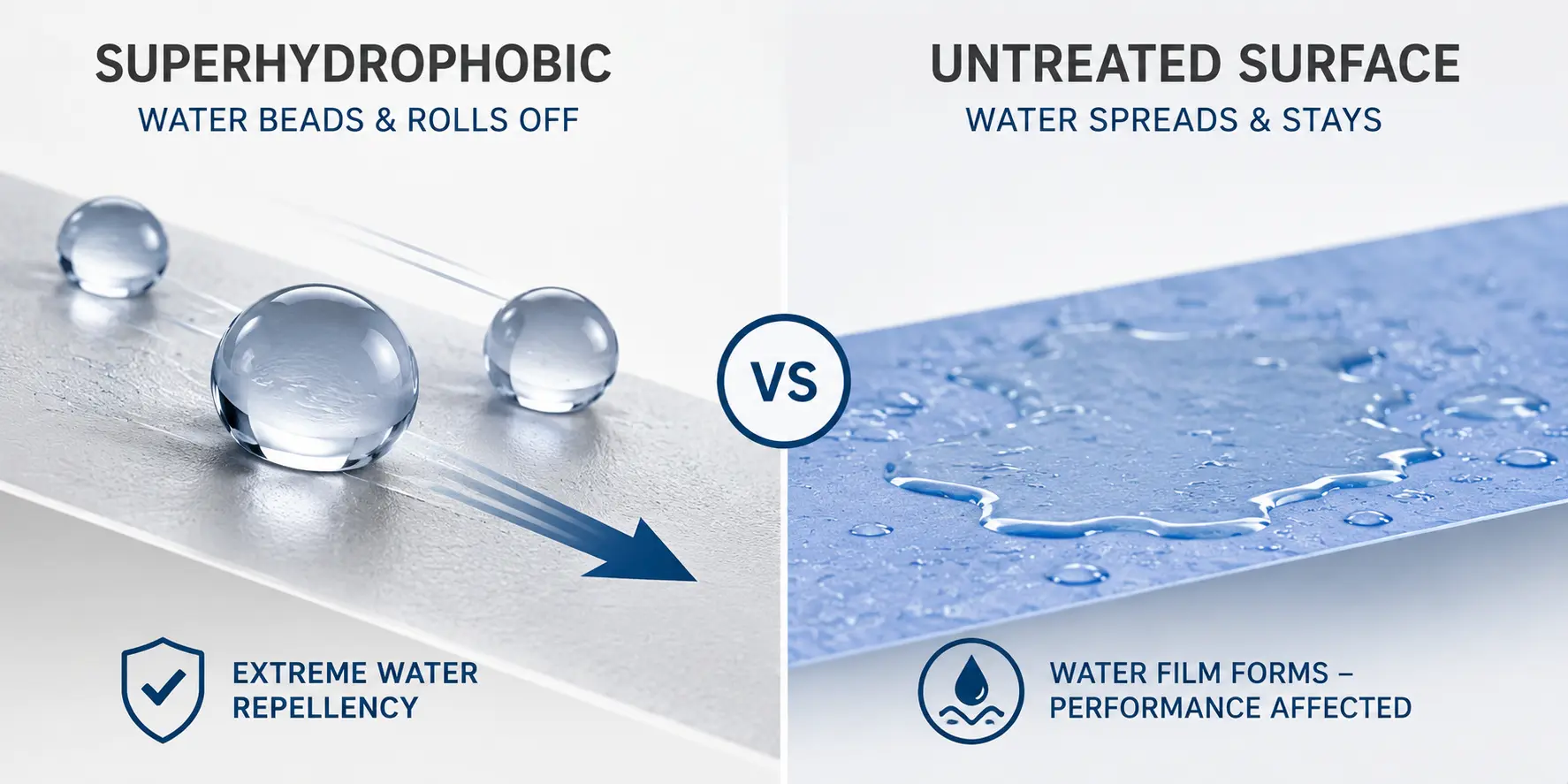
Superhydrophobic surfaces encourage water to bead and roll away, reducing persistent water film formation.
What Makes a Coating Superhydrophobic?
Hydrophobicity describes the tendency of a surface to resist wetting by water. Contact angle is commonly used to describe this behaviour: the larger the angle formed by a water droplet on the surface, the less readily the water spreads.
A conventional hydrophobic surface may cause water to bead. A superhydrophobic surface takes this behaviour much further, producing very high contact angles combined with low water adhesion so that droplets can readily roll or shed from the surface.
Contact angle alone does not tell the whole story.
A coating may show a high static water contact angle but still retain droplets if the water strongly adheres to the surface. Roll-off behaviour, durability, surface preparation, contamination, abrasion and real environmental exposure also affect practical performance.
CytoThane technologies use high or very high water contact angles together with controlled droplet roll-off behaviour to reduce water retention and water film formation on exposed surfaces.
For a deeper explanation of how surface chemistry, microscopic structure, contact angle and sliding behaviour interact, see Why Some Coatings Cause Water to Bead and Roll Off.
Why Water Film Formation Matters
On many surfaces, rain does not simply arrive as isolated droplets and disappear. Water can spread, combine and remain on the surface as a continuous or semi-continuous film.
That may be undesirable where the surface itself performs an electrical, radio-frequency, optical, sensing or aerodynamic function.
RF & Microwave Systems Water retained on antennas and radomes can contribute to signal attenuation. Superhydrophobic treatment is used to encourage rapid water shedding and reduce persistent water-film formation.
Sensors Rain, droplets or retained moisture can interfere with exposed sensing surfaces. Controlling wetting can help the surface return more quickly towards its normal operating condition.
Ice & Snow Exposure Reducing water retention can also reduce the conditions that encourage some forms of ice and snow accumulation, although performance remains dependent on the environment and application.
Where Superhydrophobic Coatings Are Used
CytoThane technologies have been developed primarily for surfaces where extreme water shedding provides a functional benefit rather than simply a cosmetic beading effect.
Antennas & Satellite Dishes
Water film formation on exposed antenna surfaces can contribute to rain-related signal losses. CytoThane materials have been used on terrestrial and satellite communications equipment to improve water shedding during rainfall. Where appearance is also important, colour-matched CytoThane MW can be considered so that the functional coating does not unnecessarily change the visual appearance of the antenna or dish.
Radomes & RF Surfaces
Radome surfaces may need to remain environmentally exposed while minimising retained water over the RF transmission path. Superhydrophobic coatings provide a surface-control route without requiring the water itself to remain as a continuous film.
Wind & Radiometric Sensors
Exposed sensors may experience temporary interference from rain, water retention or freezing conditions. Fast-shedding surface treatments can help manage water interaction with the sensing surface.
Passive Reflectors & Repeaters
Remote telecommunications infrastructure may be difficult to access and continuously exposed to rain, snow and ice. Surface treatments can be used as part of the environmental performance strategy.
Telecommunications Equipment
Depending on the design and exposure condition, superhydrophobic treatment may also be considered for selected telecommunications housings, exposed components and other surfaces where retained water can interfere with operation.
Industrial & Precision Surfaces
Where extreme water repellency rather than conventional barrier protection is required, superhydrophobic behaviour can also be evaluated on compatible metal, plastic, rubber, fabric and other engineered surfaces.
CytoThane Superhydrophobic Coating Technologies
The CytoThane family provides different routes depending on required water repellency, durability, chemistry, application method and appearance.
| Technology | General Position | Application Route |
|---|---|---|
| CytoThane MW | Established single-part superhydrophobic system for antennas, radomes and telecommunications surfaces, with colour-matching options available where the treated surface needs to retain or match an existing equipment colour. | Spray, roll and other controlled application routes depending on the process. |
| WX2100 | Aerosol version of the CytoThane MW technology for smaller areas, maintenance and field application. | Aerosol spray. |
| CytoThane TS | Higher-durability, fluorine-free superhydrophobic system. Cytonix selection data positions TS at approximately twice the abrasion and rain resistance of WX2100, making it particularly relevant where greater mechanical and weathering durability is required. | Two-part / two-stage application by spray or roll. |
| CytoThane R04 | Fluorine-free single-part superhydrophobic option. | Spray or roll. |
| CytoThane MX | Highly water-repellent telecommunications coating combining increased surface hardness with colour options. Relevant where water repellency, appearance and a harder finished surface are important. | Single-part spray or roll application depending on the process. |
Do not select by contact angle alone.
Water repellency, roll-off angle, abrasion resistance, UV exposure, colour, fluorine content, application method, substrate, handling and expected service environment should all be considered before a CytoThane material is selected.
To compare CytoThane MW, WX2100, TS, R04 and MX by application method, durability, chemistry and water-repellent performance, use the CytoThane Superhydrophobic Coating Selection Guide.
CytoThane MW & WX2100
CytoThane MW is an established single-part, air-cured superhydrophobic coating developed for marine and ground-based microwave antennas, radomes and other telecommunications equipment.
CytoThane MW can also be supplied for colour-matched applications. This can be particularly useful on antennas, radomes and telecommunications structures where the superhydrophobic treatment needs to provide extreme water shedding while maintaining or closely matching the existing equipment colour.
Cytonix reports water contact angles in the superhydrophobic range and extensive outdoor use on telecommunications equipment. When correctly applied, the coating causes water to form highly rounded droplets that readily shed from the treated surface rather than forming a persistent water film.
WX2100 is the aerosol-packaged version of the CytoThane MW technology. This provides a practical route for smaller areas and some field or maintenance applications where conventional bulk spray equipment may not be appropriate.
Single-part system
No two-component mixing process is required for the standard MW system.
Air cured
Initial rain resistance develops before full cure, with final properties developing over several days.
Flexible application
Bulk material can be applied by controlled spray or roll processes, while WX2100 provides an aerosol route.
Colour matching
Colour-matched MW options can be considered where the coating needs to integrate with the existing appearance of an antenna, radome or telecommunications structure.
Outdoor applications
Developed for exposure to rain, sunlight and demanding telecommunications environments.
CytoThane MX
CytoThane MX provides a different balance of properties within the CytoThane family. It combines high water repellency with increased surface hardness and is available with colour options for applications where the appearance of the finished surface is also important.
This can make MX relevant for telecommunications and other exposed surfaces where water shedding remains important but the application also benefits from increased surface hardness and control of the finished colour or appearance.
A different performance balance
MX should not simply be viewed as a more or less hydrophobic version of MW or TS. It provides another selection route where water repellency, surface hardness, colour, application requirements and the actual service environment need to be considered together.
Rain Fade & RF Performance
One of the most important applications for CytoThane is the management of water on microwave and satellite communication surfaces.
During heavy rain, water retained on an antenna or radome can become part of the RF transmission environment. Rather than attempting to make the structure itself a conventional environmental barrier, the superhydrophobic approach is to reduce the amount of water retained on the exposed surface.
Cytonix reports comparative testing and field experience showing improved signal margins on coated antenna systems during heavy rainfall, including applications operating in Ku- and Ka-band environments.
Important:
RF performance depends on the antenna or radome design, frequency, coating thickness, substrate, rainfall intensity, installation and many other factors. Published Cytonix results demonstrate the potential benefit of the technology but should not be treated as a guaranteed signal improvement for every system. The coating should be validated on the actual RF structure and operating condition.
Rain, Ice & Snow Behaviour
Superhydrophobic coatings do not heat a surface and should not be confused with an active de-icing system. Their role is to change the interaction between water and the surface.
By reducing wetting and encouraging water to leave the surface, CytoThane coatings can reduce the opportunity for continuous water films to remain and may reduce the adhesion or accumulation of ice and snow under suitable environmental conditions.
This can be particularly useful on exposed telecommunications equipment, passive reflectors, radomes and remote installations where retained precipitation can affect performance or increase maintenance requirements.
Superhydrophobic does not mean ice-proof.
Ice formation is affected by surface temperature, humidity, precipitation, wind, freeze-thaw conditions and mechanical exposure. Anti-icing performance should therefore be evaluated under the actual service environment.
Durability Is Part of the Coating Selection
Creating a very high initial water contact angle is only one part of successful superhydrophobic coating design. The more important question is how long the required surface behaviour remains functional.
Cytonix has evaluated CytoThane technologies against environmental conditions including UV exposure, heavy rain, temperature cycling, high humidity and salt-fog exposure. Some systems have been developed specifically to improve abrasion and weathering resistance.
Within the CytoThane family, CytoThane TS is the higher-durability route. Cytonix data indicates approximately twice the abrasion and rain resistance of WX2100, making durability an important differentiator when selecting between the technologies.
However, the micro-scale surface characteristics that create extreme water repellency can also make superhydrophobic coatings sensitive to mechanical contact.
Handling matters. Rubbing, repeated touching, abrasion and some solvent exposure can reduce superhydrophobic performance. A coating suitable for an untouched radome may therefore not be the correct choice for a surface that is frequently handled, cleaned or mechanically contacted.
Where abrasion is expected, material selection, coating architecture and maintenance strategy should be considered before the coating is specified.
Fluorinated & Fluorine-Free Options
The CytoThane family includes both fluorinated and fluorine-free technologies. This allows material selection to consider not only water repellency and durability but also changing material, environmental and regulatory requirements.
CytoThane MW and WX2100 use a fluorinated technology route, while CytoThane TS and R04 provide fluorine-free alternatives within the superhydrophobic family.
The correct choice should be based on the complete requirement rather than fluorine content alone. Application method, durability, colour, surface hardness, environmental exposure, process control and required water behaviour may all affect the decision.
Application Method Matters
Superhydrophobic performance is strongly influenced by the applied surface. The material formulation alone does not guarantee the finished result.
Depending on the CytoThane technology and the application, coating may be applied by spray, roll or other controlled methods. Spray application can provide a consistent factory-applied surface over larger areas, while roll application can offer practical advantages for some field installations by reducing overspray and giving the operator greater local control.
Successful application normally depends on:
- clean, dry and correctly prepared substrates;
- appropriate application temperature;
- controlled coating quantity and overlap;
- correct spray distance or roller selection;
- adequate flash-off and cure time;
- preventing contamination or unnecessary handling after application; and
- validating finished water contact and roll-off behaviour.
The preferred process should therefore be established by trials rather than assumed from the coating name alone.
Superhydrophobic vs Hydrophobic Coatings
Not every application that needs water repellency needs a superhydrophobic coating.
| Requirement | Likely Starting Route |
|---|---|
| Reduce normal surface wetting or contamination | Hydrophobic coating |
| Encourage extreme water beading and rapid droplet shedding | Superhydrophobic coating |
| Reduce water retention on radomes, dishes or RF surfaces | Superhydrophobic coating evaluation |
| Protect electronics against corrosion and environmental exposure | Conformal coating, Parylene or another qualified barrier route |
| Waterproof or seal an enclosure or assembly | Engineered sealing / encapsulation system rather than surface repellency alone |
Key distinction:
Superhydrophobic describes extreme surface water repellency. It does not automatically mean waterproof, impermeable, corrosion-proof or environmentally sealed.
Evaluation Before Production
Superhydrophobic coatings should be evaluated against the real application rather than selected from contact-angle data alone.
A useful validation programme may consider:
- substrate compatibility and adhesion;
- water contact angle and roll-off behaviour;
- coating coverage and visual appearance;
- RF or sensor performance before and after coating;
- rain and water exposure;
- UV and outdoor weathering;
- temperature cycling;
- salt, humidity or coastal exposure where relevant;
- handling and abrasion;
- cleaning and maintenance requirements; and
- repair or reapplication strategy.
The objective is to move from material data → application trial → performance validation → controlled implementation.
Need Help Evaluating a Superhydrophobic Coating?
SCH can support customers evaluating CytoThane and other advanced functional coating routes for antennas, radomes, telecommunications equipment, sensors and specialist surfaces.
Support can include initial material selection, application trials, process development, coating evaluation and production implementation. Where the coating route has not yet been defined, the first step is normally to understand the substrate, operating environment and performance problem before selecting a material.
Related Guidance
Why Choose SCH Services?
SCH approaches superhydrophobic coating as an engineering and process-selection problem rather than simply supplying a coating with a high contact-angle number.
- Application-led selection – starting with the environmental or performance problem before selecting the coating.
- Cytonix coating knowledge – access to specialist CytoThane technologies for superhydrophobic surface control.
- Process development – support with surface preparation, coating application and controlled implementation.
- Validation focus – encouraging evaluation against the real substrate, exposure condition and required performance.
- Wider coating expertise – the ability to compare superhydrophobic technology with hydrophobic, nano, conformal coating, Parylene and other advanced functional coating routes.
- From feasibility to production – support for initial evaluation, application trials and production coating where required.
📞 +44 (0)1226 249019 | ✉ sales@schservices.com
Technical Disclaimer
The information on this page is provided as general engineering guidance. Superhydrophobic coating performance depends on the coating formulation, substrate, surface preparation, application process, film condition, environmental exposure, handling and service conditions. Published material and test data should not be treated as proof of suitability for a specific application. Customers should validate coating compatibility and performance under representative operating conditions before production implementation. Product properties and formulations may change; current technical documentation should be reviewed as part of final material selection.