Coating Selection & Comparison Hub
Comparing conformal coating, nano coatings, hydrophobic coatings and Parylene protection strategies for electronics
This hub explains how different PCB protection technologies compare in real manufacturing environments, including conformal coatings, nano coatings, hydrophobic coatings, Parylene and hybrid protection strategies.
The articles focus on practical engineering behaviour rather than marketing claims, helping engineers understand where technologies work well, where limitations exist, and how coating selection changes depending on geometry, environment, reliability targets and production constraints.
Topics include ultra-thin coatings, hybrid strategies, hydrophobic behaviour, environmental protection limits and realistic coating-selection decision making for modern electronics assemblies.
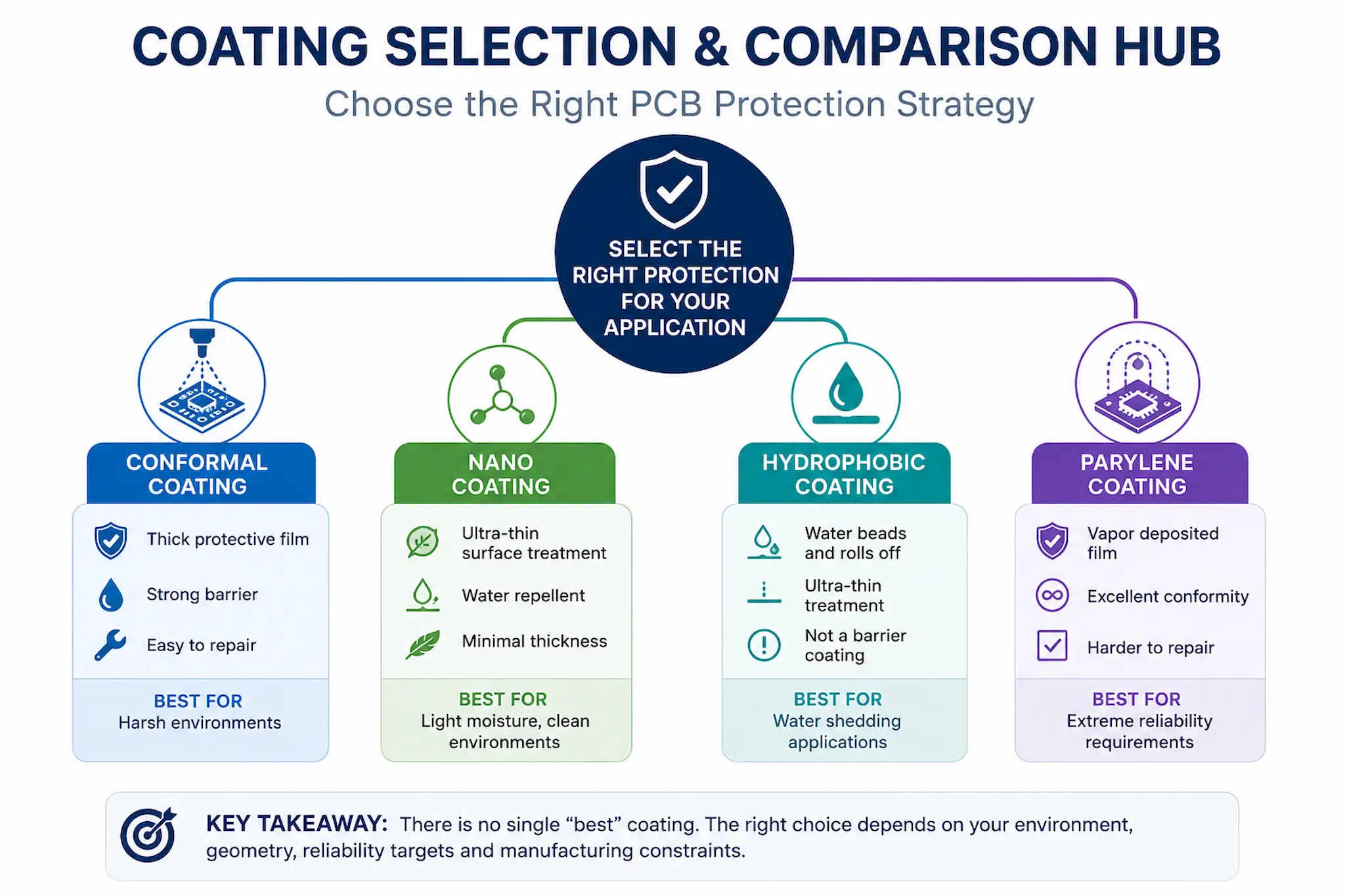
Simple comparison infographic showing how conformal coating, nano coatings, hydrophobic coatings and Parylene differ in protection behaviour, thickness and application strategy.
Where to start
The correct coating route depends first on the protection problem, not the coating name. Use the pathway below to narrow the technology family before comparing individual materials.
Conventional environmental protection
Start with conformal coating where the assembly needs a practical film barrier against moisture, contamination and environmental exposure.
Complex geometry or highly uniform coverage
Consider Parylene where conformality, dielectric behaviour, low film build or difficult geometry are central to the requirement.
Surface behaviour or ultra-thin protection
Consider nano, hydrophobic or other advanced functional coatings where surface energy, RF performance, optics or extremely low build are important.
Core Technical Coating Selection Articles
These articles compare the main electronics protection routes and help engineers decide which technology family should be investigated first.
- Conformal Coating vs Nano Coating vs Parylene – compares the strengths, weaknesses and practical limits of the major PCB protection technologies.
- Nano Coating vs Conformal Coating – compares ultra-thin surface behaviour with traditional protective coating systems.
- Parylene vs Conformal Coating: Selection Guide – compares barrier performance, geometry capability, dielectric behaviour and manufacturing considerations.
- Parylene vs Liquid Coatings: Selection Guide – compares vapour-deposited Parylene with conventional liquid coating technologies.
- Alternatives to Conformal Coating – explains where alternative technologies may outperform traditional coatings.
- How to Select a Conformal Coating Material – selecting coating chemistry based on environment, reworkability, dielectric performance and process compatibility.
Advanced Functional Coating Decision Routes
Some coating decisions involve ultra-thin, hydrophobic, RF-transparent or surface-function behaviour rather than conventional film-forming protection. These articles help identify when an advanced functional coating route should be considered, while the full technical index is managed in the Advanced Functional Coatings Hub.
- Advanced Functional Coatings Hub – full technical hub for ultra-thin, hydrophobic, RF-transparent and surface-function coating articles.
- Surface Function vs Barrier Function Coatings – understand whether the coating is changing surface behaviour or acting as an environmental barrier.
- Hydrophobic Coating vs Conformal Coating – separate water repellency from true environmental protection.
- When Nano Coatings Should NOT Be Used – identify situations where ultra-thin coatings should not replace barrier protection.
Related Insight Posts
These Insight posts support the coating selection discussion by challenging common assumptions around water beading, coating thickness and ultra-thin protection behaviour. They are not technical hub articles, but they provide useful context for decision making.
- Why Ultra-Thin Coatings Change the Protection Conversation – how ultra-thin coatings challenge traditional coating assumptions.
- Why Water Beading Is Not Proof of Electronics Protection – why visible water behaviour can mislead engineers.
- Why Water Resistance Is Not Corrosion Protection – explains why short-term water resistance and long-term corrosion protection are not the same thing.
- Why Thin Coatings Can Sometimes Protect Better Than Thick Ones – how geometry access and interface behaviour influence real protection performance.
Related Coating Solution Pages
Once the likely protection route is understood, use the relevant SCH solution pathway to compare practical options, processes and support.
- Advanced Functional Coatings – advanced coating technologies beyond traditional conformal coating systems.
- Hydrophobic Coatings – hydrophobic coating technologies and their role in electronics protection.
- Ultra-Thin Coatings – ultra-thin protective coating technologies and application strategy.
- Transitional Film Forming Coatings – bridging traditional conformal coatings and ultra-thin surface technologies.
- PFAS-Free Coatings – environmental and regulatory considerations for fluorine-free coating strategies.
- CytoPel Coating Selection Matrix – selecting advanced fluoropolymer coating technologies based on application environment and protection goals.
Related Technical Hubs
Coating selection decisions often connect directly into coating strategy, advanced functional coatings, process control and long-term reliability engineering. These related hubs expand the comparison topics into deeper technical workflows.
- Advanced Functional Coatings Hub – ultra-thin, hydrophobic, RF-transparent and surface-function coating strategies.
- Conformal Coating Strategy Hub – selecting realistic coating approaches for complex assemblies and production environments.
- Process Control Hub – coating stability, viscosity control, workflow and production management.
- Reliability & Failure Prevention Hub – contamination, geometry interaction, coating failures and long-term reliability control.
- Parylene Basics Hub – Parylene fundamentals, deposition principles and coating selection guidance.
Need help selecting the right coating strategy?
Coating selection should consider the failure mechanism, operating environment, assembly geometry, masking requirements, application process, inspection route and long-term reliability target rather than material properties alone.
Explore advanced functional coating options
Contact SCH Services to discuss coating selection, trials or process support.
Why Choose SCH Services?
- Broad coating experience: SCH Services works across conformal coating, Parylene, nano coatings and advanced functional coating technologies.
- Selection based on the engineering requirement: We help customers compare technologies against environment, geometry, performance and manufacturing constraints.
- Practical production knowledge: Our advice considers application method, masking, process control, inspection, rework and validation as well as material properties.
- Multiple implementation routes: SCH can support coating services, consultancy, trials, training, equipment and process development depending on the application.
Useful starting points include conformal coating solutions, Parylene coating solutions, advanced functional coatings and technical enquiries.
This hub provides general technical guidance on coating selection and comparison. Final coating decisions should be validated against the specific assembly design, operating environment, customer requirements, applicable standards and qualification testing.