Limitations of Hydrophobic Coatings in Electronics
Understanding where surface behaviour coatings fail to provide protection
Hydrophobic coatings are often selected because they repel water — but understanding the limitations of hydrophobic coatings in electronics is critical, as water repellency does not equal protection.
These coatings modify surface behaviour, helping liquids bead and shed from a surface. However, they do not form a continuous protective film and cannot prevent moisture ingress, corrosion or environmental failure.
The risk is not choosing the wrong material, but choosing the wrong coating regime. For full coating route comparison, see the How to Choose the Right Coating guide or compare hydrophobic coating vs conformal coating.
Not sure if this is the right route?
If your application depends on coating behaviour, see the surface vs film vs barrier guide.
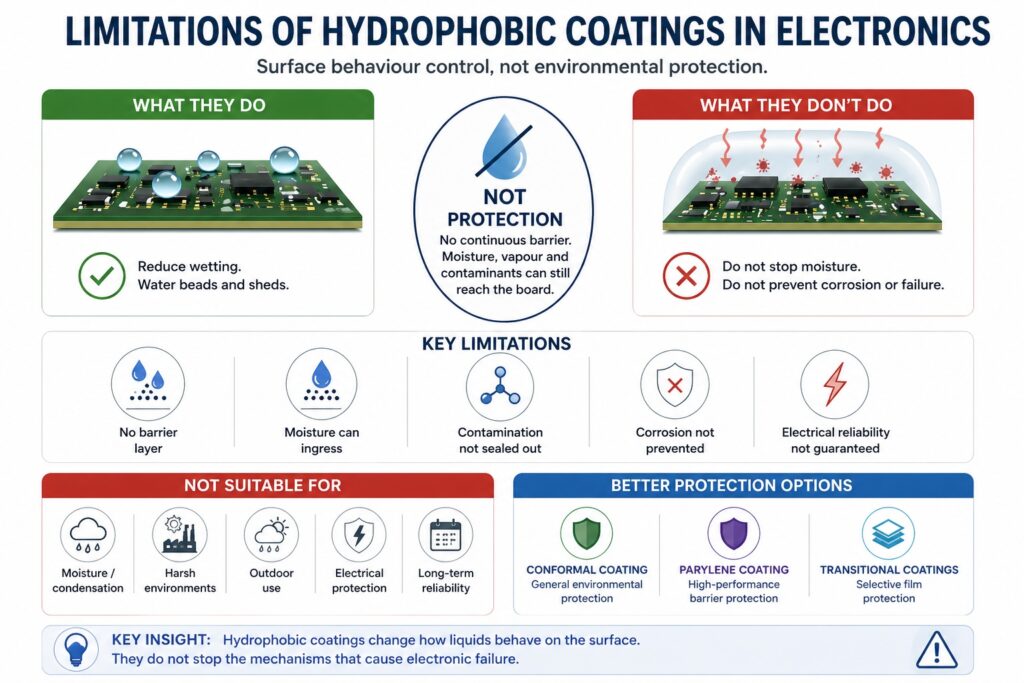
Hydrophobic coatings control surface behaviour, but do not provide a protective barrier against moisture, contamination or failure in electronics.
Why Hydrophobic Coatings Fail to Protect Electronics
- No continuous film or barrier layer
- Moisture can still reach conductive surfaces
- Contamination is not sealed out
- Corrosion mechanisms are not prevented
- Electrical reliability is not guaranteed
Even when water beads on the surface, vapour, condensation and contaminants can still interact with the assembly. For a fuller explanation, see why hydrophobic coatings don’t protect electronics.
Common Misconceptions
These misunderstandings are one of the most common causes of coating failure in electronics. For correct application cases, see when to use hydrophobic coatings.
Where Hydrophobic Coatings Are Not Suitable
- Moisture-sensitive electronics requiring reliability
- Corrosion-prone environments
- Condensation or repeated wetting conditions
- Outdoor or industrial exposure
- Electrical insulation or dielectric protection requirements
- Applications requiring long-term environmental protection
In these environments, a surface treatment alone is not enough to prevent failure. For broader ultra-thin coating comparison, see nano coating vs conformal coating.
If hydrophobic coating is not enough:
→ For general environmental protection, see conformal coating solutions
→ For high-reliability barrier protection, see Parylene coating solutions
→ For selective film protection, see transitional film-forming coatings
Key Engineering Insight
Hydrophobic coatings change how liquids behave — they do not stop failure mechanisms.
Need Help Choosing the Correct Route?
If you are unsure whether your application requires surface behaviour control, film-forming protection or full barrier coating, SCH can help define the correct coating strategy.
Why Choose SCH Services?
SCH supports coating selection based on real failure mechanisms, not assumptions based on surface behaviour.
📞 +44 (0)1226 249019 | ✉ sales@schservices.com | 💬 Discuss Your Application ›