Nano Coating vs Conformal Coating for Electronics
Understanding when ultra-thin coatings are sufficient and when full protection is required
Nano coatings and conformal coatings are often compared, but they are designed to solve different problems.
Nano coatings are ultra-thin functional coatings used to modify surface behaviour, reduce contamination or provide selective protection without adding thickness. Conformal coatings are thicker protective films designed to provide environmental protection, electrical insulation and long-term reliability.
The key decision is not which coating is “better”, but whether your application requires surface behaviour control or true environmental protection. For the underlying technical distinction, see surface-function vs barrier-function coatings. For full coating route selection, see the How to Choose the Right Coating guide.
Need help comparing advanced coating routes? Use the CytoPel Coating Selection Matrix to compare ultra-thin, hydrophobic, PFAS-free and film-forming coating strategies before selecting between nano coating, conformal coating or Parylene.
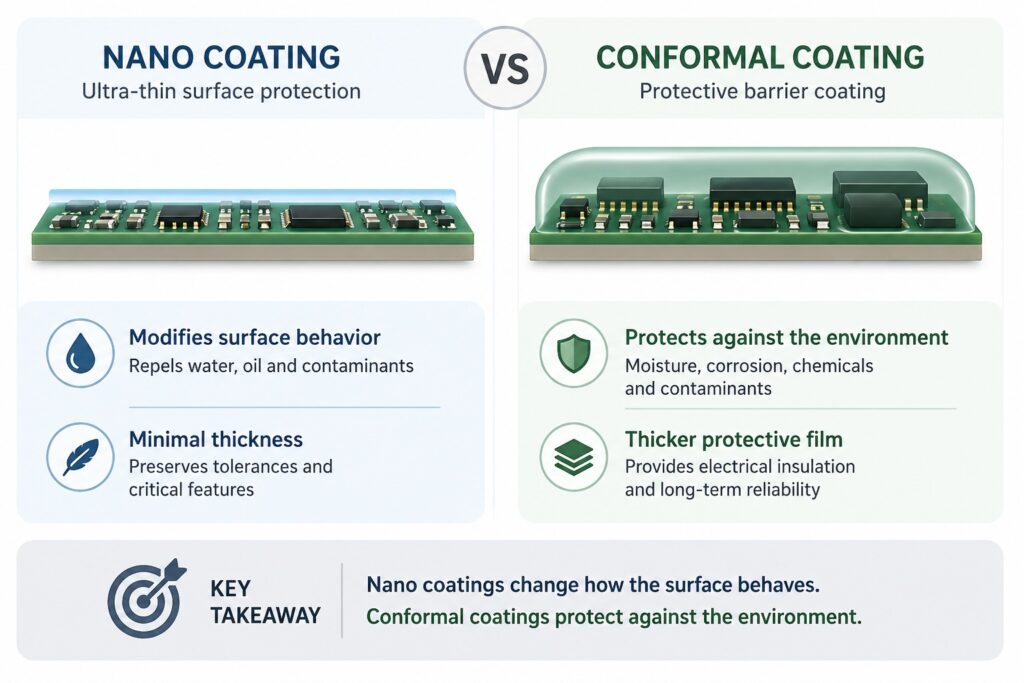
Nano coatings modify surface behaviour, while conformal coatings provide full environmental protection.
What Is the Difference?
Nano coatings are best understood as functional surface treatments, while conformal coatings are protective coating systems. For a deeper comparison of hydrophobic behaviour versus true protection, see hydrophobic coatings vs conformal coating.
Where nano coating performance depends on water repellency, contact angle or droplet roll-off, it is important to understand the difference between surface behaviour and true environmental barrier protection. See why some coatings cause water to bead and roll off and surface energy vs environmental barrier protection.
When Nano Coating Is the Right Choice
- Coating thickness must remain extremely low
- Connectors, contacts or fine geometries cannot tolerate build
- Hydrophobic or oleophobic behaviour is required
- Contamination control or cleanability is a priority
- Masking complexity needs to be reduced
- Protection is selective rather than full assembly coverage
Nano coatings are often used where process constraints or geometry make conventional coating difficult or risky. See nano coatings for electronics for more detail.
Before replacing conformal coating with nano
Nano coatings are often evaluated as a simpler, thinner or lower-cost alternative to conformal coating. In practice, many failures occur because the required protection function was never properly defined at the start of the project.
If the real requirement involves condensation, corrosion, contamination, powered humidity exposure or long-term electrical reliability, a surface-function coating alone may not provide sufficient environmental protection.
The key engineering question is whether the application requires surface behaviour control or true environmental barrier protection. For a deeper explanation of this distinction, review surface energy vs environmental barrier protection.
If you are considering replacing conformal coating with a nano coating, it is worth reviewing the application, exposure environment and failure mechanisms in detail first. You can also submit your application for review to confirm the correct protection route.
For wider selection limits and common misuse cases, see When Nano Coatings Should NOT Be Used.
When Conformal Coating Is the Right Choice
Conformal coating is normally selected when the primary requirement is long-term environmental protection rather than surface-function behaviour alone.
- Moisture, humidity or condensation exposure is present
- Corrosion protection is required
- Long-term environmental reliability is critical
- Electrical insulation and dielectric performance are needed
- Contamination + moisture interaction is a risk
Conformal coatings provide a continuous protective film that isolates the assembly from the environment. See conformal coating solutions for application approaches and process guidance.
Important: Hydrophobic Does Not Mean Protected
A nano coating may repel water, but this does not prevent moisture ingress, corrosion or electrical failure. To understand how coatings transition from surface behaviour to protection, see the surface vs film vs barrier guide, why hydrophobic coatings don’t protect electronics and why water resistance is not corrosion protection.
Typical Decision Scenarios
If the requirement is unclear, start with the coating selection guide or review when to use hydrophobic coatings and limitations of hydrophobic coatings.
Need Help Choosing the Right Approach?
If you are unsure whether your application needs nano coating or conformal coating, SCH can review the part, environment and performance requirements before recommending a coating strategy.
Why Choose SCH Services?
SCH supports coating selection, process development and application across nano coatings, conformal coatings and advanced functional coating systems.
📞 +44 (0)1226 249019 | ✉ sales@schservices.com | 💬 Discuss Your Application ›