Capillary (Wicking) Around Components in Conformal Coating
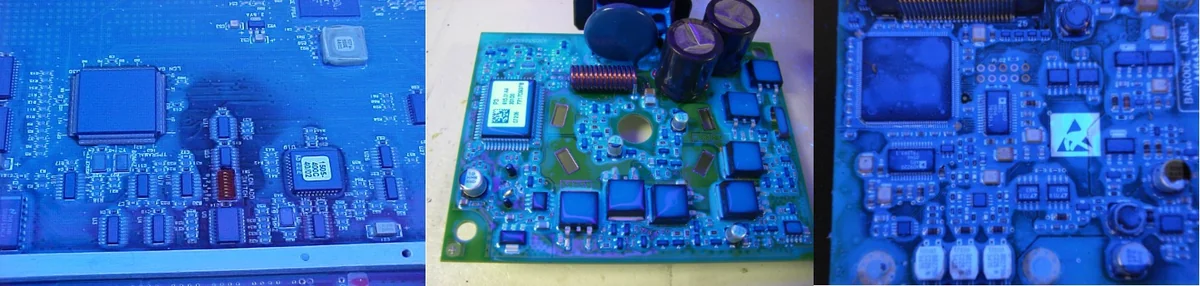
Capillary flow (wicking) occurs when conformal coating is pulled into narrow gaps, underneath component bodies, or along interfaces—often scavenging coating away from the open PCB surfaces that need protection. The result is typically patchy, geometry-driven coverage: heavy build in a hidden interface and a nearby thin/bare zone that can reduce insulation resistance and increase moisture ingress risk.
Related field observation: Wicking is not limited to gaps under components. It can also travel unexpectedly along exposed wire strands and cable terminations, where strand geometry creates a capillary path. See Why Conformal Coating Wicks Along Wire Strands — A Field Observation.
If you’re looking for the full list of defect types and failure mechanisms, use the hub overview: Conformal Coating Defects Hub.
For wider application stability and control windows (methods, repeatability and process discipline), see the Conformal Coating Processes Hub.
📄 Download: Capillary / Wicking Defects bulletin (PDF)
Article Quicklinks
| Topic | More |
|---|---|
| Definitions: what wicking is and why it matters | 🔗 |
| Root Causes: viscosity, film build, geometry and wetting gradients | 🔗 |
| Prevention: control windows, recipes and feature-specific controls | 🔗 |
| Troubleshooting & Diagnosis: confirm the mechanism and close the loop | 🔗 |
What is Capillary Flow (Wicking) in Conformal Coating?
- Wicking (capillary flow) — coating is pulled into narrow gaps/interfaces (for example under component bodies, between lead/land features, or along plastic/metal/laminate boundaries) instead of staying as a uniform surface film.
- Main risk — open surfaces can be left thin or bare, undermining the dielectric barrier and increasing susceptibility to moisture ingress and corrosion mechanisms.
- Typical locations — fine-pitch leads, low-standoff parts (QFNs, chip resistors/caps), connector walls, shield edges, sharp transitions, and any interface that forms a continuous capillary “channel”.
- Scavenging pattern — the channel effectively scavenges coating away from nearby open areas, creating a “dry ring” / under-built zone around the component while film thickness accumulates in the hidden interface.
Wicking defects are most often seen as coverage patterns (thin/bare zones adjacent to features) rather than a single isolated void.
Causes of Capillary / Wicking Defects
- Low viscosity / high flow — coating migrates into micro-gaps before it can “set” or skin; small channels win the race for liquid material.
- Over-wet films (single heavy pass) — excess material redistributes during flash-off, feeding capillary channels and pulling coverage away from open surfaces.
- Geometry and low standoff — strong capillary channels form under low-standoff parts, between lead/land features, under connector lips, and along shield edges/steps.
- Scavenging into interfaces — once the interface wets, it can hold and retain coating, leaving an adjacent “shadow” or “dry ring” on the open PCB surface.
- Surface-energy differences — mixed materials (solder mask vs metal vs plastics) create preferential wetting paths; contamination can amplify wetting gradients and make wicking less predictable. For the adhesion mechanism behind this behaviour, see why cleaning improves conformal coating adhesion.
- Slow flash-off / long open time — extended mobility gives capillary flow time to act (common with low-solids mixes, high solvent retention, or marginal flash conditions before heat cure).
- Orientation and gravity — board tilt, vertical edges and pooled zones increase dwell time and encourage migration into channels.
- Selective/robotic “keep-wet” effects — overlaps, slow speed, and high local flow around dense component fields can maintain a wet zone that continues to wick until cure.
Wicking behaviour is also influenced by coating thickness and flow conditions, which are often less controlled than expected. See Inconsistent Coating Thickness: Why Process Control Fails for how process variation drives these effects.
Diagnosis Cross-check (look-alikes):
- If the issue is bare “islands” or craters where the wet film pulled away, it’s more likely de-wetting.
- If the coating is present but has a rough/orange texture, route to orange peel.
- If you see voids/pits rather than migrated film, route to pinholes, bubbles & foam.
How to Prevent Capillary / Wicking
- Stabilise viscosity in a defined control window — verify viscosity/solids at the point of use; control solvent additions and pot-life drift so flow behaviour is predictable.
- Avoid over-wet deposits — build film with multiple lighter passes rather than one heavy pass that stays mobile and feeds capillary channels.
- Define flash-off — set time/airflow/temperature so the film stops being mobile quickly enough to resist capillary draw (especially before heat cure).
- Recipe discipline — standardise distance, overlap, speed, and flow/pressure; minimise “keep-wet” behaviour around dense component fields.
- Fixturing and orientation — reduce pooling and dwell time; where practical, adjust tilt/rotation so gravity does not keep feeding a capillary path.
- Feature-level controls — use local dams/temporary barriers/masking where needed around known capillary channels (connectors, shields, low-standoff interfaces) to block the draw path.
- Material/system choice — if mixed-substrate wetting drives the mechanism, consider a coating chemistry/solvent system that can be tuned for flow/level without excessive open time.
To verify coverage stability and acceptance criteria (UV + white-light checks and thickness verification), use a defined inspection plan from the Inspection & Quality Hub.
Troubleshooting & Diagnosis
- UV + white-light mapping — confirm the “scavenged” pattern: heavier build under/around the feature with a thin/bare zone on the nearby open surface.
- Define the capillary path — identify which interface is pulling the film (under component body, lead-to-land channel, connector wall, shield edge, underfill/edge-bond interface).
- Thickness verification — use coupons plus targeted checks on-board near the wicking zones (lead rows, low-standoff parts, edges, dense fields).
- Viscosity & solids checks — verify the coating sits inside your control window; confirm solvent additions/loss, mix age, and pot life behaviour.
- Recipe audit — head type, flow/pressure, gun distance, overlap, speed, and “keep-wet” behaviour (especially around dense component fields).
- Orientation & flash A/B trials — change tilt/rotation and flash intervals to shorten mobile time and reduce draw into gaps.
- Cleanliness & masking review — if the pattern shifts board-to-board, check handling and masking residues that alter surface energy and wetting gradients.
Looking for Other Defect Types?
This page focuses specifically on capillary flow (wicking). For the complete index of defect types and links to each technical article, use the hub overview:
Training on Conformal Coating Defects & More
SCH offers conformal coating training that goes beyond theory—recognising and preventing wicking, pinholes / bubbles/foam, orange peel, de-wetting, delamination, cracking, and corrosion. We cover process analysis, troubleshooting, materials, and application methods.
Industry Standards We Work To
SCH Services follows international standards across all our coating services, training, equipment supply and materials. Our processes are aligned to the relevant IPC standards, including:
- IPC-A-610 – Acceptability of Electronic Assemblies
- IPC-CC-830 – Qualification & Performance of Conformal Coatings
- IPC-HDBK-830 – Conformal Coating Handbook (guidance and best practice)
For further details on IPC standards, visit: electronics.org/ipc-standards ↗
Explore Topic Hubs
Conformal Coating Processes Hub
Conformal Coating Equipment Hub
Conformal Coating Masking Hub
Conformal Coating Design Hub
Conformal Coating Defects Hub
Inspection & Quality Hub
Removal & Rework Hub
Standards Hub
Parylene Basics Hub
Parylene Application Hub
Why Choose SCH Services?
Partnering with SCH Services means more than just outsourcing — you gain a complete, integrated platform for Conformal Coating, Parylene & ProShieldESD Solutions, alongside equipment, materials, and training, all backed by decades of hands-on expertise.
- ✈️ 25+ Years of Expertise – Specialists in coating technologies trusted worldwide.
- 🛠️ End-to-End Support – Guidance on coating selection, masking, inspection, and ProShieldESD integration.
- 📈 Scalable Solutions – From prototype to high-volume production.
- 🌍 Global Reach – Support across Europe, North America, and Asia.
- ✅ Proven Reliability – Built on quality, consistency, and customer satisfaction.
📞 Call: +44 (0)1226 249019 | ✉ Email: sales@schservices.com | 💬 Contact Us ›