What coating services experience teaches about speed, control and damage risk in real PCB rework
Rework is not just unavoidable — it is one of the biggest hidden cost drivers in conformal coating and Parylene processing.
In practice, the method used for rework often determines whether a defect is corrected in seconds or becomes a multi-step process involving stripping, cleaning, drying and re-inspection.
Across both liquid conformal coating services and Parylene services, the same pattern appears repeatedly: the real limitation is rarely whether the coating can be removed. The real limitation is how controlled, repeatable and localised the removal method is.
This matters because rework is where many otherwise stable coating processes lose time, create board damage, or introduce new variability. For a broader overview of removal options, see our guide to conformal coating removal methods.
Quick take. The biggest rework problem is not whether removal is possible. It is whether the removal method gives consistent control without damaging pads, solder mask, plated surfaces or adjacent components. That is why micro-abrasive removal has become so important in both conformal coating and Parylene rework.
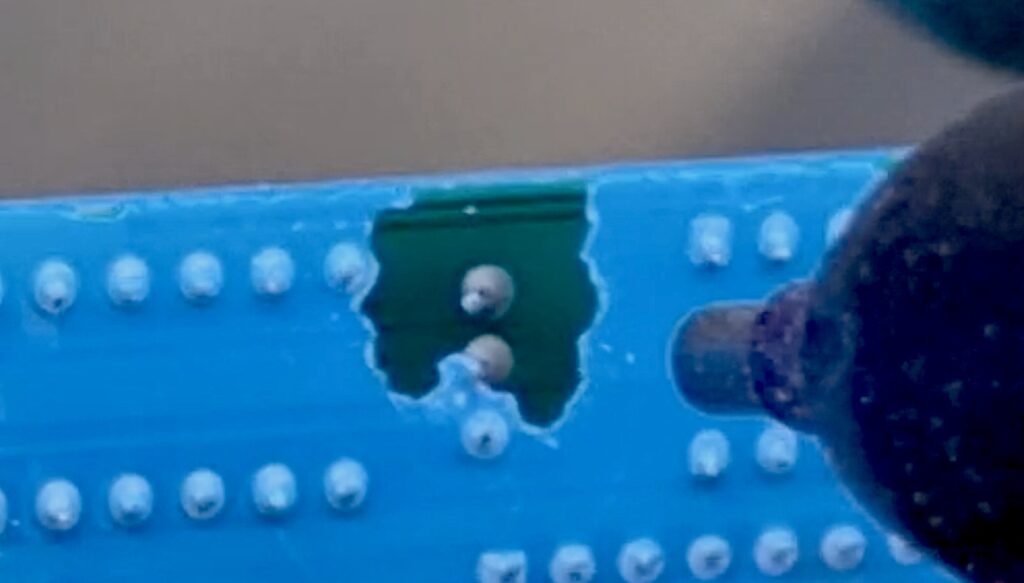
Precision removal of conformal coating using micro-abrasive blasting, demonstrating clean exposure of the PCB without substrate damage or chemical processing.
What we see in real production
Across coating services, rework typically falls into two broad categories:
- Liquid coatings such as acrylic, polyurethane and silicone — often removable, but time is lost in softening, cleaning, rinsing, drying and local touch-up.
- Parylene — chemically resistant and extremely thin, which makes traditional removal slow, inconsistent and highly operator-dependent when done manually.
In both cases, rework can be triggered by missed masking, exposed keep-out areas, engineering changes, inspection findings, soldering access requirements or local repair work. The problem is not unusual. It is routine.
The engineering challenge is therefore not “how do we avoid rework completely?” but “how do we make rework fast, localised, safe and repeatable?”
Why traditional rework methods slow the process down
In practice, most liquid conformal coating rework is carried out using chemical stripping, while Parylene removal often falls back to manual methods due to its chemical resistance. Both approaches can work, but they introduce limitations in control, consistency and process time.
Wet chemical stripping (liquid coatings)
- Primary method for acrylics and polyurethanes using local or full stripping processes
- Requires dwell time for softening, followed by cleaning and rinse stages
- Introduces risk of under-component ingress if not tightly controlled
- Can affect labels, plastics, adhesives and connector materials
- Adds process steps (strip → clean → dry → inspect) which increase cycle time
Manual removal (primarily Parylene and localised cases)
- Parylene is highly resistant to chemical stripping, so manual removal is often used
- Knives and fibre pens tend to drag rather than create clean exposure areas
- High risk of damaging pads, plating or solder mask
- Strong operator dependency and poor repeatability
- Time increases rapidly on fine-pitch or dense assemblies
Local scraping on liquid coatings (limited use cases)
- Sometimes used for small local repairs or silicone coatings where stripping is less practical
- Generally avoided for production rework due to damage risk and inconsistency
Across all methods, removal is usually achievable — but control, repeatability and process efficiency are often the real limitations.
Practical warning sign. If rework time varies dramatically between operators, boards or shifts, the issue is often not the coating chemistry itself. It is the removal method and how much operator judgement it depends on.
Why micro-abrasive blasting changes the equation
Micro-abrasive blasting addresses a specific bottleneck that appears across both liquid and Parylene rework: controlled, localised removal without chemical soak, blade pressure or thermal stress.
Using systems such as the Vaniman ProBlast 3 ESD, operators can expose solder joints, connector edges, test points and local repair areas by eroding the coating layer rather than softening it chemically or cutting it mechanically.
This matters because the rework step becomes much closer to a controlled process than an operator-dependent workaround.
For structured guidance on where micro-abrasion sits alongside chemical and manual methods, see the Removal & Rework Hub.
What the Vaniman ProBlast actually does well
The ProBlast is not an industrial sandblaster. It is a controlled micro-abrasion system intended for delicate removal work on electronics. In practice, its value comes from a few specific advantages:
- Foot-pedal control for consistent on/off blasting
- Adjustable pressure and media flow for local process tuning
- Dry removal with integrated debris extraction
- No heat and no solvent exposure
- Applicability across both liquid coatings and Parylene removal workflows
The key point is not that it removes coatings. It is that it can remove them locally, quickly and with much better repeatability than manual scraping or wet stripping in many rework situations.
Why rework fails in practice
The biggest rework issue is not removal. It is control.
- Over-removal damages solder mask or pads
- Under-removal leaves contamination or poor surfaces for re-coating
- Wet methods introduce ingress, drying and residue risks
- Manual methods create strong operator-to-operator variation
- Slow rework encourages “good enough” decision-making under production pressure
This is why rework often becomes one of the least stable parts of the coating process. It sits outside the main recipe but still has a major effect on yield, labour cost and downstream reliability.
For a wider process view of how repeatability is lost in coating operations, see Why Conformal Coating Processes Fail.
ProBlast vs wet stripping vs scraping
| Feature | ProBlast | Chemical Stripping | Manual Scraping |
| Works on Parylene? | Yes | Usually no / limited | Yes, but slow |
| Time per rework | Fast | Medium to slow | Slow |
| Risk of board damage | Low when controlled properly | Medium | High |
| Cleanliness | Dry, extracted | Wet, requires post-cleaning | Debris and fibres possible |
| Operator dependence | Lower | Medium | High |
| Safety burden | No solvents | Chemical handling and waste | Blade injury / debris risk |
Where the time saving actually comes from
When people say micro-abrasive blasting can cut rework time by up to 50%, the value is not just in faster coating removal. The time saving usually comes from eliminating secondary steps:
- No soak time waiting for chemical softening
- No rinse and dry stage after local stripping
- Less manual cutting and local board handling
- Cleaner transition into re-soldering, repair or inspection
In other words, the gain is process simplification, not just media speed.
What This Means in Practice
Rework is no longer a side issue in coating operations. It is part of the real process architecture. The removal method chosen will strongly influence labour time, operator consistency, local damage risk and the quality of the recovered surface.
For liquid coatings, this often means deciding when wet stripping is still justified and when dry local removal is the better route. For Parylene, it often means recognising that manual scraping may be technically possible but operationally poor.
This is how modern coating operations move from “rework as a workaround” to rework as a controlled process step.
Where this fits in the wider coating system
Rework links directly to masking quality, inspection effectiveness, local defect interpretation and removal method selection. That is why it should not be treated as an isolated repair function.
In practice, teams get better results when rework is planned as part of the coating process rather than left to operator improvisation after defects are found.
For the wider technical structure around removal, local stripping and process selection, use the Removal & Rework Hub.
Why Choose SCH Services?
SCH works across both liquid conformal coating and Parylene processing, so our view of rework is based on real production behaviour rather than theory alone. We support customers with coating removal strategy, process review, micro-abrasive removal systems, training and practical rework support.
- 🛠️ Removal method selection – choosing the right route for liquid coatings, Parylene and local repair tasks.
- 🎓 Training and process support – helping operators make rework more repeatable and less damaging.
- 🔧 Equipment and service support – including Vaniman ProBlast systems and practical coating removal guidance.
📞 Call: +44 (0)1226 249019 | ✉ Email: sales@schservices.com | 💬 Contact Us ›
Note: This insight provides general technical guidance only. Final removal method, process controls, board-level risk and validation decisions must be confirmed against the coating type, component sensitivity, customer specification and applicable standards.