Measured ESD coating performance across floors, packaging, tools, mats, plastics and handling materials
ProShieldESD is a filler-free conductive polymer ESD coating designed to create repeatable static-control behaviour across a wide range of materials.
Live testing at Productronica 2025 provided practical evidence of how the coating performs on real substrates including tile, PP flute board, carton, EVA foam, PVC matting, plastic cases, storage bins, brushes and pens.
This page summarises the measured results and shows where ProShieldESD can support controlled ESD-safe environments beyond conventional benches and mats.
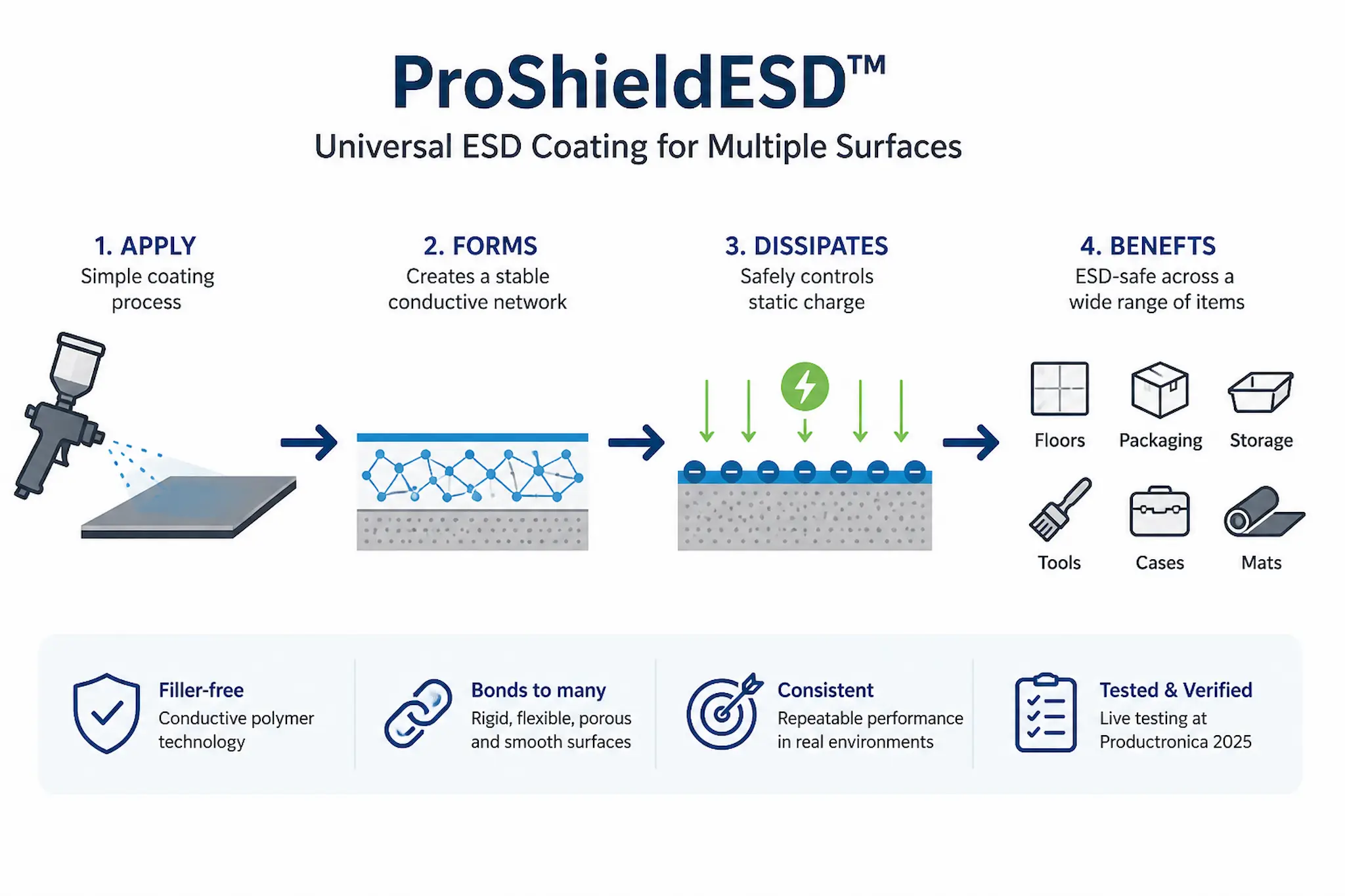
Simple overview showing how ProShieldESD forms a conductive network and dissipates static charge across different materials
Why this testing matters
Many ESD control systems rely on specialist materials, filled plastics, carbon-loaded coatings or temporary surface treatments. These approaches can work, but they often behave differently depending on substrate, wear, environment and application method.
ProShieldESD is designed as a single coating platform that can convert ordinary materials into controlled static-dissipative surfaces.
This makes it useful where manufacturers need to upgrade packaging, flooring, handling aids, storage, fixtures, tools or plastic components without redesigning the whole environment.
Key point: the value of ProShieldESD is not only that it makes one surface dissipative, but that it can create controlled ESD behaviour across many different workplace materials.
Live testing method
The Productronica demonstration used the sparktrap® EPA SafeAssure® from Keinath Electronic GmbH, Germany.
The instrument was used to evaluate coated and reference materials under controlled exhibition conditions using standards-oriented ESD measurement methods.
Measurement capability
- Flat weight probe for surface resistance
- Concentric ring probe for surface resistivity
- Precision 2-point probe for small objects
- Integrated temperature, humidity and voltage monitoring
- High-stability 100 V measurement mode
- IEC 61340 and ANSI/ESD S20.20 oriented evaluation
Environmental conditions
- Temperature: 22–23 °C
- Relative humidity: 53–55% RH
- Test voltage: 100 V
Measured ProShieldESD results
The results show controlled dissipative behaviour across a broad range of coated materials.
Most materials measured within the practical static-dissipative range used for ESD-safe environments, packaging, handling systems and workplace accessories.
| Material | Average resistance | Scientific notation | Assessment | Technical note |
| Flooring tile with ProShieldESD | 1.501 MΩ | 1.5 × 10⁶ Ω | Excellent | Strong ESD floor range for controlled discharge. |
| PP flute board | 4.778 MΩ | 4.8 × 10⁶ Ω | Very good | Stable dissipative range suitable for packaging and handling. |
| Coated carton box | 741.9 MΩ | 7.4 × 10⁸ Ω | Very good | Higher dissipative value suitable for packaging applications. |
| EVA foam | 65.35 MΩ | 6.5 × 10⁷ Ω | Very good | Consistent dissipative behaviour for protective inserts. |
| PVC mat | 964.3 kΩ | 9.6 × 10⁵ Ω | Excellent | Classic ESD mat range around 10⁶ Ω. |
| ESD linbin | 1.699 MΩ | 1.7 × 10⁶ Ω | Very good | Suitable range for ESD-safe component storage. |
| Plastic carry case | 1.644 MΩ | 1.6 × 10⁶ Ω | Excellent | Uniform dissipation for handling aids. |
| ESD brush handle | 3.009 MΩ | 3.0 × 10⁶ Ω | Excellent | Provides a safe discharge path during tool use. |
| ESD brush bristles | 317.0 kΩ | 3.1 × 10⁵ Ω | Excellent | Lower resistance supports contact discharge behaviour. |
| ESD pen | 2.113 MΩ | 2.1 × 10⁶ Ω | Excellent | Helps prevent charge accumulation during handling. |
| Metal reference surface | 88.19 kΩ | 8.8 × 10⁴ Ω | Conductive | Expected conductive reference surface. |
What the results show
The testing confirmed that ProShieldESD can generate useful static-control behaviour across very different material types.
This is important because ESD risk is rarely limited to one bench, mat or floor. Charge generation and discharge paths can involve packaging, tools, storage, handling aids, plastics, foam, boards and workplace accessories.
Practical implications
- Floors and mats can be upgraded into controlled dissipative surfaces.
- Plastic handling items can be converted for ESD-safe use.
- Packaging and cartons can be made more suitable for ESD-controlled handling.
- Foams, inserts and flute board can support controlled storage and transport.
- Brushes, pens and small tools can be treated as part of the wider ESD system.
For plastic-specific applications, see anti-static coating for plastic components.
Why filler-free ESD coating is different
Traditional ESD paints and coatings often rely on carbon, graphite, metal particles or conductive fillers. These can affect appearance, surface finish, handling, flexibility, consistency and long-term behaviour.
Filler-free ESD coating uses a different approach by forming a conductive polymer network rather than depending on dispersed particulate fillers.
This can be especially useful where the substrate needs to retain its practical function while gaining controlled static-dissipative behaviour.
Reality check: ESD performance should always be validated on the actual substrate, coating build, environment and cleaning regime used in production.
Where ProShieldESD fits
ProShieldESD is suitable where manufacturers need to create or improve static-control behaviour across multiple surfaces within a working environment.
It is particularly relevant when standard ESD products are not available, are too expensive, do not fit the geometry, or cannot be adapted easily to the application.
Typical application areas
- ESD flooring and local floor zones
- Plastic components, cases and housings
- Handling aids, trays and fixtures
- Cartons, packaging and flute board
- Foam inserts and protective storage
- Tools, pens, brushes and accessories
- Industrial areas requiring controlled static behaviour
For industrial flooring and higher-risk static-control environments, see ProShieldESD for explosive, ATEX and ESD flooring applications.
Testing does not replace application validation
The Productronica results provide strong evidence that ProShieldESD can produce controlled ESD behaviour across many substrates.
However, each real application still needs practical validation because ESD performance can be influenced by substrate condition, surface preparation, coating thickness, cure, wear, cleaning chemicals, humidity and measurement method.
For production applications, SCH can support substrate trials, resistance testing, coating process development and practical validation through ProShieldESD coating services.
Related ProShieldESD and static-control resources
Use these pages to explore the coating platform, application routes and static-control principles in more detail.
Why Choose SCH Services?
SCH Services supports customers with practical coating selection, substrate evaluation, ESD coating trials, process development and production coating services.
For ProShieldESD applications, we can help assess the substrate, define the target resistance range, prepare test samples, measure performance and develop a practical coating route for production use.
This page provides general technical guidance based on live demonstration testing and practical ESD coating experience. Final material selection, resistance targets, coating process parameters and acceptance criteria should be validated against the relevant standards, customer specifications, environmental conditions and production qualification tests for the intended application.