Surface Preparation & Cleanliness for Reliable Coating
How to prevent adhesion failures, corrosion and electrical leakage before coating
Effective surface preparation and cleanliness are critical to conformal coating reliability. Contaminants such as flux residues, oils, process residues and ionic salts can reduce adhesion, increase corrosion risk and contribute to electrical leakage in service.
Cleanliness is not about appearance. It is about controlling the surface condition so the coating wets correctly, bonds consistently and performs reliably over time.
This topic forms part of a wider coating process control framework. See the Electronic Coating Process Control for Reliability guide for full context.
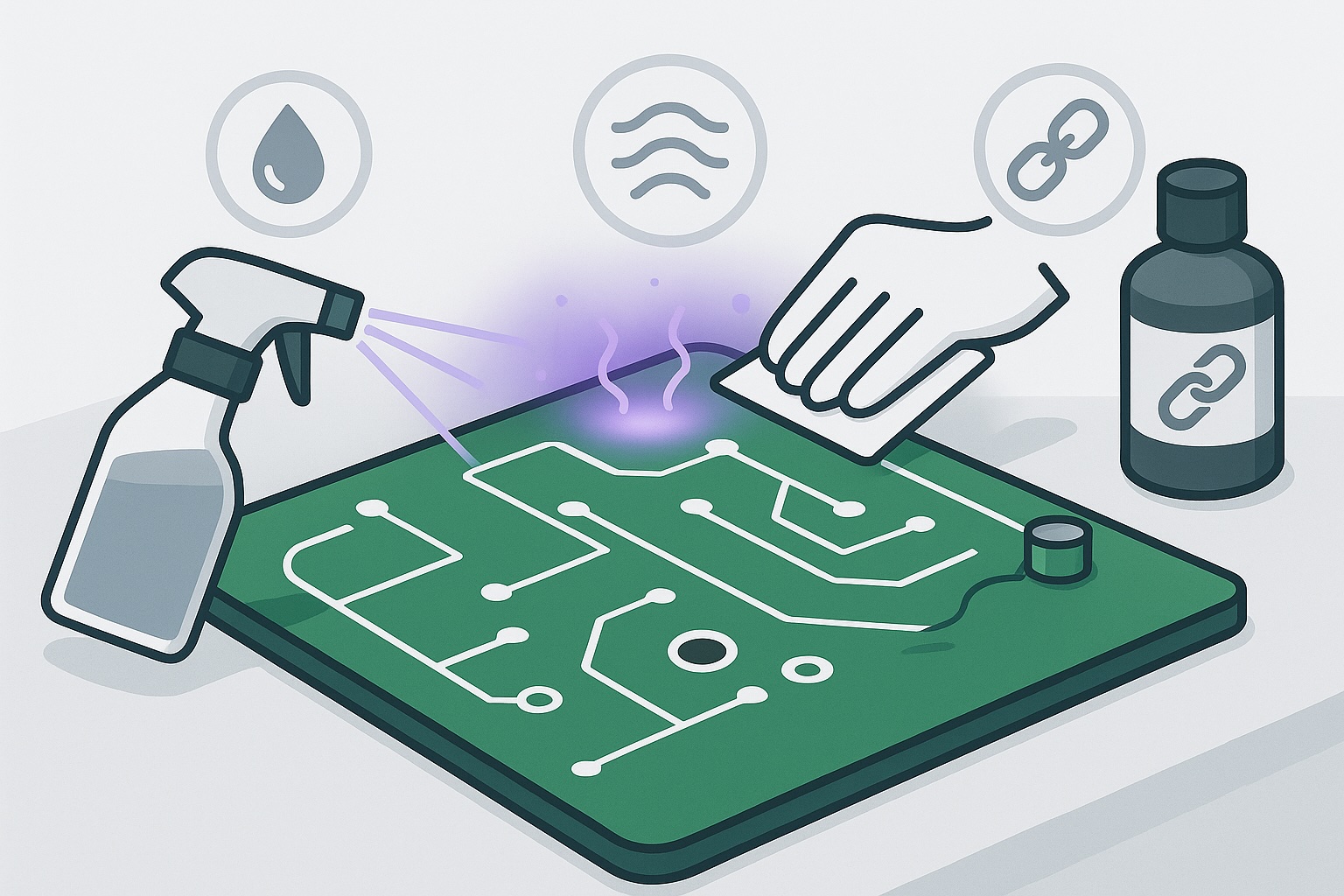
Why surface preparation matters
Surface preparation directly determines whether a coating process remains stable or produces avoidable defects. Even when coating material and application are correct, contamination at the substrate level can still undermine performance.
- Adhesion: Clean, dry surfaces allow coatings to form a reliable bond. For more detail, see why cleaning improves conformal coating adhesion.
- Electrical reliability: Ionic contamination contributes to corrosion, leakage currents and dendritic growth. Surface contamination is not limited to fluxes and process residues. Fingerprints, gloves, packaging contact and handling marks can also affect coating performance. See Fingerprints and Handling Contamination Before Conformal Coating for practical production examples.
- Consistency: Poor preparation leads to dewetting, bubbles and adhesion loss. For practical production examples, see Common Causes of De-Wetting After Cleaning and Silicone Contamination from Masking Materials.
Process warning: even perfect masking cannot compensate for poor surface preparation. A board may have clean keep-out boundaries and still show de-wetting, fish eyes, craters, thin coverage or adhesion loss if the coated surface is contaminated or poorly prepared. See Why Perfect Masking Still Produces Conformal Coating Defects.
Surface behaviour note: Cleanliness affects more than contamination levels alone. Surface energy and micro-scale surface structure directly influence how conformal coatings wet, spread and bond to the PCB surface. The same surface-science principles that allow hydrophobic coatings to repel water can also influence coating wetting, de-wetting and long-term adhesion behaviour. For the underlying surface interaction mechanisms, see How Hydrophobic Coatings Work.
Surface preparation must be considered alongside coating thickness and inspection. See thickness verification and why coating processes fail in complex assemblies for related process risks.
Many recurring coating problems are eventually traced back to contamination, surface condition or preparation issues that were not fully understood during process development. These problems rarely appear in isolation and often interact with coating application, inspection and process control decisions. For a broader engineering perspective, see Why Conformal Coating Processes Fail.
Surface preparation methods
The correct preparation method depends on contamination type, substrate and coating chemistry.
- Cleaning: Aqueous, semi-aqueous and solvent systems remove flux, oils and residues. However, changes in chemistry, rinse effectiveness, drying parameters or maintenance practices can sometimes introduce new coating defects rather than eliminate them. Incomplete drying can also leave residual moisture beneath components or within the PCB assembly before coating. See Cleaning Process Changes Causing New Conformal Coating Defects and Moisture Trapped Before Conformal Coating for practical production guidance.
- Plasma treatment: Increases surface energy and improves adhesion, particularly for Parylene and plastics.
- Micro-abrasion: Used in rework to remove oxides or aged coating in controlled conditions.
- Adhesion promoters: Improve bonding on difficult substrates and reduce edge-lift risk.
Reality check: Cleaning is not always beneficial. Poorly controlled or partial cleaning can introduce more risk than leaving a stable residue untouched.
For complex assemblies, preparation must also consider geometry and masking constraints. See selective coating accuracy and connector protection strategies for application-related considerations.
Cleanliness testing
No single test defines cleanliness. Methods should match the failure mode being controlled.
- ROSE testing: Measures total ionic contamination for process monitoring.
- Ion chromatography: Identifies specific contaminants for root-cause analysis.
- Surface energy testing: Assesses wetting behaviour and dewetting risk.
Key point: Cleanliness testing is part of a wider validation system. It should be used alongside coating inspection and witness testing, not in isolation.
Standards and guidance
Standards provide context, but final requirements must be based on the assembly and reliability target.
- IPC-5704 – cleanliness requirements
- IPC-A-610 – workmanship and acceptability
- IEC 60664 – insulation coordination
- Customer specifications often define tighter limits
Related process guidance
- Process Control Overview
- Why Cleaning Improves Conformal Coating Adhesion
- Flux Residues Causing Conformal Coating Failure
- Boards Look Clean but Still Fail Conformal Coating
- Cleaning Process Changes Causing New Conformal Coating Defects
- Moisture Trapped Before Conformal Coating
- Fingerprints and Handling Contamination Before Conformal Coating
- Why Coating Fails
- Thickness Verification
- Selective Coating Accuracy
- Connector Protection
Why Choose SCH Services?
SCH Services supports coating process control through practical training, consultancy and equipment selection. The focus is on helping customers move from material selection to stable, repeatable production processes.
- Conformal Coating Solutions
- Coating Services
- Operator Training
- Process Consultancy
- Inspection & Process Equipment
For support with contamination control, adhesion or coating reliability, contact SCH Services.
This article is provided as general technical guidance only. Final process decisions should be validated against the specific assembly, contamination profile, coating chemistry and applicable qualification or customer standards.