Why Conformal Coating Fails in Complex PCB Assemblies
Understanding why coating failure is often driven by PCB geometry, masking limits, contamination and process control rather than the coating material alone
When conformal coating fails on complex PCB assemblies, the immediate reaction is often to question the coating material. In reality, many failures are driven by process, geometry and application constraints rather than chemistry alone.
Assemblies with press-fit connectors, tight spacing, mixed surface finishes, high component density and particle-sensitive areas create coating challenges that cannot be solved by material selection alone.
This article explains why coating failures occur in complex PCB assemblies and why the problem should often be treated as a process architecture decision, not simply a material choice.
This topic forms part of a wider coating process control framework. See the Electronic Coating Process Control for Reliability guide for full context.
Key point: In complex assemblies, coating failure is often caused by the interaction between coating behaviour and PCB geometry, not by the coating material acting in isolation.
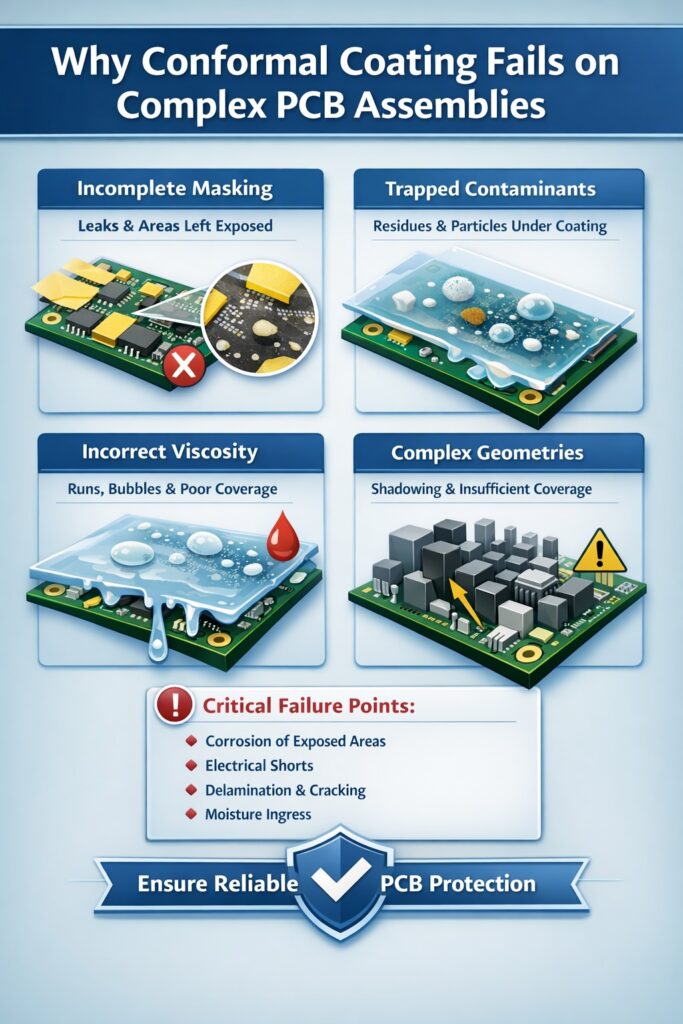
Common causes of conformal coating failure including masking issues, contamination, viscosity control and complex PCB geometry.
The assumption that the coating is the problem
Most investigations into coating failure begin with the question: “Is the coating material failing?”
In complex PCB assemblies, this is often the wrong starting point.
The coating may be behaving exactly as expected: flowing, wetting, penetrating and curing according to its chemistry. The failure arises because those behaviours are incompatible with the geometry and constraints of the assembly.
Material selection still matters, but only within the limits defined by the process. If the process is not viable, changing the coating material rarely solves the problem.
This is why many conformal coating failures should be treated as process failures first, not material failures. For a broader engineering perspective on how coating systems break down in production, see Why Conformal Coating Processes Fail.
Geometry defines coating behaviour
On simple boards, coating behaviour is usually easier to predict. On complex assemblies, geometry dominates the process.
- Tight gaps create capillary effects.
- Component shadowing affects coverage.
- Mixed surface energies change wetting behaviour.
- Vertical and horizontal transitions affect film build.
- Sharp edges and component leads can create thin-film weak points.
These effects are not unusual defects. They are natural outcomes of fluid behaviour.
This is why coating behaviour cannot be fully controlled by machine programming alone. Even accurate selective coating systems must work within the physical limits of fluid flow, wetting and edge definition.
For more detail, see Selective Conformal Coating Accuracy: Why ±1 mm Is the Reality.
Surface behaviour note: Wetting, surface energy and micro-scale surface structure strongly influence how coatings and liquids move across a PCB. The same low-surface-energy behaviour that allows hydrophobic coatings to make water bead and roll off can also affect whether a conformal coating wets, spreads or pulls back on complex surfaces. For the surface science behind this behaviour, see How Hydrophobic Coatings Work.
Boundary control is the real challenge
In many complex assemblies, the critical requirement is not simply coverage. It is controlled non-coverage.
This often includes:
- Connector interfaces.
- Test points.
- Press-fit zones.
- Switches and contacts.
- Mechanical interfaces.
The challenge is not only applying coating. It is preventing coating from reaching sensitive areas while still achieving protection elsewhere.
Many processes fail because masking becomes unstable, coating spreads beyond intended boundaries or capillary action pulls coating into restricted areas.
Connector contamination is a common example. Coating can reach protected contact areas through masking gaps, movement, capillary action or poor sealing, even when masking initially appears acceptable. See the bulletin Connector Masking Failures: Contact Area Contamination for a practical production example. Smaller masking features can create similar boundary-control problems when they lift, move or allow coating beneath the edge; see Masking Dots Lift During Conformal Coating.
If boundary control cannot be reliably achieved, the protection strategy may need to be reconsidered rather than adjusted repeatedly within the same flawed process route.
For connector-specific risks and protection strategies, see Protecting Connector Interfaces Without Conformal Coating Them.
Contamination is often the hidden failure driver
Many coating failures are not caused by coating behaviour alone, but by what is already present on the PCB before coating is applied.
- Flux residues.
- Handling contamination, including fingerprints, gloves, packaging contact and inspection handling. See Fingerprints and Handling Contamination Before Conformal Coating for practical guidance on how contact contamination can be introduced before coating.
- Dust and airborne particles.
- Moisture exposure, including residual moisture trapped beneath components, inside gaps or within contamination residues before coating. Even when an assembly appears dry, trapped moisture can later contribute to white residues, corrosion, adhesion loss and electrical leakage after coating. See Moisture Trapped Before Conformal Coating for practical troubleshooting guidance.
- Ionic contamination.
When coating is applied over contamination, it does not remove the risk. It can lock the contamination beneath the coating and make later failure harder to diagnose.
This can lead to electrical leakage, corrosion initiation, reduced adhesion and long-term reliability problems.
This is why surface preparation and cleanliness must be treated as part of the coating process rather than a separate housekeeping activity. A board can also appear visually clean while still carrying residues or surface-condition problems that affect coating performance; see Boards Look Clean but Still Fail Conformal Coating. When coating defects appear after a change in cleaning chemistry, rinse quality, drying, maintenance or process settings, see Cleaning Process Changes Causing New Conformal Coating Defects. For the adhesion mechanism behind this, see why cleaning improves conformal coating adhesion.
Viscosity and process control drive consistency
Even with the correct material and a clean PCB, coating performance depends heavily on process control.
One of the most important variables is viscosity.
- Film thickness becomes inconsistent.
- Edge definition becomes unstable.
- Wicking and spread increase.
- Repeatability is lost.
- Coverage becomes harder to inspect and control.
- Local coating thickness may vary significantly across the same assembly, making single-point measurements potentially misleading.
Viscosity directly affects how the coating flows, levels and builds on the surface.
Production observation: Coating quality can change even when machine settings remain unchanged. Solvent loss, temperature variation and material ageing can alter viscosity throughout production, affecting thickness, edge definition and repeatability. See the bulletin Viscosity Drift in Conformal Coating Processes: The Hidden Cause of Process Variation.
Stable processes require defined viscosity windows, controlled working methods and verification through inspection and thickness measurement. For control methods, see conformal coating viscosity control and coating thickness verification.
Thickness variation is particularly important on large or geometrically complex assemblies where coating build can change significantly between locations. For a practical production example, see Why One Coating Thickness Reading Can Be Misleading.
Application method defines what is achievable
Different coating methods have fundamentally different capabilities and limitations.
- Spray coating: flexible, but sensitive to operator control and environment.
- Selective coating: repeatable, but still limited by fluid behaviour at boundaries.
- Dip coating: consistent for coverage, but harder for exclusion zones.
- Brush coating: precise locally, but difficult to scale consistently.
- Parylene: uniform vapour-deposited coverage, but dependent on careful masking and process control.
Each method defines what is realistically achievable in terms of coverage, boundary control, repeatability and throughput.
If the chosen method cannot meet the requirements of the assembly, repeated adjustment may not fix the outcome. The process route itself may be wrong.
For a structured comparison of application capabilities and limitations, see conformal coating application processes.
Press-fit connectors are high-risk coating areas
Press-fit connectors combine two difficult requirements.
- Clean, uncoated electrical interfaces.
- High-risk contamination and coating ingress zones.
Coating risks include wicking, contact interference, contaminant entrapment and poor control of exclusion boundaries.
These areas should be treated as process-critical exclusion zones, not simply as areas to avoid during coating.
Where press-fit or connector reliability is important, the coating strategy should be defined before production rather than corrected after defects are found.
When the coating route needs reassessment
Coating failures are rarely caused by one factor alone. They usually result from the interaction between geometry, contamination, viscosity, application method, boundary control and operating environment.
Process reality: Even when masking is applied correctly and all keep-out areas remain protected, coating defects can still occur elsewhere on the assembly. Wetting failures, contamination, adhesion problems, viscosity variation, thickness drift and cure-related issues are independent process variables. A successful masking operation does not automatically mean a successful coating process. See the bulletin Why Perfect Masking Still Produces Conformal Coating Defects.
If failure is being driven by tight geometry, connector risk, masking limits or contamination sensitivity, the issue may not be fixable within a conventional conformal coating process.
Temperature can also change the decision. Elevated operating temperatures or thermal cycling can expose weaknesses in material selection, adhesion, film stress and long-term reliability.
In these cases, the protection route should be reassessed using the Coating Selection Guide, rather than assuming a different conformal coating material will solve the problem.
Any alternative coating route must then be validated on representative assemblies rather than idealised samples. See Test Coupons & Witness Boards for structured validation approaches.
Struggling with coating failure on a complex assembly?
If coating performance is being limited by geometry, masking, contamination or process instability, the issue is rarely solved by changing material alone. Identifying the root cause early prevents repeated trial-and-error and production risk.
Explore coating failure analysis and process consultancy
If you are currently experiencing coating defects or need support defining a stable coating strategy, you can also submit your application for review.
The three real process options
For complex PCB assemblies, there are usually three practical coating strategies.
- Full conformal coating with controlled masking.
- Full ultra-thin or nano coating where barrier protection is not the main requirement.
- Hybrid coating strategy using different protection routes in different areas.
Choosing between these is a process architecture decision, not just a material selection decision.
Where masking becomes impractical or connector risk dominates the process, a hybrid coating strategy may be more realistic than forcing a conventional coating process to do something it cannot reliably achieve.
Related process guidance
This article sits at the failure-analysis end of the process control cluster. The most relevant follow-on topics are process control, boundary control, contamination control and coating route selection.
Process control and validation
- Electronic Coating Process Control for Reliability
- Test Coupons & Witness Boards
- Conformal Coating Thickness Verification
Geometry, connectors and boundary control
- Selective Conformal Coating Accuracy
- Protecting Connector Interfaces Without Conformal Coating Them
- Hybrid Conformal and Nano Coating Strategy
Failure types and coating route selection
Conclusion: complex PCB coating failure is usually a strategy failure
When conformal coating fails on complex PCB assemblies, the root cause is rarely the coating material alone.
The problem is usually the mismatch between geometry, coating behaviour, process capability, boundary control and real-world operating requirements.
The solution is not always a “better” material. It is a realistic coating strategy matched to the assembly.
Start by reviewing the failure route, then compare the available protection options using the Coating Selection Guide.
Why Choose SCH Services?
SCH Services supports customers with conformal coating selection, coating process development, masking strategy, inspection, failure investigation, coating services, training and production implementation.
We help customers treat conformal coating as a controlled manufacturing process, not simply as a material application step.
- Conformal Coating Solutions
- Coating Selection Guide
- Conformal Coating Services
- Conformal Coating Training
- Conformal Coating Consultancy
- Masking Solutions
If coating failure is being driven by PCB geometry, connector risk, masking limits or process instability, contact SCH Services to review the assembly, coating route and production method together.
This article provides general technical guidance only. Final coating strategies, masking approaches, process controls and validation methods should be confirmed against specific product requirements, operating environments, customer specifications, applicable standards and qualification testing.