Ultra-thin functional coatings protect by changing surface behaviour
They are not simply thinner versions of conventional conformal coatings
An ultra-thin functional coating is a very low-build protective or surface-modifying film applied to an electronic assembly, component or material surface. Unlike traditional conformal coatings, the main objective is not always to create a thick environmental barrier.
Instead, ultra-thin coatings often work by changing how the surface behaves. They may reduce wetting, improve water repellency, provide low surface energy, reduce contamination interaction, support optical clarity or protect sensitive areas where thicker coatings would create problems.
This makes them useful in applications where the coating must add function without adding significant thickness, weight, masking complexity or performance interference.
For the broader commercial overview, see Ultra-Thin Coatings for Electronics, PCBs & Precision Components.
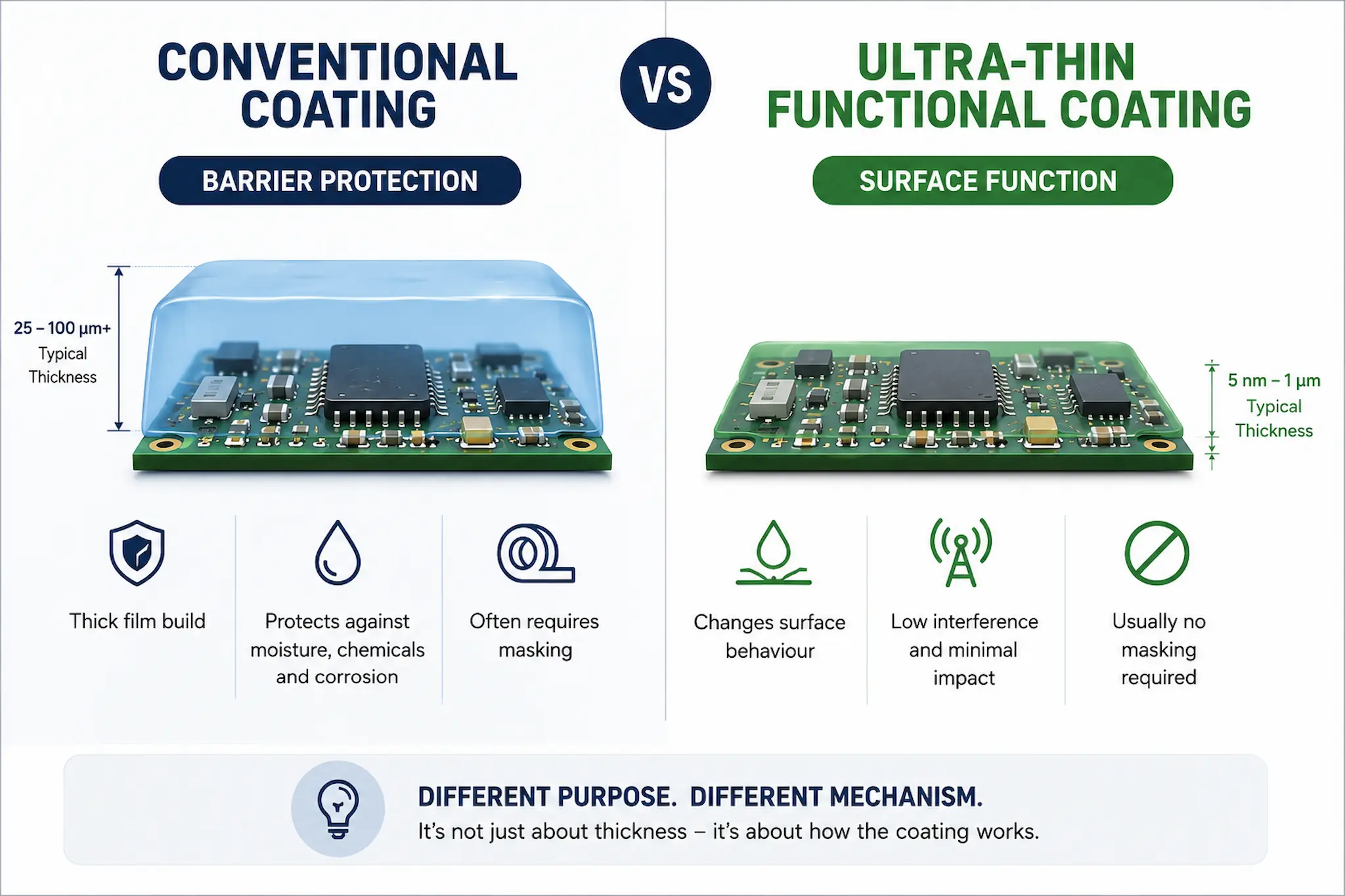
Ultra-thin functional coatings work differently from conventional conformal coatings by changing surface behaviour rather than relying on thick barrier protection.
How ultra-thin coatings differ from conventional conformal coatings
Conventional conformal coatings are normally selected to provide a continuous protective barrier across a PCB assembly. They are commonly used to protect against moisture, contamination, corrosion and environmental exposure.
Ultra-thin functional coatings are different. They are usually selected when the product needs a specific surface function while keeping the coating as thin and non-intrusive as possible.
Conventional coating
Usually focused on film build, coverage, insulation and environmental barrier performance.
Ultra-thin coating
Usually focused on surface behaviour, low interference and maintaining product function.
The key difference is not only thickness. It is the protection mechanism and the reason the coating is being used.
For a deeper explanation of this distinction, see Surface Function vs Barrier Function Coatings.
What functions can an ultra-thin coating provide?
Ultra-thin functional coatings are normally selected for targeted performance rather than general-purpose protection. The exact function depends on the coating chemistry, application method, film continuity and operating environment.
Hydrophobic behaviour
Reducing liquid wetting and helping water form droplets rather than spread across the surface.
Low surface energy
Changing how liquids, residues or contaminants interact with the coated surface.
Low optical impact
Supporting applications where light output, colour or clarity must not be significantly affected.
Low electrical interference
Helping protect sensitive electronics where thicker coatings may affect RF or signal behaviour.
In many cases, the coating works because it changes surface interaction and surface energy behaviour rather than simply adding a thicker barrier layer.
Where ultra-thin functional coatings are used
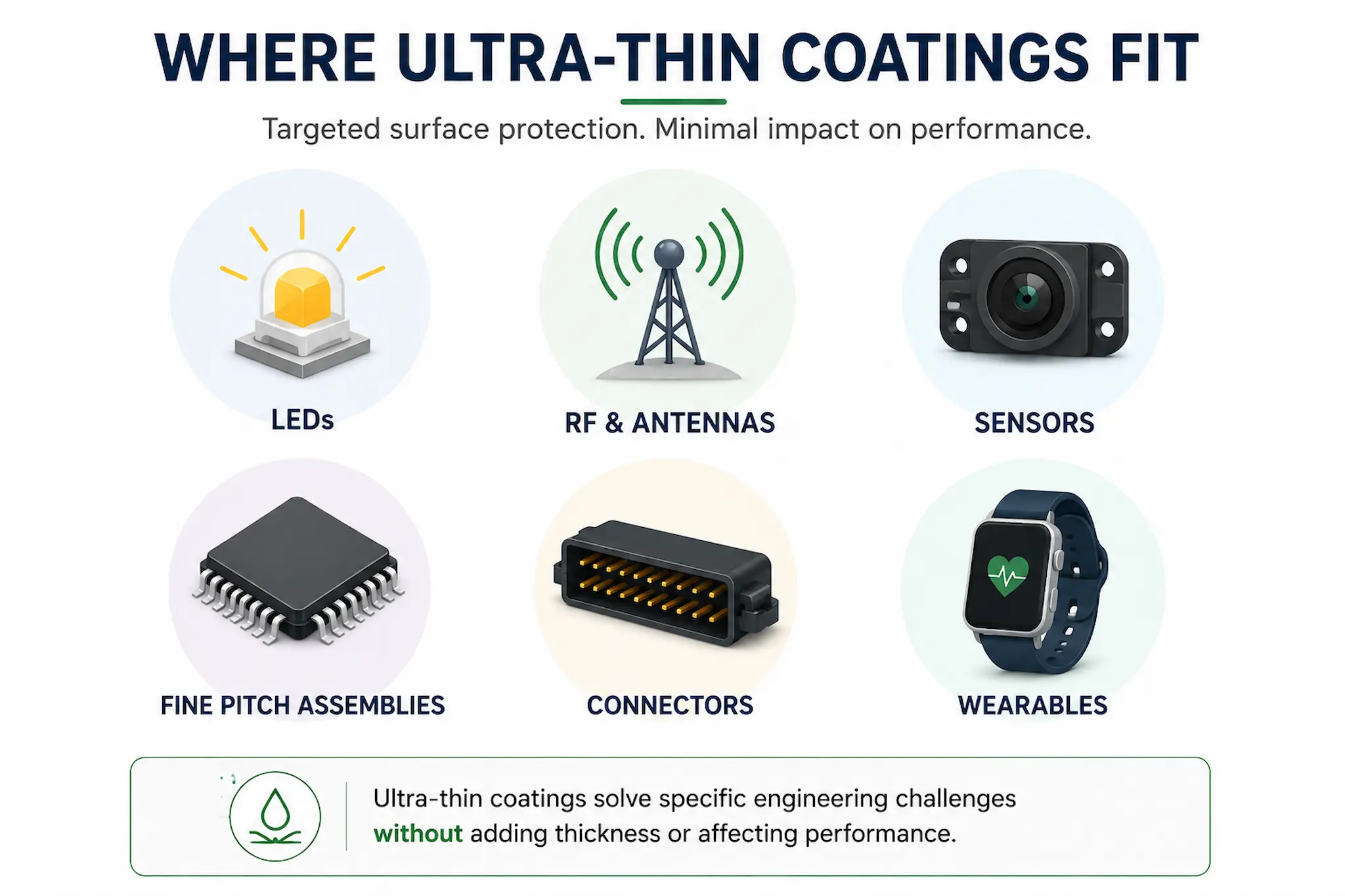
Ultra-thin coatings are often used where protection is needed without adding significant thickness or affecting performance.
Ultra-thin coatings are most useful where conventional coating thickness creates a design, production or performance problem. They are often considered for assemblies with tight geometry, sensitive surfaces or performance-critical features.
- LED assemblies where optical output must be maintained. See Ultra-Thin Coatings for LEDs and Optical Electronics.
- RF circuits, antennas and sensors where coating thickness may affect dielectric loading, signal behaviour or functional performance. See RF transparent coatings for electronics & antennas.
- Dense PCB assemblies with BGAs, fine-pitch devices or limited clearance.
- Products where masking cost or masking risk is too high.
- Electronics requiring water-repellent surface behaviour rather than heavy film build.
For related coating selection context, see Advanced Functional Coatings, Ultra-Thin Coatings and Hydrophobic Coatings.
What ultra-thin coatings should not be assumed to do
Ultra-thin coatings should not automatically be treated as direct replacements for conventional conformal coatings or Parylene coatings. A very thin film may change surface behaviour without providing the same barrier thickness, dielectric margin or long-term environmental robustness as a thicker coating system.
In many applications, the critical engineering question is whether the requirement is surface-function behaviour or true environmental separation. This distinction is explored further in Surface Energy vs Environmental Barrier Protection.
Water beading, for example, can be useful evidence of hydrophobic behaviour, but it does not prove corrosion resistance, environmental isolation or full electronics protection. Protection still depends on coating continuity, contamination, exposure conditions, electrical bias, surface cleanliness and product qualification.
Ultra-thin coatings should be validated against the failure mode they are intended to reduce, not judged only by appearance or droplet behaviour.
For more detail on these limitations, see Why Water Beading Is Not Proof of Electronics Protection, Why Water Resistance Is Not Corrosion Protection and Why Hydrophobic Coatings Don’t Protect Electronics.
How to decide whether an ultra-thin coating is suitable
The decision should begin with the product risk, not the coating thickness. The coating should be selected only after the required protection mechanism and validation route are understood.
Define the risk
Moisture, condensation, contamination, chemicals, handling or optical exposure.
Define the constraint
Thickness, masking, RF behaviour, optical clarity, clearance or process complexity.
Define the test
Electrical, environmental, chemical, optical or process validation based on the application.
The coating is suitable when it reduces the real risk without creating a larger functional or production problem.
Ultra-thin coatings are not suitable for every environment or failure mechanism. For wider selection limits and common misuse cases, see When Nano Coatings Should NOT Be Used.
In some applications, reducing interference can be more valuable than increasing thickness. This is discussed further in Why Thin Coatings Can Sometimes Protect Better Than Thick Ones.
Related technical reading
These pages provide additional context for selecting and validating thin, hydrophobic and functional coating systems:
Why Choose SCH Services?
SCH Services supports coating selection, coating trials, process development and production coating for electronics where protection, reliability and manufacturability all need to be considered together.
- Practical coating experience: SCH works across conformal coating, Parylene and advanced functional coating processes.
- Process-led decision support: coating selection is based on application risk, production method and validation requirements.
- Trial and production capability: SCH can support early evaluation, sample coating, process definition and subcontract coating routes.
Disclaimer: This article is provided as general technical guidance only. Coating selection, process design and product suitability must be validated against the relevant application requirements, operating environment, customer specifications and qualification tests.