Mon - Thur 7.30-15.30   Fri 7.30-14.00

Are There Design Rules For The Conformal Coating Dip Application?


Are There Design Rules For The Conformal Coating Dip Application?

There are design guidelines that can be used to help make conformal coating of circuit boards using the dip process a lot easier. Having these specific design rules for dipping conformal coating can help save a lot of time, money and trouble on the production line.

Here are a list of rules and guidelines that could be considered.

  • Design the board so the masking components are at one end of the circuit. This allows the board to be dipped to a depth before the connectors are coated.
  • Design to hold the board correctly. Make it easy to hold the circuit easily.
  • Design the fixture correctly to avoid coating contamination. Don’t let the fixture get coated.
  • Match the coating material to the dip process. Ensure compatibility.
  • Design the board to drain to a corner. It ensures less build up is found on the board.
  • Avoid using components that can hold conformal coating. When the board drains ensure the component can too.
  • Use the correct components. Use components that are easy to mask.

To find out more click dipping design rules for conformal coating.


Why use conformal coating design rules?

7

Circuit board design rules and guidelines, when using conformal coating, can save you money, time and problems.

They include:

  • General design
  • Selective Robot
  • Dipping
  • Batch Spraying
  • Parylene

Each has overlapping rules and guidelines that also can be very specific to the application process.


Why it all can go wrong in the design stage for conformal coating

Most companies have successfully adopted Design for Manufacture (DFM) principles. They have increased the level of communication between design teams and those required to manufacture the product, to eliminate or reduce the number and variety of production challenges.

However, this is not always the case. Conformal coating is not simply a consumable material. Unfortunately, for too many designers, conformal coating is simply a part number, to be applied to circuit boards.

For companies embracing lean philosophies and applying coatings, this failure to appreciate the subtleties of the application process can result in an un-coatable (at least as specified) assembly process.

Fortunately, the design rules for conformal coating are straightforward. Follow them and you can save money and time in your application process.

However, if the rules are not followed, the resultant circuit board design can challenge even the most sophisticated conformal coating system and its operator to achieve the finish desired. It is almost certain that the majority of these ‘nightmare’ scenarios could have been headed off during the design and or prototyping stages of development.


Find out how we can help you with your conformal coating application selection now.

Contact us to discuss your needs and let us explain how our coating equipment could work for you.

Contact us now.


How Do I Spray My Conformal Coating?


SCH UK Image 3conformal coating batch spraying Collage 640x480

Batch spraying is one of the widest used techniques used in low and medium volume conformal coating processing.

Whether you are using a compressed air spray gun or an aerosol can, the conformal coating is sprayed across the whole of the circuit board. It can produce a high quality coating finish that gives the best protection due to good edge coverage.

However, it is not a selective process. All parts are coated on the circuit board. Therefore, masking may be required to protect components that must not be coated.


What Equipment Do You Need For Batch Conformal Coating spraying?

SCHUK Image 2

If you are not using aerosols then for conformal coating spraying a typical set up is:

  • Spray gun
  • Air Compressor for the Air Supply
  • Spray booth

This is a low cost set up that can handle a fairly high volume of product. However, the quality of the finish is dependent on the quality of the spray equipment itself and the operator.

find out more about our conformal coating spray booth and how it can help you.


How Do You Apply the Conformal Coating by Spraying?

Although the process can be material specific there are a few general guidelines for applying conformal coating by spraying.

These include:

  • Only apply thin, consistent coats. It may be necessary to apply more than one coat.
  • Apply the coating in a narrow raster pattern across the circuit.
  • Rotate the board 90 degrees and repeat. Continue until the whole board is coated to avoid 3D effects.
  • Allow the coating to dry enough to avoid problems like bubbles before applying a second coat.

Following a few simple guidelines can save a lot of problems.

Let us help you with our conformal coating training courses for spraying conformal coating.


What variables control the quality of the conformal coating in batch spraying?

SCHUK Image 1

Variables that influence the quality of the coating process in spraying are:

  • The operator skill
  • Quality of the spray equipment
  • Viscosity of the conformal coating
  • Blending the conformal coating to the right viscosity is critical.
  • The level of masking required

Find out how we can help you with your conformal coatings now.

Contact us to discuss your needs and let us explain how hydrophobic coatings could work for you.

Contact us now.


The ABCs of ultra-thin fluoropolymer coatings for electronic circuit boards


Nano coatings are no mask conformal coatings with great water repellent properties

What is a fluoropolymer coating?

A fluoropolymer coating is typically comprised of fluorocarbons and characterised by carbon-fluorine bonds.

They have many interesting properties and especially for printed circuit boards. However the three key properties for electronics are that the coatings are:

  • Hydrophobic
  • Chemically resistant
  • No masking required

These properties can be key to protecting the electronics and providing a highly cost effective production process.

Hydrophobic coating

  • Fluorocarbons are not susceptible to Van der Waals force.
  • This gives the coatings their signature characteristics. That is they are non-stick, hydrophobic and friction reducing.
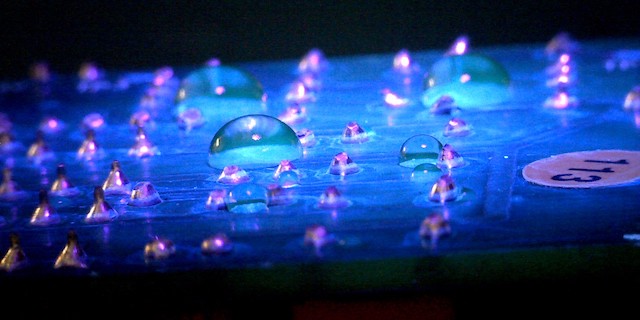
  • Therefore, water does not like to wet the surface of the circuit board and this gives the circuit excellent protection.

Chemically Resistant

  • These fluorinated coatings are chemically inert.
  • Owing to the fluorine bonds, fluoropolymer coatings demonstrate a high level of durability as well as resistance to acids, bases and most solvents.
  • This gives the circuit board a high degree of protection from chemical attack.

No masking required

Finally, what is really interesting is that these properties are exhibited at ultra-thin film thicknesses. Typically a dry film can be 1-2um or even less.

This means that masking generally is not required for circuit boards before application.  Therefore, you can dip the whole product into the liquid and there is no issue with electrical contact. This can lead to significant cost savings in production.

Find out more about our range of fluoropolymer nano coatings here.


What other properties do the fluoropolymer coatings have that may be relevant in electronics?

SCHUK 2

As already mentioned these hydrophobic coatings have very specialised properties.

They can include:

  • Being highly hydrophobic (water repellent)
  • Having a high moisture barrier
  • Requiring no masking before application
  • Being highly oleophobic (oil repellent)
  • Having a high chemical resistance
  • Having a high lubricity
  • Having high dielectric properties
  • Providing high corrosion resistance
  • Providing good abrasion / wear resistance

Note, not all fluoropolymer coatings have all of the above properties. But, some coatings can in fact have almost all of the properties.

The fluoropolymer coatings are extremely flexible coatings and becoming more prolifically used throughout engineering.


What sectors of industry are fluoropolymer coatings being used in protecting electronics?

SCHUK3

Fluorinated coatings are used to protect electronics in almost all industrial sectors.

They include:

  • Aviation
  • Aerospace
  • Defence
  • Automotive
  • Industrial
  • Oil & Gas
  • LEDs
  • Medical
  • Optics
  • Telecommunications
  • White goods / Commercial

This list is limited and there are a lot more areas that they are used.


What are the major differences between a fluoropolymer coating and a conformal coating for protecting an electronic printed circuit board or assembly?

There are several key differences between a conformal coating and a fluoropolymer coating.

They include:

  • Hydrophobic Properties – A fluoropolymer coating is generally hydrophobic in nature. It repels water when the water is on the surface of the coating.
  • Extremely thin coating – The fluoropolymer coating is normally applied a lot thinner than a typical liquid conformal coating. This is due to its superior performance when repels liquids
  • No masking – Due to the extremely thin fluoropolymer coating applied (<1-2um), the components that normally require protecting (connectors, switches etc) from the insulating liquid conformal coating may not need to be masked for the fluoropolymer. The circuit board can be completely submerged in the liquid with no masking applied without fear of damaging the connections.
  • Simple process – No masking means an extremely fast application process
  • Fast drying – due to the thin nature of the fluoropolymer coating and the solvents normally used the coating dries extremely quickly.

Find out how we can help you with your ultra-thin hydrophobic coatings now.

Contact us to discuss your needs and let us explain how hydrophobic coatings could work for you.

Contact us now.

How to Remove Parylene From a Printed Circuit Board


conformal coating rework collage 640_SCH UK

Removing conformal coatings from a printed circuit board (PCB) is a hard process to do well. Removing Parylene coating is even more difficult.

The problems are many but a key reason is that the Parylene coating itself is chemically inert. It has a very high chemical resistance so the solvents don’t work well. This means any chemical attack tried with solvents or other liquid chemicals on the Parylene is as much likely to damage the circuit board than remove the actual coating.

This leaves the basic option of mechanical abrasion.

Mechanical Abrasion

Mechanical abrasion is a well known method for Parylene Removal. It can be done crudely by scraping off the Parylene with a knife or tool. Or, removal can be done with a media blast system like a Vaniman Problast system that gradually erodes the Parylene coating away.

However, mechanical abrasion is a time consuming process and is highly skilled. Also, it tends to be a localised repair and removal technique.

The concept of completely removing all of the Parylene off a circuit by mechanical abrasion is considered almost impossible unless a ridiculous amount of time and effort is injected into the process.


Find out now how much money you can save by using our Parylene removal service

We are happy to provide a quotation for removing Parylene through our coating services so you can see for yourself how much you can save.

Contact us now to request your quotation for complete removal of Parylene from a circuit board. Or, give us a call at (+44) 1226 249019 or email your inquiries at sales@schservices.com


How thick should I apply my conformal coating?


So, a question I am regularly asked is,“What is a good conformal coating thickness for my printed circuit board?”

Well, the simple answer is thick enough so the conformal coating works and protects the circuit board. But not too thick as this can cause problems for the circuit board in the long term.

After all, the performance of the conformal coating is dependent on the material applied. But, it is possible to quantify this a little more.


Help for determining the right conformal coating thickness

First off it’s probably best to use guidelines from International Standards like IPC A 610. These standards specify the conformal coating thickness based upon the generic material types like acrylics, polyurethanes, and silicones. Further, you can also reference this data against the material manufacturers technical recommendations.

Combining these two pieces of information should give you a target range for a suitable thickness. However, ultimately, the coating thickness is down to the user.

How you decide if the conformal coating thickness is good enough is up to you. Too thin and you will not protect the circuit as effectively as you may need. Too thick and you could have reliability issues in the future. So, monitor your conformal coating thickness with care.

So what do the IPC Standards recommend when considering coating thickness?

The IPC A 610 standard defines ideal thickness values as:

  • Acrylic: 30-130μm
  • Polyurethane: 30-130μm
  • Silicone: 50-210μm

However, this is not the end of the story. Using the target coating thicknesses as an absolute value can be problematic.

The reality is that the thickness will vary massively across the circuit board due to many factors including the surface tension of the liquid, the surface energy of the board surface, the design of the board, the material properties and the application method used.

So, there may be areas on the board that could fall outside of the range where the coating thickness will be less or more than the ideal values. Therefore, it is highly recommended that the range should be considered as an average value across the board for the conformal coating thickness.

In fact, the IPC go further and suggest using flat test coupons coated in the same way as the process you use for the circuit boards. Then, these test coupons are measured against the standards. In the end how you decide if the coating thickness is good enough is up to you.

Too thin and you will not protect the circuit as effectively as you may need. Too thick and you could have reliability issues in the future.  So, monitor your conformal coating with care.

Learn more about the different methods for measuring the thickness of conformal coating here. Find out more about conformal coating thickness targets and how they are defined by chemistry and function through our knowledge hub.


Need to know more about measuring conformal coating thickness in your application process?

Contact us now and we can discuss how we can help you. Or, give us a call at (+44) 1226 249019 or email your inquiries at sales@schservices.com

Find out how one company saved 60% of their process costs by changing to custom conformal coating masking boots


Diamond MT, a conformal coating and Parylene coating service provider in the USA, found they saved more than 60% of their current costs by switching to the SCH range of conformal coating masking boots.

Sean Horn, Diamond MT, explains how they did it.

“We had initially wanted to try SCH’s conformal coating masking boots for price savings. However, once we began to work with Lee on our specific masking application, we realised that we could extend the life of our boots over 200%. We switched immediately!

We then realised the importance of working with someone who understands coatings. We will not being going back to our previous supplier.”

Sean Horn, Director, Diamond MT, Parylene and conformal coating subcontract service provider.

Diamond MT saved more than 60% of their current masking costs by switching to the SCH range of conformal coating masking boots.

Diamond MT saved more than 60% of their current masking costs by switching to the SCH range of  masking boots.


So why did Diamond MT switch to our range of masking boots?

When the analysis was completed, it was found pricing for our conformal coating masking boots was lower by 30% compared to their current supplier. This made a significant saving to Diamond MT and immediately a trial production run was started.

What was really interesting was after using them in the first month, Diamond MT found the masking boots lasted twice as long as their original boot from the alternate supplier. This meant that now Diamond MT has halved the volume of boots they order and this has reduced their costs by 60% for the year.

What started as a simple trial led to a huge saving to Diamond MT as a partner with SCH.

Read our article in the Conformal Coating Masking Knowledge Hub on Reusable masking boots and find out how they give fast, repeatable seals around connectors and keep-outs, so you can lift first-pass yield and cut masking labour.


Need to know more about using conformal coating masking boots in your application process?

Contact us now and we can discuss how we can help you. Give us a call at (+44) 1226 249019 or email your inquiries at sales@schservices.com


How do I correctly dip coat my circuit board in conformal coating?


Dip coating is a traditional conformal coating application method that has been used to conformal coat circuit boards for a very long time.

The process in its simplest form is as follows:

  • The printed circuit board (PCB) is dipped into a tank of conformal coating liquid.
  • This can be complete submersion or partial dip.
  • The board can be dipped vertically, horizontally or at another angle.
  • The board can be dipped manually or automatically.
  • The board is removed from the coating and the excess coating drains away.

This process is highly effective in applying a conformal coating to a printed circuit board (PCB).


What equipment may you need for dipping circuit boards in conformal coating?

A simple process is a board dipped by hand into a container of conformal coating. This can give some reasonable results. However, normally dip coating equipment is used. This is especially true if medium and high volume processing is required.

The reason for using dipping machines is because the process has variables that are critical to film integrity and they are controlled by the machine system. The variables that are critical for film quality and thickness are:

  • The speed of immersion
  • Dwell time in the coating
  • The withdrawal speed of the board

These factors, plus the viscosity of the conformal coating, are important to create a high quality finish and reduce costs.

A simple process is a board dipped by hand into a container of conformal coating. This can give some reasonable results. However, normally dip coating equipment is used. This is especially true if medium and high volume processing is required.


How cost effective is the dip process for conformal coating?

The conformal coating process itself can be extremely low cost.

The cost of a dip system can be low compared to many other processes and when balanced against the speed of application.

However, if the circuit board demands a lot of components be masked before processing then the overall coating process can be expensive.

Masking for dipping can be very demanding and very difficult to complete successfully.


Need to know more about using a conformal coating in your application process?

Contact us now and we can discuss how we can help you.

Give us a call at (+44) 1226 249019 or email your inquiries at sales@schservices.com


How Do I Measure Conformal Coating Thickness?


There are several ways to measure the conformal coating thickness on a printed circuit board (PCB).  They can be either used on dry or wet film coating.

These techniques include:

  • Non-destructive eddy current system
  • Micrometer screw gauge
  • Wet film gauge

These techniques are explored further below. Alternatively, click through to our article Conformal Coating Thickness Measurement: Wet, Dry & Optical Methods to get a more detailed review.


Non-destructive eddy current system

A fast method for measure coating thickness is a system using eddy currents. The process can be extremely quick and accurate to ±1 um.

Using a gauge and flying probe for the measurement the system is extremely easy to use. The process works by placing the test probe head flat on the surface of the conformal coating and the measurement is almost instantaneous. The system provides an immediate repeatable result for thickness measurement of conformal coating.

Using a test probe system like the Positector 6000 can quickly give you conformal coating thickness measurements without damaging the circuit board.

Test coupons are the ideal method for measuring the coating thickness, whether is it spraying or dipping, and can be kept as a physical record of the performance.

Apply the coating to the test coupons at the same time as the circuit board then provides a permanent measurement and an accurate guide to the coating thickness.

There are a couple of issues using a system like this.

First, there needs to be metal in the circuit board directly below the tested point. Otherwise, the system cannot work.

Second, there needs to be a flat area large enough for the test probe. The smallest practical probe is approximately 6mm diameter so any area smaller than this is not practical.

Finally, the surface measured for the probe needs to be flat. If not then there will be errors in the measurement.


Micrometer screw gauge

The low cost method is using a calibrated micrometer screw gauge that can measure down to ± 10 um. First measure a point on the board or test coupon, apply the coating, cure and measure the test coupon again at the same point. The difference gives you the coating thickness.

A couple of pitfalls to avoid are ensuring the coating is cured hard enough since if it is soft it could compact and give a false reading. Also, do not measure one point. Take an average of at least 3 or 4 points since this will give a better result statistically.

Test coupons are the ideal method for measuring the coating thickness, whether is it spraying or dipping, and can be kept as a physical record of the performance.


Wet film gauge

A final method is a wet film measurement technique that is very cost effective.

The technique uses a comb with different size patterns that is placed in the wet coating and the imprint left indicates the wet film thickness. Knowing the solids content of the material means that the material thickness can be calculated.

A wet film gauge is a low cost method for measuring coating thickness while the conformal coating is wet. Using the solids content in the material and the wet film thickness allows the dry film thickness to be estimated.

Need to know more about conformal coating thickness measurement?

Find out more from our article Conformal Coating Thickness Measurement: Wet, Dry & Optical Methods to get a more detailed review.

Or, contact us now and we can discuss how we can help you. Give us a call at (+44) 1226 249019 or email your inquiries at sales@schservices.com


Is There a Free Guide on Conformal Coating Defects?


Collage of conformal coating capillary flow and wicking defects around PCB components.

SCH services Ltd provide an information section on conformal coating defects in their Defects Knowledge Hub.

This hub explains the most common defects and failure mechanisms, their root causes, and practical actions to prevent or correct them in production.

Conformal coating defects can undermine PCB protection, reduce insulation resistance, and cause costly rework or field failures. This hub explains the most common defects like de-wetting, de-lamination, corrosion and cob-webbing and details their causes and how to prevent them.

All this is linked to detailed technical articles and inspection guidance.


Need to know more about coating defects?

Contact us now and we can discuss how we can help you. Or, give us a call at (+44) 1226 249019 or email your inquiries at sales@schservices.com


Why Does Cleaning Improve the Adhesion of a Conformal Coating?


In general it is important that conformal coatings have good adhesion in order to be effective. However, there is no single theory that describes the property of adhesion for conformal coatings.

There are three basic mechanisms for conformal coatings that are known to help with good adhesion. They are:

  1. Adsorption
  2. Chemical Bonding
  3. Mechanical Interlocking
There are three basic mechanisms for conformal coatings that are known to help with good adhesion. They are adsorption, chemical bonding and mechanical Interlocking

Adsorption

This is where the molecules in the conformal coating wet or flow freely over the substrate and make intimate contact with the substrate. This forms interfacial (electrostatic) bonds with van-der-Waal forces.

Any contamination between the two will weaken the adsorption. Any de-wetting (prevention of wetting) will also hinder the adsorption.

Cleaning the surface of contamination will help with adsorption.

Chemical bonds

The bonds are formed at the interface between the conformal coating and the substrate.

Good bonding gives strong adhesion of the conformal coating to the substrate. If bonding cannot be achieved due to contamination then poor adhesion may result.

Cleaning the surface of contamination will help the chemical bonding process.

Mechanical interlocking

The conformal coating film penetrates the roughness on the substrate surface and is achieved once the coating dries.

If the surface is smooth then the mechanical bonding is less effective. If the surface can be cleaned, leaving a rough surface, then more effective bonding can be achieved.

Cleaning the surface of contamination will help.


Achieving the best conformal coating adhesion

Surface contamination can be critical when considering conformal coating and the process. If you can clean the contamination from the surface then the adhesion should improve.

All three mechanisms do not have to occur to form good adhesion. Depending on the specific conformal coating system, substrate, and application method, different mechanisms could work. However, good wetting or adsorption is normally required for good bonding.

So, if in doubt clean the surface of the substrate to achieve good conformal coating bonding.


Need to know more about conformal coating adhesion?

Effective surface preparation and cleanliness are critical for conformal coating reliability. Contaminants such as flux residues, oils, and ionic salts can cause adhesion loss, corrosion, or electrical leakage.

To find out more read our guide, Surface Preparation & Cleanliness for Reliable Conformal Coating, which covers cleaning methods, cleanliness testing, adhesion promoters, and industry standards.

Contact us now and we can discuss how we can help you. Or, give us a call at (+44) 1226 249019 or email your inquiries at sales@schservices.com

0
  • Your current order total is £0.00 — you must have an order with a minimum of £75.00 to place your order.
0
Your Cart
Your cart is empty
  • Your current order total is £0.00 — you must have an order with a minimum of £75.00 to place your order.
Calculate Shipping
  • Your current order total is £0.00 — you must have an order with a minimum of £75.00 to place your order.

Conformal Coating UK

Conformal Coating UK
Privacy Overview

This website uses cookies so that we can provide you with the best user experience possible. Cookie information is stored in your browser and performs functions such as recognising you when you return to our website and helping our team to understand which sections of the website you find most interesting and useful.