Mon - Thur 7.30-15.30   Fri 7.30-14.00

The Science Behind Fluoropolymer Nano Coatings for Protecting Electronic Circuit Boards


Nano-coatings are being used regularly to protect printed circuit board assemblies. This is because the material they are made of fluorinated polymers and these materials have very specialized properties that produce very different results to traditional conformal coatings.

So, what are the unique properties of a Nano-coating?

To understand the properties of a Nano-coating you have to understand what a fluoropolymer coating is made of.

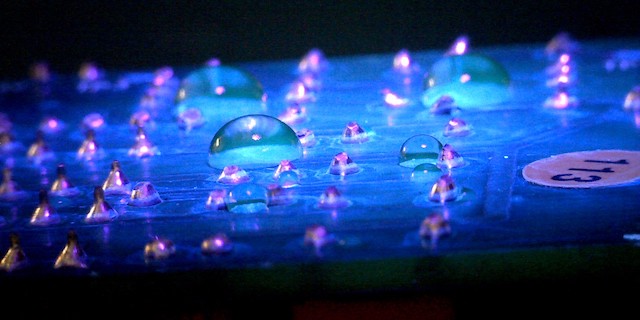
Typically, the coating itself is comprised of fluorocarbons and characterised by carbon-fluorine bonds. Since the coating is made of fluorocarbons then the film surface is not susceptible to Van der Waals forces (interfacial electrostatic bonds). Therefore, the surface energy of the fluoropolymer coating is extremely low and hydrophobic (water repellent). It acts like Teflon on a frying pan.

This non-wetting of water on the circuit board is one of the many key properties making them so popular.

SCH UK1


What other properties do Nano-coatings have that may help protect circuit boards?

For electronic circuit board assemblies there are several key properties that are being used.

These include being:

  • Hydrophobic: Being highly water repellent
  • Ultra-thin: Protection whilst being extremely thin
  • High moisture barrier: Low water vapor transmission rate provides excellent corrosion resistance
  • Chemically resistant: Having a high chemical resistance helps protect the circuits from chemical attack.
  • Good dielectrics: fluoropolymer coatings have high dielectric properties

However, to really understand the benefits you have to look at the key difference compared to a conventional conformal coating. That is that no masking is required when applying the Nano-coating.


So, why is there no need to mask when using a Nano-coating?

First, consider a normal conformal coating is applied at typical thicknesses of 25um or more. Also, the conformal coating is a high insulation material. Therefore, at this thickness the conformal coating would electrically insulate components like connectors and it must not be applied to any part that needs electrical conductivity.

However, this is not a problem for a Nano-coating.

Since the Nano-coating can be applied at ultra-thin thicknesses (1-2um in thickness or less) without any protection performance reduction, then the extremely soft coating is easily removed or scratched away when the connectors are joined and the electrical circuit is easily made.

This key parameter of not requiring masking during Nano-coating application combined with the hydrophobic nature of the coating material makes the Nano-coatings highly effective in protecting electronic circuit boards at a very low cost per unit.


Want to find out more about Nano-coatings?

At SCH Technologies, we supply ultra-thin Nano-coatings based on advanced fluoropolymer chemistries. These coatings provide a cost-effective way to protect printed circuit board assemblies (PCBAs) and other electronics from moisture, corrosion, and environmental damage. ย We also offer a subcontract conformal coating service and can apply these nano-coatings for you.

Find out more and Contact us now to discuss your needs and let us explain how we can help you.

What is a fluoropolymer nano coating and how can it protect my circuit board?


What is a fluoropolymer nano coating and how can it protect my circuit board?

A fluoropolymer Nano-coating is an ultra-thin film comprised of fluorocarbons and characterised by carbon-fluorine bonds.

Chemically inert, fluorocarbons are not susceptible to Van der Waals force. This means that films formed using these materials are non-stick (hydrophobic and water repellent) and friction reducing.

Also, due to the fluorine bonds, these Nano-coatings demonstrate a high level of chemical resistance to acids, bases and most solvents. This makes them excellent materials for protecting electronic circuits at certain circumstances.ย 


What properties of the Nano-coatings are used to protect circuit boards?

Fluoropolymer coatings have very specialised properties. However, for electronics the main properties that are useful include:

  • Being highly hydrophobic (water repellent)
  • Having a high moisture barrier
  • Having a high chemical resistance
  • Having high dielectric properties
  • Providing high corrosion resistance
  • Providing good abrasion / wear resistance

These properties are excellent for protecting circuit board assemblies in harsh environments.


Find out how we can help you with your conformal coating process now.

Contact us now to discuss your needs and let us explain how we can optimize your process for you.

Hydrophobic Conformal Coatings: Can Acrylic Systems Be Made Water-Repellent?


Understanding the difference between moisture resistance, water repellency and hybrid coating strategies for PCB protection

Many engineers choose conformal coatings to improve insulation performance, reduce moisture-driven failure risk and provide a protective barrier against contamination. However, standard liquid conformal coatings are not automatically hydrophobic in the true surface-energy sense, and that distinction matters when water exposure is part of the design concern.

Acrylics, polyurethanes and similar coatings can perform well against humidity and general environmental exposure, but they do not usually cause water to de-wet and roll away from the surface. Where that behaviour is required, the conversation shifts from conventional conformal coating performance to surface energy, hydrophobicity and, in some cases, hybrid coating strategies.

This article explains why standard acrylic conformal coatings are not normally water-repellent, where hydrophobic behaviour comes from, and when a hybrid approach may be worth considering.

What problem are engineers really trying to solve?

When users ask for a โ€œhydrophobic conformal coatingโ€, they are often combining two related but different requirements. One is conventional conformal coating performance such as dielectric protection, edge coverage and environmental shielding. The other is surface water repellency, where droplets bead on the surface rather than spread across it.

These are not identical properties. A coating can have strong moisture resistance without being strongly water-repellent, and a very thin hydrophobic treatment can repel water without delivering the same barrier behaviour or film build as a conventional conformal coating.

Hydrophobic coating and nano coating examples for PCB protection

Hydrophobic performance is usually linked to low surface energy chemistry rather than standard conformal coating chemistry alone.

Key point: moisture protection and water repellency are related, but they are not the same engineering requirement.

Why standard acrylic coatings are not usually hydrophobic

Acrylic conformal coatings are widely used because they are practical, repairable and effective in many electronics protection applications. They can provide good insulation performance and useful resistance to humidity, particulates and general atmospheric exposure.

What they do not usually provide is a very low surface energy finish. Without that low-energy surface, water is more likely to wet the coating rather than ball up and move away from it. In practical terms, that means water droplets can spread across the surface instead of forming a more mobile bead.

This is why a standard acrylic coating may still be the right choice for many assemblies, but it should not automatically be described as hydrophobic unless that behaviour has been specifically designed into the coating system.

What makes a coating hydrophobic?

Hydrophobic behaviour comes from surface chemistry that makes it energetically unfavourable for water to wet the surface. Instead of spreading out, the water forms droplets with a higher contact angle and is more likely to roll or shed from the coated area.

This type of behaviour is commonly associated with fluorinated or other low-surface-energy thin-film technologies rather than traditional bulk conformal coatings. In electronics, that can include ultra-thin hydrophobic systems sometimes described as nano coatings, depending on the chemistry and application method involved.

Comparison between standard conformal coating wetting and hydrophobic coating water beading

Standard conformal coatings can resist moisture exposure, but a hydrophobic surface changes how water interacts with the coating. The left side shows an acrylic conformal coating. the right side shows a hydrophobic coating over the top of the acrylic coating.

Can acrylic and hydrophobic performance be combined?

In some cases, yes. The practical question is whether the assembly needs the film-build and protection profile of a conventional conformal coating plus an added hydrophobic surface effect. That leads to the idea of a hybrid system rather than a simple one-material answer.

A hybrid approach may involve a conventional coating layer supported by a low-surface-energy top surface or treatment. The goal is to retain useful conformal coating properties while improving surface water repellency. This is not automatically the best option in every application, but it can be valuable where both barrier protection and de-wetting behaviour matter.

For a broader engineering discussion of this approach, see our article on hybrid conformal and nano coating strategy for PCBs.

Reality check: a hydrophobic coating is not the same as immersion protection, and water beading alone should not be used as proof of long-term reliability.

Where hydrophobic behaviour may be useful

Hydrophobic behaviour can be useful where assemblies may see intermittent water contact, splash exposure or condensation events and where rapid shedding of water from the surface is desirable. It may also help reduce the tendency for water films to remain on the surface for extended periods.

Typical reasons for specifying this type of performance include:

  • Reducing surface wetting in condensation-prone environments
  • Supporting contamination resistance where water carry-over is a concern
  • Combining conventional PCB protection with improved water shedding
  • Exploring lower-profile alternatives to thick conventional coatings in selected cases

Comparison: standard acrylic vs hydrophobic thin film vs hybrid system

Feature Standard Acrylic Coating Hydrophobic Thin Film Hybrid Approach
Film build Moderate conventional coating thickness Very thin Depends on system design
Water repellency Usually limited Usually strong Potentially improved
Barrier-style protection Strong in many applications Application-specific Can be balanced
Rework / handling implications Generally familiar Depends on chemistry Needs evaluation
Best use case General environmental protection Ultra-thin water-repellent surfaces Applications needing both functions

Specification caution: do not confuse moisture resistance with hydrophobicity

This is one of the most common specification mistakes. A coating may pass internal moisture or insulation expectations without behaving as a visibly water-repellent surface. Equally, a coating that repels water may not replace the need for conventional thickness, coverage control or broader environmental testing.

The right solution depends on the real failure mode. If the problem is humidity-driven leakage, a conventional conformal coating may be entirely appropriate. If the problem is surface water retention or repeated wetting events, a hydrophobic or hybrid approach may deserve investigation.

For related process thinking, you may also find our article on nano coating PCB limitations useful when comparing ultra-thin and conventional protection strategies.

Water wetting on standard acrylic coating compared with de-wetting on hydrophobic coating

Surface wetting behaviour can look very different even when two coating systems are both described as protective.

Why Choose SCH Services?

SCH Services supports customers with practical coating selection, process guidance and application support across conventional conformal coatings, advanced functional coatings and specialist protection strategies.

If you are comparing standard coatings, hydrophobic coatings or hybrid protection strategies, contact SCH Services to discuss the application in practical engineering terms.

โ†‘ Back to top

This article is provided as general technical guidance only. Coating selection, hydrophobic performance and long-term protection suitability should always be validated against the actual operating environment, material compatibility, qualification requirements and relevant test standards.

The ABCs of ultra-thin fluoropolymer coatings for electronic circuit boards


Nano coatings are no mask conformal coatings with great water repellent properties

What is a fluoropolymer coating?

A fluoropolymer coating is typically comprised of fluorocarbons and characterised by carbon-fluorine bonds.

They have many interesting properties and especially for printed circuit boards. However the three key properties for electronics are that the coatings are:

  • Hydrophobic
  • Chemically resistant
  • No masking required

These properties can be key to protecting the electronics and providing a highly cost effective production process.

Hydrophobic coating

  • Fluorocarbons are not susceptible to Van der Waals force.
  • This gives the coatings their signature characteristics. That is they are non-stick, hydrophobic and friction reducing.
  • Therefore, water does not like to wet the surface of the circuit board and this gives the circuit excellent protection.

Chemically Resistant

  • These fluorinated coatings are chemically inert.
  • Owing to the fluorine bonds, fluoropolymer coatings demonstrate a high level of durability as well as resistance to acids, bases and most solvents.
  • This gives the circuit board a high degree of protection from chemical attack.

No masking required

Finally, what is really interesting is that these properties are exhibited at ultra-thin film thicknesses. Typically a dry film can be 1-2um or even less.

This means that masking generally is not required for circuit boards before application. ย Therefore, you can dip the whole product into the liquid and there is no issue with electrical contact. This can lead to significant cost savings in production.

Find out more about our range of fluoropolymer nano coatings here.


What other properties do the fluoropolymer coatings have that may be relevant in electronics?

SCHUK 2

As already mentioned these hydrophobic coatings have very specialised properties.

They can include:

  • Being highly hydrophobic (water repellent)
  • Having a high moisture barrier
  • Requiring no masking before application
  • Being highly oleophobic (oil repellent)
  • Having a high chemical resistance
  • Having a high lubricity
  • Having high dielectric properties
  • Providing high corrosion resistance
  • Providing good abrasion / wear resistance

Note, not all fluoropolymer coatings have all of the above properties. But, some coatings can in fact have almost all of the properties.

The fluoropolymer coatings are extremely flexible coatings and becoming more prolifically used throughout engineering.


What sectors of industry are fluoropolymer coatings being used in protecting electronics?

SCHUK3

Fluorinated coatings are used to protect electronics in almost all industrial sectors.

They include:

  • Aviation
  • Aerospace
  • Defence
  • Automotive
  • Industrial
  • Oil & Gas
  • LEDs
  • Medical
  • Optics
  • Telecommunications
  • White goods / Commercial

This list is limited and there are a lot more areas that they are used.


What are the major differences between a fluoropolymer coating and a conformal coating for protecting an electronic printed circuit board or assembly?

There are several key differences between a conformal coating and a fluoropolymer coating.

They include:

  • Hydrophobic Properties – A fluoropolymer coating is generally hydrophobic in nature. It repels water when the water is on the surface of the coating.
  • Extremely thin coating – The fluoropolymer coating is normally applied a lot thinner than a typical liquid conformal coating. This is due to its superior performance when repels liquids
  • No masking – Due to the extremely thin fluoropolymer coating applied (<1-2um), the components that normally require protecting (connectors, switches etc) from the insulating liquid conformal coating may not need to be masked for the fluoropolymer. The circuit board can be completely submerged in the liquid with no masking applied without fear of damaging the connections.
  • Simple process – No masking means an extremely fast application process
  • Fast drying – due to the thin nature of the fluoropolymer coating and the solvents normally used the coating dries extremely quickly.

Find out how we can help you with your ultra-thin hydrophobic coatings now.

Contact us to discuss your needs and let us explain how hydrophobic coatings could work for you.

Contact us now.

0
  • Your current order total is £0.00 โ€” you must have an order with a minimum of £75.00 to place your order.
0
Your Cart
Your cart is empty
  • Your current order total is £0.00 โ€” you must have an order with a minimum of £75.00 to place your order.
Calculate Shipping
  • Your current order total is £0.00 โ€” you must have an order with a minimum of £75.00 to place your order.

Conformal Coating UK

Technical banner showing PCB and process icons representing conformal coating, masking, inspection and training on the SCH technical knowledge hub.
Conformal Coating UK
Privacy Overview

This website uses cookies so that we can provide you with the best user experience possible. Cookie information is stored in your browser and performs functions such as recognising you when you return to our website and helping our team to understand which sections of the website you find most interesting and useful.