Reusable Masking Boots – Speed, Cost & Repeatability
Reusable Masking Boots for Conformal Coating
Reusable masking boots give fast, repeatable seals around connectors and keep-outs, helping improve first-pass yield and reduce masking labour. They can also be combined with liquid mask to create more robust barrier systems where geometry demands it.
Compared with tapes and dots, boots can reduce setup time, improve edge definition and lower cost per board as volumes rise. Their biggest advantage is not just speed, but repeatability across operators, shifts and repeat production.
For a wider process view, see our articles on improving masking process reliability with custom boots and how one company reduced masking costs by more than 60%.
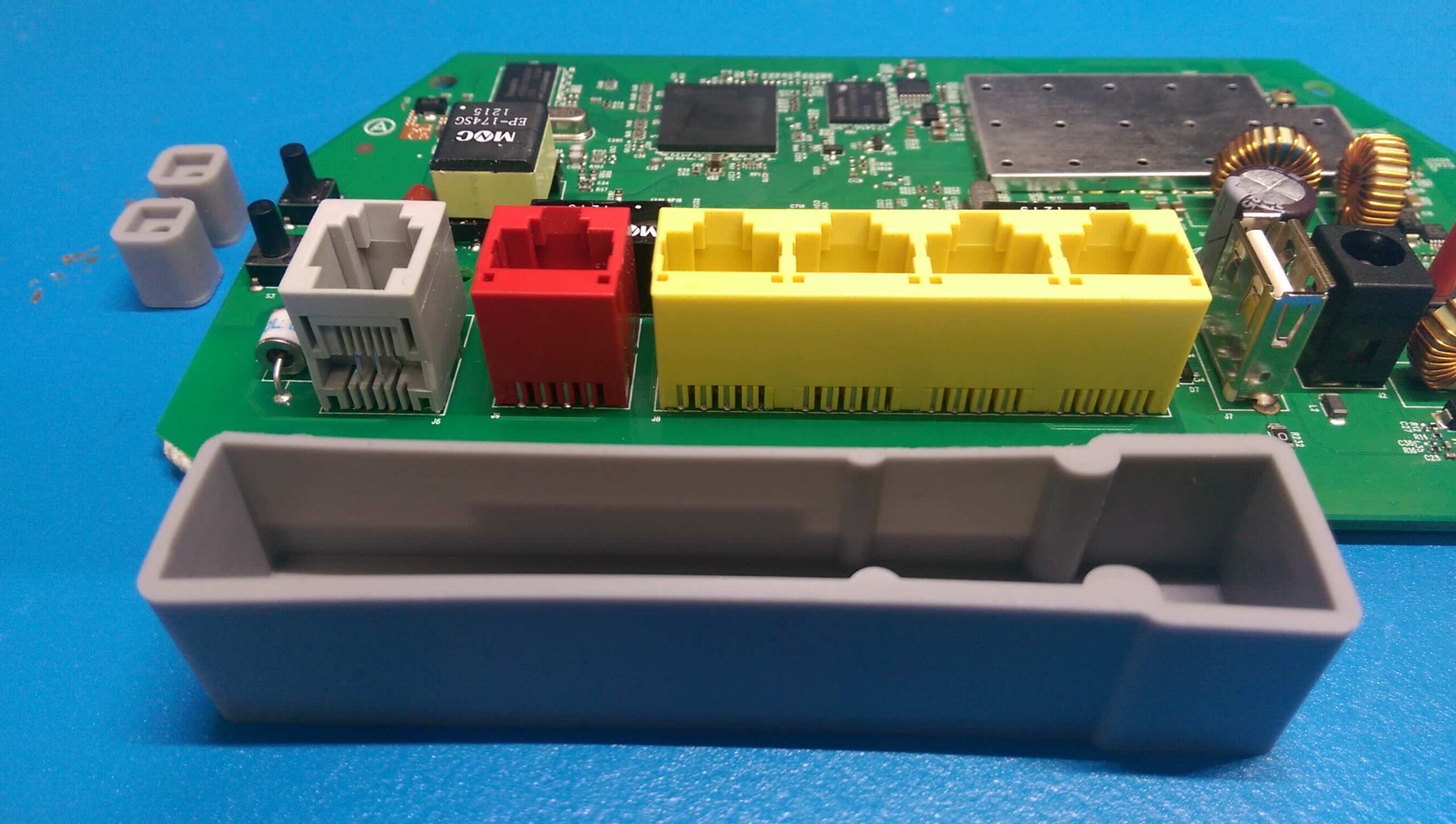
Reusable masking boots provide fast, repeatable masking around connector bodies and defined keep-out areas, improving process consistency and reducing masking variability.
Quick Links
When to Use Reusable Masking Boots
- Medium to high volumes where masking time dominates cycle time
- Repetitive builds with common connector families such as headers, USB, RF and edge connectors
- Tight keep-outs that need reliable barrier sealing and crisp edges
- Programmes that demand consistent cosmetics and reduced operator variation
Reusable boots are most valuable where repeatability matters commercially. In these applications, they help reduce manual variation and make masking more predictable as part of the full coating process.
Benefits & ROI of Reusable Boots
- Speed: faster load and unload than taping, making setup more predictable
- Repeatability: uniform compression supports cleaner break lines and fewer touch-ups
- Cost per board: unit cost falls as reuse count rises
- Quality: less fibre transfer and cleaner masking boundaries than many tape-based approaches
- Housekeeping: fewer offcuts and simpler waste streams
Example ROI: reducing masking time from 5 minutes to 1 minute per board saves 4 minutes per assembly. Over a 100-board batch, that equates to more than 6.5 hours of masking labour removed from the process.
Where the same connectors and keep-outs are repeated regularly, reusable boots can recover their initial cost quickly through labour reduction, improved repeatability and lower rework risk.
In liquid conformal coating applications, reusable boots can often achieve high reuse counts when correctly specified, handled and cleaned. Actual service life varies with coating chemistry, geometry and process conditions.
Tip: track reuse count and defects per 100 boards to show payback clearly.
Fit & Selection: Getting the Seal Right
- Profile match: choose connector-specific silicone masking boots or measure L × W × H and latch or lead features
- Compression: aim for light, full-perimeter compression without stressing the component
- Material: use a heat-stable elastomer with solvent resistance appropriate to your chemistry
- Handling: add pull tabs or ribs for gloved removal and colour-code by board variant if needed
Where tape, dots or sheets are used alongside boots, adhesive choice also matters. Silicone-based adhesive systems can introduce contamination risk on sensitive assemblies.
SCH offers silicone-free masking materials for liquid conformal coatings to support cleaner processing and help reduce contamination-related defects such as dewetting or poor coating wetting.
Process Compatibility
- Spray: boots act as a shield until sealed; use liquid mask where coating may penetrate underneath to create a barrier if required
- Dip: confirm full seal (or use latex) and qualify for capillary forces and edge-break lines
- Selective robot: boots can reduce no-coat programming and overspray cleanup
- Parylene: use dedicated, fully sealed designs because vapour reaches everywhere
Process compatibility must always be checked against the actual coating chemistry and masking objective. A boot that performs well in liquid coating may behave very differently in Parylene barrier sealing.
Care & Cleaning for Longer Reuse
- Wipe after each cycle and deep-clean on a defined interval based on build hours
- Use approved solvents only and avoid swelling or softening the elastomer
- Inspect lips and corners and retire boots showing nicks or permanent deformation
- Log reuse counts by boot ID to predict replacement and protect yield
Care and handling often determine whether boots deliver the expected commercial benefit in production.
Common Pitfalls to Avoid
- Undersize fit: can lift components or stress solder joints
- Over-compression: can leave witness marks or drive coating under the boot
- Worn edges: can cause weeping and ragged break lines
- Mixed chemistries: some solvents attack elastomers, so compatibility must be checked first
Where tapes or dots are used alongside boots, contamination from silicone-based adhesives can also become a hidden pitfall on sensitive coating processes.
Reusable Boots vs Tapes & Dots
- Boots: best for repeat builds, connectors and speed, with higher upfront cost but strong reuse potential
- Tapes and dots: flexible for odd shapes and one-off work, but with more labour and waste
- Hybrid: combine boots with liquid mask or tape where a full boot is not available
When tapes, dots or sheets are required, silicone-free masking options can provide a cleaner choice where contamination control is important.
Read masking strategies to choose the right approach for your process
FAQs on Reusable Masking Boots
How many cycles can I expect?
Typically, service life depends on chemistry, temperature, handling and whether the boot is being used in liquid conformal coating or Parylene sealing. In liquid conformal coating applications, high reuse counts are often achievable when the boot is correctly specified, handled and cleaned.
Will boots work for dip coating?
Yes, but seal performance and capillary effects should be qualified on representative coupons before release.
Do I still need tapes?
Sometimes. Use tapes, dots, shields or liquid mask for features that boots cannot reach or for one-off work.
Are silicone boots solvent safe?
Often yes, however you should always test against your specific solvent blend to avoid swelling or softening.
Why does silicone-free masking matter?
Where tapes, dots or sheets are used in the process, silicone-based adhesives can create contamination risk. Silicone-free masking materials can help support cleaner processing on sensitive assemblies.
Next Steps & Related Guides
Why Choose SCH Services?
Partnering with SCH Services means more than just outsourcing — you gain a complete, integrated platform for Conformal Coating, Parylene & ProShieldESD, alongside equipment, materials and training, backed by decades of hands-on expertise.
- ✈️ 25+ Years of Expertise – Specialists trusted by aerospace, medical, defence and automotive sectors.
- 🛠️ End-to-End Support – Selection, masking design, application methods and inspection.
- 📈 Scalable Solutions – From prototypes to high-volume production.
- 🌍 Global Reach – Responsive support across Europe, North America and Asia.
- ✅ Proven Reliability – Quality, consistency and customer satisfaction.
📞 Call: +44 (0)1226 249019 |
✉ Email: sales@schservices.com |
💬 Contact Us ›