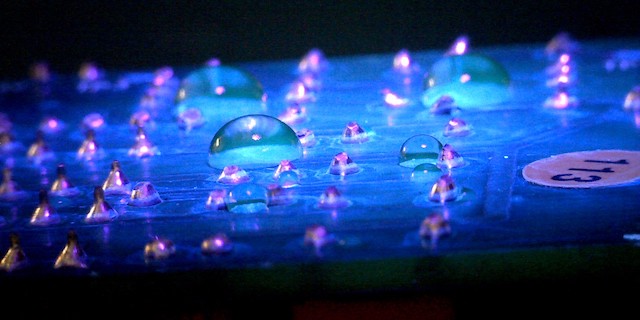
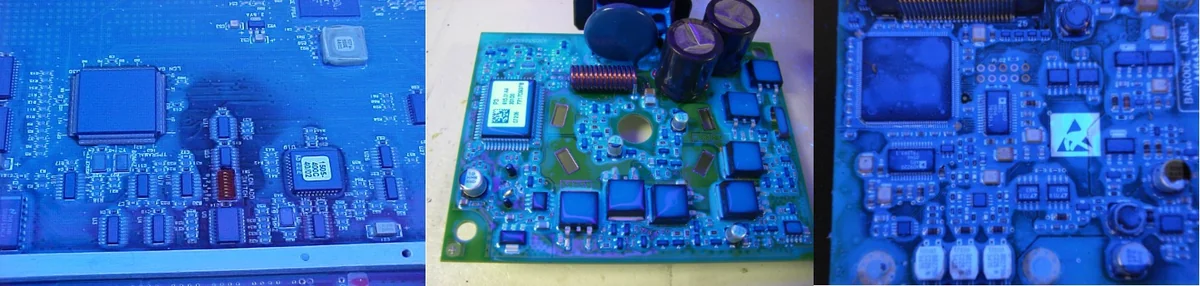
Mon - Thur 7.30-15.30   Fri 7.30-14.00

What Application Methods Are Used for Conformal Coating?


Conformal coatings can be applied to printed circuit boards (PCB) in the production process environment in many alternative ways. Listed below are the common methods of applying the conformal coating materials:

  • Brushing
  • Aerosol spray
  • Batch spray
  • Selective spray
  • Dipping
  • Vapour deposition
There are many different methods of applying conformal coatings including brushing, aerosol spray, batch spray, selective spray, dipping and vapour deposition (Parylene).

Common methods of applying conformal coatings include brushing, aerosol spray, batch spray, selective spray, dipping and vapour deposition (Parylene).

It is possible to split the different application methods and their suitability in many different ways including:

  • Compatibility with the conformal coating material
  • Design of the circuit board
  • Suitability to low, medium and high volume
  • Manual versus automatic process
  • Type of method of application
  • Level of control required

Each of the various methods has different advantages and disadvantages and should be carefully considered.

This thought process relates to the holistic approach to conformal coating processing that states that you should consider the conformal coating material, the application process and the circuit board together and not as three separate entities.


Find out how we can help you with your conformal coating application selection now.

Partnering with SCH Services means more than just outsourcing โ€” you gain a complete, integrated platform for Conformal Coating, Parylene & ProShieldESD Solutions, alongside equipment, materials and training, all backed by decades of hands-on expertise.

  • โœˆ๏ธ 25+ Years of Expertise โ€“ Specialists in coating technologies trusted worldwide.
  • ๐Ÿ› ๏ธ End-to-End Support โ€“ Coating selection, masking, inspection and process validation.
  • ๐Ÿ“ˆ Scalable Solutions โ€“ From prototypes and NPI through to high-volume production.
  • ๐ŸŒ Global Reach โ€“ Responsive support across Europe, North America and Asia.
  • โœ… Proven Reliability โ€“ Built on quality, consistency and long-term customer partnerships.

๐Ÿ“ž Call: +44 (0)1226 249019
โœ‰ Email: sales@schservices.com
๐Ÿ’ฌ Contact Us โ€บ


Hydrophobic Conformal Coatings: Can Acrylic Systems Be Made Water-Repellent?


Understanding the difference between moisture resistance, water repellency and hybrid coating strategies for PCB protection

Many engineers choose conformal coatings to improve insulation performance, reduce moisture-driven failure risk and provide a protective barrier against contamination. However, standard liquid conformal coatings are not automatically hydrophobic in the true surface-energy sense, and that distinction matters when water exposure is part of the design concern.

Acrylics, polyurethanes and similar coatings can perform well against humidity and general environmental exposure, but they do not usually cause water to de-wet and roll away from the surface. Where that behaviour is required, the conversation shifts from conventional conformal coating performance to surface energy, hydrophobicity and, in some cases, hybrid coating strategies.

This article explains why standard acrylic conformal coatings are not normally water-repellent, where hydrophobic behaviour comes from, and when a hybrid approach may be worth considering.

What problem are engineers really trying to solve?

When users ask for a โ€œhydrophobic conformal coatingโ€, they are often combining two related but different requirements. One is conventional conformal coating performance such as dielectric protection, edge coverage and environmental shielding. The other is surface water repellency, where droplets bead on the surface rather than spread across it.

These are not identical properties. A coating can have strong moisture resistance without being strongly water-repellent, and a very thin hydrophobic treatment can repel water without delivering the same barrier behaviour or film build as a conventional conformal coating.

Hydrophobic coating and nano coating examples for PCB protection

Hydrophobic performance is usually linked to low surface energy chemistry rather than standard conformal coating chemistry alone.

Key point: moisture protection and water repellency are related, but they are not the same engineering requirement.

Why standard acrylic coatings are not usually hydrophobic

Acrylic conformal coatings are widely used because they are practical, repairable and effective in many electronics protection applications. They can provide good insulation performance and useful resistance to humidity, particulates and general atmospheric exposure.

What they do not usually provide is a very low surface energy finish. Without that low-energy surface, water is more likely to wet the coating rather than ball up and move away from it. In practical terms, that means water droplets can spread across the surface instead of forming a more mobile bead.

This is why a standard acrylic coating may still be the right choice for many assemblies, but it should not automatically be described as hydrophobic unless that behaviour has been specifically designed into the coating system.

What makes a coating hydrophobic?

Hydrophobic behaviour comes from surface chemistry that makes it energetically unfavourable for water to wet the surface. Instead of spreading out, the water forms droplets with a higher contact angle and is more likely to roll or shed from the coated area.

This type of behaviour is commonly associated with fluorinated or other low-surface-energy thin-film technologies rather than traditional bulk conformal coatings. In electronics, that can include ultra-thin hydrophobic systems sometimes described as nano coatings, depending on the chemistry and application method involved.

Comparison between standard conformal coating wetting and hydrophobic coating water beading

Standard conformal coatings can resist moisture exposure, but a hydrophobic surface changes how water interacts with the coating. The left side shows an acrylic conformal coating. the right side shows a hydrophobic coating over the top of the acrylic coating.

Can acrylic and hydrophobic performance be combined?

In some cases, yes. The practical question is whether the assembly needs the film-build and protection profile of a conventional conformal coating plus an added hydrophobic surface effect. That leads to the idea of a hybrid system rather than a simple one-material answer.

A hybrid approach may involve a conventional coating layer supported by a low-surface-energy top surface or treatment. The goal is to retain useful conformal coating properties while improving surface water repellency. This is not automatically the best option in every application, but it can be valuable where both barrier protection and de-wetting behaviour matter.

For a broader engineering discussion of this approach, see our article on hybrid conformal and nano coating strategy for PCBs.

Reality check: a hydrophobic coating is not the same as immersion protection, and water beading alone should not be used as proof of long-term reliability.

Where hydrophobic behaviour may be useful

Hydrophobic behaviour can be useful where assemblies may see intermittent water contact, splash exposure or condensation events and where rapid shedding of water from the surface is desirable. It may also help reduce the tendency for water films to remain on the surface for extended periods.

Typical reasons for specifying this type of performance include:

  • Reducing surface wetting in condensation-prone environments
  • Supporting contamination resistance where water carry-over is a concern
  • Combining conventional PCB protection with improved water shedding
  • Exploring lower-profile alternatives to thick conventional coatings in selected cases

Comparison: standard acrylic vs hydrophobic thin film vs hybrid system

Feature Standard Acrylic Coating Hydrophobic Thin Film Hybrid Approach
Film build Moderate conventional coating thickness Very thin Depends on system design
Water repellency Usually limited Usually strong Potentially improved
Barrier-style protection Strong in many applications Application-specific Can be balanced
Rework / handling implications Generally familiar Depends on chemistry Needs evaluation
Best use case General environmental protection Ultra-thin water-repellent surfaces Applications needing both functions

Specification caution: do not confuse moisture resistance with hydrophobicity

This is one of the most common specification mistakes. A coating may pass internal moisture or insulation expectations without behaving as a visibly water-repellent surface. Equally, a coating that repels water may not replace the need for conventional thickness, coverage control or broader environmental testing.

The right solution depends on the real failure mode. If the problem is humidity-driven leakage, a conventional conformal coating may be entirely appropriate. If the problem is surface water retention or repeated wetting events, a hydrophobic or hybrid approach may deserve investigation.

For related process thinking, you may also find our article on nano coating PCB limitations useful when comparing ultra-thin and conventional protection strategies.

Water wetting on standard acrylic coating compared with de-wetting on hydrophobic coating

Surface wetting behaviour can look very different even when two coating systems are both described as protective.

Why Choose SCH Services?

SCH Services supports customers with practical coating selection, process guidance and application support across conventional conformal coatings, advanced functional coatings and specialist protection strategies.

If you are comparing standard coatings, hydrophobic coatings or hybrid protection strategies, contact SCH Services to discuss the application in practical engineering terms.

โ†‘ Back to top

This article is provided as general technical guidance only. Coating selection, hydrophobic performance and long-term protection suitability should always be validated against the actual operating environment, material compatibility, qualification requirements and relevant test standards.

How Do I Spray My Conformal Coating?


SCH UK Image 3conformal coating batch spraying Collage 640x480

Batch spraying is one of the widest used techniques used in low and medium volume conformal coating processing.

Whether you are using a compressed air spray gun or an aerosol can, the conformal coating is sprayed across the whole of the circuit board. It can produce a high quality coating finish that gives the best protection due to good edge coverage.

However, it is not a selective process. All parts are coated on the circuit board. Therefore, masking may be required to protect components that must not be coated.


What Equipment Do You Need For Batch Conformal Coating spraying?

SCHUK Image 2

If you are not using aerosols then for conformal coating spraying a typical set up is:

  • Spray gun
  • Air Compressor for the Air Supply
  • Spray booth

This is a low cost set up that can handle a fairly high volume of product. However, the quality of the finish is dependent on the quality of the spray equipment itself and the operator.

find out more about our conformal coating spray booth and how it can help you.


How Do You Apply the Conformal Coating by Spraying?

Although the process can be material specific there are a few general guidelines for applying conformal coating by spraying.

These include:

  • Only apply thin, consistent coats. It may be necessary to apply more than one coat.
  • Apply the coating in a narrow raster pattern across the circuit.
  • Rotate the board 90 degrees and repeat. Continue until the whole board is coated to avoid 3D effects.
  • Allow the coating to dry enough to avoid problems like bubbles before applying a second coat.

Following a few simple guidelines can save a lot of problems.

Let us help you with our conformal coating training courses for spraying conformal coating.


What variables control the quality of the conformal coating in batch spraying?

SCHUK Image 1

Variables that influence the quality of the coating process in spraying are:

  • The operator skill
  • Quality of the spray equipment
  • Viscosity of the conformal coating
  • Blending the conformal coating to the right viscosity is critical.
  • The level of masking required

Find out how we can help you with your conformalย coatings now.

Contact us to discuss your needs and let us explain how hydrophobic coatings could work for you.

Contact us now.


The ABCs of ultra-thin fluoropolymer coatings for electronic circuit boards


Nano coatings are no mask conformal coatings with great water repellent properties

What is a fluoropolymer coating?

A fluoropolymer coating is typically comprised of fluorocarbons and characterised by carbon-fluorine bonds.

They have many interesting properties and especially for printed circuit boards. However the three key properties for electronics are that the coatings are:

  • Hydrophobic
  • Chemically resistant
  • No masking required

These properties can be key to protecting the electronics and providing a highly cost effective production process.

Hydrophobic coating

  • Fluorocarbons are not susceptible to Van der Waals force.
  • This gives the coatings their signature characteristics. That is they are non-stick, hydrophobic and friction reducing.
  • Therefore, water does not like to wet the surface of the circuit board and this gives the circuit excellent protection.

Chemically Resistant

  • These fluorinated coatings are chemically inert.
  • Owing to the fluorine bonds, fluoropolymer coatings demonstrate a high level of durability as well as resistance to acids, bases and most solvents.
  • This gives the circuit board a high degree of protection from chemical attack.

No masking required

Finally, what is really interesting is that these properties are exhibited at ultra-thin film thicknesses. Typically a dry film can be 1-2um or even less.

This means that masking generally is not required for circuit boards before application. ย Therefore, you can dip the whole product into the liquid and there is no issue with electrical contact. This can lead to significant cost savings in production.

Find out more about our range of fluoropolymer nano coatings here.


What other properties do the fluoropolymer coatings have that may be relevant in electronics?

SCHUK 2

As already mentioned these hydrophobic coatings have very specialised properties.

They can include:

  • Being highly hydrophobic (water repellent)
  • Having a high moisture barrier
  • Requiring no masking before application
  • Being highly oleophobic (oil repellent)
  • Having a high chemical resistance
  • Having a high lubricity
  • Having high dielectric properties
  • Providing high corrosion resistance
  • Providing good abrasion / wear resistance

Note, not all fluoropolymer coatings have all of the above properties. But, some coatings can in fact have almost all of the properties.

The fluoropolymer coatings are extremely flexible coatings and becoming more prolifically used throughout engineering.


What sectors of industry are fluoropolymer coatings being used in protecting electronics?

SCHUK3

Fluorinated coatings are used to protect electronics in almost all industrial sectors.

They include:

  • Aviation
  • Aerospace
  • Defence
  • Automotive
  • Industrial
  • Oil & Gas
  • LEDs
  • Medical
  • Optics
  • Telecommunications
  • White goods / Commercial

This list is limited and there are a lot more areas that they are used.


What are the major differences between a fluoropolymer coating and a conformal coating for protecting an electronic printed circuit board or assembly?

There are several key differences between a conformal coating and a fluoropolymer coating.

They include:

  • Hydrophobic Properties – A fluoropolymer coating is generally hydrophobic in nature. It repels water when the water is on the surface of the coating.
  • Extremely thin coating – The fluoropolymer coating is normally applied a lot thinner than a typical liquid conformal coating. This is due to its superior performance when repels liquids
  • No masking – Due to the extremely thin fluoropolymer coating applied (<1-2um), the components that normally require protecting (connectors, switches etc) from the insulating liquid conformal coating may not need to be masked for the fluoropolymer. The circuit board can be completely submerged in the liquid with no masking applied without fear of damaging the connections.
  • Simple process – No masking means an extremely fast application process
  • Fast drying – due to the thin nature of the fluoropolymer coating and the solvents normally used the coating dries extremely quickly.

Find out how we can help you with your ultra-thin hydrophobic coatings now.

Contact us to discuss your needs and let us explain how hydrophobic coatings could work for you.

Contact us now.

How to Remove Parylene From a Printed Circuit Board


conformal coating rework collage 640_SCH UK

Removing conformal coatings from a printed circuit board (PCB) is a hard process to do well. Removing Parylene coating is even more difficult.

The problems are many but a key reason is that the Parylene coating itself is chemically inert. It has a very high chemical resistance so the solvents donโ€™t work well. This means any chemical attack tried with solvents or other liquid chemicals on the Parylene is as much likely to damage the circuit board than remove the actual coating.

This leaves the basic option of mechanical abrasion.

Mechanical Abrasion

Mechanical abrasion is a well known method for Parylene Removal. It can be done crudely by scraping off the Parylene with a knife or tool. Or, removal can be done with a media blast system like a Vaniman Problast system that gradually erodes the Parylene coating away.

However, mechanical abrasion is a time consuming process and is highly skilled. Also, it tends to be a localised repair and removal technique.

The concept of completely removing all of the Parylene off a circuit by mechanical abrasion is considered almost impossible unless a ridiculous amount of time and effort is injected into the process.


Find out now how much money you can save by using our Parylene removal service

We are happy to provide a quotation for removing Parylene through our coating services so you can see for yourself how much you can save.

Contact us now to request your quotation for complete removal of Parylene from a circuit board. Or, give us a call at (+44) 1226 249019 or email your inquiries at sales@schservices.com

ย 

How thick should I apply my conformal coating?


So, a question I am regularly asked is,“What is a good conformal coating thickness for my printed circuit board?”

Well, the simple answer is thick enough so the conformal coating works and protects the circuit board. But not too thick as this can cause problems for the circuit board in the long term.

After all, the performance of the conformal coating is dependent on the material applied. But, it is possible to quantify this a little more.


Help for determining the right conformal coating thickness

First off itโ€™s probably best to use guidelines from International Standards like IPC A 610. These standards specify the conformal coating thickness based upon the generic material types like acrylics, polyurethanes, and silicones. Further, you can also reference this data against the material manufacturers technical recommendations.

Combining these two pieces of information should give you a target range for a suitable thickness. However, ultimately, the coating thickness is down to the user.

How you decide if the conformal coating thickness is good enough is up to you. Too thin and you will not protect the circuit as effectively as you may need. Too thick and you could have reliability issues in the future. So, monitor your conformal coating thickness with care.

So what do the IPC Standards recommend when considering coating thickness?

The IPC A 610 standard defines ideal thickness values as:

  • Acrylic: 30-130ฮผm
  • Polyurethane: 30-130ฮผm
  • Silicone: 50-210ฮผm

However, this is not the end of the story. Using the target coating thicknesses as an absolute value can be problematic.

The reality is that the thickness will vary massively across the circuit board due to many factors including the surface tension of the liquid, the surface energy of the board surface, the design of the board, the material properties and the application method used.

So, there may be areas on the board that could fall outside of the range where the coating thickness will be less or more than the ideal values. Therefore, it is highly recommended that the range should be considered as an average value across the board for the conformal coating thickness.

In fact, the IPC go further and suggest using flat test coupons coated in the same way as the process you use for the circuit boards. Then, these test coupons are measured against the standards. In the end how you decide if the coating thickness is good enough is up to you.

Too thin and you will not protect the circuit as effectively as you may need. Too thick and you could have reliability issues in the future. ย So, monitor your conformal coating with care.

Learn more about the different methods for measuring the thickness of conformal coating here. Find out more about conformal coating thickness targets and how they are defined by chemistry and function through our knowledge hub.


Need to know more about measuring conformal coating thickness in your application process?

Contact us now and we can discuss how we can help you. Or, give us a call at (+44) 1226 249019 or email your inquiries at sales@schservices.com

Find out how one company saved 60% of their process costs by changing to custom conformal coating masking boots


A practical case study showing how lower unit cost and longer boot life combined to reduce annual masking spend

Masking cost is often judged only on the price of the individual boot, tape or masking component. In production, that is too narrow. True masking cost is driven by purchase price, life in service, replacement frequency and the effect on process consistency.

This customer case study shows why that distinction matters. A lower purchase price created the initial interest, but the real saving came from improved boot life and reduced ordering volume over time.

For subcontract coating businesses and production environments, this is the difference between buying masking products and improving the economics of the masking process itself.

Customer background

Diamond MT, a conformal coating and Parylene coating service provider in the USA, reviewed its current masking boot supply as part of a cost-reduction exercise. The initial aim was straightforward: find a more competitive option without compromising masking performance.

What followed was more valuable than a simple price comparison. Once the masking application was reviewed properly, the customer identified both an immediate purchase saving and a significant improvement in boot life.

Diamond MT saved more than 60 percent of their masking costs by switching to reusable conformal coating masking boots from SCH Services

Diamond MT reduced masking costs by more than 60% after moving to SCH reusable conformal coating masking boots with improved service life.

Key point: the biggest saving did not come from unit price alone. It came from combining lower purchase cost with longer usable life in production.

What Diamond MT said

Sean Horn of Diamond MT explained that the original interest was based on price. However, after reviewing the application and using the boots in service, the commercial picture changed significantly.

โ€œWe had initially wanted to try SCHโ€™s conformal coating masking boots for price savings. However, once we began to work with Lee on our specific masking application, we realised that we could extend the life of our boots over 200%. We switched immediately.

We then realised the importance of working with someone who understands coatings. We will not be going back to our previous supplier.โ€

Sean Horn, Director, Diamond MT, Parylene and conformal coating subcontract service provider.

So why did Diamond MT switch?

The first finding was simple: SCH masking boots were priced approximately 30% lower than the customerโ€™s existing supply. That was enough to justify an initial production trial and begin comparing real-world performance.

The more important finding came after the first month of use. Diamond MT found that the boots lasted around twice as long as the previous alternative. This changed the economics of the full process, because the customer no longer needed to replace boots at the same rate.

As a result, annual ordering volume was effectively halved. When lower purchase price and longer service life were combined, the customerโ€™s total masking boot cost fell by more than 60% over the year.

What this case study really shows

This is not just a price story. It is a process-cost story. In masking applications, the cheapest-looking option is not always the lowest-cost option once replacement frequency, handling life and repeat usage are included.

For many users, especially in repetitive production or subcontract coating environments, the more important question is how long the masking product survives in real service and how consistently it performs over time.

That is why custom reusable boots can create a stronger commercial result than basic unit-price comparison suggests. If you want to explore the broader process-control argument, see our article on improving conformal coating masking process reliability with custom boots.

Where reusable masking boots add most value

Reusable masking boots are most valuable where a masking feature is repeated often enough for speed, seal repeatability and service life to matter commercially. This is particularly relevant in production runs involving connectors, interfaces and defined keep-out areas.

  • High-repeat masking applications
  • Subcontract coating and service environments
  • Connector and keep-out protection
  • Processes where masking labour is significant
  • Applications where consistent fit and reuse life affect cost

If you are comparing different masking options, our reusable masking boots guide explains how these products are used to create fast, repeatable seals around connectors and protected features.

Related guidance

These pages explain where reusable boots fit commercially and technically within the wider masking process.

Why Choose SCH Services?

SCH Services supports manufacturers and coating service providers with practical masking solutions, production-focused advice and reusable products designed for real conformal coating and Parylene applications. We help customers look beyond simple purchase price and focus on total masking cost, repeatability and process performance.

If you want to review whether reusable masking boots are likely to reduce masking cost in your own process, get in touch and we can discuss the application with you.

Back to top โ†‘

This article is provided as general guidance and customer example content only. Cost savings, service life and suitability will vary depending on masking geometry, coating type, handling practice, reuse conditions and production environment. All applications should be assessed against actual process conditions.

Is There a Free Guide on Conformal Coating Defects?


Collage of conformal coating capillary flow and wicking defects around PCB components.

SCH services Ltd provide an information section on conformal coating defects in their Defects Knowledge Hub.

This hub explains the most common defects and failure mechanisms, their root causes, and practical actions to prevent or correct them in production.

Conformal coating defects can undermine PCB protection, reduce insulation resistance, and cause costly rework or field failures. This hub explains the most common defects like de-wetting, de-lamination, corrosion and cob-webbing and details their causes and how to prevent them.

All this is linked to detailed technical articles and inspection guidance.


Need to know more about coating defects?

Contact us now and we can discuss how we can help you. Or, give us a call at (+44) 1226 249019 or email your inquiries at sales@schservices.com


Infographic explaining whether MIL-SPEC qualification is required for conformal coating and how legacy MIL-I-46058C references relate to modern standards.

Do you need MiL spec qualification for your conformal coating?


A common question from aerospace and defence customers is: โ€œDo we need MIL-SPEC qualification for our conformal coating?โ€

The short answer is: sometimes โ€” but only when it is contractually required.

Confusion usually arises because legacy military standards are still referenced on drawings, purchase orders, or coating datasheets, even though the underlying standards landscape has changed.

For a full explanation of how military (MIL) requirements relate to modern conformal coating standards, see: MIL-I-46058C (Cancelled) & MIL Standards for Conformal Coating
.


When is MIL-SPEC actually required?

In practice, manufacturers usually know they require MIL-related compliance when:

  • The product is for a military or defence programme
  • MIL requirements are explicitly called up on the customer drawing
  • The purchase order or contract includes MIL flow-down requirements

If none of these are present, โ€œMIL-SPECโ€ is often being used as shorthand for high reliability rather than a defined manufacturing requirement. This is where misunderstandings commonly occur.


Be cautious with datasheets claiming โ€œmeets MIL-I-46058Cโ€

Many conformal coating datasheets state that the material โ€œmeets the requirements of MIL-I-46058Cโ€. This wording should be treated with caution.

MIL-I-46058C is a cancelled standard, and simply stating compliance does not mean the coating has been independently approved or qualified. In many cases, the claim refers only to internal or historical test data.

Where defence programmes genuinely require MIL-style material qualification, customers will often expect evidence beyond a datasheet statement.


What is the Qualified Product List (QPL)?

Historically, conformal coatings tested against MIL-I-46058C were listed on the Qualified Product List (QPL).

The MIL-I-46058C Conformal coating standard has been inactive for new designs since the late 1990s, but QPL listings are still referenced in legacy documentation and long-lifecycle programmes.

Coatings appearing on the QPL would have undergone independent third-party testing rather than self-certification. This is an important distinction.

However, the presence (or absence) of a coating on the QPL does not automatically determine its suitability for modern programmes. What matters today is how customer requirements are defined and verified.


What is normally used instead today?

Modern defence and aerospace programmes typically rely on a combination of:

  • IPC-CC-830 for conformal coating material performance and qualification
  • IPC-A-610 for workmanship and acceptance criteria
  • Customer drawings and specifications defining coverage, keep-out zones and inspection evidence

MIL requirements are therefore usually met through industry standards plus contractual flow-downs, rather than through a single active โ€œMIL-SPECโ€ document.


Need to understand how the standards fit together?

The Conformal Coating Standards Hub brings together SCHโ€™s guidance on IPC-A-610, IPC-CC-830, IEC 60664, UL 746, NASA workmanship standards and how they relate to conformal coating and Parylene.

It is designed to help engineering, quality and procurement teams understand:

  • What each standard actually covers
  • How acceptance, material qualification and inspection requirements interact
  • Where legacy MIL references still appear โ€” and how to interpret them safely

You can also explore related hubs covering Design, Inspection & Quality and Parylene Coating.


If you need help interpreting customer requirements, legacy MIL references, or selecting compliant coating materials and inspection criteria, contact SCH Services.

๐Ÿ“ž Call: +44 (0)1226 249019 ย | โœ‰ Email: sales@schservices.com

0
  • Your current order total is £0.00 โ€” you must have an order with a minimum of £75.00 to place your order.
0
Your Cart
Your cart is empty
  • Your current order total is £0.00 โ€” you must have an order with a minimum of £75.00 to place your order.
Calculate Shipping
  • Your current order total is £0.00 โ€” you must have an order with a minimum of £75.00 to place your order.

Conformal Coating UK

Technical banner showing PCB and process icons representing conformal coating, masking, inspection and training on the SCH technical knowledge hub.
Conformal Coating UK
Privacy Overview

This website uses cookies so that we can provide you with the best user experience possible. Cookie information is stored in your browser and performs functions such as recognising you when you return to our website and helping our team to understand which sections of the website you find most interesting and useful.