Understanding why successful Parylene coating depends on people, process knowledge and controlled production behaviour
Parylene coating is often viewed as a machine-led vacuum deposition process. In practice, many of the problems seen in production are caused before or after deposition, not inside the chamber itself.
Adhesion failure, masking leakage, poor fixture design, uneven coating results, contamination and difficult rework are usually process-control problems. Training is therefore not just about learning how to operate a Parylene system. It is about understanding how each stage affects coating reliability.
This post explains why structured Parylene training is important for organisations building in-house capability or improving an existing process.
This simplified Parylene coating training model shows how each stage of the process contributes to final coating reliability.
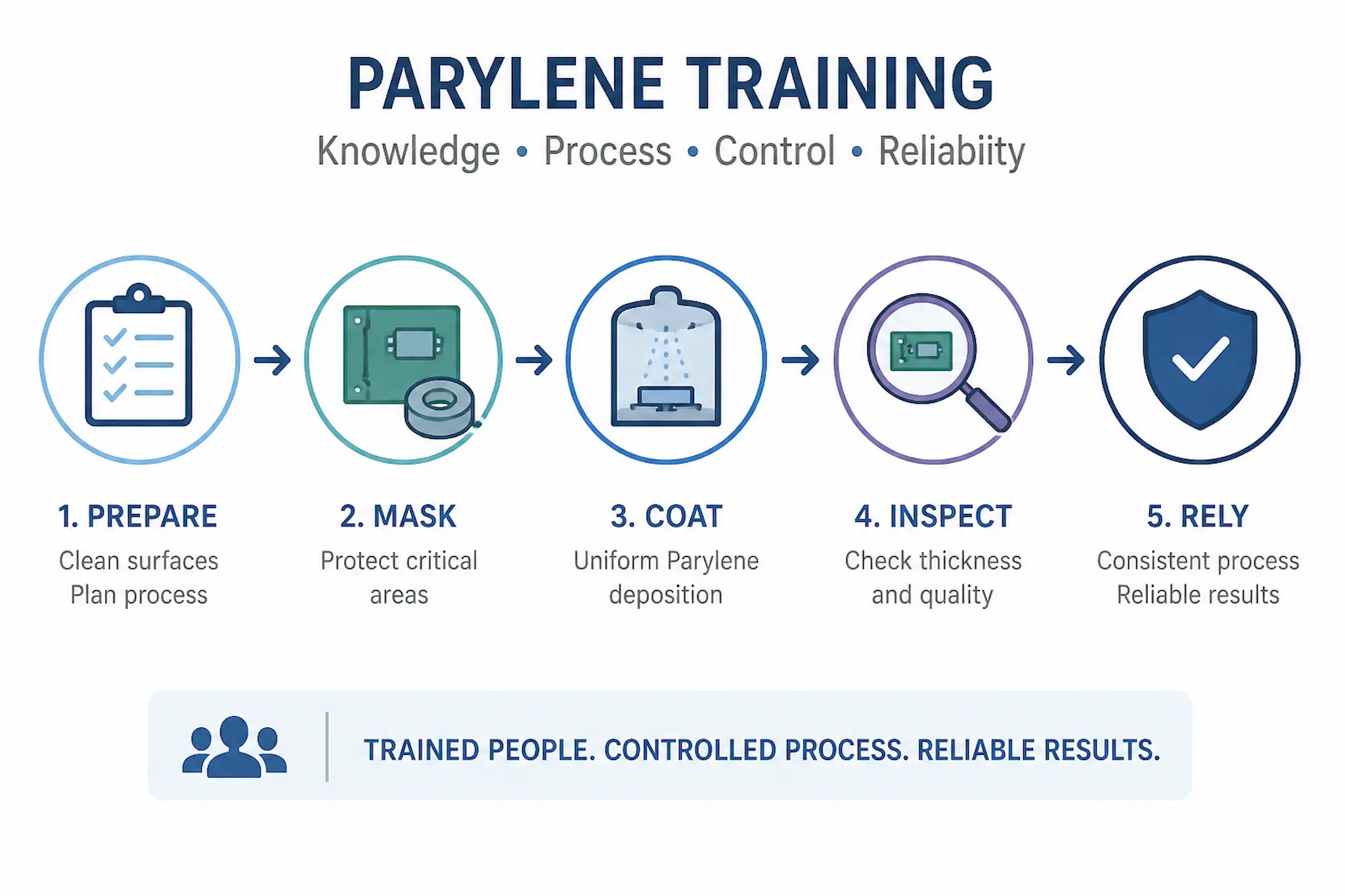
Parylene coating training focuses on controlling each stage of the process, from preparation and masking through to inspection and repeatable production.
Where Parylene Processes Typically Go Wrong
Parylene is a high-performance coating, but it is not forgiving when the surrounding process is poorly controlled. Small weaknesses in preparation, handling or masking can create large reliability problems later.
Reality check: A good Parylene machine does not automatically create a good Parylene process. The process depends on preparation, masking, loading, inspection and operator judgement.
- Surface contamination can reduce adhesion even when deposition parameters are correct.
- Poor masking design can cause leakage, shadowing, difficult removal or component damage.
- Incorrect fixturing can restrict vapour access or create inconsistent coating distribution.
- Weak inspection methods can miss defects until qualification or field use.
- No defined rework route can turn small production issues into expensive scrap.
Why Training Matters
Effective Parylene training helps operators, engineers and quality teams understand the full coating route rather than treating deposition as an isolated step.
Good training should connect the practical decisions made on the shop floor with the final coated result. This includes how parts are cleaned, how masking is selected, how fixtures are loaded, how coating thickness is checked and how defects are investigated.
For organisations introducing Parylene in-house, this reduces the learning curve. For established users, it helps identify process weaknesses before they become repeat production failures.
Core Areas a Parylene Training Programme Should Cover
A useful training programme should be practical, process-led and matched to the parts being coated. It should not only explain Parylene chemistry, but also how to control the process in real production.
Process Understanding
Parylene chemistry, vapour deposition principles, chamber behaviour and process limitations.
Preparation and Masking
Cleaning, handling, adhesion control, tapes, boots, plugs, fixtures and barrier strategies.
Inspection and Quality
Thickness measurement, visual inspection, defect recognition, documentation and process checks.
Rework and Repair
Controlled coating removal, local repair, restoration methods and risk management.
Training at Your Site or in a Controlled Facility
Parylene training can be delivered in different ways depending on the maturity of the process and the needs of the team.
Training at a specialist facility
Facility-based training allows operators and engineers to learn in a controlled production-style environment. This is useful when teams need to understand the complete coating workflow before applying the knowledge to their own products.
Training at the customer site
On-site training is often the stronger option when a team already has equipment installed, specific product families to coat or live process issues to solve. It allows training to be connected directly to the equipment, assemblies, masking methods and quality expectations used in production.
For organisations planning in-house capability, SCH provides dedicated Parylene training and support covering practical process control, operator knowledge and production readiness.
Training Should Continue After the Course
Parylene capability is built over time. The first training session gives the team a foundation, but real process strength comes from applying that knowledge to production parts, reviewing results and improving controls.
Ongoing support may include troubleshooting, process review, masking improvements, inspection guidance, fixture development and support for unusual or sensitive assemblies.
Where the process is still being developed, it is also useful to connect training with wider Parylene coating solutions, including coating services, equipment support, masking and process development.
Why Choose SCH Services?
SCH Services supports manufacturers with practical coating knowledge, process development and hands-on production experience across conformal coating, Parylene and advanced functional coatings.
- Practical support from coating engineers, not generic classroom-only training.
- Experience with masking, inspection, rework, repair and process control.
- Support for organisations developing or improving in-house coating capability.
- Clear route from training into process support, coating services or equipment implementation.
To discuss a Parylene coating training requirement, contact SCH Services through the contact page.
Disclaimer: This article is general technical guidance only. Parylene process decisions, training requirements and production controls should be assessed against the specific assembly, coating specification, reliability requirements and applicable qualification standards.