Why Conformal Coating Fails: Real Causes & Solutions
Understanding the practical causes of coating failure and how to prevent reliability problems before production
Conformal coating is used to protect electronic assemblies from moisture, contamination, corrosion, electrical leakage and environmental stress.
However, coating failure is still common when the coating is treated as a material choice rather than a controlled manufacturing process.
Most conformal coating failures are caused by a combination of surface cleanliness, coating selection, application method, PCB geometry, masking control, cure conditions, inspection limits and the final operating environment.
Why Conformal Coating Fails in Practice
Conformal coating failure occurs when the coating does not form, maintain or deliver the protection expected from it.
This may appear as visible defects such as bubbles, cracking, de-wetting or lifting. It may also appear later as corrosion, electrical leakage, intermittent faults or field reliability problems.
A coating can look acceptable after application but still fail if the underlying process is not controlled. A board may pass visual inspection but still contain ionic residues, weak adhesion, insufficient coating thickness or exposed critical areas.
This is why conformal coating should be specified as a complete protection system, not simply as “apply coating to the PCB”.
For a structured breakdown of how these variables interact in production, see electronic coating process control.
Key point: Coating failure is usually a process failure, not just a material failure.
The diagram below summarises the most common causes of conformal coating failure and how they relate to process control.
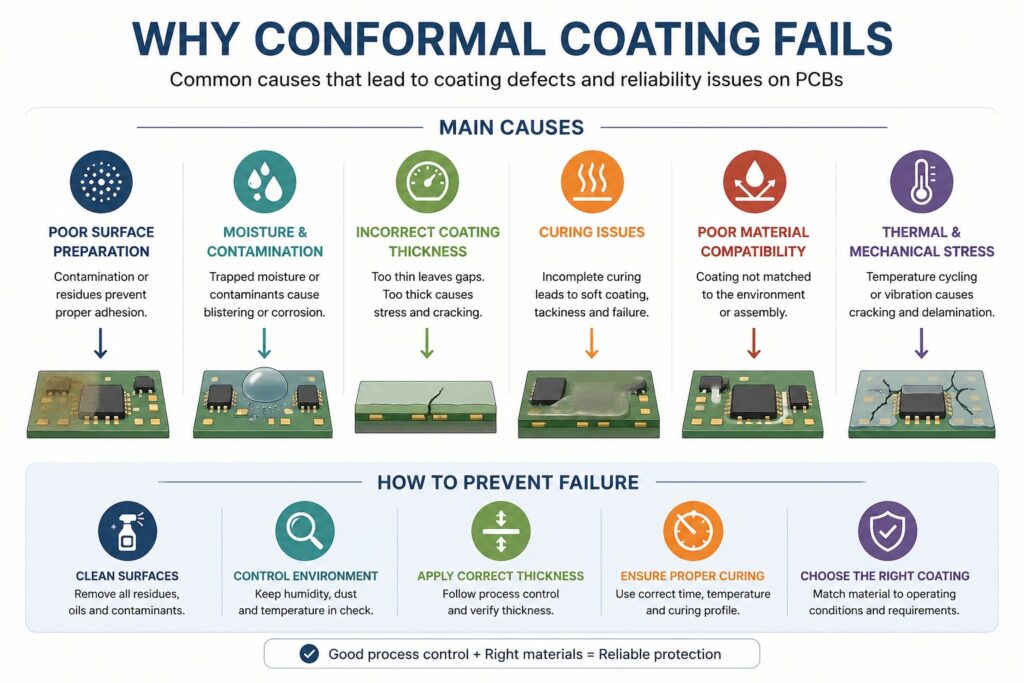
Overview of common conformal coating failure causes including contamination, thickness issues and curing problems, with key prevention steps.
Main Causes of Conformal Coating Failure
Poor surface preparation and contamination
Surface contamination is one of the most common causes of coating failure. Flux residues, process chemicals, oils, fingerprints, moisture and ionic contamination can all interfere with adhesion and long-term reliability. In some cases, surface activation methods such as plasma cleaning are used to improve adhesion — but only when the underlying failure mechanism requires it.
When contamination is trapped beneath the coating, the coating may seal the problem in rather than solve it. This can lead to corrosion, dendritic growth, leakage current or adhesion failure over time.
For related guidance, see Conformal Coating Surface Preparation & Cleanliness.
Incorrect coating selection
Different coating materials behave differently. Acrylics, urethanes, silicones, Parylene and ultra-thin functional coatings do not offer the same moisture resistance, chemical resistance, temperature capability, dielectric performance, thickness, repairability or masking requirements.
A coating may fail because it was never the right protection route for the environment. For example, an ultra-thin hydrophobic coating may improve wetting behaviour but will not provide the same barrier performance as a conventional conformal coating.
For a wider decision route, use the Coating Selection Guide.
Incomplete or inconsistent coverage
Conformal coating only protects where it is present at the correct thickness and with the correct coverage.
Exposed areas, thin edges, missed component sides and shadowed regions can become the weak points that define the reliability of the whole assembly.
For a deeper technical explanation, see Why Conformal Coating Fails Complex PCB Assemblies.
Coating applied too thin or too thick
Film thickness is a common failure driver. If the coating is too thin, it may not provide sufficient environmental or dielectric protection.
If the coating is too thick, it may introduce stress, cracking, poor cure, solvent entrapment, edge build-up or mechanical problems.
This is particularly important in immersion processes where coating thickness is created by fluid behaviour rather than simple application. See dip coating process control for how viscosity, withdrawal speed and drainage influence final film build. These same variables also affect spray and selective processes, particularly where edge control and film consistency are critical.
For related guidance, see Conformal Coating Thickness Verification.
Masking and keep-out failures
Many failures happen because coating enters connectors, switches, contacts, test points, mating surfaces or other keep-out areas.
In other cases, excessive masking or poor mask design leaves critical protection areas exposed. The result is either functional failure from unwanted coating ingress or reliability failure from insufficient protection.
Where tight boundaries are required, it is important to recognise that coating does not stop exactly where it is applied. Final coating edges are governed by liquid behaviour rather than machine paths, as explained in selective conformal coating accuracy.
Curing and drying problems
Even if the coating is correctly applied, poor cure or drying control can cause failure.
Solvent entrapment, insufficient cure, excessive film build, poor airflow, low temperature or incorrect process timing can all affect final coating performance.
In many cases, instability is not caused by cure alone but by upstream process variation, particularly viscosity control in conformal coating, which directly affects film formation, solvent retention and defect risk.
Environmental mismatch
The coating must be matched to the actual service environment. Moisture, condensation, chemicals, temperature cycling, vibration, UV exposure, handling, cleaning fluids and operating voltage can all influence coating performance.
A coating that works well in a controlled indoor environment may fail quickly in a harsh industrial, outdoor, automotive, aerospace, marine or chemically exposed application.
Common Warning Signs
Some coating failures are visible immediately. Others only appear after testing, ageing or field exposure.
- De-wetting or coating pulling away from the surface
- Bubbles, foam or pinholes
- Cracking, crazing or splitting
- Peeling, lifting or delamination
- White residues or staining beneath the coating
- Corrosion under or around the coating
- Coating wicking into connectors or components
- Uneven thickness or exposed areas
- Electrical leakage or intermittent faults during humidity testing
Visible defects should not be treated as cosmetic issues only. They often indicate a process, material or design problem that may affect long-term reliability.
For a symptom-based breakdown of the main visible defect mechanisms, see Top Conformal Coating Failure Mechanisms. Where failures are driven by dense layouts, connectors, masking limits or difficult geometry, see Why Conformal Coating Fails in Complex PCB Assemblies.
How to Prevent Conformal Coating Failure
Start with the environment
Before selecting a coating, define what the assembly needs protection from: moisture, condensation, salt, chemicals, dust, handling contamination, high voltage stress, thermal cycling or a combination of factors.
Control cleanliness before coating
Cleaning and cleanliness verification should be treated as part of the coating process. Applying coating over unknown contamination can create hidden reliability risks that are difficult to diagnose later.
Design the coating process around the PCB
The PCB layout, component height, connector positions, keep-out areas, edge geometry and production volume should all influence the application method.
Spray, dip, selective coating, Parylene and advanced functional coatings each suit different constraints. In practice, this is defined by the conformal coating application process and how well it is matched to PCB geometry, masking requirements and production conditions.
Validate thickness and coverage
Inspection should confirm that the coating is present where required and absent where prohibited.
UV inspection, thickness measurement, witness coupons, test boards and defined acceptance criteria all help reduce process variation.
Use trials before production release
Coating trials are especially important for complex boards, new materials, high-reliability applications and assemblies with strict masking or environmental requirements.
A small trial can identify coverage, adhesion, masking and cure problems before they become production failures.
Choosing the Right Protection Route
If conformal coating failure is being investigated, the correct solution may not simply be “apply more coating”.
The better question is whether the selected protection route, material, application method and process controls are suitable for the board and environment.
In some cases, conventional conformal coating is the right answer. In others, Parylene, an advanced functional coating, a hybrid coating strategy, improved cleaning, better masking or a process redesign may be more appropriate.
Use the Coating Selection Guide to compare conformal coating, Parylene and advanced functional coating routes.
Related Technical Articles
Use these supporting articles to move from failure symptoms to root causes and process solutions.
Understand failure mechanisms
- Pinholes, Bubbles & Foam in Conformal Coating
- De-Wetting in Conformal Coating
- Cracking in Conformal Coating
- Corrosion & Ionic Contamination
Investigate process-related causes
- Surface Preparation & Cleanliness
- Conformal Coating Viscosity Control
- Dip Coating Process Control
- Selective Conformal Coating Accuracy
Process selection and system-level thinking
What this means for your process
If you are seeing coating failures, the issue is rarely a single defect or material problem. It is usually a combination of process, design and control limitations.
- If failures vary between batches → your process is not controlled
- If failures are location-specific → geometry and application method are driving the issue
- If failures appear over time → environment or contamination is the root cause
At this point, continuing to adjust materials or settings rarely resolves the issue. The most effective next step is a structured review of the full coating process and how it interacts with the assembly.
Why Choose SCH Services?
If coating failures are being driven by contamination, geometry, process variation or masking limits, the solution is rarely a single adjustment. It requires understanding how the full coating process behaves in relation to the assembly.
We help customers treat coating as a controlled manufacturing process, not simply a material application step.
- Conformal Coating Solutions
- Coating Selection Guide
- Conformal Coating Services
- Conformal Coating Training
- Conformal Coating Consultancy
If you are seeing coating failures, defects or reliability concerns, SCH can help review the board design, coating material, application method, masking requirements and operating environment together.
Disclaimer: This article provides general technical guidance only. Final coating selection, process definition and acceptance criteria should be validated against the relevant product requirements, customer specifications, industry standards and qualification testing.