Hydrophobic Coatings for Electronics, PCBs & Precision Components
Water-repellent coatings for electronics – when to use hydrophobic coatings vs conformal coating and Parylene
Hydrophobic coatings are used where the main requirement is to control how water, moisture or contamination behaves on the surface of a PCB, sensor, electronic assembly or precision component.
They can help reduce surface wetting, improve moisture shedding, support cleanability and provide low-build functional protection without automatically moving to the thickness, masking burden or full barrier behaviour of traditional conformal coating or Parylene.
This page helps you decide whether a hydrophobic coating is the right route for your application, or whether you should instead consider conformal coating, Parylene coating, ultra-thin coatings or another route within SCH’s Advanced Functional Coatings platform.
Hydrophobic coatings for electronics are often used on PCBs, sensors and precision components where water repellency, condensation behaviour or cleanability is the primary concern. For broader route comparison, see the Coating Selection Guide.
Selection check: If your main requirement is water behaviour (wetting, shedding, contamination), hydrophobic coating is likely appropriate. If the requirement includes corrosion protection, moisture ingress prevention or electrical reliability, review surface vs film vs barrier, hydrophobic vs conformal coating or when to use hydrophobic coatings before selecting a route.
If you are comparing specific CytoPel hydrophobic and advanced functional coating options, use the CytoPel coating selection matrix.
The diagram below shows how hydrophobic coatings reduce surface wetting and improve performance in electronics and precision components.
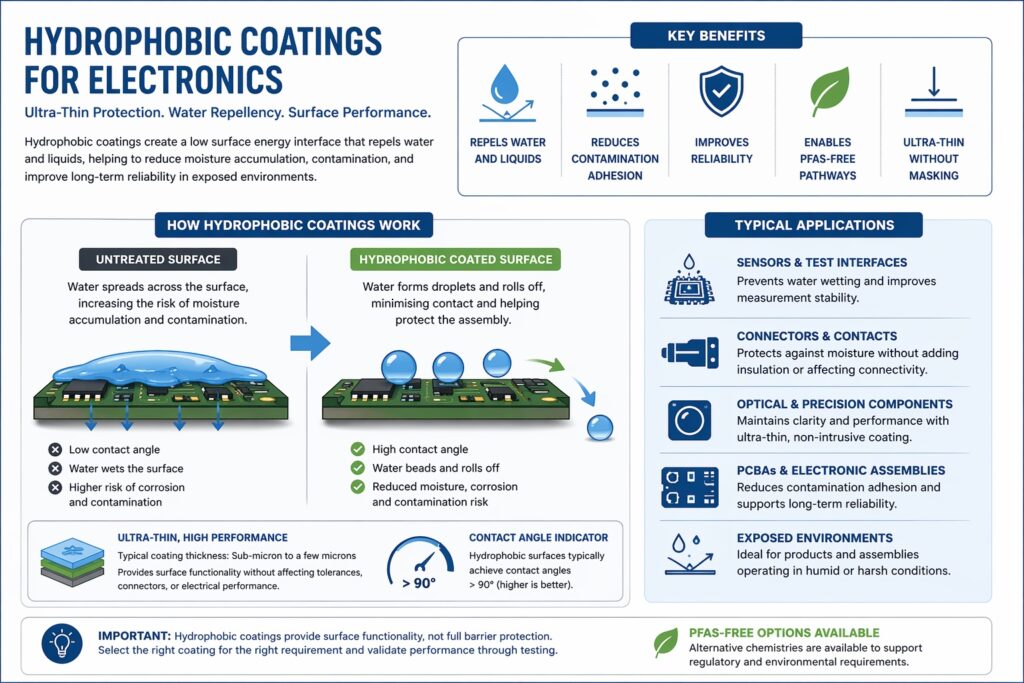
Hydrophobic coatings reduce water wetting and contamination by creating a low surface energy interface without the thickness of conventional conformal coating or Parylene.
You Are in the Right Place If…
Hydrophobic coatings are usually the right route when the problem is surface behaviour rather than full environmental encapsulation.
- Water, condensation or fluid exposure is causing wetting, pooling or surface contamination
- You need liquid repellency rather than a thick protective coating
- The part has tight tolerances, connectors, contacts, optics or precision features
- You want to improve cleanability or reduce contamination retention
- You need a low-build surface treatment that does not significantly change dimensions
- You are exploring whether a hydrophobic or low surface energy film can solve the problem before moving to conformal coating or Parylene
If the requirement includes long-term corrosion protection, dielectric isolation, full moisture barrier performance or mechanical protection, hydrophobic coating alone is unlikely to be sufficient. See why hydrophobic coatings don’t protect electronics.
When Hydrophobic Coating Is Not the Right Answer
Hydrophobic does not automatically mean waterproof, sealed or protected. This distinction matters because many failures occur when a water-repellent surface is expected to behave like a true protective coating system.
Correct selection depends on whether the application needs water repellency alone, condensation management, chemical resistance, salt-spray resistance, temperature performance, sealing or a true protective barrier. The exposure condition must be defined before the coating route is selected.
For common boundary cases, see limitations of hydrophobic coatings, surface energy vs environmental barrier protection and why water resistance is not corrosion protection.
What Problems Hydrophobic Coatings Are Used to Solve
Hydrophobic coatings work by changing surface energy. Rather than always building a thick protective film, they create a surface that is less easily wetted by water and, in some cases, other contaminants.
Performance is often described using contact angle and wetting behaviour, but these values must be interpreted alongside durability, handling, abrasion, chemical exposure and real-use conditions.
Hydrophobic behaviour is strongly influenced by both surface chemistry and microscopic surface structure. To understand how low surface energy, contact angle and surface texture work together to create water repellency, see why some coatings cause water to bead and roll off.
Reduce Water Wetting
Water is more likely to bead and move across the surface rather than spread into a continuous film, supporting drainage, drying and moisture shedding.
Improve Cleanability
Lower surface energy can reduce contamination retention and make some surfaces easier to clean, depending on the contamination type and operating environment.
Maintain Tight Tolerances
Low-build hydrophobic coatings can be useful around connectors, contacts, optics, sensors and precision features where coating thickness must be tightly controlled.
Support Selective Functional Protection
Hydrophobic coatings can be used where surface behaviour needs to be modified without applying a full coating system. In some cases, higher-build hydrophobic films may also provide selective chemical or contamination resistance.
Explore Superhydrophobic Behaviour
Extreme water repellency may be relevant in some applications, but very high contact angles do not automatically deliver durability, chemical resistance or production reliability.
Key point: Hydrophobic does not equal barrier protection. A water-repellent surface and a true environmental protection system are fundamentally different. For a deeper explanation, read Hydrophobic Coatings: Surface vs Film vs Barrier.
Typical Applications
Hydrophobic coatings are most useful where the surface interaction with water, moisture, condensation or contamination is the main issue.
- PCBs and electronic assemblies exposed to condensation or intermittent moisture
- Sensors, optics, RF assemblies, antennas and precision parts where contamination retention needs to be reduced without disrupting signal, optical or dimensional performance. See RF transparent coatings for electronics & antennas.
- Connector-adjacent areas where conventional coating build creates risk
- Components where cleanability, wetting control or surface repellency is more important than full encapsulation
- Selective surface treatment where dimensional impact must remain minimal
- Applications where a hybrid coating strategy may be required, combining conformal coating, Parylene, nano coating or hydrophobic treatment in different zones
For complex assemblies, hydrophobic coatings are often evaluated as part of a wider coating selection process rather than treated as a direct substitute for conformal coating or Parylene. For ultra-thin route comparison, see nano coating vs conformal coating.
If hydrophobic coating is not enough
→ For full PCB protection, corrosion resistance or environmental durability, review conformal coating solutions → For ultra-uniform coverage, complex geometry and high-performance barrier protection, review Parylene coating solutions
Implementation Pathways
Hydrophobic coatings can be implemented in different ways, but performance is highly dependent on how the coating is applied and validated.
- Customer-Led Application – Materials evaluated and applied in-house where suitable coating capability already exists
- SCH-Enabled Implementation – Material selection, process development, training and equipment support for controlled in-house application
- SCH Coating Services – Coatings applied by SCH under controlled conditions to support consistency, repeatability and validated performance
Because hydrophobic coatings are highly sensitive to surface preparation, handling and process control, real-world performance cannot be assumed from datasheets alone.
- Surface behaviour validation – confirming wetting, shedding and contamination performance
- Durability testing – assessing wear, handling and environmental exposure
- Process sensitivity – understanding how application method affects performance
For customers who need to prove performance before committing to materials, equipment or production processes, SCH provides advanced functional coating services for controlled application, validation trials and production coating support.
Need Help Choosing the Correct Route?
If you are unsure whether your application needs hydrophobic coating, ultra-thin surface modification, chemical resistance, conformal coating or Parylene, SCH can review the part, exposure conditions and performance requirement before recommending a coating route.
Frequently Asked Questions
What is a hydrophobic coating for electronics?
A hydrophobic coating is a coating or surface treatment that reduces water wetting and helps water bead or shed from a surface. It is commonly used on PCBs, sensors and precision components where surface behaviour matters and full conformal coating may not be required.
Can hydrophobic coatings waterproof electronics?
No. Hydrophobic coatings improve water repellency but do not automatically provide waterproofing, sealing or full environmental barrier protection. For full protection, conformal coating or Parylene may be required.
What is the difference between hydrophobic coating and conformal coating?
Hydrophobic coatings primarily modify surface behaviour or provide selective low-build protection. Conformal coatings create a thicker protective layer for moisture, contamination and corrosion protection across electronic assemblies. For more detail, see hydrophobic coating vs conformal coating.
Are hydrophobic coatings durable?
Durability depends on the coating chemistry, film build, surface preparation and operating environment. Some ultra-thin hydrophobic coatings can wear over time, particularly in high-contact, abrasive or chemically aggressive environments.
Can hydrophobic coatings provide chemical resistance?
Some film-forming hydrophobic coatings can provide useful chemical or contamination resistance, but this must be validated against exposure type, dwell time, temperature and mechanical conditions.
Why Choose SCH Services?
SCH supports hydrophobic coating projects from initial evaluation through to controlled implementation, ensuring surface performance and durability are matched to the real application requirement.
- 💧 Hydrophobic Performance Focus – Understanding of wetting behaviour, cleanability and contamination control
- 🛠️ Process Development Expertise – Practical implementation support for low-build functional coatings
- 🔬 Ultra-Thin Coating Knowledge – Control of film build around connectors, contacts and critical features
- 📈 From Feasibility to Production – Evaluation, testing, process control and scale-up support
- 🔗 Integrated Coating Strategy – Linking hydrophobic coatings with nano coatings, conformal coating, Parylene and advanced functional coating routes where required
SCH also provides advanced functional coating services for customers who want hydrophobic coatings applied, validated and scaled without committing to full in-house setup.
📞 +44 (0)1226 249019 | ✉ sales@schservices.com | 💬 Discuss Your Application ›