Advanced Functional Coatings for Electronics & Precision Components
Decision guide for surface control, selective protection and low-build coating strategies
Advanced functional coatings are used when the requirement is more specific than general environmental protection. The first decision is not “which coating do we use?” but “what problem are we trying to solve?”
Use this page to move quickly from application problem to coating behaviour and then to the correct coating route. If the requirement is water repellency or extreme water shedding, thickness control, PFAS reduction, chemical exposure resistance or selective protection, the correct answer may not be a traditional conformal coating or Parylene coating process. For broader coating route selection, see the How to Choose the Right Coating guide.
Once the correct route has been identified, the next step is proving and implementing it. SCH can support advanced functional coating services for application, validation, production coating and scale-up.
Start with the problem, define how the coating must interact with the environment, then move directly to the correct route.
Start here:
If you are unsure whether your requirement is surface behaviour, film-forming protection or barrier performance, do not choose a coating yet.
Use the surface vs film vs barrier guide to define how the coating must behave.
If you are comparing specific CytoPel materials, use the CytoPel coating selection matrix to compare ultra-thin, PFAS-free, hard and UV-curable coating options.
If the requirement is still unclear, discuss your application and we will help define the correct coating approach before selection.
Nano & Hydrophobic Coating Decision Guides
Use these technical guides when deciding whether an ultra-thin or hydrophobic coating is sufficient, or whether the application needs a protective conformal coating, Parylene or film-forming route.
- Nano Coating vs Conformal Coating for Electronics
- Why Some Coatings Cause Water to Bead and Roll Off
- Hydrophobic Coating vs Conformal Coating for Electronics
- Why Hydrophobic Coatings Don’t Protect Electronics
- When to Use Hydrophobic Coatings in Electronics
- Limitations of Hydrophobic Coatings in Electronics
These guides are particularly useful where water repellency, surface behaviour, contamination control or reduced coating thickness are being considered.
Start With the Application Problem
Do not start with coating type. Start with the constraint driving the decision.
Once the constraint is clear, define how the coating must behave in the application.
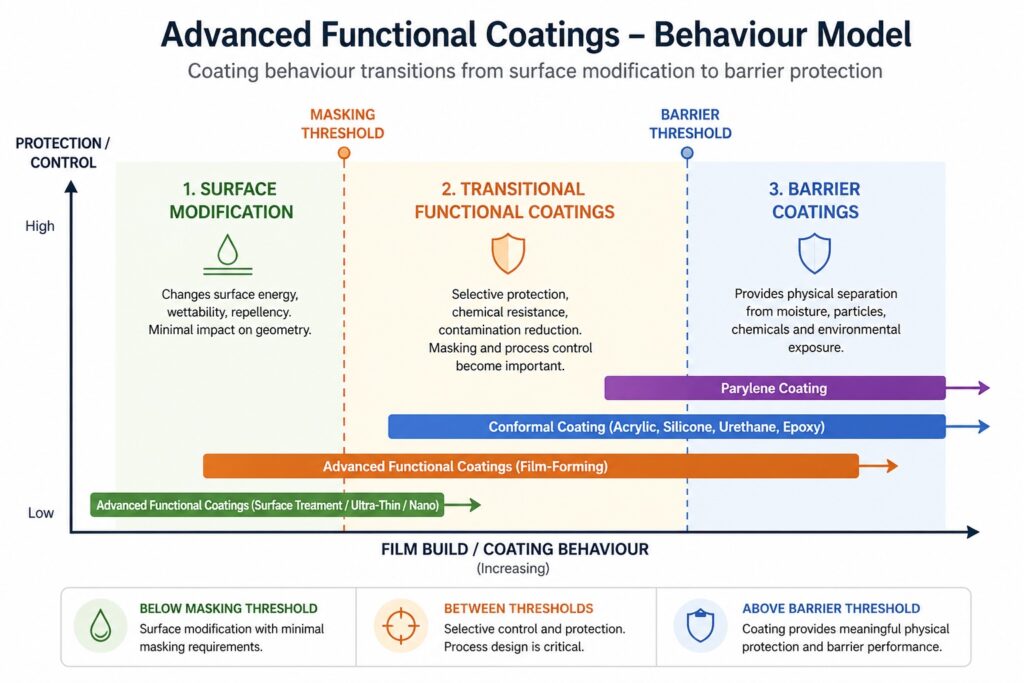
Coating performance is defined by how it interacts with the environment: controlling surface behaviour, reducing exposure through a film, or preventing exposure through a barrier.
Decide How the Coating Needs to Behave
Thickness alone does not define performance. Coatings must be selected based on how they control interaction with the environment.
Key Decision Point
Surface-function coatings control interaction. Barrier coatings prevent exposure. Film-forming coatings sit between these states. Do not treat them as equivalent. For a practical example, see hydrophobic coating vs conformal coating.
For deeper technical guidance on how ultra-thin coatings behave in real applications, see surface energy vs environmental barrier protection, RF transparent coatings for electronics & antennas and why water resistance is not corrosion protection.
Check the Two Practical Thresholds
Most coating failures occur at these transition points:
Many applications sit between these thresholds and require engineered coating behaviour rather than default material selection.
Need help proving the coating route?
Advanced functional coatings often need practical validation before they can be specified with confidence. Surface behaviour, chemical resistance, masking, durability and coating thickness should be tested against the real application rather than assumed from material type alone.
Review Advanced Functional Coating Services
If you are unsure whether the requirement is surface control, film-forming protection or full barrier performance, you can also submit your application for review.
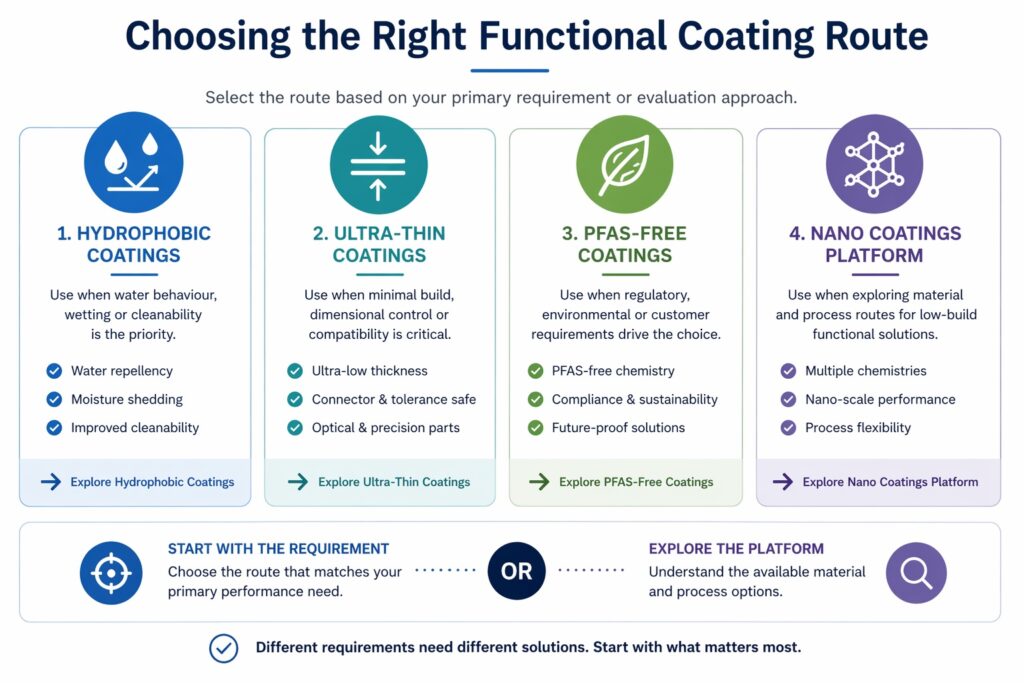
Choose the Right Route
Move directly to the pathway that matches the required behaviour.
Superhydrophobic
Extreme water-repellent surfaces for rapid droplet shedding and reduced water film formation on antennas, radomes and exposed surfaces.
Transitional Film-Forming
Selective protection between surface treatment and full barrier coating.
Need Parts Coated?
For feasibility trials, validation or production coating without internal setup.
When an advanced functional coating may not be the right route
If the requirement is broad PCB environmental protection, review our conformal coating solutions. If the requirement is high-performance vapour-deposited barrier protection, complex geometry coverage or very uniform film build, review our Parylene coating solutions. If the issue is ultra-thin coating selection, review nano coating vs conformal coating.
Advanced Functional Coatings FAQs
What is an advanced functional coating?
An advanced functional coating is a coating selected for a specific surface or performance function, such as hydrophobic behaviour, low coating build, chemical resistance, contamination control or selective protection.
How are advanced functional coatings different from conformal coatings?
Conformal coatings are generally used for broader environmental protection of electronic assemblies. Advanced functional coatings are used where the requirement is more specific, such as surface wetting control, ultra-thin protection or targeted film-forming behaviour.
When should I use a hydrophobic coating?
A hydrophobic coating should be considered when the main requirement is water repellency, wetting control or reduced contamination. If the application requires true environmental isolation, a film-forming or barrier coating may be more appropriate. For correct application cases, see when to use hydrophobic coatings.
What is the difference between surface-function and barrier-function coatings?
Surface-function coatings control how liquids, contamination or fluids interact with the surface. Barrier-function coatings provide physical separation between the substrate and the environment.
Can nano coatings replace conformal coatings?
Nano coatings can be useful where very low build and surface behaviour are required, but they are not direct replacements for conformal coatings where full barrier protection, mechanical durability or validated environmental isolation is needed.
Why Choose SCH Services?
SCH helps define whether your application requires surface control, film-forming protection or full barrier performance, then supports coating selection, trials, validation and production implementation.
For customers ready to move from selection into practical implementation, SCH also provides advanced functional coating services covering feasibility trials, process validation and controlled production coating support.
📞 +44 (0)1226 249019 | ✉ sales@schservices.com | 💬 Discuss Your Application ›